Raise your hand if the word “amps” makes your brain politely shut down. 🙋♂️
You’re not alone. Volts, amps, kilowatts, breakers — it sounds like a physics exam you forgot to study for. And honestly, most of us just want to plug in the car and walk away. 😅
But here’s the thing nobody tells you: picking the wrong amperage is the single most common way people either waste hundreds of dollars (or thousands of rupees) on a charger they can’t use — or end up charging painfully slowly for years. 😬
The good news? You do not need to understand electrons or pass an electrician’s exam. You just need this one guide. Let’s get EV charger amps explained in plain, human English — so you buy exactly the right charger for your car and your home, the first time. 👇
⚡ The Short Answer
Here’s EV charger amps explained in a single sentence: more amps means faster charging — but only if your car AND your home wiring can both handle it.
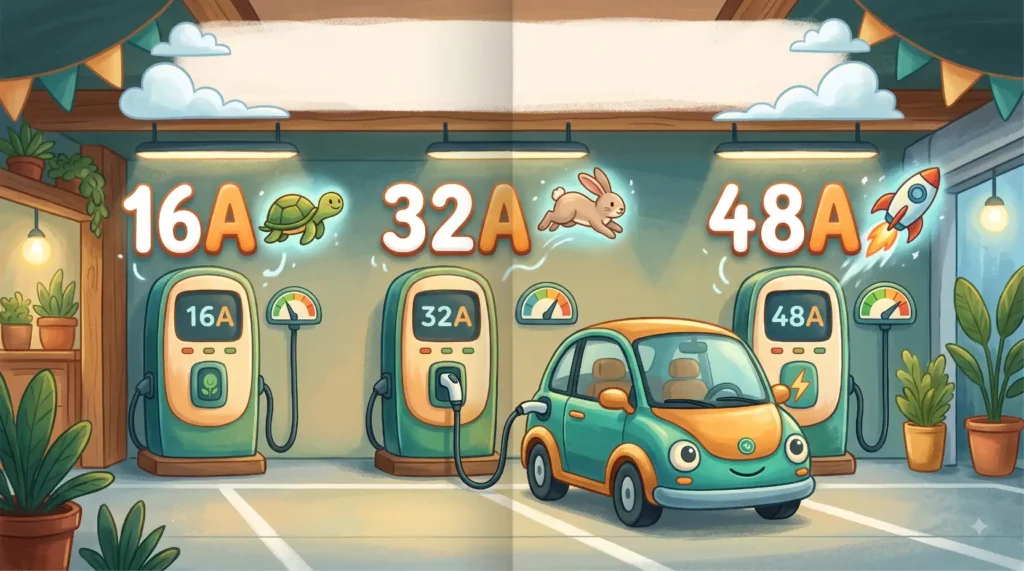
- 16A ≈ 3.7 kW — slow, gentle, and cheap to install 🐢
- 32A ≈ 7.7 kW — the sweet spot for the vast majority of homes 🐇
- 48A ≈ 11.5 kW — fast, built for big batteries and beefy circuits 🚀
Notice the “AND” doing the heavy lifting there. A 48A charger bolted to a car that only accepts 32A gives you zero extra speed. A 48A charger on a panel that can’t supply 60A is unsafe — and won’t pass inspection.
So the real goal isn’t “biggest.” It’s “right-sized.” Pick the amperage your car can actually accept and your panel can safely deliver. That’s the entire secret of EV charger amps explained. 🎯
📊 16A vs 32A vs 48A: Side-by-Side
| Amperage | Power | Range Added per Hour | Best For | Circuit Needed |
|---|---|---|---|---|
| 🐢 16A | ~3.7 kW | ~12–15 mi (20–25 km) | Scooters, PHEVs, light drivers | 20A breaker |
| 🐇 32A | ~7.7 kW | ~25–30 mi (40–50 km) | Most EV owners | 40A breaker |
| 🚀 48A | ~11.5 kW | ~35–44 mi (55–70 km) | Big-battery EVs, heavy daily drivers | 60A breaker |
Screenshot this table. Seriously — it’s basically the whole EV charger amps explained decision compressed into one glance. ⚡
A quick note on the “range per hour” numbers: they’re estimates based on a typical EV using around 3 to 4 miles per kWh (or roughly 5 to 6 km per kWh). A heavy SUV will get less; an efficient sedan will get more. But the relative gaps between 16A, 32A, and 48A stay roughly the same.
🔌 The Golden Rule: Match Three Things
If you remember nothing else from this guide, remember this. To get EV charger amps explained right, you match three things — and the lowest of the three wins. 🥇
1. Your car’s onboard charger. 🚗
Every EV has a built-in AC charger that sets a hard ceiling on how fast it can sip power at home. If your car only accepts 7.2 kW AC, a 48A (11.5 kW) wall unit gives you exactly nothing extra. You’d literally be paying for capacity the car refuses to use.
2. Your home’s circuit capacity. 🏠
Higher amps demand a bigger breaker, thicker wire, and sometimes a panel upgrade. If your electrical panel is already maxed out, jumping to 48A might trigger an expensive service upgrade you didn’t budget for.
3. Your actual daily needs. 📏
This one gets ignored constantly. If 32A already refills your daily mileage overnight while you sleep, what does 48A buy you? A charger that finishes at 1 a.m. instead of 4 a.m. — while you’re unconscious either way. 😴
The “best” amperage is the one that satisfies all three without overshooting. Bigger is not automatically better. It’s just bigger (and pricier). 😎
🧮 What’s the “80% Rule”? (Please Don’t Skip This)
Here’s the pro nugget that quietly saves people from buying the wrong charger: a circuit can only continuously deliver 80% of its breaker’s rating.
EV charging is what electricians call a “continuous load” — it pulls steady current for hours, not seconds. To keep wires from overheating over those long sessions, code requires you to leave a 20% safety margin. So:
- A 40A breaker → safely runs a 32A charger ✅
- A 60A breaker → safely runs a 48A charger ✅
- A 20A breaker → safely runs a 16A charger ✅
See the pattern? Take the breaker size, multiply by 0.8, and that’s your maximum continuous charger amperage. This is why chargers are always rated a notch below their circuit — it’s not marketing, it’s physics and fire safety baked into the electrical code.
Your electrician knows this cold. But now you know it too — which means nobody can upsell you a 48A charger and quietly install it on a 50A circuit (which would be unsafe and non-compliant). 🧠
💡 Planning the wiring and want to budget realistically? Read: How Much Does It Cost to Install a Home EV Charger?
🔋 What Each Amperage Actually Delivers
Numbers in a table are tidy, but let’s translate them into real life. ☕
16A (≈3.7 kW): the gentle trickle. 🐢
In an hour you’ll add roughly 12 to 15 miles (20 to 25 km). Plug in overnight for 8 hours and you’ve gained around 100 miles (160 km) — plenty for a plug-in hybrid, an electric scooter, or someone with a short, predictable commute. It’s also the cheapest to wire because it often runs on a humble 20A circuit you may already have. The downside: if you drain a big battery, 16A can’t realistically top it up in one night.
32A (≈7.7 kW): the everyday champion. 🐇
This is where most people should land. An hour adds about 25 to 30 miles (40 to 50 km), so a typical EV recovers a full day’s driving in a couple of hours and a near-empty battery overnight. It hits the AC ceiling of a huge number of popular EVs, meaning you’re not leaving speed on the table. For the vast majority of homeowners, 32A is the genuine sweet spot — fast enough to never think about it, cheap enough not to wince.
48A (≈11.5 kW): the heavy hitter. 🚀
An hour adds roughly 35 to 44 miles (55 to 70 km). This is the play for big-battery EVs, multi-car households, ride-share drivers, or anyone with a long daily commute who wants the battery full in a hurry. But it only pays off if your car accepts 11 kW AC. Bolt one to a 7.2 kW car and you’ve bought a Ferrari engine for a scooter. 🛵
The honest takeaway: more amps shine when your battery is big and your hours to charge are short. If neither is true for you, you’re paying for headroom you’ll never touch.
⚙️ Breaker and Wire-Gauge Basics (the 2-Minute Version)
You won’t be running cable yourself, but understanding the basics keeps you from getting talked into the wrong setup. 🛠️
Think of your wiring like plumbing. Amps are how much water flows; the wire is the pipe. Push too much current through a pipe that’s too thin and it heats up — which is exactly what you don’t want inside your walls.
So each amperage level needs a matching wire gauge. As a rough US (AWG) guide:
- 16A → typically 12-gauge copper wire on a 20A breaker
- 32A → typically 8-gauge copper wire on a 40A breaker
- 48A → typically 6-gauge copper wire on a 60A breaker
In India, electricians size in square millimeters instead. A 16A circuit commonly uses around 2.5 mm² to 4 mm² cable; a 32A circuit steps up to roughly 6 mm². Always defer to your licensed electrician and local code — wire sizing also depends on cable run length, conduit, and ambient heat.
Two more terms worth knowing. Hardwired means the charger is permanently connected into the circuit — required for most 48A units. Plug-in means it uses a heavy-duty outlet (like a NEMA 14-50 in the US), which is convenient but usually caps you at 40A breaker / 32A charging. If you want the full 48A, plan on hardwiring. 🔧
💡 Want to see how the amperage you pick changes the whole wiring quote? It’s all connected — your amperage choice drives your breaker, your wire, and your final install bill.
🇮🇳 Single-Phase vs Three-Phase: The India Factor
Here’s where US and India readers genuinely diverge, and it’s a huge part of getting EV charger amps explained for your country. 🌍
Single-phase power is what most Indian homes (and all standard US residential 240V circuits) have. It’s a two-wire supply. For practical home EV charging on single-phase, you’re realistically capped around 7.2 kW — which is exactly that 32A sweet spot. This is the single biggest reason 32A dominates the Indian home-charging market.
Three-phase power uses three live wires and is common in larger Indian homes, villas, and commercial buildings. It lets you step up to around 11 kW AC at home — opening the door to faster charging similar to a US 48A setup. If your house already has a three-phase connection (check your meter or electricity bill), an 11 kW charger becomes a real option.
So the India decision usually shrinks to a clean fork:
- Single-phase home? 32A (7.2 kW) is almost always your ceiling and your best buy. 16A handles scooters and budget EVs. ✅
- Three-phase home? You can go up to 11 kW — but still only if your car accepts it. 🚀
The US equivalent: nearly every home has 240V single-phase service, and the question is simply whether your panel has room for a 40A circuit (32A) or a 60A circuit (48A). No three-phase juggling required. 🇺🇸
🔮 Future-Proofing Without Overspending
“But what if I buy a bigger EV in three years?” — a fair question, and the smartest one most people ask. 🤔
There’s a clever middle path that doesn’t blow your budget: wire for the future, charge for today. You ask your electrician to run a circuit and conduit sized for 48A even if you install a 32A charger now. The thick wire is the expensive, disruptive part to upgrade later — the charger itself is easy to swap.
That way, if you upgrade to a long-range EV down the road, you snap in a 48A unit and you’re done. No tearing open walls, no second trench across the garage. 🧰
But — and this is important — don’t future-proof blindly. If you live in a single-phase Indian home where 32A is the hard ceiling, chasing 48A capacity is wasted money. There’s no 48A future to prepare for on that supply. Future-proofing only makes sense when your electrical service can actually grow into it. 🎯
A reasonable rule of thumb: wire one tier up, install what you need now. It’s the sweet spot between “stuck slow” and “spent too much.”
💰 How Higher Amps Hit Your Wallet
Let’s talk money, because the amperage you choose ripples straight through to your install bill. 💸
The charger hardware itself is only part of the story. A 48A charger costs a bit more than a 32A one, sure — but the bigger jump is in everything around it:
- Thicker wire costs more per foot/meter, and 48A needs noticeably beefier cable than 32A.
- A larger breaker (60A vs 40A) is a minor cost, but it has to fit.
- Panel capacity is the wild card. If your panel is full, a 48A circuit might force a service upgrade — easily the most expensive line item of the whole project, sometimes running into four figures in dollars or tens of thousands of rupees.
- Hardwiring labor (often required for 48A) can run more than a simple plug-in 32A install.
So the real cost gap between 32A and 48A isn’t “one charger vs another.” It’s potentially a whole panel upgrade vs none. That’s why so many people land on 32A: it delivers most of the speed for a fraction of the total complication. 🧾
The flip side: if your car genuinely accepts 48A and you drive a lot, the faster charging can pay you back in convenience every single day for a decade. Spend where it actually serves you. ⚖️
💡 For the full breakdown of what each amperage tier does to your final quote, see How Much Does It Cost to Install a Home EV Charger?
🧑🔧 Worked Examples: Putting It All Together
Theory is nice. Let’s run three real-world scenarios so EV charger amps explained actually clicks. 💡
Example 1: The commuter with a mainstream EV (US). 🚗
Priya drives a popular crossover that accepts 7.2 kW AC, commutes 40 miles round trip, and parks in a garage overnight. Her panel has spare capacity for a 40A circuit. Verdict: 32A. It matches her car’s ceiling exactly, refills her commute in under two hours, and a 48A circuit would add cost with zero speed gain. Right-sized. ✅
Example 2: The long-range road-tripper (US). 🛷
Marcus owns a big-battery truck that accepts 11.5 kW AC and regularly runs the battery low. He has a modern panel with room for a 60A circuit. Verdict: 48A. His car can use every amp, his panel supports it, and faster overnight fills genuinely help. Worth the extra spend. 🚀
Example 3: The single-phase home in India. 🇮🇳
Anita has a single-phase connection and a new EV that accepts 7.4 kW AC. Verdict: 32A (7.2 kW). It’s the practical ceiling of her supply and a perfect match for her car. Going hunting for 48A would mean chasing a three-phase upgrade she doesn’t need. Sweet spot. ✅
Notice the pattern in all three? Nobody picked “the biggest.” They each picked the one where car, home, and need lined up. That’s the entire game. 🎯
📈 How 2026 Trends Affect Your Amperage Choice
The EV charger amps explained conversation keeps shifting as the market matures. Here’s where things stand heading deeper into 2026. 📅
In the US: Newer EVs increasingly accept 48A (11.5 kW) AC charging, and builders are wiring new homes “EV-ready” with 60A circuits baked into the garage from day one. So a growing share of buyers are future-proofing with 48A — and when the home is built for it, that’s a smart move. But plenty of popular, affordable EVs still cap at 32A, so 32A remains the most common real-world choice. The trend is “48A-ready,” not necessarily “48A-needed.” 🏠
In India: The market is firmly 32A-centric, and that’s driven by physics, not preference. Most homes run single-phase, which practically caps charging around 7.2 kW (32A). So 32A units are the default sweet spot, while affordable 16A chargers serve the booming electric-scooter and budget-EV crowd. Homes lucky enough to have three-phase service can reach for 11 kW — but they’re the minority. Expect 32A to stay the dominant home-charging amperage across India for the foreseeable future. 🇮🇳
The common thread for 2026: match the trend to your supply. A US “48A-ready” wave doesn’t help a single-phase Indian home, and India’s 32A norm doesn’t limit a US owner with a 60A circuit. Local reality wins. 🌐
✅ 5 Tips to Pick the Right Amperage
- Look up your EV’s max AC charging rate first. 📋 It’s in the spec sheet or owner’s manual, and it caps everything else. Start here, always.
- Respect the 80% rule. Take your available breaker size, multiply by 0.8, and that’s your safe continuous charger amperage. Never push past it.
- Future-proof modestly. If you might buy a bigger EV later and your supply can grow, wire for 48A but install the charger you need today.
- Single-phase home (India)? 32A is usually your ceiling. Don’t chase 48A on a supply that physically can’t deliver it.
- Get your electrician to confirm breaker + wire gauge for your chosen amperage before you buy anything. One conversation prevents one expensive mistake. 🧑🔧
🛒 Best Chargers by Amperage (Shop This Post)
Once you know your number, matching it to the right hardware is the easy part. Here are the picks by amperage tier. 😍
1. 32A Smart Charger — The Sweet Spot 🐇
Perfect for most EVs and most homes, on both 240V US circuits and Indian single-phase. Smart scheduling, app control, and Wi-Fi let you charge on cheap overnight rates automatically. If you’re not sure, this is the safe, do-everything choice.
👉 Shop 32A smart chargers
2. 48A Charger — The Future-Proof Pick 🚀
For big-battery EVs sitting on a 60A circuit (or three-phase 11 kW in India). Maximum home charging speed, hardwired and built to last. Buy this only if your car can actually accept 11 kW — otherwise the 32A pick is smarter.
👉 Shop 48A chargers
3. 16A Portable Charger — The Flexible Backup 🎒
Ideal for scooters, plug-in hybrids, light commuters, and travel. It plugs into common outlets, tucks in your trunk, and saves the day when you’re away from your main charger.
👉 Shop 16A portable chargers
🛍️ Shop This Post: (These are affiliate picks — buying through them costs you nothing extra and helps support EVs Mirror. 🙏 Thank you!)
🎯 Quick Quiz: How Many Amps Do You Need?
Answer three quick questions and tally your letters. 📝
- What’s your car’s max AC charging rate? 🅐 3.3–3.7 kW 🅑 7.2 kW 🅒 11+ kW
- What’s your home supply? 🅐 Basic circuit 🅑 Standard single-phase / 40A 🅒 Three-phase / 60A
- How much do you drive daily? 🅐 Light 🅑 Normal 🅒 Heavy
Mostly 🅐: 16A is plenty — go gentle and save money. 🐢
Mostly 🅑: 32A is your sweet spot — install with confidence. 🐇
Mostly 🅒: Go 48A (or 11 kW three-phase) and enjoy the speed. 🚀
📋 Amperage Selection Checklist
- [ ] Find your EV’s max onboard AC charging rate (spec sheet/manual)
- [ ] Check your electrical panel’s spare capacity
- [ ] Apply the 80% rule (breaker × 0.8 = max charger amps)
- [ ] Decide: 16A / 32A / 48A
- [ ] Confirm single-phase vs three-phase (especially in India)
- [ ] Verify wire gauge and breaker size with your electrician
- [ ] Decide hardwired vs plug-in based on amperage
- [ ] Choose a charger that matches that amperage ⚡
🤔 People Also Ask
Q: How many amps does my EV charger need?
A: Match it to your car’s max AC charging rate and your panel’s capacity — the lower of the two wins. For most people, 32A (7.7 kW) is the sweet spot. Big-battery EVs on a 60A circuit benefit from 48A, while scooters and PHEVs charge just fine on 16A. That’s EV charger amps explained in one breath.
Q: Is a 48A charger better than a 32A charger?
A: Only if your EV can actually accept 48A and your home has a 60A circuit. If your car caps at 7.2 kW, a 48A charger delivers the exact same speed as 32A while costing more to buy and install. For a large share of EVs, 32A and 48A are identical in real-world charging.
Q: Can I plug a 48A charger into any outlet?
A: No. A 48A charger almost always must be hardwired onto a dedicated 60A circuit with the proper heavy-gauge wiring. It can’t run off a standard wall socket or even most plug-in outlets. Plug-in setups generally top out at 32A on a 40A breaker.
Q: What does the 80% rule mean for EV charging?
A: Because EV charging is a continuous load, a circuit can only safely deliver 80% of its breaker’s rating over long sessions. So a 40A breaker supports a 32A charger, and a 60A breaker supports a 48A charger. Multiply any breaker by 0.8 to find its safe charger amperage.
Q: Will higher amps damage my EV battery?
A: No. Your car’s onboard charger strictly limits how much it draws, so it only ever pulls what it can safely accept. Higher amps simply let it charge faster up to that built-in limit — there’s no risk of “overfeeding” the battery.
Q: What amperage is best for a single-phase home in India?
A: For most single-phase Indian homes, 32A (around 7.2 kW) is both the practical ceiling and the ideal choice. 16A chargers suit electric scooters and budget EVs, while 11 kW charging requires a three-phase connection that only some homes have.
🚀 The Bottom Line
There it is — EV charger amps explained without the headache. More amps means faster charging, but only up to what your car will accept and what your panel can safely supply. Pick the level where your car, your home, and your daily needs all line up, and you’ll never overpay or under-charge. ⚡
For most people on both sides of the world, 32A is the magic number — fast, affordable, and a perfect match for the majority of EVs and home supplies. Check your car’s rate, respect the 80% rule, confirm your wiring with an electrician, and you’re set for the next decade. 🎯
💬 Still unsure which amperage fits your car? Drop your EV model in the comments and we’ll point you to the right one!
📤 Know someone drowning in charger specs? Share this and clear it up for them in two minutes. 🙏
🔖 Bookmark EVs Mirror for more jargon-free, no-nonsense EV guides.
👉 Ready to pick the actual unit? See our roundup: Best Level 2 Home EV Chargers in 2026