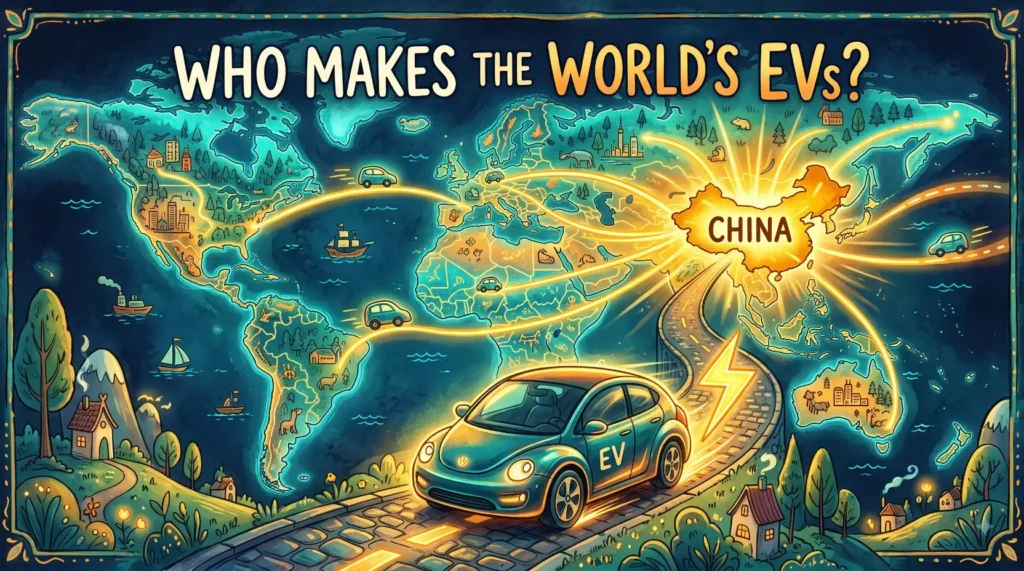
If you’ve felt like every other EV headline lately has the word “China” in it, you’re not imagining things. 🌏 In 2025, roughly 63% of all electric cars sold on the planet were sold in China — and the trend has carried right into 2026.
That’s not a small lead. It means that for every ten EVs rolling out of showrooms worldwide last year, somewhere around six found their first owner in China. The rest of the world — the US, Europe, India, everywhere — split the remaining four. 😮
And it’s not just about who’s buying. Chinese automakers like BYD are now exporting aggressively, opening factories abroad, and quietly becoming the default EV brand across Southeast Asia and Latin America.
So whether you’re shopping for an electric car in Ohio or Bengaluru, understanding the China EV market share 2026 story matters — because it’s already shaping the prices you see, the models you can choose from, and the policies your government is writing. 👇
⚠️ Heads up (please read this): This is a news explainer built on widely reported industry figures from sources like the IEA and BloombergNEF, current as of 2025–2026. Market-share numbers, sales totals, and forecasts are illustrative and get revised constantly as new data lands. Treat every figure here as a directional snapshot, not a guaranteed final number — and check current reporting before making a purchase or investment decision.
⚡ The Short Answer
If you only have thirty seconds, here’s the gist of the China EV market share 2026 story:
- 🇨🇳 China sold ~63% of the world’s EVs in 2025 — by far the single largest market, and it’s still leading in 2026.
- 🌍 Global EV sales topped 20 million in 2025 (around 25% of all new cars), with 23 million-plus expected in 2026 (roughly 27% share), per BloombergNEF/IEA-style estimates.
- 🔋 China leads because of scale, batteries, and supply chain — it makes most of the world’s EV batteries and key minerals processing.
- 🚗 BYD and other Chinese brands are surging in emerging markets like Southeast Asia and Latin America.
- 🇺🇸 US buyers see very few Chinese EVs thanks to steep tariffs — so prices and choice move differently there.
- 🇮🇳 India gets BYD and MG models plus local manufacturing, with more affordable EVs on the way.
China’s dominance is a double-edged sword: cheaper, faster innovation for buyers, but real debates about trade and dependency. Both figures and policies are evolving — verify current data before you act. 😎
📊 Where the World’s EVs Are Sold — At a Glance
Different regions play very different roles in the global EV story. Here’s a quick map of how things looked in 2025 and where the trend points for 2026 — think of this as a directional snapshot, not a precise ledger, because these numbers get revised every quarter. 👇
| Region | ~2025 EV Share / Role (Illustrative) | 2026 Trend (Illustrative) |
|---|---|---|
| 🇨🇳 China | ~63% of global EV sales — the dominant market | Still leading; growth maturing but huge |
| 🇪🇺 Europe | Second-largest bloc; steady but slower | Rebound expected as new models arrive |
| 🇺🇸 United States | Smaller share; few Chinese EVs due to tariffs | Mixed — policy shifts cloud the outlook |
| 🌏 Southeast Asia | Fast-growing; Chinese brands moving in | Rising sharply on BYD/MG-style entries |
| 🌎 Latin America | Emerging; cheap Chinese EVs gaining ground | Strong growth from affordable imports |
| 🇮🇳 India | Early stage but accelerating | Climbing as local manufacturing scales |
These figures are illustrative and based on 2025–2026 industry reporting. The exact percentages move as fresh data lands — so use this as a shape-of-the-world guide, not gospel. 🎯
🗞️ The Headline: China Sold ~63% of the World’s EVs in 2025
Let’s start with the number everyone’s quoting. In 2025, China accounted for somewhere in the neighborhood of 63% of global electric car sales — a staggering concentration for any single country. 🇨🇳
To put that in human terms: China’s EV market alone is bigger than the EV markets of every other country combined. When industry analysts talk about “the global EV transition,” they’re largely talking about what’s happening on Chinese roads.
And the momentum isn’t slowing in 2026. While growth rates are naturally maturing — you can’t keep doubling forever — China remains the undisputed leader heading through the year.
Why does this matter to you, thousands of miles away? Because scale at that level changes everything downstream. 🌊
When one market is this enormous, it sets the pace for battery prices, manufacturing techniques, and the speed of new model launches. The cars and the tech eventually ripple outward — even to markets where Chinese brands themselves can’t easily sell.
So the China EV market share 2026 figure isn’t just trivia. It’s the gravitational center the entire industry is orbiting around right now. 🪐
🔋 Why China Leads: Scale, Batteries, and the Supply Chain
China didn’t stumble into EV dominance. It built it, deliberately, over more than a decade. Three pillars hold the whole thing up. 🏗️
Pillar one: sheer scale. China is the largest car market on Earth, full stop. When a country that size decides to electrify — backing it with subsidies, charging infrastructure, and city policies that favor EVs — adoption snowballs fast.
Pillar two: batteries. This is the big one. China dominates the EV battery supply chain, producing a huge share of the world’s cells and controlling much of the processing for critical minerals like lithium, graphite, and rare earths. 🔋
The battery is the single most expensive part of an EV. So whoever controls battery production controls a massive slice of the cost — and China has a commanding position there.
Pillar three: the supply chain ecosystem. It’s not just batteries. China has the suppliers, the factories, the engineers, and the logistics all clustered together, which makes building an EV faster and cheaper than almost anywhere else. 🏭
Stack those three pillars together and you get a manufacturing machine that can produce capable EVs at prices Western automakers struggle to match. That cost advantage is the engine behind the entire China EV market share 2026 story.
It’s also exactly why trade tensions have flared — but we’ll get to that. ⚖️
💰 What China’s Dominance Means for Global Prices and Choice
Here’s where it gets personal for your wallet. When the world’s biggest EV maker is also one of its cheapest, the effects spread far beyond China’s borders. 💸
On prices: Intense competition inside China has triggered fierce price wars, pushing EV costs down dramatically. That pressure encourages global automakers to cut their own prices and accelerate cheaper models just to stay competitive.
Even if you never buy a Chinese car, the threat of cheap Chinese EVs nudges every other brand to sharpen its pencil. 🖊️
On choice: China’s market churns out an astonishing variety of EVs — tiny city cars, family SUVs, luxury sedans, you name it. Many of those designs and technologies eventually influence what shows up in showrooms elsewhere.
On innovation speed: Chinese brands iterate incredibly fast. Features like swappable batteries, ultra-fast charging, and slick in-car software often appear there first, then set new expectations globally. ⚡
The flip side? In markets that block or heavily tariff Chinese EVs — like the US — buyers may not feel the full price benefit directly. The cheap cars exist; they’re just harder to access.
That gap between “what’s possible globally” and “what’s available locally” is one of the defining tensions of the China EV market share 2026 era. And it’s why two buyers on opposite sides of the world can have wildly different EV experiences. 🌐
By the way, if you’re weighing whether an EV even makes sense for your budget versus a hybrid, our companion breakdown is worth a read: EV vs Hybrid: Which Is Cheaper to Own Today? 💡
🌏 BYD and Chinese Brands Are Conquering Emerging Markets
If you want to see China’s EV strategy in action, don’t look at the US or Europe. Look at Southeast Asia and Latin America. 🌎
Chinese automakers — led by BYD, but joined by MG, GWM, Chery, and others — have been expanding aggressively into emerging markets where there’s little local competition and lots of price-sensitive demand.
In places like Thailand, Indonesia, Brazil, and Mexico, affordable Chinese EVs are filling a gap that Western and Japanese brands left wide open. 🚗
The playbook is simple but effective: bring in capable EVs at prices local buyers can actually afford, then set up regional factories to dodge import duties and build goodwill with host governments.
BYD in emerging markets has become almost a case study in how to scale globally. By manufacturing locally and pricing aggressively, these brands are becoming the default electric option in entire regions. 🌟
This matters for the bigger picture. Even as the US and parts of Europe wall off Chinese EVs, the rest of the world is increasingly being electrified by Chinese cars.
That divergence — closed markets here, open markets there — is reshaping who leads the global auto industry for the next decade. And it’s happening faster than most people realize. 🚀
🇺🇸 The US Picture: Tariffs, Fewer Chinese EVs, and What Buyers Feel
For American readers, the China EV market share 2026 story comes with a big asterisk: you mostly can’t buy the cars everyone’s talking about. 🇺🇸
The US has imposed steep tariffs on Chinese EVs, effectively pricing them out of the market. The stated goal is to protect domestic automakers and jobs from a flood of cheaper imports.
The result? American buyers see relatively few Chinese-branded EVs on dealer lots. The fierce price competition reshaping the rest of the world is muted here. 🚧
So what do US buyers actually feel? A few things.
Higher relative prices. Without cheap Chinese EVs applying downward pressure, US EV prices tend to stay higher than in more open markets. You’re shopping a narrower, pricier field. 💵 (Roughly speaking, many new US EVs still land well above the $30,000–$40,000 range, though incentives and used options help.)
Policy uncertainty. US EV policy — tax credits, charging funding, emissions rules — has been a moving target, which makes both automakers and buyers cautious.
A slower price-war effect. The aggressive discounting happening abroad arrives in the US in diluted form, mostly through domestic brands trimming prices to move inventory. 🏷️
The honest trade-off is this: tariffs may protect US jobs and supply-chain security, but they also mean American buyers don’t get the cheapest EVs the world is producing. Reasonable people disagree on whether that’s worth it. ⚖️
If you’re a US buyer trying to figure out whether the numbers work today given all this, the cost-of-ownership math is the place to start — and our EV vs Hybrid: Which Is Cheaper to Own Today? guide walks through it without the hype. 🧮
🇮🇳 The India Picture: BYD, MG, Local Manufacturing, and What’s Coming
India sits in a fascinating middle ground in the China EV market share 2026 story — more open than the US, but with strong incentives to build locally. 🇮🇳
Chinese-linked brands already have a real presence. BYD sells EVs in India directly, while MG (under different ownership but with Chinese engineering roots) has been one of the more visible EV players, especially with affordable models that found genuine traction.
But India’s government clearly wants the cars built on Indian soil, not just imported. 🏭
Policy increasingly favors local manufacturing — through production-linked incentives and import rules designed to pull global automakers into setting up Indian factories rather than simply shipping cars in.
That’s a deliberate strategy: capture the jobs, the supply chain, and the technology transfer, while still giving Indian buyers access to modern EVs at competitive prices. 💪
For Indian buyers, the practical upside is real. More EVs are arriving across price points, and competition — including pressure from Chinese-engineered models — is helping push prices toward levels everyday families can consider. (Many India-market EVs now start in the ₹10–20 lakh range, with cheaper options expanding.) 💰
And the pipeline is getting crowded in the best way. A wave of new electric models — from homegrown brands like Tata and Mahindra to global entrants — is set to hit Indian roads through late 2026.
We’ve rounded up the most exciting ones here: The Most Anticipated India EV Launches of Late 2026. 🚗
The bottom line for India: you get the benefit of global EV competition and a domestic manufacturing push — a combination that should keep choice expanding and prices competitive. 🎯
🤝 The Competition Upside for Buyers (Wherever You Are)
Let’s zoom out and talk about the genuinely good news, because it’s easy to lose it in the trade-war headlines. 😊
More competition is, broadly, great for buyers. When the world’s biggest manufacturer is relentlessly cutting costs and innovating, the entire industry has to keep up — and that pressure flows to you.
You get better cars faster. Range, charging speed, software, and features all improve more quickly when there’s a fierce global race. ⚡
You get more price pressure over time. Even in protected markets, the existence of cheap, capable EVs elsewhere pushes domestic brands to compete harder on value.
You get more choice across segments. The variety exploding in China — budget commuters, family SUVs, premium sedans — tends to inspire similar variety everywhere, eventually. 🚙
You benefit from cheaper batteries. As China drives battery costs down through scale, that cost curve benefits EV buyers globally, since batteries are the single biggest component cost. 🔋
None of this is automatic or evenly distributed — tariffs and local policy shape how much of the upside actually reaches your driveway. But the underlying force is real: a hyper-competitive global EV market generally pushes prices down and quality up over time.
That’s the optimistic read on China EV market share 2026, and it’s a legitimate one. 🌟
⚖️ The Risks and Debates: Dependency, Trade, and Fairness
Now the harder conversation — because a balanced view has to hold both sides. 🤔
Dependency. When one country dominates EV and battery production, the rest of the world becomes reliant on it for critical technology and minerals. Many governments worry about that concentration, especially for something as strategic as transportation and energy. 🌐
Trade fairness. Critics argue Chinese EVs benefit from heavy state support, making it hard for foreign automakers to compete on a level field. That’s a core justification behind tariffs in the US and tariff debates in Europe.
Supporters counter that every major auto industry has received some form of government backing, and that protectionism mostly hurts consumers by keeping cheap cars out. Both arguments have merit. ⚖️
Jobs and industry. Western and Indian policymakers face a real tension: open the doors to cheap Chinese EVs and risk domestic automakers and jobs, or wall them off and risk slower adoption and higher prices for citizens. There’s no clean answer. 🏭
Security and data. Some governments also raise concerns about software, connectivity, and data in foreign-made vehicles — a debate that’s still evolving and far from settled.
The honest takeaway is that China’s EV dominance is genuinely double-edged. It delivers cheaper, faster innovation to the world, and it concentrates strategic power and sparks legitimate trade friction. 🌗
Anyone telling you it’s purely good or purely bad is selling something. The reality is a messy, ongoing negotiation between affordability, fairness, jobs, and security — and it’s far from resolved. 🎯
📈 2026: Global EV Competition Trends
The China EV market share 2026 picture is moving fast, and a few trends are worth watching as the year unfolds. 🌊
First, the global market keeps growing. With 20 million-plus EVs sold in 2025 and 23 million-plus projected for 2026 (roughly 27% of all new cars, per BloombergNEF/IEA-style forecasts), the transition is accelerating, not stalling. 📈
Second, Chinese export expansion continues. Expect more BYD and rival factories opening in Southeast Asia, Latin America, and beyond, deepening their hold on emerging markets. 🌏
Third, tariff walls stay up — and get debated. The US is likely to maintain steep barriers, Europe keeps wrestling with its own tariff stance, and India keeps nudging automakers toward local production. ⚖️
Fourth, battery costs keep falling, which should make EVs more affordable globally over time — even in protected markets, eventually. 🔋
Fifth, legacy automakers fight back. Western, Japanese, Korean, and Indian brands are racing to launch competitive, lower-cost EVs to defend their turf. That competition benefits buyers. 🏁
The practical lesson? Treat every percentage and forecast as a directional snapshot. These numbers get revised constantly — so confirm the latest reporting before making any big decision. 🎯
✅ 5 Takeaways for Buyers
Ready to boil it all down? Here’s the clean version. 🏁
- China leads the EV world by a mile — ~63% of 2025 global sales, still ahead in 2026. That scale shapes prices and tech everywhere. 🇨🇳
- Cheaper batteries and fierce competition help you long-term, even if your local market blocks Chinese cars directly. 🔋
- US buyers feel less of the price drop because tariffs keep cheap Chinese EVs out — so shop incentives and used EVs carefully. 🇺🇸
- India buyers benefit from BYD/MG presence plus a local-manufacturing push and a strong launch pipeline. 🇮🇳
- It’s a genuine trade-off, not a slam dunk — cheaper innovation versus dependency and trade fairness. Stay informed and verify current figures. ⚖️
🛒 Shop This Post
A few things that pair nicely with joining the EV wave, whatever brand you end up choosing. 😍
1. A Home EV Charger (Level 2) ⚡
No matter which EV you buy, a solid Level 2 home charger is the single best upgrade for convenience and low per-mile costs. It’s the foundation of stress-free ownership.
👉 Shop home EV chargers
2. A Portable EV Charging Cable 🔌
A reliable portable charger gives you a backup for travel, apartments, or anywhere a fixed unit isn’t installed yet — handy peace of mind for any EV owner.
👉 Shop portable EV chargers
3. An OBD2 EV Battery Health Scanner 🔋
Whether you buy new or used, a battery-health scanner helps you keep tabs on your pack’s condition over time — smart insurance for your biggest EV investment.
👉 Shop EV battery scanners
🛒 Affiliate disclosure: Some links above are affiliate links. If you buy through them, EVs Mirror may earn a small commission at no extra cost to you — it helps keep our news explainers free. 🙏 We only suggest things we’d actually point a friend toward.
🎯 Quick Quiz: How Well Do You Get the China EV Story?
Give yourself a quick gut-check. 👇
- Roughly what share of global EV sales did China have in 2025? 🅐 ~25% 🅑 ~63%
- Why does China lead so heavily? 🅐 Scale + batteries + supply chain 🅑 Just luck
- Why do US buyers see few Chinese EVs? 🅐 Steep tariffs 🅑 They’re banned worldwide
Answers: 1️⃣ 🅑 ~63% · 2️⃣ 🅐 Scale + batteries + supply chain · 3️⃣ 🅐 Steep tariffs
Mostly right? 🟢 Nice — you’ve got the big picture. Just keep an eye on updated figures as 2026 data lands.
Missed a few? 🟡 No worries — re-skim the headline and “why China leads” sections and you’ll have it cold.
📋 Your China-EV-Story Checklist
- [ ] Understand that China sold ~63% of the world’s EVs in 2025 🇨🇳
- [ ] Know the three reasons it leads: scale, batteries, supply chain 🔋
- [ ] Recognize how global competition affects prices and choice 💰
- [ ] Note that US tariffs limit Chinese EV availability there 🇺🇸
- [ ] See how BYD/MG and local manufacturing shape India’s market 🇮🇳
- [ ] Watch BYD’s expansion in Southeast Asia and Latin America 🌏
- [ ] Hold a balanced view on dependency and trade debates ⚖️
- [ ] Treat all figures as illustrative and verify current data ✅
🤔 People Also Ask
Q: What is China’s EV market share in 2026?
A: China remains the world’s dominant EV market in 2026. Based on 2025 reporting, it accounted for roughly 63% of global electric car sales, and it’s continued to lead through 2026 even as growth matures. The exact China EV market share 2026 figure shifts as fresh data lands, so treat it as a directional snapshot and check current industry reporting before relying on a precise number.
Q: How many EVs were sold globally in 2025 and 2026?
A: Industry estimates (BloombergNEF/IEA-style) put global EV sales above 20 million in 2025 — around 25% of all new cars — with 23 million-plus projected for 2026, roughly a 27% share. These totals are illustrative and get revised as the year’s data finalizes.
Q: Why does China dominate the EV industry?
A: Three big reasons: enormous scale as the world’s largest car market, control over much of the EV battery supply chain and critical-mineral processing, and a tightly clustered manufacturing ecosystem. Together they let Chinese automakers build capable EVs at lower costs than most rivals.
Q: Can you buy Chinese EVs like BYD in the US?
A: Mostly no. The US has imposed steep tariffs on Chinese EVs, which effectively keeps them off American dealer lots. As a result, US buyers see relatively few Chinese-branded EVs and feel less of the global price competition than buyers in more open markets.
Q: Is BYD available in India?
A: Yes. BYD sells EVs in India directly, and MG (with Chinese engineering roots) has been a visible affordable-EV player. India’s policy increasingly pushes automakers toward local manufacturing, so expect more EVs built on Indian soil alongside imports.
Q: Is China’s EV dominance good or bad for buyers?
A: It’s genuinely double-edged. It delivers cheaper batteries, faster innovation, and more global price competition that tends to help buyers over time. But it also concentrates strategic power and sparks legitimate trade and dependency debates. How much upside you feel depends heavily on your country’s tariffs and local policy.
🚀 The Bottom Line
The single biggest fact in electric cars right now is simple: China makes and buys most of the world’s EVs. With roughly 63% of 2025 global sales and a continued lead in 2026, it’s the gravitational center of the entire industry — setting the pace on prices, batteries, and innovation. 🌏
What that means for you depends on where you live. In the US, tariffs mute the price benefits but aim to protect domestic jobs. In India, BYD and MG plus a strong local-manufacturing push are expanding choice and competition. And across emerging markets, Chinese brands are quietly becoming the default. 💸
It’s not a clean good-or-bad story. Cheaper, faster EVs for the world come bundled with real questions about dependency, trade fairness, and security. The smart move is to stay informed, hold a balanced view, and verify the latest figures before making any big decision — because in the China EV market share 2026 era, the numbers move fast. ⚡
💬 Where do you stand? Are tariffs protecting jobs or just raising your prices? Drop your take in the comments.
📤 Know someone EV shopping? Forward them this explainer so they understand the forces shaping their options. 🙏
🔖 Bookmark EVs Mirror for honest, no-hype EV news and money guides.
👉 Next, do the math for your situation: EV vs Hybrid: Which Is Cheaper to Own Today? — and if you’re in India, see The Most Anticipated India EV Launches of Late 2026. ⚡
This article is a general news explainer based on 2025–2026 industry reporting (IEA, BloombergNEF-style estimates). Market-share figures, sales totals, and forecasts are illustrative and change constantly. Always verify current data and consult relevant professionals before making purchase or investment decisions.