Remember the early 2010s, when every phone came with its own weird charging brick? 🔌 You had mini-USB, micro-USB, that one proprietary plug your friend’s old phone used, and Apple doing its own thing entirely. Borrowing a charger felt like a small negotiation.
EV charging plugs are living through that exact same messy chapter right now. Too many standards, a lot of confusion, and the nagging worry that the plug on your shiny new car is quietly about to become a paperweight. 😵
Here’s the good news, though. The dust is finally settling. The connector wars are wrapping up, and knowing exactly where things stand will stop you from buying the wrong car, the wrong home charger, or an adapter you didn’t actually need.
So let’s make sense of CCS vs CHAdeMO vs NACS once and for all — written plainly, for real drivers in both the US and India. 👇
⚡ The Short Answer
If you only have thirty seconds, here’s the CCS vs CHAdeMO vs NACS state of play in 2026:
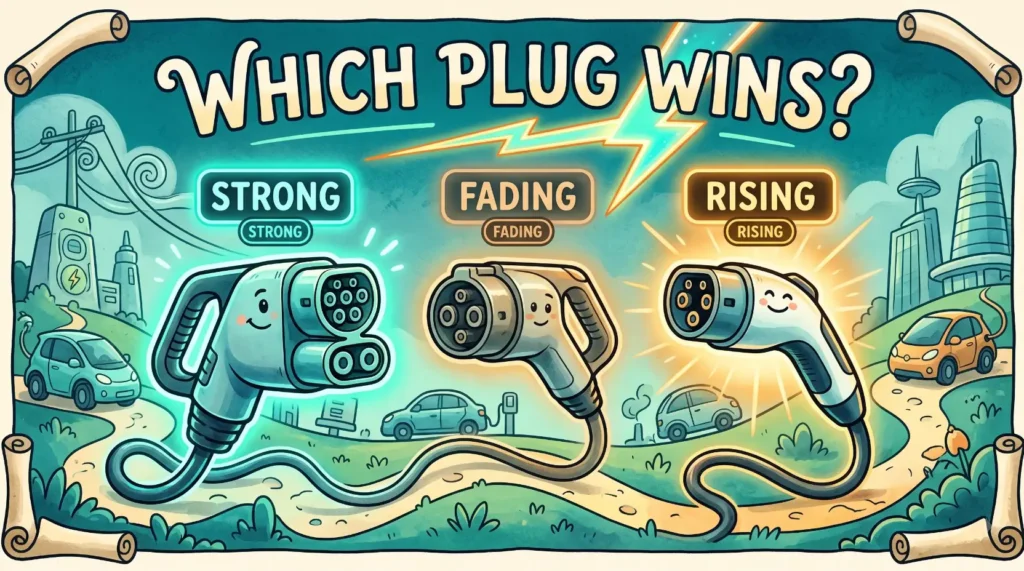
- 🔌 CCS — the long-running fast-charging standard. It splits into CCS1 (United States) and CCS2 (India and Europe). Still everywhere, still reliable.
- 🚀 NACS — Tesla’s slim connector, now the de facto charging standard in the US as nearly every major automaker adopts it.
- 🪦 CHAdeMO — the older Japanese DC standard. It’s fading fast and showing up only on a handful of legacy EVs.
The direction of travel is crystal clear: NACS is winning in the US, CCS2 owns India, and CHAdeMO is quietly retiring. 😎
Now let’s unpack what that actually means for your car, your wallet, and your next road trip.
📊 CCS vs CHAdeMO vs NACS — At a Glance
Before we go deep, here’s the whole landscape in one tidy table. Pin this in your head. 👇
| Connector | Status (2026) | Region | What You Should Know |
|---|---|---|---|
| 🔌 CCS1 | Strong, transitioning | United States | Was the US default; being supplemented by NACS via adapters |
| 🔌 CCS2 | Dominant | India & Europe | The clear standard for fast charging — straightforward |
| 🚀 NACS | Rising fast, winning US | United States | Now the official North American standard; Supercharger access |
| 🪦 CHAdeMO | Declining / retiring | Legacy & older EVs | Rare on new cars; networks rarely add it anymore |
Notice something important: the snapshot matters far less than the trend lines. And those trend lines point hard toward NACS in the US and CCS2 in India. 🎯
The rest of this guide walks through each connector, what it means where you live, and the practical moves that keep you charged no matter what’s plugged into your car.
🔌 CCS Explained: The Established Workhorse
For most of the last decade, CCS was the connector quietly holding the whole non-Tesla world together. 🔌
CCS stands for Combined Charging System, and the name is the key to understanding it. It “combines” two things into one port: a top section for regular AC charging (the kind you use overnight at home) and a bottom section with two extra big pins for DC fast charging on the highway. One port, both jobs. Neat.
But here’s where new EV owners trip up — CCS comes in two flavors that are not interchangeable:
CCS1 is the North American version. If you bought a non-Tesla EV in the US between roughly 2018 and 2024 — a Ford Mustang Mach-E, a Hyundai Ioniq 5, a Chevy Bolt — there’s a strong chance it shipped with a CCS1 port.
CCS2 is the European and Indian version. It looks similar but adds a Type 2 AC section on top, which handles three-phase charging better. Across India and the EU, CCS2 is simply the standard.
For Indian readers especially, this makes life easy. 😎 Your Tata, MG, Hyundai, or Kia EV almost certainly uses CCS2, and the public fast-charging network — Tata Power, Statiq, Ather Grid’s DC points, the highway corridors — is built around it. No connector anxiety required. You roll up, you plug in, you charge.
The one wrinkle in the US is that CCS1, despite being everywhere, is now playing second fiddle to a newer arrival. Which brings us to the big story.
🚀 NACS: The Standard That’s Taking Over the US
If there’s one headline in the CCS vs CHAdeMO vs NACS saga, it’s this: NACS won North America. 🚀
NACS stands for the North American Charging Standard, but let’s be honest about what it really is — it’s Tesla’s connector. For years, Tesla used its own slim, elegant plug while everyone else used the chunkier CCS1. Tesla then opened up the design, renamed it NACS, and one by one the big automakers fell in line: Ford, GM, Rivian, Hyundai, Kia, Honda, Volkswagen, Nissan, and more all committed to it.
Why did everyone switch? Two reasons, both practical:
First, the plug itself is genuinely better — smaller, lighter, easier to handle, and it does both AC and DC charging through fewer pins. 👌
Second, and far more important, NACS is your key to the Tesla Supercharger network. That network is large, dependable, and famously well-maintained — exactly the things the patchwork of older CCS networks struggled with. Giving non-Tesla drivers access to it was a game-changer.
So in 2026, new US EVs increasingly ship with a NACS port straight from the factory. And the cars that still have CCS1? They get into the Supercharger party using an adapter — a small dongle that bridges the two standards. 🎯
If you want the full walkthrough on actually plugging a non-Tesla EV into a Supercharger, we’ve got you covered here: 👉 How to Use a Tesla Supercharger With a Non-Tesla EV
💡 Carrying the right dongle matters: Best Charging Adapters Every EV Owner Should Carry
🪦 CHAdeMO: The Standard That’s Fading Out
Every format war has a loser, and in the CCS vs CHAdeMO vs NACS race, that’s CHAdeMO. 🪦
CHAdeMO (the name is a quirky Japanese pun, roughly “how about a cup of tea while you charge?”) was one of the earliest DC fast-charging standards. It powered the original Nissan Leaf and Mitsubishi’s early EVs, and for a moment in the mid-2010s it was a serious contender.
But it had a fatal flaw: it needed a separate port just for AC charging, so cars ended up with two awkward charging flaps. CCS, with its clever combined design, simply made more sense. The market voted, and CHAdeMO lost.
Today, CHAdeMO is essentially legacy hardware. 🪦 New EVs don’t use it. New charging stations rarely install it. And the chargers that still have a CHAdeMO cable are aging — some networks are quietly pulling them to free up space for CCS and NACS.
If you’re shopping for a brand-new EV anywhere in the US or India, you will not encounter CHAdeMO. You can mentally cross it off your list. The only people who need to think about it are folks who already own — or are tempted by a cheap used — older Leaf-style EV. We’ll deal with that scenario in a moment.
🌍 What Each Connector Means by Region
This is the part where everything clicks into place, because the right answer genuinely depends on where you drive. 🌍
🇺🇸 In the United States: NACS is becoming the default on new cars and is fast becoming the connector you’ll see on most chargers. CCS1 is still widely supported throughout the transition — millions of cars use it, and networks aren’t ripping it out overnight — but adapters increasingly do the heavy lifting to connect CCS1 cars to NACS stalls. CHAdeMO is retiring. So if you’re a US driver, your two words to remember are NACS and CCS1.
🇮🇳 In India: CCS2 is king, full stop. The car standard is CCS2, the highway fast-charging corridors are built around CCS2, and you don’t need to overthink it. NACS isn’t relevant for the vast majority of Indian buyers — there’s no Supercharger ecosystem driving adoption the way there is in the US. CHAdeMO was never a meaningful factor here either. So Indian drivers have it the simplest of anyone: just CCS2. 🎯
The big takeaway? Know your region, and the connector question goes from intimidating to obvious in about two seconds.
🔧 Adapters: The Bridge Across the Transition
Here’s the calming truth that defuses most connector panic: adapters exist precisely to bridge these gaps. 🆘
An adapter is a short, sturdy piece of hardware that lets a car with one connector plug into a charger with another. In the US right now, this is the hero of the story. A CCS1 car can carry a NACS adapter and suddenly unlock thousands of Supercharger stalls it couldn’t use before. Going the other way, a NACS car can carry a CCS1 adapter to use older CCS networks.
A few ground rules to keep you safe and charged:
- ✅ Match the adapter to your car’s port. The adapter direction matters — a “CCS-to-NACS” adapter is not the same as a “NACS-to-CCS” one. Read the listing carefully.
- ✅ Buy quality. A DC fast charger pushes serious power through that little dongle. Cheap, no-name adapters can overheat or fail. Stick to reputable brands, ideally automaker-approved ones. 🔥
- ✅ DC vs AC adapters are different beasts. Some adapters only handle slower AC charging; the ones you want for road trips handle high-power DC. Check the spec.
For Indian drivers, the adapter conversation is mostly a non-issue — CCS2 to CCS2 means you rarely need one. It’s the US transition period that makes adapters a road-trip essential. 🗺️
🔌 Build your kit the smart way: Best Charging Adapters Every EV Owner Should Carry
⚡ AC vs DC: The Connector Basics Everyone Skips
Before you stress about plug shapes, it helps to understand the two types of charging happening through them — because every connector is really doing one of two jobs. 🔋
AC charging is slow and steady. This is your home wall box and most workplace or shopping-center chargers. The power coming out of the wall is alternating current (AC), and your car’s onboard charger converts it to the direct current (DC) your battery actually stores. Because that little onboard converter can only work so fast, AC charging tops out at modest speeds — perfect for overnight, useless for a quick highway splash.
DC fast charging skips the car’s onboard converter entirely. The big roadside station does the AC-to-DC conversion itself and shoves direct current straight into the battery. That’s why it’s so much faster — and why those connectors (the bottom pins of CCS, all of NACS, the whole CHAdeMO plug) are physically bigger and chunkier. ⚡
Why does this matter for the connector debate? Because the combined designs — CCS and NACS — handle both AC and DC through a single port. CHAdeMO needed a separate AC plug, which is a big part of why it lost. When you understand AC vs DC, the whole “why did the industry consolidate” story suddenly makes sense.
🛒 What to Check Before You Buy (Car or Adapter)
Whether you’re choosing a new EV or grabbing an adapter, run through this quick mental checklist so you never get caught out. 🧠
Before buying a car:
– 🔌 What port does it ship with? In the US in 2026, ask specifically whether it’s NACS or CCS1 — it changes which chargers are most convenient for you.
– 🚀 Is a NACS adapter included or available? Many automakers now bundle or sell one for CCS1 cars. Factor that into your decision.
– 🇮🇳 In India, confirm it’s CCS2. It almost certainly is, but a five-second check never hurts.
Before buying an adapter:
– ✅ Confirm the direction (your car’s port → the charger you want to use).
– ✅ Confirm it handles DC if you want it for fast charging, not just home AC.
– ✅ Check that your automaker approves it — some warranties and Supercharger access depend on using a sanctioned adapter.
– ✅ Read recent reviews. Heat management and build quality separate the good ones from the scary ones. 🔥
Two minutes of homework here saves you a roadside headache later. 😎
🆘 What To Do If You Own a CHAdeMO EV
So you’ve got an older Nissan Leaf or a similar early EV with a CHAdeMO port. Don’t panic — but do plan ahead. 🪦
Your car still works exactly as it always did. The issue isn’t your vehicle; it’s the shrinking number of public CHAdeMO connectors out there. Here’s how to stay ahead of it:
- 🏠 Lean on home charging. Your AC home setup is unaffected by the CHAdeMO retirement — most of your charging probably happens here anyway.
- 🗺️ Map CHAdeMO chargers before trips. Use a route-planner app and filter specifically for CHAdeMO. Don’t assume a station has it; many newer sites don’t.
- 🔌 Look into a CHAdeMO adapter for your situation, if one exists for your market and car — though options are more limited than for the CCS/NACS world.
- 🔄 Plan your next car around CCS or NACS. When it’s time to upgrade, you’ll move into the mainstream and never think about connector scarcity again.
The honest bottom line: a CHAdeMO EV is perfectly usable today, especially as a home-charged commuter, but it’s a sunset standard. Buy used with eyes open, and don’t pay a premium for one. 😌
📈 How 2026 Trends Affect Connectors
Zoom out, and the CCS vs CHAdeMO vs NACS picture in 2026 is a story of consolidation — which is genuinely great news for drivers. 📈
In the US — the great NACS consolidation: Adoption is no longer a question of “if.” Automaker after automaker has committed, new cars are rolling off lines with NACS ports, and the adapter ecosystem has matured enough that even CCS1 owners get Supercharger access. The chaotic, confusing connector landscape that scared off buyers for years is collapsing into a single dominant standard. Fewer dead-end plugs, more reliable charging. 🚀
In India — CCS2 cements its lead: India never had the multi-standard mess the US did. CCS2 was chosen early and stuck, and the country’s expanding fast-charging corridors continue to be built around it. As more highways get DC stations, compatibility stays beautifully predictable — buy almost any mainstream EV and it just fits. 🇮🇳
The era of connector confusion is ending. In the US it ends with NACS; in India it was barely an era at all because CCS2 settled things early. Either way, 2026 is the year “which plug?” stops being a real worry. 🌍
✅ 5 Tips for Navigating Connectors
Keep these five moves in your back pocket and you’ll never be caught flat-footed. 🎯
- Know your car’s connector cold. CCS1, CCS2, or NACS — it’s the single most useful fact about your EV. 🔌
- In the US, factor NACS into any new-car decision. It’s where the network and the future are heading. 🚀
- Carry the right adapter for your region’s transition. For US drivers, a quality DC-capable NACS adapter is road-trip gold. 🆘
- Avoid CHAdeMO-only EVs if buying used — unless it’s a cheap home-charged commuter and you know what you’re getting into. 🪦
- Filter chargers by connector before every road trip. A route planner that shows compatible stalls turns anxiety into a non-event. 🗺️
🛒 Shop This Post
A few genuinely useful picks to make the connector transition painless. 😍
1. A NACS / CCS Bridge Adapter 🔌
The single most useful accessory for a US driver during the transition. Plug your CCS1 car into Supercharger stalls, or your NACS car into older CCS networks. Buy a quality, DC-capable, automaker-friendly one.
👉 Shop charging adapters
2. A Route Planner App (Premium) 🗺️
Filters chargers by your exact connector type and plans stops around real, compatible stalls. The fastest cure for connector anxiety on long drives.
👉 Shop EV route planner apps
3. A Portable Level 1/2 Charger (Backup) 🎒
Charges from standard outlets regardless of which fast-charge standard your car uses. The safety net that gets you home when public DC fails you.
👉 Shop portable EV chargers
🛒 Disclosure: These are affiliate picks. They cost you nothing extra, and they help keep EVs Mirror running. 🙏
🎯 Quick Quiz: Which Connector Matters for You?
Answer three quick questions and find your path. 🧩
- Where do you mostly drive? 🅐 United States 🅑 India
- New or used EV? 🅐 New 🅑 Used
- Do you already carry the right adapter? 🅐 Yes 🅑 No
Mostly 🅐 (US-focused): Your world is NACS. Plan new-car purchases around it, and keep a quality CCS/NACS adapter in the frunk.
Mostly 🅑 (India-focused or used): CCS2 is almost certainly your standard, and life is simple — just confirm your car’s port and check chargers before long trips.
📋 Connector Checklist
Run this before your next charge, purchase, or road trip. ✅
- [ ] Identify your car’s exact connector (CCS1 / CCS2 / NACS)
- [ ] Know your region’s dominant standard (US = NACS/CCS1, India = CCS2)
- [ ] Understand whether you need AC, DC, or both
- [ ] Carry the right DC-capable bridge adapter (US drivers)
- [ ] Avoid paying a premium for CHAdeMO-only used EVs
- [ ] Filter chargers by connector type in your route planner
- [ ] Confirm charger compatibility before every road trip
- [ ] Stay aware of the ongoing NACS transition (US) ⚡
🤔 People Also Ask
Q: What’s the difference between CCS, CHAdeMO, and NACS?
A: In the CCS vs CHAdeMO vs NACS lineup, CCS is the established combined AC/DC standard (CCS1 in the US, CCS2 in India and Europe). NACS is Tesla’s connector, now the official North American standard as automakers adopt it for Supercharger access. CHAdeMO is an older Japanese DC standard that’s being phased out. Direction: NACS in the US, CCS2 in India, CHAdeMO retiring.
Q: Which EV charging connector is winning in 2026?
A: It depends on the region. In the US, NACS is rapidly becoming the dominant standard. In India and Europe, CCS2 leads comfortably. CHAdeMO is being phased out everywhere. The whole CCS vs CHAdeMO vs NACS debate is consolidating around NACS (US) and CCS2 (India).
Q: Do I need an adapter for NACS or CCS?
A: In the US during the transition, yes — a NACS adapter lets a CCS1 car use Tesla Superchargers, and a CCS adapter lets a NACS car use older networks. Always match the adapter to your car’s port and make sure it handles DC fast charging. In India, CCS2-to-CCS2 means adapters are rarely needed.
Q: Is CHAdeMO still usable in 2026?
A: Yes, but only on older EVs, and public support is shrinking. New cars don’t use it and new stations rarely install it. If you own a CHAdeMO EV, lean on home charging and map compatible stations before long trips.
Q: Which connector does my car use?
A: Check your owner’s manual or the badge near your charge port. US cars use CCS1 or NACS, India and Europe use CCS2, and a few legacy EVs (like the early Nissan Leaf) use CHAdeMO. When in doubt, your automaker’s app or support line will confirm it instantly.
Q: Will my CCS car become obsolete because of NACS?
A: No. CCS1 cars remain widely supported through the transition, and adapters give them access to NACS Superchargers too. You won’t be stranded — the industry built the adapter bridge specifically so existing CCS owners stay fully usable for years.
🚀 The Bottom Line
The long, confusing CCS vs CHAdeMO vs NACS saga is finally resolving into something refreshingly simple. NACS is becoming the US standard, CCS2 rules India, and CHAdeMO is gently riding off into the sunset. 🌅
Your action plan is short: know your car’s connector, factor NACS into US buying decisions, carry a quality DC-capable adapter during the transition, and don’t overpay for CHAdeMO-only used EVs. Do those four things and the plug chaos that once worried buyers becomes a non-issue.
The phone-charger era of EVs is ending — and a single, predictable plug future is finally arriving. ⚡
💬 Which connector does your EV use? Drop it in the comments and help a fellow driver!
📤 Know someone stressed about charging plugs? Send them this guide. 🙏
🔖 Bookmark EVs Mirror for clear, no-nonsense EV charging guides.
👉 Up next: How to Use a Tesla Supercharger With a Non-Tesla EV