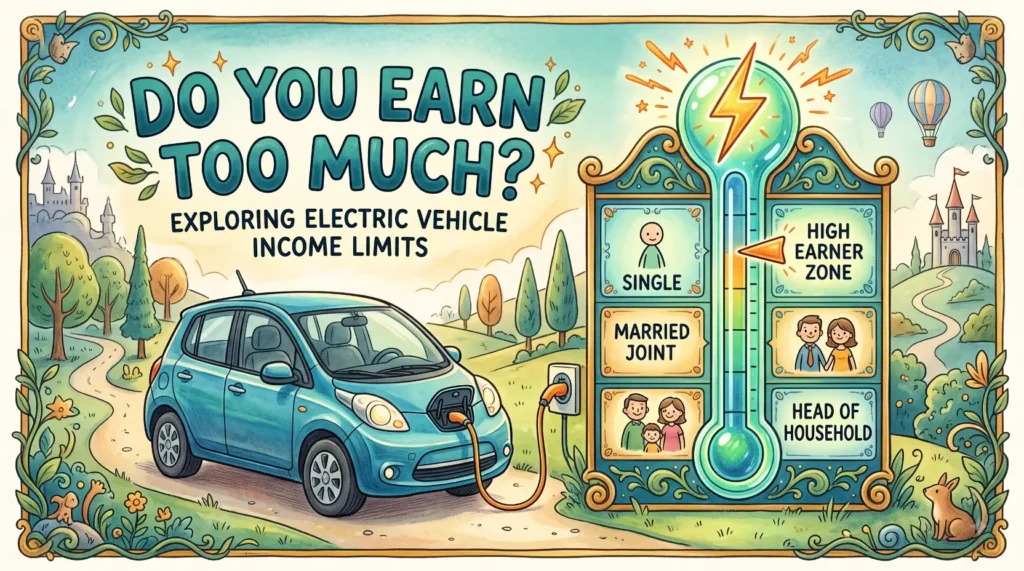
You found the perfect electric car. ⚡ It’s sitting right there on the qualifying list, the dealer quoted you a number you can actually live with, and you’ve already mentally spent the savings. Then a friend who “knows about taxes” asks one quiet question: “Wait — what’s your income?”
And just like that, the deal gets complicated. 😬
Here’s the thing almost nobody tells first-time EV buyers: the vehicle qualifying is only half the battle. You have to qualify too. The government doesn’t hand out this credit to everyone — it’s designed to help middle-income households, so there’s a ceiling on how much you can earn and still claim it. Cross that line by even a dollar, and the credit can disappear entirely.
That ceiling is the thing we’re unpacking today. By the end of this guide, you’ll understand exactly how the EV tax credit income limit works. 👇
⚠️ Important — read this first: Tax rules change, and EV incentives are especially political. Thresholds can be raised, lowered, or repealed entirely by new legislation, and the version in effect when you buy is the one that counts. This article is general educational information, not tax advice. Every dollar figure here is illustrative — always confirm the current numbers on the official IRS website and talk to a qualified tax professional before you rely on anything. We are not your accountant, and your situation is unique. 🙏
⚡ The Short Answer
If you only have thirty seconds, here’s how the EV tax credit income limit generally works:
- 🧾 It’s based on your Modified Adjusted Gross Income (MAGI) — not your salary, not your gross pay, but a specific tax number.
- 👥 The cap changes with your filing status — single, head of household, or married filing jointly each get a different ceiling.
- 🚗 Used EVs have lower income caps than new EVs, because the used-car credit targets budget buyers.
- 📅 You can usually use the lower of this year’s or last year’s MAGI — the “two-year lookback.”
- ❌ Go over the cap and you generally lose the entire credit — there’s no partial version that scales down.
Stay under the ceiling that matches your filing status, and you’ve passed the income test. 😎 Now let’s get into the details that actually matter.
📊 EV Tax Credit Income Limit — Illustrative Caps by Filing Status
Below is the EV tax credit income limit structure people most often reference. These figures reflect the MAGI caps that have been widely cited in recent years — but treat them as a general illustration, not a guarantee. 👇
| Filing Status | New EV (MAGI cap — illustrative) | Used EV (MAGI cap — illustrative) |
|---|---|---|
| Single | ~$150,000 | ~$75,000 |
| Head of Household | ~$225,000 | ~$112,500 |
| Married Filing Jointly | ~$300,000 | ~$150,000 |
| Married Filing Separately | ~$150,000 | ~$75,000 |
Notice the pattern: married-filing-jointly couples get the highest ceiling, single filers the lowest, and the used-EV caps are roughly half the new-EV caps. That structure tends to hold even when the exact dollar amounts shift. 🎯
But please — do not buy a car based on this table alone. Pull up the current-year figures on IRS.gov, because Congress can change these, and a repeal or revision could land at any time.
🧾 First Things First: What MAGI Actually Means
The entire EV tax credit income limit rests on one number — your Modified Adjusted Gross Income, or MAGI. 🧾
Here’s where people trip up. They look at their paycheck, see a big number, and panic. But MAGI is not your gross salary. It’s a tax-specific figure that starts with your Adjusted Gross Income (AGI) and then adds a few items back in.
Think of it as a three-step ladder:
- Gross income — everything you earned: wages, freelance income, interest, dividends, capital gains.
- Adjusted Gross Income (AGI) — your gross income minus certain “above-the-line” deductions like traditional IRA contributions, HSA contributions, student loan interest, and self-employment tax adjustments.
- MAGI — your AGI with a handful of specific items added back (for most people, MAGI and AGI are very close or identical).
For the average wage earner with no foreign income or exotic deductions, MAGI often lands close to AGI. But the gap matters when you’re near the cap — a single retirement contribution could be the difference between qualifying and not. 😎
💡 Want the full eligibility picture, including which vehicles qualify and how much you can claim? Read our companion guide: EV Tax Credit 2026: Who Qualifies and How Much?
👥 New-EV Income Caps: The Higher Ceiling
For a new electric vehicle, the income ceilings are the more generous ones. Based on the figures widely cited in recent years, the new-EV EV tax credit income limit has generally looked like this:
- 🧍 Single filers: MAGI around $150,000
- 🏠 Head of household: MAGI around $225,000
- 💑 Married filing jointly: MAGI around $300,000
So a married couple earning a combined $290,000 might comfortably clear the bar, while a single filer at $160,000 would be shut out. Filing status genuinely changes the math.
This is also why some couples pay close attention to how they file. Married filing jointly carries the highest ceiling by far — but jumping to “filing separately” can drop a spouse down to the single-filer cap. There’s no one-size-fits-all answer here, which is exactly why a tax professional earns their fee. 🎯
And again — these are illustrative. The cap that applies to you is whatever the IRS publishes for the tax year in which you take delivery of the car. Confirm it.
🚗 Used-EV Income Caps: A Much Tighter Squeeze
Buying used? The EV tax credit income limit gets noticeably stricter. The used-EV credit (sometimes called the “previously owned clean vehicle credit”) was built specifically for budget-conscious buyers, so the caps are roughly half the new-EV ceilings:
- 🧍 Single filers: MAGI around $75,000
- 🏠 Head of household: MAGI around $112,500
- 💑 Married filing jointly: MAGI around $150,000
This catches a lot of people off guard. 😬 They assume that because used cars are cheaper, the rules must be looser. It’s the opposite — the income bar is lower for used EVs, not higher.
The practical takeaway: you might easily qualify for a new-EV credit but blow right past the used-EV cap, or vice versa. Never assume the two credits share the same income threshold. Match your MAGI to the specific credit you’re chasing. 🎯
📅 The Two-Year Lookback: Your Secret Weapon
Here’s the single most underrated rule in the entire EV tax credit income limit system — and the one that rescues the most buyers. 📅
Under the rules as generally written, you’re allowed to use the lower of your MAGI from the year you take delivery OR the prior tax year. This is the “two-year lookback,” and it’s genuinely powerful.
Picture this. You sold a business, cashed out some stock, or got a one-time bonus this year that pushed your income way up. Normally that windfall would blow past the cap. But if last year’s MAGI was under the threshold, you can use that lower number instead. ✅
It works the other way too. If you had a lean prior year — maybe you were between jobs, on parental leave, or just starting out — that lower figure can carry you across the finish line even if this year is stronger.
This flexibility is a lifesaver for anyone with variable or lumpy income: freelancers, commission-based salespeople, business owners, and folks with big capital-gains swings. 😎 Just confirm the lookback still applies under the current-year rules before you count on it — provisions like this can be adjusted.
🔍 MAGI vs. Gross Income: Why the Difference Saves Deals
Let’s hammer this home, because it’s where the most expensive misunderstandings happen.
Your gross income is the big, scary number at the top — total wages before anything comes out. Your MAGI is a smaller, refined number after legitimate adjustments. And the EV tax credit income limit is measured against MAGI, not gross income.
Why does this matter so much? Because the gap between the two can be thousands of dollars. Consider someone with a $158,000 salary who feels over the single-filer cap. But after maxing out a traditional 401(k) and contributing to an HSA, their AGI — and likely their MAGI — could drop comfortably under $150,000. 🎯
So before you assume you earn “too much,” do the actual MAGI calculation. People disqualify themselves on the spot all the time when, on paper, they’d have squeaked under the line. Don’t be that person. 😅
This is also a reminder that the income test is a tax question, not a salary question — and tax questions reward people who plan ahead.
❌ What Happens If You Go Over the Cap
This is the part that genuinely scares people, and it deserves a clear, calm explanation — especially with the rise of the point-of-sale rebate. 😬
In the old way, you claimed the EV credit when you filed your tax return. If your income turned out to be over the limit, the IRS simply denied the credit. Disappointing, but contained.
The newer point-of-sale option lets you take the credit as an upfront discount right at the dealership — you drive off having already pocketed the savings. Wonderful, except for one catch: the credit is still subject to the income test at tax time.
So here’s the risk. If you take the money at the dealer, then your final MAGI ends up over the cap (and the prior-year lookback doesn’t save you either), you may have to repay the credit when you file. 😵 That’s a nasty surprise for a number that big.
The credit is also generally all-or-nothing — there’s no sliding scale that gives you a smaller credit for going slightly over. One dollar over the limit can mean zero dollars of credit. That’s why estimating your MAGI before you accept a point-of-sale discount is so important.
💡 Confused about whether to take the discount upfront or claim it later? We break down the trade-offs here: Point-of-Sale EV Rebate vs Tax Credit: Which to Use?
🛠️ Strategies to Manage Your MAGI (Legally)
If you’re hovering near the EV tax credit income limit, there are legitimate, common-sense levers people discuss with their accountants. None of these are tricks — they’re standard tax planning. But please run them past a professional, because the wrong move can cost more than the credit. 🙏
- Max out pre-tax retirement contributions. Traditional 401(k) and traditional IRA contributions lower your AGI, which usually lowers your MAGI.
- Contribute to an HSA. If you have a qualifying high-deductible health plan, HSA contributions are another above-the-line reduction.
- Time your income. Self-employed folks sometimes have flexibility on when income lands — pushing a payment into the following year can keep the current year under the cap.
- Lean on the lookback. If a windfall hit this year, check whether last year’s lower MAGI qualifies you instead.
- Mind your capital gains. Selling appreciated assets in the same year you buy an EV can inflate MAGI — spreading sales across years may help.
⚠️ Every one of these has ripple effects elsewhere in your taxes. What saves you on the EV credit could cost you somewhere else. Talk to a tax pro before pulling any of these levers. 🎯
🧮 How to Actually Estimate Your MAGI
Enough theory — here’s a rough, do-it-at-the-kitchen-table approach to ballparking your MAGI. (Your tax software or accountant will do this precisely; this is just to see roughly where you stand.) 🧾
- Start with your AGI. Grab last year’s tax return — your AGI is right there on the form. That’s your baseline.
- Adjust for big changes this year. Got a raise, a bonus, a new side hustle, or a property sale? Add or subtract those.
- Add back the MAGI items. For most people this is small or zero, but things like foreign-earned income exclusions get added back. (A tax pro confirms which apply to you.)
- Compare both years. Calculate this year’s estimate and pull last year’s AGI — remember the lookback lets you use the lower one.
- Compare to the cap. Line your lower MAGI up against the illustrative cap for your filing status and credit type (new vs. used).
If you’re within a few thousand dollars of the line, that’s your cue to bring in a professional rather than guessing. The stakes — a four-figure credit — are worth a one-hour consultation. 😎
📈 How 2026 Changes Could Affect Income Limits
EV incentives live in a constant state of political tug-of-war, and the EV tax credit income limit is squarely in the crosshairs. 📈
Several things can shift with new legislation: the dollar amount of the caps, whether the two-year lookback survives, how MAGI is calculated, and even whether the credit exists at all. Incentive programs have been expanded, narrowed, and sunset before — and they could be again.
There’s also the timing question. What matters is the rule in effect for the tax year you take delivery, not the rule that existed when you started shopping. If you order a car in one year and receive it in the next, the applicable thresholds could differ. ⏳
The honest bottom line: anything in this article could be out of date by the time you read it. That’s not a cop-out — it’s the reality of tax policy. Verify the current-year income limits on the official IRS source before you rely on them, and let a tax professional confirm how the live rules apply to your specific return. 🎯
✅ 5 Steps to Check You’re Under the Cap
Here’s your simple, repeatable checklist for clearing the income test confidently. ✅
- Calculate your MAGI for both years. This year’s estimate and last year’s actual — you’ll want both for the lookback. 🧾
- Identify your filing status’s cap. Single, head of household, or married filing jointly each have a different ceiling. 👥
- Confirm whether you’re chasing the new or used credit. The used-EV cap is much lower — match accordingly. 🚗
- Apply the two-year lookback. Use the lower of your two MAGI figures if the rules allow it. 📅
- Verify everything against the current IRS numbers. Then have a tax professional sanity-check it before you accept any point-of-sale discount. ⚡
🛒 Shop This Post
A few tools that make navigating the income test (and your EV purchase) a whole lot less stressful. 😍
1. Tax Software That Calculates MAGI Automatically 🧾
Skip the kitchen-table math. Quality tax software computes your AGI and MAGI for you and flags whether you’re near an income threshold — perfect for checking the EV credit test.
👉 Shop tax preparation software
2. A Financial Planning App for Income Timing 📊
If you’re self-employed or have variable income, a budgeting and financial-planning tool helps you see your year-to-date earnings and plan contributions that could keep your MAGI under the cap.
👉 Shop financial planning tools
3. A Level 2 Home EV Charger ⚡
Your home charger may qualify for its own separate incentive — and unlike the vehicle credit, the home-charging equipment credit often works on different rules. Worth installing regardless of your income test outcome.
👉 Shop home EV chargers
🛒 Affiliate disclosure: Some links above are affiliate links. If you buy through them, EVs Mirror may earn a small commission at no extra cost to you — it helps keep these guides free. We only recommend categories we’d point a friend toward. 🙏
🎯 Quick Quiz: Are You Under the Cap?
Answer honestly. 👇
- Have you calculated your actual MAGI (not just your salary)? 🅐 Yes 🅑 No
- Do you know the specific cap for your filing status? 🅐 Yes 🅑 No
- Did you have a lower-income prior year you could fall back on? 🅐 Yes 🅑 No
- Are you sure whether you want the new or used credit? 🅐 Yes 🅑 No
Mostly 🅐: 🟢 You’re in great shape — confirm the current IRS figures and you can move forward confidently.
Mostly 🅑: 🟡 Pump the brakes. Calculate your MAGI and check the lookback before assuming anything — you may qualify (or disqualify yourself) in ways you don’t expect.
📋 Income-Limit Checklist
- [ ] Calculate current-year MAGI 🧾
- [ ] Calculate (or pull) prior-year MAGI 📅
- [ ] Identify your filing status’s cap 👥
- [ ] Decide new vs. used credit 🚗
- [ ] Apply the two-year lookback (use the lower year) 📊
- [ ] Estimate the repayment risk before any point-of-sale discount ❌
- [ ] Verify all numbers on the official IRS website 🔍
- [ ] Consult a tax professional ⚡
🤔 People Also Ask
Q: What is the income limit for the EV tax credit in 2026?
A: The EV tax credit income limit is based on your Modified Adjusted Gross Income (MAGI) and varies by filing status. For new EVs, the illustrative caps have been roughly $150,000 (single), $225,000 (head of household), and $300,000 (married filing jointly), with used-EV caps about half those amounts. These figures are illustrative — verify the current thresholds on the official IRS source.
Q: What income actually counts toward the EV credit income test?
A: Your Modified Adjusted Gross Income (MAGI) — not your gross salary. MAGI starts with your Adjusted Gross Income and adds back certain items. Because pre-tax deductions like traditional 401(k) and HSA contributions lower your AGI, your MAGI can be meaningfully lower than your paycheck suggests.
Q: Can I use last year’s income to qualify for the EV tax credit?
A: Yes, generally. The rules typically allow a two-year lookback — you can use the lower of your current-year or prior-year MAGI. So a lower-income previous year can rescue your eligibility even after a high-earning year. Confirm the lookback still applies under the current rules.
Q: Are the income limits different for used EVs?
A: Yes — significantly. The used-EV credit has lower income caps than the new-EV credit, roughly half, because it’s designed for budget buyers. You might qualify for a new-EV credit but exceed the used-EV cap, so always match your MAGI to the specific credit.
Q: What happens if my income is just over the limit?
A: The credit is generally all-or-nothing, so going even slightly over usually means you lose it entirely. First check whether the prior-year lookback helps. If you already took a point-of-sale discount, you may have to repay the credit at tax time — so consult a tax professional about your specific situation.
Q: Does the EV credit income cap apply to the point-of-sale rebate too?
A: Yes. Even if you take the credit as an upfront discount at the dealership, the income test still applies when you file. If your final MAGI exceeds the cap and the lookback doesn’t save you, you may have to repay the amount — so estimate your MAGI before accepting the rebate.
🚀 The Bottom Line
The EV tax credit income limit is one of the most common — and most preventable — reasons buyers miss out on thousands of dollars. It comes down to a few clear ideas: the test is based on your MAGI (not your salary), the caps change with your filing status, used EVs have much lower ceilings than new ones, and the two-year lookback can save you after a high-earning year. ⚡
The biggest mistakes happen when people assume they earn “too much” without ever running the MAGI math, or when they grab a point-of-sale discount without checking the income test first. Don’t do either. Calculate both years’ MAGI, find your filing-status cap, apply the lookback, and — above all — verify the live numbers on IRS.gov and run it past a tax professional before you commit. Your situation is unique, and a one-hour consult is cheap insurance against a four-figure mistake. 🎯
💬 Did the income limit change your EV plans? Share your experience (no personal financial details, please) in the comments!
📤 Know someone about to buy an EV? Forward them this guide before they sign anything. 🙏
🔖 Bookmark EVs Mirror for honest, no-hype EV money guides.
👉 Up next: Point-of-Sale EV Rebate vs Tax Credit: Which to Use?
This article is general educational information, not individualized tax advice. EV incentive rules change frequently and can be repealed. Always verify current thresholds with the IRS and consult a qualified tax professional about your specific situation.