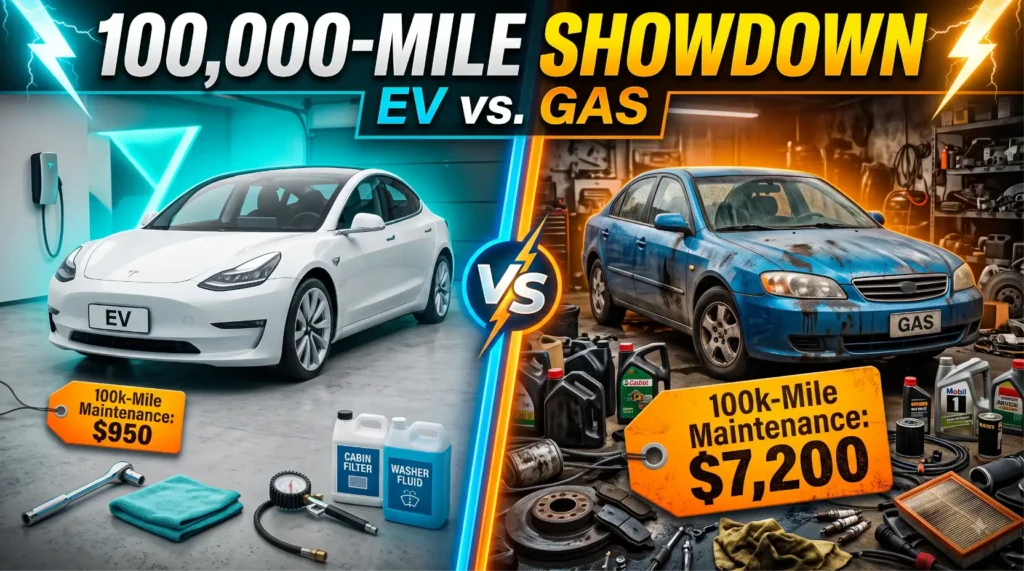
Here’s a stat that makes gas-car owners do a little double-take: a typical EV has roughly 20 moving parts in its drivetrain. A petrol or diesel engine? Hundreds. 🔧
Pistons, valves, timing chains, the gearbox, the exhaust, the fuel system — all of it spinning, heating, leaking, and slowly wearing out. An electric motor, by comparison, is almost boringly simple. One spinning rotor, some bearings, and a reduction gear.
Fewer parts means fewer things to break, leak, or replace. That single fact is the engine behind the entire EV vs gas maintenance cost debate — and over 100,000 miles, the gap is bigger than most people expect.
But “cheaper” doesn’t mean “free.” EVs have their own quirks, and a few line items where they actually cost more than a gas car. Let’s run the honest, no-hype showdown for 2026 — in dollars and rupees. 👇
⚡ The Short Answer
If you only read one section, read this one.
- ⚡ EV maintenance over 100,000 miles: roughly $1,500–$3,000 (₹50,000–₹1,20,000)
- ⛽ Gas car over 100,000 miles: roughly $6,000–$9,000 (₹2,00,000–₹3,50,000)
- 💰 EVs cost about 40–60% less to maintain across that distance.
The savings come mostly from things EVs simply don’t have: no oil changes, no spark plugs, no timing belts, no exhaust, no multi-speed transmission to flush. Add regenerative braking that spares your brake pads, and the math tilts hard toward electric. 😎
The catch? EVs eat tyres faster, still need a few fluids, and ride on a 12V battery that loves to die at the worst moment. We’ll cover all of it. 🔋
📊 EV vs Gas Maintenance Cost — Side-by-Side
Before we dig into the why, here’s the EV vs gas maintenance cost comparison item by item over 100,000 miles. 👇
| Maintenance Item | ⚡ EV | ⛽ Gas Car |
|---|---|---|
| Engine oil changes | ❌ None | ✅ ~15–20 changes ($$$) |
| Brake pads & rotors | Rare (regen does the work) | Frequent (1–2 full sets) |
| Spark plugs / ignition | ❌ None | ✅ Yes |
| Timing belt / chain | ❌ None | ✅ Yes (pricey) |
| Engine air filter | ❌ None | ✅ Every 15–30k mi |
| Transmission service | ❌ Minimal (single-speed) | ✅ Fluid flush + repairs |
| Exhaust / catalytic converter | ❌ None | ✅ Wear & failures |
| Fuel system / injectors | ❌ None | ✅ Cleaning & repairs |
| Coolant / battery thermal fluid | Some (long intervals) | More (engine cooling) |
| Brake fluid | ✅ Periodic | ✅ Periodic |
| Tyres | Sooner (heavier + torque) | Normal |
| Cabin air filter | ✅ Yes | ✅ Yes |
| Wipers / washer fluid | ✅ Yes | ✅ Yes |
| 12V battery | ✅ Yes | ✅ Yes |
Look down that “❌ None” column. That’s where most of the savings live. Nearly every recurring gas-car expense — oil, plugs, belts, exhaust, fuel system — simply isn’t part of an EV’s life. 💸
🔋 Where EVs Save: No Oil, No Plugs, Fewer Parts
Let’s start with the easy win: no oil changes. ⛽➡️🚫
A gas car needs its oil swapped every 5,000–10,000 miles. Over 100,000 miles that’s 15 to 20 visits, each costing $40–$100 in the US or ₹2,500–₹6,000 in India. Add in oil filters, and you’re looking at $800–$1,500 (₹40,000–₹90,000) just to keep the engine lubricated.
An EV has no combustion engine, so there’s nothing to lubricate that way. That entire category vanishes. It’s the single biggest reason the EV vs gas maintenance cost comparison looks so lopsided.
Then come the parts that don’t exist on an EV:
- 🔌 Spark plugs and ignition coils — gone. No combustion, no spark needed.
- ⏱️ Timing belt or chain — gone. A snapped timing belt can be a four-figure repair on a gas car.
- 💨 Exhaust system and catalytic converter — gone. Catalytic converters alone can cost $1,000+ to replace.
- ⛽ Fuel injectors, fuel pump, fuel filter — gone.
- ⚙️ Multi-speed transmission — most EVs use a single-speed gearbox, so there’s no transmission flush or rebuild looming at 80,000 miles.
Every one of those is a part that can wear out, fail, or need servicing on a gas car. On an EV, it’s simply not there to break. Fewer moving parts isn’t a marketing line — it’s the whole financial story. 🎯
🛑 Why Regenerative Braking Saves Your Brakes
Here’s a savings most new EV owners don’t see coming: their brakes barely wear out. 🤯
When you lift off the accelerator in an EV, the motor flips into reverse-duty and becomes a generator. It slows the car and recovers energy back into the battery. This is regenerative braking, and it does the lion’s share of everyday slowing.
The result? Your actual friction brake pads and rotors hardly get used. Many EV owners report their original brake pads lasting well past 100,000 miles — sometimes the whole life of the car.
A gas car, by contrast, slows entirely with friction. Brake pads typically need replacing every 30,000–50,000 miles, and rotors not long after. Over 100,000 miles, that’s one or two full brake jobs — $300–$800 each in the US, ₹15,000–₹40,000 in India.
There’s even a hidden bonus: because the pads sit idle so much, the bigger EV brake risk is actually rust and seizing from under-use — easily managed with the occasional firm stop to clean the surfaces. 😎
🛠️ Where EVs Still Cost You: Tyres, Coolant, Filters & the 12V
Now for the honest part. EVs are maintenance-light, not maintenance-free. A fair EV vs gas maintenance cost comparison has to call out where the electric car still empties your wallet.
🛸 Tyres — sooner than you’d like. This is the big one, and it gets its own section below. Heavier cars plus instant torque chew through rubber faster than ICE drivers are used to.
🧊 Battery thermal coolant. Most EVs run liquid cooling to keep the battery pack happy. Intervals are long — often 100,000+ miles or many years — but when service is due, it’s an EV-specific job that costs money.
🌬️ Cabin air filter. Every car has one, EVs included. Swapping it keeps the climate system fresh and is one of the cheapest jobs in motoring — especially if you DIY it.
🪟 Wipers, washer fluid, suspension. Totally normal wear items. EVs are heavier, so suspension bushings and shocks can wear a touch faster, but it’s nothing dramatic.
🔋 The 12V battery. Yes — even your fancy electric car has a humble 12-volt lead-acid (or small lithium) battery running the lights, computers, and door locks. It typically lasts 3–5 years, and when it dies, the car can refuse to even “boot.” It’s the single most common EV breakdown call. A maintainer is cheap insurance. ⚡
🛢️ Brake fluid and minor service. EVs still get periodic brake-fluid flushes and a general inspection. Light, but not nothing.
💡 Want the full picture beyond just upkeep? Read How Much Does It Really Cost to Own an EV for 5 Years? — it folds maintenance into depreciation, charging, and insurance.
🛸 Why EV Tyres Wear Faster (and How to Slow It)
If there’s one place EVs lose the maintenance battle, it’s tyres. Let’s be specific about why. 👇
1. Weight. Battery packs are heavy — an EV often weighs 20–30% more than a comparable gas car. More weight pressing down means more friction, and more friction means faster tread wear.
2. Instant torque. Electric motors deliver maximum twist from a standstill. Every enthusiastic launch from a traffic light scrubs a little extra rubber off the tyres. It’s fun, but it’s not free.
3. Specialized tyres. Many EVs ship with low-rolling-resistance, noise-dampening tyres built for efficiency and quietness. They work brilliantly — but they tend to cost more to replace and can wear faster than standard rubber.
Put it together and EV tyres often need replacing every 25,000–40,000 miles instead of 40,000–60,000. Over 100,000 miles that can mean one extra set — a real cost in both markets.
The good news: you can fight back. 🥊
- ✅ Rotate every 5,000–7,500 miles so wear spreads evenly.
- ✅ Check pressures monthly — under-inflated tyres wear edges fast and kill range.
- ✅ Ease off the launches — smooth starts dramatically extend tread life.
- ✅ Get a wheel alignment if you notice uneven wear.
🔧 DIY Maintenance You Can Actually Do Yourself
One quietly great thing about EVs: a lot of their upkeep is dead simple. No oily engine bay to wrestle with means more jobs land within reach of a regular owner. 🛠️
Here’s what most people can tackle in a driveway with basic tools:
- 🌬️ Cabin air filter swap. Usually behind the glovebox, often a 10-minute job, and the filter costs a fraction of a shop visit.
- 🪟 Wiper blade replacement. Clip off, clip on. Two minutes per side.
- 💧 Washer fluid top-up. As easy as it sounds.
- 🔋 12V battery care. Hook up a maintainer when the car sits for a week or more — it prevents the dreaded dead-12V no-start.
- 🛸 Tyre pressure checks with a portable inflator, and visual tread inspections.
What you should still leave to professionals: anything touching the high-voltage battery pack, the orange cables, or the thermal coolant system. That’s specialist territory — and honestly, there’s so little of it that the savings on everything else more than make up for it.
Every DIY job is money that stays in your pocket instead of going to labour rates. That’s how the EV vs gas maintenance cost gap gets even wider for hands-on owners. 💰
🇮🇳 India Angle: Service Networks & Real-World Savings
For Indian buyers, maintenance is a huge part of the ownership decision — and here the EV story is genuinely strong, with one caveat. 🏍️🚗
The savings are real. Petrol-car servicing in India is frequent and adds up — oil, filters, labour, and the steady drip of replacement parts. EVs skip nearly all of it. Many EV owners report annual service bills a fraction of what their petrol cars cost, often saving ₹1,50,000–₹2,50,000 in maintenance across 100,000 km versus an equivalent petrol car.
The caveat: service networks. This is where India differs from the US. Petrol cars enjoy a workshop on practically every corner. EV service is still concentrated around brand dealerships and larger cities, so a complex repair might mean a longer wait or a trip to an authorised centre.
The trend, though, is firmly positive. As of 2026, manufacturers are expanding service reach, training more technicians, and independent garages are slowly building EV competence. The early “where do I even get this fixed” worry is fading fast.
For the typical urban Indian commuter — short daily drives, lots of stop-go traffic where regen shines — an EV’s low and predictable upkeep is one of its most underrated advantages. 🇮🇳
💰 The 100,000-Mile Bottom Line ($ and ₹)
Let’s add it all up. Here’s the full EV vs gas maintenance cost tally over 100,000 miles (~160,000 km). 💸
⚡ Electric vehicle:
– Tyres (often one extra set), cabin filters, wipers, brake fluid, 12V battery, occasional coolant, light service.
– Total: ~$1,500–$3,000 (₹50,000–₹1,20,000)
⛽ Gas car:
– 15–20 oil changes, 1–2 brake jobs, spark plugs, air filters, transmission service, exhaust repairs, fuel-system work, plus tyres and the usual wear items.
– Total: ~$6,000–$9,000 (₹2,00,000–₹3,50,000)
The verdict:
– 🤑 EV saves roughly $4,000–$6,000 over 100,000 miles in the US.
– 🤑 EV saves roughly ₹1,50,000–₹2,50,000 in India.
That’s a 40–60% reduction in upkeep — money that goes a long way toward offsetting an EV’s higher sticker price or pricier tyres. Spread across the life of the car, it quietly reshapes the total cost of ownership in the EV’s favour. 🎯
📈 2026 Trends Affecting Maintenance Costs
The maintenance picture isn’t frozen — it’s shifting, and mostly in the EV’s favour. Here’s what’s moving in 2026. 👇
🔧 Wider service access. More independent shops and trained technicians in both the US and India mean EV-specific work is getting cheaper and easier to book — eroding one of the last areas where EVs were pricier.
🛸 Better EV tyres. Tyre makers now design specifically for heavy, high-torque EVs, with compounds that last longer while staying quiet and efficient. The tyre penalty is shrinking.
🔋 Smarter 12V systems. Newer EVs use lithium 12V batteries and smarter charging logic, reducing the classic dead-12V headache that strands owners.
📊 Predictive maintenance. Over-the-air diagnostics increasingly flag issues before they become repairs, helping owners fix small things cheaply instead of waiting for big failures.
Net effect: the few areas where gas cars held a maintenance edge are narrowing, while their built-in costs — oil, plugs, exhaust — aren’t going anywhere. 🚀
✅ 5 Ways to Keep EV Maintenance Low
Want to land at the cheap end of that $1,500 range? Build these habits. 🎯
- Rotate tyres on schedule and keep pressures correct. 🛸 This is your single biggest controllable cost — even wear and proper inflation can add thousands of miles of tread life.
- Drive smoothly and lean on regen. Gentle starts and one-pedal driving preserve both tyres and brake pads. Bonus: it boosts range too.
- DIY the easy stuff. 🌬️ Cabin filters, wipers, and washer fluid are simple, cheap, and keep you out of the service bay.
- Protect the 12V battery. 🔋 Use a maintainer if the car sits, especially in extreme heat or cold. A dead 12V is the most common — and most preventable — EV stranding.
- Follow the light service schedule. Keeping up with the (minimal) recommended checks protects your warranty and catches small issues early. 🔧
🛒 Shop This Post
A few affiliate-friendly picks that make low-cost EV ownership even easier. 😍
1. EV-Rated Tyres + Portable Tyre Inflator 🛸
Tyres are the EV’s biggest upkeep cost — so start with rubber built for the weight and torque, and a compact inflator to keep pressures spot-on between rotations. Proper inflation alone can stretch tread life and recover lost range.
👉 Shop EV tyres & inflators
2. Cabin Air Filters + Wiper Blades 🌬️
The easiest DIY swaps in motoring. Keep a fresh cabin filter and good blades on hand and skip the shop markup entirely.
👉 Shop filters & wipers
3. A 12V Battery Maintainer 🔋
Cheap insurance against the most common EV breakdown — the surprise dead 12V battery. Plug it in when the car sits and never get stranded in your own driveway.
👉 Shop battery maintainers
🛒️ Disclosure: These are affiliate picks. If you buy through our links it costs you nothing extra, and it helps support EVs Mirror. 🙏
🎯 Quick Quiz: How Much Will You Save?
Answer three quick questions to gauge your maintenance savings. 👇
- Your previous car? 🅐 High-maintenance gas car 🅑 Already low-cost economy car
- Do you DIY simple jobs? 🅐 Yes, give me the tools 🅑 No, I’d rather pay a shop
- Your driving style? 🅐 Smooth, lots of regen 🅑 Aggressive, love the launches
Mostly 🅐: 🟢 Your maintenance savings will be substantial — you’re squarely in the 50–60% cheaper zone.
Mostly 🅑: 🟡 Still meaningfully cheaper than gas, just a touch less dramatic. Tyres will be your main cost.
📋 Maintenance-Cost Checklist
Run through this before you buy or to budget your current EV. ✅
- [ ] List your gas car’s recurring service costs (oil, brakes, plugs)
- [ ] Note everything an EV skips (oil changes, plugs, belts, exhaust)
- [ ] Budget for tyres — they’ll come sooner than on an ICE car
- [ ] Budget for cabin filters and wiper blades (cheap, DIY-able)
- [ ] Plan 12V battery care and grab a maintainer
- [ ] Check the battery thermal coolant interval for your model
- [ ] Follow the EV’s light service schedule to protect warranty
- [ ] Compare the full 100,000-mile totals in $ or ₹ ⚡
🤔 People Also Ask
Q: What is the EV vs gas maintenance cost over 100,000 miles?
A: An EV typically costs $1,500–$3,000 (₹50,000–₹1,20,000) to maintain over 100,000 miles, versus $6,000–$9,000 (₹2,00,000–₹3,50,000) for a gas car — roughly 40–60% less. The savings come mainly from skipping oil changes and from regenerative braking that spares the brake pads.
Q: Do EVs really not need oil changes?
A: Correct. EVs have no combustion engine, so there’s no engine oil to change. That eliminates one of the most frequent and costly gas-car maintenance items — 15 to 20 changes over the life of a typical engine.
Q: Why do EV brakes last so much longer?
A: Regenerative braking uses the electric motor to slow the car and recover energy, so the friction pads and rotors do far less work. Many EV pads last past 100,000 miles, while gas cars often need brake jobs every 30,000–50,000 miles.
Q: Where does an EV still cost more to maintain than a gas car?
A: Mainly tyres. EVs are heavier and have instant torque, so they wear rubber faster — often needing replacement every 25,000–40,000 miles. EV-specific tyres can also cost more, which is the one line item where the EV vs gas maintenance cost comparison favours the gas car.
Q: What maintenance do EVs still need?
A: Tyres (sooner), cabin air filters, wiper blades, washer fluid, brake fluid flushes, the 12V battery, and occasional battery coolant checks on some models. It’s a short, light list compared to a gas car.
Q: Are EVs cheaper to service in India despite a smaller network?
A: Generally yes. No oil changes and far fewer moving parts make EV servicing cheaper and less frequent than petrol-car servicing. The main trade-off is that EV service centres are still concentrated in cities and dealerships, though networks are expanding quickly in 2026.
🚀 The Bottom Line
The 100,000-mile maintenance showdown isn’t close. EVs typically cost 40–60% less to keep running — saving around $4,000–$6,000 in the US or ₹1,50,000–₹2,50,000 in India. ⚡
No oil changes, no spark plugs, no timing belts, no exhaust, and barely-used brakes do the heavy lifting. The trade-off is real but small: tyres sooner, a few fluids, a cabin filter, and a 12V battery that needs a little love. Manage those — especially the tyres — and you’ll land at the cheap end of the range.
“Maintenance-light” beats “maintenance-heavy” every single year you own the car. 😎
💬 What’s your EV cost you in maintenance so far? Drop it in the comments to help others compare!
📤 Know someone tired of oil changes? Send them this showdown. 🙏
🔖 Bookmark EVs Mirror for honest, no-hype EV ownership guides.
👉 Up next: Cost to Charge a Tesla at Home vs Supercharger — see how charging savings stack on top of maintenance savings.