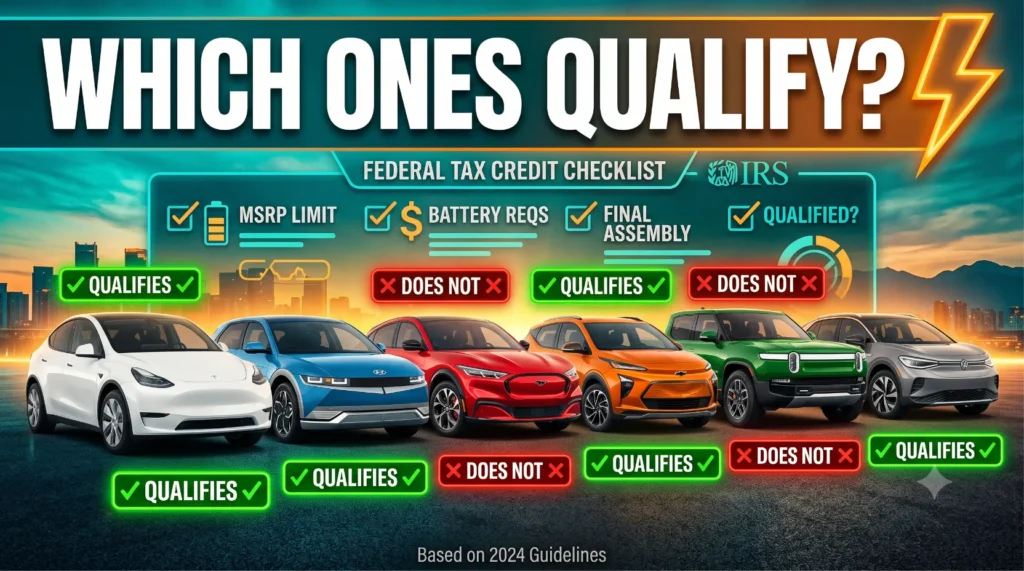
You’d assume a tax credit literally named for “electric vehicles” would cover, well, every electric vehicle on the lot. 😅 It doesn’t. Not even close.
Thanks to a thicket of sourcing rules, assembly requirements, and price caps, only a slice of the EVs on sale actually unlock the federal incentive. And the list of qualifying models shifts almost season to season as automakers re-shuffle their supply chains.
Buy the wrong trim expecting $7,500 back, and you could be staring at a tax bill with a hole in it. 😬 So before you sign anything, you need a clear read on EVs that qualify for tax credit eligibility. 👇
⚠️ Important — please read this first. Tax topics are “Your Money or Your Life” material, and this one moves fast. The federal EV credit’s qualifying-vehicle list changes constantly, individual rules can be revised, and the entire program can be scaled back or repealed by legislation. This article is general education, not tax advice. The model examples below are illustrative only — never treat any specific car as guaranteed to qualify. Always confirm your exact trim and VIN on FuelEconomy.gov / the IRS, and talk to a qualified tax professional before you buy. ⚖️
⚡ The Short Answer
If you just want the gist before the deep dive:
- 📋 There’s an official list. The IRS and FuelEconomy.gov maintain the only authoritative roster of qualifying vehicles and their credit amounts. Nothing else counts.
- 🏭 Final assembly must happen in North America. No exceptions — this is a hard gate.
- 🔋 Two battery rules split the credit in half. One worth $3,750 (battery components), one worth $3,750 (critical minerals). Meet both and you reach the full $7,500.
- 🏷️ Price caps disqualify pricey trims. $80,000 for SUVs, vans, and pickups; $55,000 for everything else.
- 📅 The list changes — often. Re-check close to purchase, because last year’s answer may be wrong today.
Never assume. Always verify the exact car on the official list. 😎
📊 What Determines Qualification — At a Glance
Five factors decide whether a vehicle clears the bar, and at what amount. Here’s the cheat sheet. 👇
| Factor | What it controls | Typical effect |
|---|---|---|
| 🏭 Final assembly location | Pass/fail gate | Must be assembled in North America, or no credit at all |
| 🔋 Battery component sourcing | Half the credit | Worth up to $3,750 if the threshold is met |
| ⛏️ Critical mineral sourcing | The other half | Worth up to $3,750 if the threshold is met |
| 🏷️ MSRP cap | Pass/fail gate | $80k SUVs/trucks/vans · $55k cars — over the cap = excluded |
| 📅 Current list status | Reality check | A model can move on or off the list as sourcing changes |
A vehicle can land on full ($7,500), half ($3,750), or zero depending on how these stack up. 🎯 Figures are general guidance — verify the exact amount for your model on the official list.
🤷 Why the Qualifying List Changes So Often
Here’s the question almost every shopper asks: why can’t the government just publish one stable list and leave it alone?
Because the credit isn’t tied to what the car is — it’s tied to how and where it was built. 🔧
The rules link eligibility to where the vehicle is assembled, where its battery components are manufactured, and where the critical minerals inside that battery were extracted or processed. Those are supply-chain facts, and supply chains are anything but static.
When an automaker shifts battery production to a new plant, swaps a mineral supplier, or moves final assembly across a border, the math changes — sometimes mid-model-year. A car that earned the full credit in January can quietly drop to half (or nothing) by autumn. 😮
The required sourcing percentages also ratchet up over time by design. Each year, automakers have to source a higher share of battery components and minerals from approved regions to keep the same credit. Some manufacturers keep pace; others fall behind and lose eligibility.
Layer in legislative changes — Congress can amend or sunset the program — and you’ve got a list that’s genuinely a moving target. That’s not a flaw in this article; it’s the nature of the credit. It’s also exactly why every section here ends with the same advice: check the current official list before you buy. 📋
🏭 Rule #1: The Final Assembly Requirement
This is the first gate, and it’s brutally simple: the vehicle’s final assembly must take place in North America (the US, Canada, or Mexico). ✅
If the car was assembled anywhere else, it’s out — full stop. No amount of clever battery sourcing rescues a vehicle that fails this test. This single rule is why many popular imported EVs you’d expect to qualify simply don’t.
Here’s the tricky part: assembly location can vary by trim or production run for the same nameplate. An automaker might build one version of a model in a North American plant and another version overseas. Two cars with the same badge in the showroom, two different answers. 🤔
That’s why the official tool asks for your VIN, not just the model name. The VIN encodes where that specific unit was built.
💡 Want the full eligibility picture — income limits, who can claim, how much? Start here: EV Tax Credit 2026: Who Qualifies and How Much?
Action step: before you fall in love with a specific car, confirm that VIN was assembled in North America. Don’t rely on the brand’s reputation — verify it. 🛠️
🔋 Rule #2: The Battery Component Requirement (Worth $3,750)
Now we get to the half that trips people up. The federal credit isn’t one $7,500 prize — it’s two stacked $3,750 pieces, each with its own test. 🧩
The first piece is the battery component requirement. To earn this $3,750, a qualifying percentage of the value of the battery’s components must be manufactured or assembled in North America. 🔋
That percentage isn’t fixed — it climbs over time. Early on, a manufacturer might only need to hit a modest share; later, the bar rises significantly. So a vehicle that cleared this hurdle in a previous year can fall short once the threshold steps up, even if the car itself didn’t change.
This is why you’ll sometimes see an EV listed for exactly $3,750 rather than the full amount. It usually means the vehicle satisfies one of the two battery tests but not the other. 🎯
There’s also a sourcing-integrity layer: batteries with components made by a “foreign entity of concern” can be disqualified from this portion entirely. The details are technical and they evolve — another reason to lean on the official list rather than do this arithmetic yourself.
Action step: if the official list shows your model at $3,750, don’t assume it’s a typo or that you’ll “get the rest later.” Confirm whether it’s the battery-component or the mineral half you’re missing — and whether that’s expected to change. 📄
⛏️ Rule #3: The Critical Mineral Requirement (The Other $3,750)
The second $3,750 piece hinges on critical minerals — the lithium, nickel, cobalt, graphite, and similar materials inside the battery. ⛏️
To earn this half, a qualifying percentage of the value of those minerals must be extracted or processed in the US (or a country the US has a relevant trade agreement with), or recycled in North America.
Like the component rule, this threshold ratchets upward each year. And because mining and mineral processing are concentrated in a handful of countries, this is often the harder of the two tests for automakers to satisfy — global mineral supply chains are slow and expensive to relocate. 🌍
So when a vehicle qualifies for only half the credit, the missing piece is frequently the mineral side. A model can also flip between full and half credit within the same year if its supplier mix shifts.
This is the deepest reason two near-identical EVs — same class, same price, similar specs — can carry totally different credit amounts. It’s not about the car you can see; it’s about the mineral map you can’t. 🗺️
Action step: never compare two EVs on sticker price alone when a tax credit is in play. Pull each one up on the official list and compare the actual credit each currently earns. 🔎
💵 Full vs. Partial: $7,500 vs. $3,750 vs. $0
Let’s tie the battery rules together, because this is where the real money decision lives.
The federal new-EV credit is structured like this:
- $3,750 for meeting the critical minerals requirement, plus
- $3,750 for meeting the battery components requirement.
Add them up and the picture is clean: 🧮
| Outcome | What it means |
|---|---|
| ✅ $7,500 (full) | The vehicle meets both the mineral and component thresholds |
| 🟡 $3,750 (half) | It meets one of the two, but not both |
| ❌ $0 | It fails both battery tests, fails final assembly, or busts the MSRP cap |
The lesson: don’t budget around the maximum by default. 🙙 Plenty of perfectly good EVs land at $3,750, and a buyer who planned their finances around $7,500 can get an unpleasant surprise at tax time.
The official list publishes the precise amount for each qualifying vehicle. Treat that number — not your assumption — as the truth. ✅
🏷️ Rule #4: MSRP Caps by Vehicle Type
Even a vehicle that aces every sourcing test can be knocked out by one thing: price. 🏷️
The credit applies a manufacturer’s suggested retail price (MSRP) ceiling that depends on the body style:
| Vehicle type | MSRP cap |
|---|---|
| 🚙 SUVs, vans, and pickup trucks | $80,000 |
| 🚗 Cars (sedans, hatchbacks, wagons) | $55,000 |
Two gotchas here, and they catch people constantly. 😵
First — it’s the trim’s price, not the base model’s. A base version might sneak under the cap while a loaded trim with the bigger battery and premium package sails right over it. Same model name, opposite outcome.
Second — body-style classification can be surprising. What you think of as a “crossover” might be classified as a car (lower $55k cap) or an SUV (higher $80k cap), and it isn’t always intuitive. The official list uses the government’s classification, which is the one that matters.
Also note: the cap is based on MSRP, not your negotiated price. Talking the dealer down below $55k on a $60k-MSRP sedan does not bring it back into eligibility. 💸
Action step: match your exact trim’s MSRP against the correct cap for its official classification — before you start adding options. 🧾
🔎 How to Check a Specific Model or Trim (Official Tools)
Enough theory — here’s the practical workflow. There is exactly one reliable way to confirm EVs that qualify for tax credit status, and it’s the official tools. 📋
1. Go to FuelEconomy.gov’s tax-credit tool. It’s run by the Department of Energy and EPA and is updated as eligibility changes. It lets you filter by model year and see current credit amounts.
2. Cross-check the IRS guidance. The IRS publishes the rules and qualifying-vehicle information that the credit is built on. When the two line up, you can trust the answer.
3. Use the VIN, not just the model name. Because assembly location and sourcing can vary by individual vehicle, the VIN is what nails down your car’s eligibility. The dealer can give you the VIN before purchase.
4. Re-check right before you buy. A list you screenshotted three months ago may be stale. Pull it fresh the week you’re signing. ⏰
What not to trust: a salesperson’s verbal promise, a Reddit thread, a year-old blog post (yes, including older versions of this one 😅), or a manufacturer’s marketing page. Those can all be outdated or simply wrong. The official tools are the source of truth — everything else is a rumor until verified.
When you’re ready to actually file, here’s your step-by-step: How to Claim the Federal EV Tax Credit Step by Step. 🗂️
🛡 What to Do If Your EV Doesn’t Qualify
So you ran the VIN and your dream EV came back as $0 — or only $3,750. Don’t panic. You’ve still got real options. 💪
Option 1 — Buy used and use the used-EV credit. 🔁
There’s a separate credit for qualifying pre-owned EVs, generally worth up to $4,000 (or a percentage of the sale price, whichever is lower). The qualifying rules are different — and notably, the strict battery-sourcing tests that block so many new vehicles don’t apply the same way. There are price and income limits, so verify the specifics, but a used EV can be the smarter play when a new one won’t qualify.
Option 2 — Consider the lease “loophole.” 📝
When you lease an EV, the credit is often claimed by the leasing company (the vehicle’s owner) under the commercial-vehicle rules — which don’t carry the same assembly and sourcing restrictions. The leasing company can then pass the savings to you as a lower monthly payment or capitalized-cost reduction. This is why a car that fails to qualify for a purchase credit can still effectively deliver savings on a lease. ⚠️ It’s not automatic — confirm the lease actually passes the incentive through, in writing, before signing.
Option 3 — Stack state and local incentives. 🏛️
Federal isn’t the only game. Many states offer rebates, reduced registration fees, HOV access, or utility incentives that don’t care about North American assembly at all. These can soften the blow of missing the federal credit.
Option 4 — Claim the home charger credit separately. ⚡
The federal credit for installing a home EV charger is its own thing, with its own rules — and it doesn’t depend on which EV you bought. Even if your vehicle misses out, your charging setup might still earn a credit. 🔌
💡 Don’t write off an EV just because it failed the new-purchase credit. Leasing, used-EV rules, and state programs change the math entirely. Always confirm the current rules for each path.
📈 How 2026 Changes Could Affect Which EVs Qualify
Here’s the part nobody can promise you certainty on — and honesty matters more than confidence on a tax topic. 🧭
Several forces are reshaping the qualifying list in 2026, and they push in different directions:
- 🔼 Rising sourcing thresholds. The required percentages for battery components and critical minerals climb on a schedule. Some automakers are racing to onshore production and will gain eligibility; others will lose it as the bar rises faster than their supply chains can move.
- 🏭 New North American battery plants. A wave of domestic battery and mineral-processing facilities is coming online. As they ramp up, models that previously earned only half could move to the full $7,500 — but timing varies plant by plant.
- ⚖️ Legislative and political risk. This is the big one. The credit is a creature of legislation, which means it can be expanded, narrowed, frozen, or repealed depending on policy decisions. A program that exists today is not guaranteed to exist — or to exist in the same form — tomorrow.
- 🔄 Supplier reshuffling. Even without new laws, ordinary supplier changes will keep nudging individual models on and off the list throughout the year.
The honest takeaway: the only way to know your car’s status on the day you buy is to check the official list on that day. 📅 Any “definitive 2026 list” you see floating around — here or elsewhere — should be treated as a snapshot that may already be out of date. Trust the live tools, and loop in a tax pro for anything with real money attached. 🤝
✅ 5 Steps to Confirm a Specific EV Qualifies
A quick, repeatable routine you can run on any vehicle. 🔁
- Pull up the official FuelEconomy.gov tax-credit tool and filter to your model year. 📋
- Enter or confirm the VIN of the exact car you’re considering — not just the model name. 🔢
- Read the listed credit amount ($7,500, $3,750, or none) and note which it is. 💵
- Match your trim’s MSRP against the correct cap ($80k SUV/truck/van · $55k car). 🏷️
- Get it in writing from the dealer, and re-check the list the week you sign. 📄
Do all five and you’ll never be blindsided by a credit that doesn’t apply. ✅
🛒 Shop This Post
A few tools that make the whole process smoother. 😍
1. EV Research & Comparison Tool 📊
Side-by-side specs, pricing, and current incentive estimates so you can shortlist EVs before you check the official list.
👉 Shop EV research tools
2. Tax Software With EV Credit Support 🧾
Once you’ve bought a qualifying vehicle, software that handles the EV credit forms keeps your filing clean and audit-ready.
👉 Shop tax software
3. A Level 2 Home EV Charger ⚡
Charge faster at home — and remember the home-charger credit is separate from the vehicle credit, so this may pay you back regardless of which EV you choose.
👉 Shop home EV chargers
🛓 Affiliate disclosure: These are affiliate picks. If you buy through our links, we may earn a small commission at no extra cost to you — it helps keep EVs Mirror running. 🙏 We only suggest tools we’d point a friend toward.
🎯 Quick Quiz: Is Your EV Actually Eligible?
Answer honestly. 👀
- Did you check the official list (not a blog or a dealer’s word)? 🅐 Yes 🅑 No
- Did you verify the VIN, not just the model name? 🅐 Yes 🅑 No
- Is your exact trim’s MSRP under the right cap? 🅐 Yes 🅑 Unsure
- Do you know if you’re getting $7,500 or $3,750? 🅐 Yes 🅑 No
Mostly 🅐: 🟢 You’ve done the homework — just re-check the list the week you buy.
Mostly 🅑: 🔴 Pump the brakes and run the 5-step check above before you sign anything.
📋 Qualification Checklist
Print it, screenshot it, whatever works. 🖨️
- [ ] Checked the official FuelEconomy.gov / IRS qualifying-vehicle list
- [ ] Confirmed the VIN, model, trim, and year
- [ ] Verified final assembly is in North America
- [ ] Noted the exact credit amount (full $7,500 / half $3,750 / none)
- [ ] Matched the trim’s MSRP against the correct cap
- [ ] Explored backups (used-EV credit, lease pass-through, state incentives)
- [ ] Got written confirmation from the dealer
- [ ] Re-checked the list close to purchase (it changes!) ⚡
🤔 People Also Ask
Q: Which EVs that qualify for tax credit get the full $7,500?
A: Only vehicles on the current official list that meet both battery requirements (components and critical minerals), are assembled in North America, and fall under the MSRP cap. Models meeting just one battery test typically get $3,750. Because the list shifts as supply chains change, always verify your exact trim and VIN on FuelEconomy.gov / the IRS before buying. ✅
Q: Why don’t all electric vehicles qualify for the tax credit?
A: The credit ties eligibility to where the car is assembled and where its battery components and critical minerals are sourced — plus a price cap. EVs that fail final assembly in North America, miss the battery thresholds, or exceed the MSRP cap qualify partially or not at all.
Q: Where can I find the official list of EVs that qualify for tax credit benefits?
A: On FuelEconomy.gov’s tax-credit tool and the IRS’s published guidance. These are the only authoritative, regularly updated sources. Treat dealer claims, social posts, and older articles as unverified until you confirm them on the official tools. 📋
Q: Can a qualifying EV still be disqualified by its price?
A: Yes. Even a model that aces every sourcing test is excluded if the specific trim’s MSRP tops the cap — $80,000 for SUVs, vans, and pickups, or $55,000 for cars. It’s based on MSRP, not your negotiated price, so check your exact trim.
Q: What if my EV doesn’t qualify for the new-vehicle credit?
A: You still have options — the used-EV credit (up to $4,000, with different and often looser sourcing rules), the lease pass-through (where the leasing company claims the credit and lowers your payment), state and local incentives, and the separate home-charger credit. Confirm the current rules for each path. 🛡️
Q: Does the qualifying list really change that often?
A: Yes. Rising sourcing thresholds, new battery plants, supplier swaps, and possible legislative changes all move models on and off the list — sometimes within a single year. That’s why you should re-check the official list the week you buy, not months in advance. 📅
🚀 The Bottom Line
The dream of walking onto a lot, picking any EV, and pocketing $7,500 just isn’t how this works. 🤷 Only vehicles on the current official list — assembled in North America, meeting the battery-component and critical-mineral thresholds, and priced under the MSRP cap — earn the credit, and the exact amount can be the full $7,500, half at $3,750, or nothing at all.
The single habit that protects you: verify the specific car on the official FuelEconomy.gov / IRS tools, by VIN, the week you buy. 📋 Confirm the amount, check the price cap, get it in writing, and — for anything with real money on the line — run it past a tax professional. And if your favorite EV doesn’t make the cut, remember the used-EV credit, the lease loophole, and state programs can still get you ahead. 💪
Do that, and a credit that doesn’t apply will never catch you off guard. ⚡
💬 Did your EV make the qualifying list — and was it full or half? Drop your model in the comments!
📤 Know someone EV shopping? Send them this before they sign. 🙏
🔖 Bookmark EVs Mirror for honest, no-hype EV money guides.
This article is general information, not tax advice. Eligibility rules and the qualifying-vehicle list change frequently and can be repealed. Verify the current official list with the IRS / FuelEconomy.gov and consult a tax professional before purchasing.