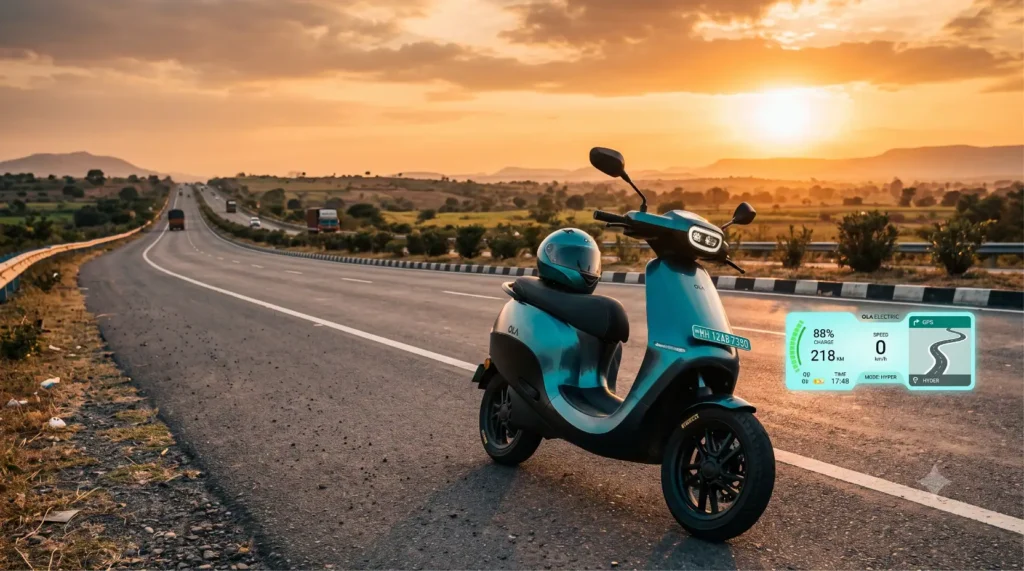
Picture this. You’re standing in a showroom, and a salesperson points at a glossy scooter and says, “This one does 180 kilometres on a single charge.” Your eyes light up. 😍
Then you buy it, ride it home in the real world — with traffic, your office bag, a bit of throttle happiness — and it dies at 115 km. Suddenly that big number feels like a magic trick that didn’t survive daylight.
If you’ve been burned by brochure promises, or you simply ride far enough that range genuinely matters, this guide is for you. We’re going to cut through the marketing and figure out which models actually earn the title of longest range electric scooter India has on the road in 2026.
⚡ The Short Answer
Short on time? Here’s the cheat sheet before we dig in:
- 🔋 Claimed numbers lie a little. Expect 20–35% less than the brochure says, every single time.
- 🏆 A few real champs exist. Some long-range archetypes genuinely deliver 130–160 km in mixed riding.
- 🪫 Battery size is king. Bigger kWh packs buy range — but also weight, cost, and longer charge times.
- 🍃 Eco mode is your friend. Riding mode and speed can swing your range by 40 km or more.
- 🚚 Most people don’t need 150 km. Delivery riders and intercity commuters do; the average city rider doesn’t.
- 💰 Big range costs more. You pay a clear premium for those extra electrons.
🛵 Quick Comparison: 6 Long-Range Scooter Picks for 2026
Prices below are illustrative on-road bands and shift hugely by city, variant, and subsidy. Range figures are general and hedged — treat them as ballpark, not gospel. The gap between claimed and real-world range is the whole point of this table. 👇
| Scooter Archetype | Claimed Range | Est. Real-World Range | Price Band (₹) | Standout |
|---|---|---|---|---|
| The Long-Range Flagship (e.g. Ather 450 Apex / longer-range trims) | ~150–160 km | ~110–130 km | ₹1.5L – ₹2.0L | Polished software & ride feel |
| The Performance Cruiser (e.g. Ola S1 Pro-style) | ~175–195 km | ~120–145 km | ₹1.3L – ₹1.7L | Big battery, sporty punch |
| The Range King (e.g. Simple One/Dot-style) | ~200+ km | ~140–160 km | ₹1.4L – ₹1.8L | Headline-grabbing pack size |
| The Electric Motorcycle (e.g. Ultraviolette-style) | ~190–250 km | ~140–180 km | ₹2.5L – ₹4.0L | Highway-grade range & speed |
| The Trusted Long-Hauler (e.g. TVS iQube ST-style) | ~140–150 km | ~100–125 km | ₹1.3L – ₹1.6L | Legacy brand & service net |
| The Value Long-Ranger (e.g. Hero Vida-style) | ~140–165 km | ~100–130 km | ₹1.1L – ₹1.5L | Range per rupee |
🤔 Claimed vs Real-World Range: The Big Caveat
Let’s start with the single most important thing in this entire article. 🎯
Almost every range figure you see on a poster comes from an “ideal certification cycle” — a controlled test at gentle, steady speeds with no traffic, no hills, no wind, and a lightweight rider. It’s the EV equivalent of a fuel-economy lab number.
Your commute looks nothing like that lab. So the brochure number is a ceiling you’ll basically never touch.
As a rule of thumb, knock 20–35% off whatever the brand claims. ✂️
So a scooter advertised at 160 km realistically gives you around 105–130 km in mixed city-and-suburb riding. A “200 km” headline scooter lands closer to 140–160 km when you actually live with it.
This isn’t the brands being evil — it’s just how certification works worldwide. The trick is learning to mentally translate the number before you fall in love with it.
That’s why throughout this guide, when we talk about the longest range electric scooter India buyers can get, we always anchor to the real number, not the billboard one.
🏆 The Genuine Long-Range Champions (Archetypes)
So who actually delivers? Let’s walk through the archetypes worth your attention. ⭐
The Long-Range Flagship. Think Ather 450 Apex or the brand’s longer-range trims. These pair a sizeable battery with genuinely refined software and tight ride quality. Claimed range pushes toward 150–160 km; real-world sits comfortably in the 110–130 km zone.
The Performance Cruiser. Ola S1 Pro-style machines stuff in a large pack and pair it with a punchy motor. The headline number can be eye-watering, but ride it hard and reality bites. Still, even in real terms, 120–145 km is genuinely useful.
The Range King. This is the Simple One / Dot-style archetype that chases the biggest possible nameplate figure — sometimes north of 200 km claimed. 📣
In the real world that often translates to a strong 140–160 km, which is still seriously impressive for a scooter. These models exist to win the spec war, and on paper they usually do.
The Electric Motorcycle. Ultraviolette-style machines blur the line between scooter and motorcycle. With big packs and highway capability, real-world range can stretch to 140–180 km — but you pay handsomely and it’s a different kind of vehicle entirely.
If you want a broader look across categories, our Best Electric Scooters in India for 2026 guide covers the full spread beyond just the range chasers.
🔬 What Actually Drives Scooter Range
Range isn’t one number from heaven — it’s the result of a handful of factors fighting each other. Understand these, and you’ll never be fooled by a spec sheet again. 🧠
Battery capacity (kWh). This is the big one. More stored energy means more kilometres, full stop. A 3.0 kWh pack will simply outrun a 2.0 kWh pack, all else equal. Long-range scooters are almost always defined by their larger packs.
Weight. Bigger batteries are heavy, and heavier scooters need more energy to move. Add your own body weight plus a pillion plus a grocery haul, and range quietly drains.
Riding mode. This is the lever most people ignore. 🎚️
Eco mode caps power and smooths acceleration to stretch every electron. Sport mode does the opposite — instant torque, top speed, and a battery that empties fast. The same scooter can show a 40 km swing in range just by switching modes.
Terrain and speed. Flat city roads at 40 km/h are kind to range. Flyovers, highways, and hills at 70 km/h are brutal. Air resistance climbs sharply with speed, so cruising fast is the fastest way to drain a pack.
Tyre pressure, weather, and even traffic patterns all chip in too. Range is a living number, not a fixed promise.
🎯 How to Actually Get 150km+ Range
Here’s the good news: with the right scooter and the right habits, that 150 km dream is reachable. You just have to ride smart. 🧘
Live in eco mode. It feels boring at first, but eco mode is where the big range hides. Save sport mode for the occasional fun blast, not your daily grind.
Respect the sweet spot. Most e-scooters are most efficient around 35–45 km/h. Pushing to 65–70 km/h might shave minutes off your commute but can cost you 25–30% of your range. The maths rarely favours speed.
Mind the load and the launches. 🏋️
Every extra kilo costs range, so don’t treat your scooter as a permanent storage locker. And jackrabbit starts at every light are range poison — smooth, gradual acceleration sips energy instead of gulping it.
Keep the basics dialled in. Correct tyre pressure, a healthy battery, and gentle regen-friendly braking all add up. None of these is dramatic alone, but stacked together they’re the difference between hitting 150 km and stalling at 110. Treat the battery well and it returns the favour — our How to Maintain an Electric Scooter Battery guide covers the habits that keep your real-world range from sliding over the years.
🔌 Fast-Charging on Long-Range Scooters
There’s an obvious catch with big batteries: more capacity takes more time to fill. ⏳
A 3.5 kWh pack on a standard home charger can take 5–7 hours for a full top-up. That’s fine if you charge overnight, but it changes the equation if you ride far and need to turn around quickly.
This is exactly why fast charging has become a headline feature on long-range models in 2026.
Many flagship long-range scooters now hit 0–80% in roughly 50 minutes to an hour at compatible fast chargers. ⚡
For a delivery rider or someone doing back-to-back intercity hops, that’s transformative — a quick coffee-break charge keeps you moving instead of parking the bike for half a day.
A small but smart move: carry a quality portable charger as backup. Any office socket, café plug, or friend’s garage becomes a top-up point, which quietly extends how far you can really go in a day. For long-range riders, that flexibility is worth its weight in electrons.
🚚 Who Actually Needs 150km+ Range?
Time for some honesty, because not everyone needs a giant battery. 🙋
Delivery and gig riders. If you’re doing food, parcel, or e-commerce runs, you might rack up 80–120 km a day across countless short trips. For you, a long-range scooter that charges fast isn’t a luxury — it’s the difference between a full shift and a stranded afternoon.
Long-distance commuters. Riding 50–70 km each way, or hopping between towns? A 150 km real-world scooter lets you do the round trip and still have a buffer, charging just every other day.
The “I hate charging” crowd. 😴
Some people simply don’t want to plug in often. A big battery means charging once or twice a week instead of nightly — pure convenience, even if you don’t ride huge distances.
But here’s the reality check: the average Indian commuter covers 25–35 km a day. If that’s you, a 150 km scooter means you’re paying for range you’ll rarely touch. That money might be better spent on build quality, service, or simply a cheaper scooter. Be honest about your real daily distance before you chase the biggest number.
💰 The Price Premium for Big Batteries
Range isn’t free. In fact, it’s one of the most expensive things you can buy on a scooter. 💸
The battery is the single costliest component in any EV, and bigger packs scale the price up fast. That’s why long-range models routinely sit ₹30,000–₹70,000 above their standard-range siblings.
A flagship long-range trim can push toward ₹1.8–2.0 lakh on-road, while an electric-motorcycle-style range monster can sail past ₹3 lakh.
So the question becomes: is the premium worth it for you? 🤷
If you genuinely ride far or earn on your scooter, yes — the extra range pays for itself in convenience and uptime. The cost-per-kilometre logic clearly favours the big battery.
But if you’re buying 150 km of range to use 35 km of it, you’re funding a number, not a need. The smart move is to match capacity to your real commute. A right-sized battery beats an oversized one that empties your wallet for range you’ll never see. When weighing the longest range electric scooter India sells against a sensible mid-range pick, the deciding factor should always be your actual daily distance.
🍃 Range-Extending Habits That Actually Work
Beyond picking the right scooter, your daily habits quietly decide how much range you really get. These cost nothing and add up fast. 🌱
Plan smooth routes. Avoid stop-go chaos and pointless flyovers where you can. Steady cruising at moderate speed is range heaven.
Pre-cool your expectations, not your ego. Resist the urge to win every traffic-light drag race. Each aggressive launch is a measurable chunk of range gone.
Charge smart, not just full. 🔋
For daily riding, keeping the battery in a comfortable 20–80% window is gentler on long-term health — which keeps your real-world range from degrading early. Top up to 100% only when you genuinely need the full distance.
Keep weight in check and tyres firm. Two of the easiest, most ignored range wins. Dump the junk from your storage box and check tyre pressure weekly.
Stack these habits with a genuine long-range scooter, and that 150 km figure stops being a fantasy and starts being your normal Tuesday. 🛵
📈 2026: Scooter Range Is Climbing
The good news for range-hungry buyers is that 2026 is the best year yet — and it’s only getting better. 📊
Battery energy density keeps improving, which means brands are squeezing more kilometres out of packs that don’t weigh much more than before. The “200 km claimed” scooter, unthinkable a few years ago, is now a real category.
Competition is doing the rest. With so many players chasing the range crown, every launch nudges the bar higher.
Charging is catching up too. Fast-charging support is spreading from premium flagships down into more affordable long-range models, and public charging plus battery-swap networks are filling in across metros and tier-2 cities.
The upshot? Real-world range that genuinely clears 130–150 km is no longer exotic. It’s becoming the expectation for the long-range segment — and the brochure-versus-reality gap, while still real, is slowly narrowing as honesty improves.
✅ 5 Tips for Max Range
Quick, practical wins before you ride off:
- Default to eco mode. It’s the single biggest range lever you control. 🍃
- Cruise at 35–45 km/h. The efficiency sweet spot beats chasing top speed every time.
- Accelerate gently. Smooth launches sip energy; hard ones gulp it.
- Lighten the load. Empty that storage box and skip the unnecessary pillion when you can.
- Check tyres weekly. Under-inflated tyres quietly steal range you paid for. 🛸
🛒 Shop This Post
A few accessories genuinely make long-range scooter life smoother and safer. Here’s what’s worth it:
- 🔋 A compact portable charger — backup peace of mind for top-ups at work, a café, or a friend’s place. Essential for anyone pushing distance.
- 🪖 A certified helmet — non-negotiable, and you’ll wear it every single day, so buy comfort and a clear visor.
- 🧰 A scooter accessory kit (phone mount, weatherproof cover, storage) — small upgrades that make long rides far nicer.
Disclosure: Some links on this page are affiliate links. If you buy through them, we may earn a small commission at no extra cost to you. It helps keep evsmirror.com running — thanks for the support! 💚
🎯 Quick Quiz: Do You Need a Long-Range Scooter?
Answer honestly:
- How far do you ride daily? Under 40 km / 40–80 km / 80+ km
- Can you charge during the day? Easily / Sometimes / Rarely
-
Is the scooter part of your income? No / Somewhat / Yes
-
Mostly first options → A standard-range scooter is plenty. Save the money.
- Mostly middle options → A value long-ranger hits the sweet spot.
- Mostly last options → Go for a genuine 150km+ flagship with fast charging.
📋 Long-Range Buyer’s Checklist
Tick these off before you pay:
- [ ] Mentally subtracted 20–35% from the claimed range
- [ ] Confirmed the real-world range comfortably covers my daily distance
- [ ] Checked battery capacity (kWh), not just the range headline
- [ ] Verified fast-charging support and home charge time
- [ ] Compared the long-range trim’s price premium vs the standard version
- [ ] Confirmed a service centre is nearby with good reviews
- [ ] Planned where I’ll charge on a long-distance day
- [ ] Bought a certified helmet 🪖
🤔 People Also Ask
Which is the longest range electric scooter India has in 2026?
The headline crown usually goes to Range King-style models (Simple One / Dot-style) that claim 200+ km, with electric-motorcycle archetypes like Ultraviolette-style machines pushing even higher. But in real-world terms, expect roughly 140–180 km from the very best, since brochure figures sit 20–35% above what you’ll actually ride.
What is a realistic real-world range for a long-range electric scooter India buyers can get?
For genuine long-range models, plan on 110–160 km of real-world range depending on riding mode, speed, and load. A scooter claiming 160 km typically delivers 110–130 km in mixed riding, while a 200 km claim lands closer to 140–160 km.
Why is my scooter’s range lower than the advertised number?
Because advertised range comes from an ideal lab cycle — gentle, steady speeds with no traffic, hills, or wind. Real riding includes all of those, plus your weight and acceleration habits, which is why real-world range runs 20–35% below the brochure figure.
Does eco mode really increase scooter range?
Yes, significantly. Eco mode caps power and smooths acceleration, which can add 30–40 km of range compared to sport mode on the same scooter. It’s the single biggest range lever you control day to day.
How long does a big-battery long-range scooter take to charge?
A large 3.0–3.5 kWh pack typically needs 5–7 hours on a standard home charger. Many 2026 long-range models support fast charging that reaches 80% in under an hour at compatible stations, which is ideal for delivery and intercity riders.
Is a 150km+ range scooter worth the extra cost?
It is if you genuinely ride far — long commutes, intercity hops, or delivery work — where the range pays for itself in convenience and uptime. If your daily ride is only 25–35 km, you’re likely paying a ₹30,000–₹70,000 premium for range you’ll rarely use.
🚀 The Bottom Line
Here’s the honest truth: the longest range electric scooter India offers in 2026 isn’t whichever model wins the billboard war — it’s the one whose real-world range comfortably clears your daily distance with room to spare.
Chase the real number, not the brochure number. Lean on eco mode, respect the speed sweet spot, and match battery size to your actual commute rather than your ego. Do that, and 150 km of usable range stops being a marketing fairy tale and becomes your everyday reality. 🛵💨
Want the wider field before you decide? Start with our Best Electric Scooters in India for 2026 guide. And once you’ve picked your long-ranger, protect its range for years with How to Maintain an Electric Scooter Battery.
👉 Bookmark evsmirror.com, grab that portable charger and certified helmet, and make 2026 the year your range anxiety finally disappears. ⚡