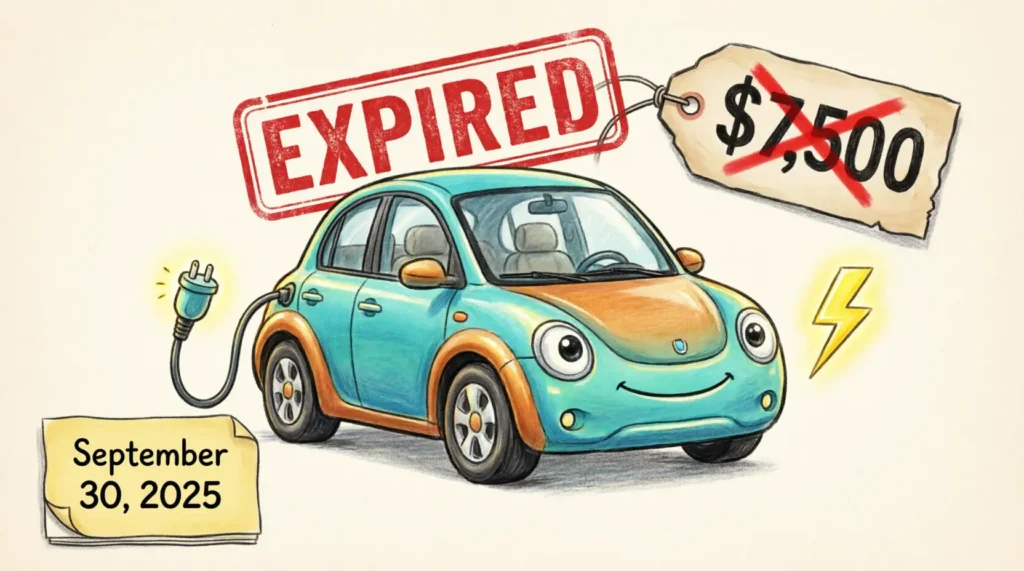
Well, that’s a wrap. 🏁 The big one — the federal $7,500 credit on a new electric vehicle and the $4,000 break on a used one — officially stopped on September 30, 2025. If you walked onto a dealer lot on October 1 expecting Uncle Sam to knock thousands off your EV, you got a rude surprise: nothing.
For years, that credit was the not-so-secret sauce that made going electric pencil out for a lot of American families. 💸 It softened the sticker shock, shrank the monthly payment, and tipped plenty of fence-sitters into the EV column. And now, for the first time in over a decade, it’s simply not there.
So if you’re car shopping right now and confused about what changed, you’re in the right place. This is the plain-English rundown of why the EV tax credit ended 2026 shoppers are now navigating, what’s actually still on the table, and how to come out ahead anyway. 👇
⚠️ Important — read this first: This is a tax and finance topic, which means it’s the kind of thing where getting it wrong can cost real money. Nothing here is financial or tax advice. Tax law and incentives change constantly and vary wildly by your income, state, and situation. Every figure below is illustrative and current as of June 2026 — not a promise about your specific purchase. Always verify with the official IRS sources, your state energy office, and a qualified tax professional before relying on anything. 🙏
⚡ The Short Answer
If you only have thirty seconds, here’s the whole story 👇
- 🚫 The federal $7,500 new / $4,000 used EV purchase credit is gone. It expired September 30, 2025, accelerated by the One Big Beautiful Bill Act (Public Law 119-21, July 2025).
- 📅 For 2026, there is no federal credit for buying an EV. New or used, that line item is zero.
- 🧾 One exception: buyers with a binding written contract and a payment made before October 1, 2025 may still claim it on their 2025 tax return via Form 8936.
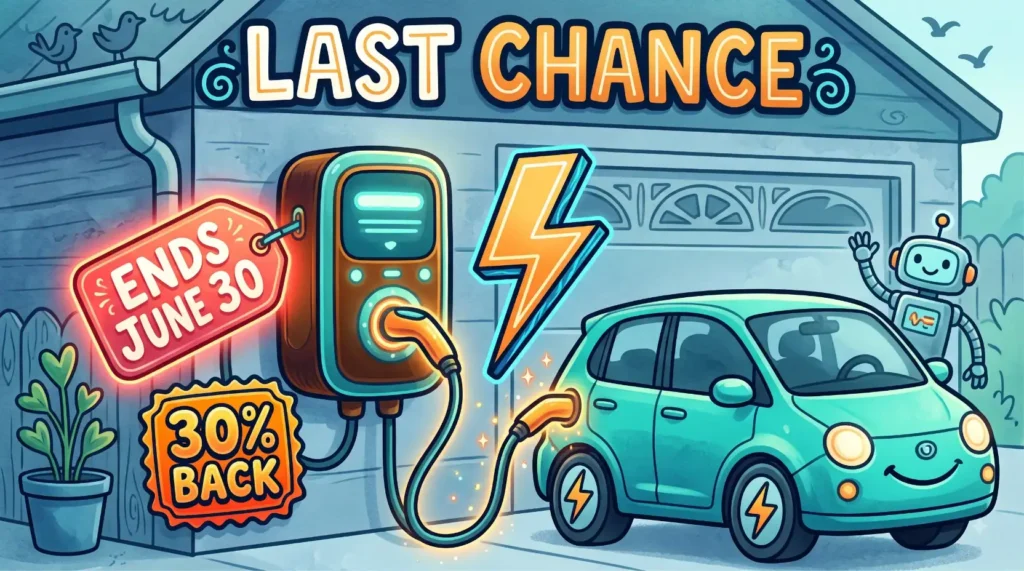
- 🔌 The home-charger credit still lives — barely. The Section 30C credit (30% of cost, up to $1,000 for homeowners) is available, but it ends June 30, 2026.
- 🗺️ State and local incentives remain in places like California, Colorado, New York, New Jersey, Oregon, Massachusetts, and Vermont — though they’re income- and price-capped and change often.
Bottom line: the news that the EV tax credit ended 2026 buyers are dealing with isn’t the whole story — a few smaller doors are still open if you move fast. 😎
📊 EV Incentives in 2026 — Status & What To Do
Here’s the full picture at a glance. Treat the “status” column as current-as-of-June-2026 and illustrative — these things move. 👇
| Incentive | Status in 2026 | What To Do |
|---|---|---|
| 💵 Federal $7,500 new EV credit | ❌ Expired Sept 30, 2025 | Don’t budget for it; it’s gone |
| 💵 Federal $4,000 used EV credit | ❌ Expired Sept 30, 2025 | Same — zero federal help on used |
| 🧾 Claim on 2025 return (pre-Oct 1 contract) | ⚠️ Only with binding contract + payment | File Form 8936; see a tax pro |
| 🔌 Section 30C home-charger credit | ⏳ Active but ends June 30, 2026 | Install + claim before the deadline |
| 🗺️ State / local rebates (CA, CO, NY, etc.) | ✅ Still available (capped, variable) | Check your state energy office now |
| 🏭 Manufacturer / dealer discounts | ✅ Growing in 2026 | Negotiate hard; ask about leases |
This is a map, not the final word. The federal lines are settled, but state programs and dealer deals shift month to month — verify before you count on any of them. 🎯
🛑 What Exactly Ended, and When
Let’s be precise, because precision matters with money. 🛑
The federal clean vehicle credits — the up to $7,500 for a qualifying new EV under Section 30D and the up to $4,000 for a used EV under Section 25E — stopped applying to vehicles acquired after September 30, 2025. That’s the hard cutoff.
For more than a decade, some version of a federal EV credit existed. The 2022 Inflation Reduction Act had actually expanded it and set it up to run through 2032. So this isn’t a credit that quietly hit its natural sunset — it was cut short by years.
The mechanism was the One Big Beautiful Bill Act, signed into law as Public Law 119-21 in July 2025. Among its many provisions, it accelerated the expiration of the EV purchase credits to that September 30 date.
So when people say the EV tax credit ended 2026 shoppers face a different math, this is the root of it: a deliberate, legislated early shutdown, not a lapse anyone forgot to renew. 📅
🤷 Why It Ended (The Short Political Version)
I’ll keep this neutral, because your politics aren’t my business — but the “why” helps you predict what comes next. 🤷
The federal EV credits were always somewhat contentious. Supporters framed them as climate policy and a way to build a domestic EV supply chain. Critics argued they were expensive, disproportionately helped higher-income buyers, and amounted to the government picking winners.
The One Big Beautiful Bill Act was a broad budget-and-tax package, and rolling back the EV credits was part of a larger effort to offset other priorities and reduce federal spending in this area. The EV provisions were a relatively small line in a very large bill.
What that means for you: this was a policy choice, and policy choices can swing back. We’ll get to what might change later. For now, the practical reality is simply that the money isn’t there in 2026. 💸
🚫 What 2026 Buyers Actually Get Now (Federally: Nothing)
Here’s the part nobody enjoys hearing. For a standard EV purchase in 2026, the federal purchase incentive is zero. 🚫
- ❌ No $7,500 off a new EV.
- ❌ No $4,000 off a used EV.
- ❌ No point-of-sale instant rebate at the dealer (that whole mechanism rode on the now-expired credit).
- ❌ No income-cap workaround, no “prior year MAGI” trick — because there’s no credit left to qualify for.
If you bought or are buying an EV in 2026 with no pre-October-2025 contract, you simply don’t get a federal break on the purchase. Full stop. That’s the practical core of why the EV tax credit ended 2026 reality matters so much to shoppers’ budgets this year.
The one narrow exception: if you signed a binding written contract and made a payment (even a nominal one) before October 1, 2025, the IRS has indicated you may still be able to claim the credit on your 2025 tax return using Form 8936 — even if you took delivery later. This is exactly the kind of edge case where you want a tax professional, not a blog, confirming your eligibility. 🧾
🔌 The Home-Charger Credit Is Still Alive (Until June 30, 2026)
Okay, some better news. 😅 Not every federal EV incentive vanished — and this one is easy to miss.
The Section 30C Alternative Fuel Vehicle Refueling Property Credit — the home-charger credit — is still available in 2026. For homeowners, it’s worth 30% of the cost of your charging equipment and installation, up to $1,000.
But here’s the catch you cannot afford to forget: this credit ends June 30, 2026. The One Big Beautiful Bill Act set that termination date, so it’s a genuinely short window.
A few things worth knowing 👇
- 🏡 It covers the charger hardware and eligible installation costs (electrician, wiring, panel work tied to the install).
- 📍 For the personal-use residential credit, your home generally needs to be in an eligible census tract (often low-income or non-urban areas) — this rule trips a lot of people up, so check your address before assuming you qualify.
- 🧾 You claim it on Form 8911 with your federal return.
If you’ve been putting off a proper Level 2 charger install, this is your nudge: doing it before June 30, 2026 could mean up to $1,000 back. After that, the federal help on chargers is gone too. ⏳
🗺️ State & Local Incentives That Remain
Here’s where the real opportunity hides in 2026. The feds bowed out, but plenty of states never relied on Washington for their EV programs. 🗺️
Several states still run their own rebates, tax credits, or grants. Generally speaking, these programs:
- 💰 Offer anywhere from a few hundred to several thousand dollars, depending on the state and vehicle.
- 🧾 Come with income caps (often favoring low- and middle-income buyers).
- 🏷️ Apply price caps on the vehicle.
- 🔄 Change frequently — funding runs out, rules update, programs pause and relaunch.
States that have historically maintained active EV incentive programs include California, Colorado, New York, New Jersey, Oregon, Massachusetts, and Vermont, among others. Colorado, for instance, has been known for unusually generous state-level EV credits, while California has long run point-of-sale-style rebate programs targeted at income-qualified buyers.
Beyond the state level, don’t overlook local and utility incentives. Many electric utilities offer rebates on chargers, discounted off-peak EV charging rates, or even cash toward the vehicle itself. These are some of the most overlooked savings out there.
Because these programs vary so much and change so often, the move is simple: check your specific state’s energy or environment department website and your utility’s EV page before you buy. Don’t assume — verify the current rules for your zip code. 😎
📉 How Losing $7,500 Changes EV Affordability & TCO
Let’s talk about what this actually does to your wallet, because it’s more nuanced than “EVs cost $7,500 more now.” 📉
On the surface, yes — without the credit, the effective price of a qualifying new EV just jumped by up to $7,500, and used EVs lost their $4,000 cushion. That’s a real hit to upfront affordability, and it stings most on lower-priced EVs where the credit represented a huge chunk of the deal.
But the smarter way to think about this is total cost of ownership (TCO) over several years, not just the day-one price. EVs still tend to win on the running-cost side: cheaper “fuel” (electricity vs. gas), far less maintenance, no oil changes, fewer moving parts to break.
The credit going away doesn’t change any of that ongoing math — it only changes the starting line. So an EV that was a slam-dunk with the credit might now be a closer call, and the only way to know is to run your real numbers.
That’s exactly why I’d point you to our EV 5-Year Cost of Ownership breakdown before you decide. Model the purchase price without the credit, layer in charging and maintenance savings, factor in depreciation, and see where the EV actually lands against a comparable gas car. The answer is often still “yes” — just by a smaller margin. 🎯
And don’t forget the recurring costs you can control. Trimming your insurance is one of the easiest wins — our guide on How to Lower Your EV Insurance Premium walks through practical ways to claw back some of what the lost credit took. 💡
🔄 How Buyers Are Adapting in 2026
Here’s the encouraging part: the market didn’t just freeze when the credit died. It adapted — fast. 🔄
A few trends are reshaping how people are getting into EVs this year 👇
- 🏷️ Price drops. With the credit gone, automakers know the effective price jumped, and several have responded with direct price cuts and incentives to keep sales moving. In some cases, manufacturers are essentially “eating” part of what the credit used to cover.
- 📝 Leasing surges. Leasing has become a popular workaround. Lease deals can bake in manufacturer incentives directly into the monthly payment, which for some shoppers softens the blow of the missing purchase credit.
- 🤝 Harder negotiating. With no point-of-sale rebate to lean on, buyers are negotiating more aggressively on the actual transaction price, trade-in value, and financing rate.
- 🚙 Used-market interest. Even without the $4,000 used credit, used EV prices have softened in places, and patient shoppers are finding deals — just without the federal sweetener.
The throughline here is that the credit’s disappearance shifted the savings game from “government rebate” to “negotiation and structure.” The money’s still out there — it’s just in price cuts, lease math, and state programs now instead of a federal check. 💪
🔮 What Could Change Politically
Now for the honest crystal-ball section. ✋ I can’t predict the future, and neither can anyone selling you a car.
EV incentives have a long history of being switched on and off by whoever’s in power. The federal credit was expanded in 2022 and cut short in 2025 — that’s a lot of movement in three years. Future legislation could, in theory, revive a federal credit, create a new version, or leave the field to the states indefinitely.
There’s also constant motion at the state level, which is arguably more relevant to you day-to-day. States add, expand, pause, and cut programs based on budgets and politics. A state with no incentive today could launch one next year, and vice versa.
So what should you do with that uncertainty? 👇
- 📰 Check current status before you shop, not based on an article (including this one) you read months ago.
- 🚫 Don’t structure your whole budget around a hoped-for future credit that doesn’t exist yet.
- ⏳ If a current incentive has a deadline (looking at you, June 30 home-charger credit), act inside the window rather than betting it’ll be extended.
Treat incentives as a bonus you confirm in real time — never a guarantee you bank on. 🎯
🇮🇳 Quick India Contrast Note
For our readers across the pond — and curious US folks — here’s an interesting flip side. 🇮🇳
While the US just removed its big federal EV incentive, India’s central government incentives remain active in 2026. The PM E-DRIVE scheme (the successor to the older FAME programs) continues to support EV adoption, with a particular focus on electric two-wheelers, three-wheelers, buses, and charging infrastructure.
So the global picture is genuinely split right now: the US is in a “no federal purchase credit” phase, while India is still actively subsidizing electrification at the national level. Different markets, different stages, different political winds.
If you’re an Indian reader, the takeaway is the opposite of the US one — there are central incentives to tap, and they too come with their own eligibility rules and deadlines worth verifying. 🛵
📈 2026: Post-Credit EV Market Trends
So what does the EV landscape actually look like now that the federal training wheels are off? A few patterns are emerging. 👇
- 💲 Manufacturer-led pricing. With no federal credit to point to, automakers are competing more openly on sticker price and built-in incentives. The “discount” moved from the IRS to the dealer.
- 📊 A short-term demand wobble. Many markets saw a rush of buyers in mid-2025 trying to beat the September 30 deadline, followed by a softer stretch afterward — classic pull-forward behavior.
- 🔋 Falling battery costs still helping. Independent of any credit, battery prices have trended down over time, which quietly keeps pressure on EV prices in buyers’ favor.
- 📝 Lease-heavy deals. Expect leasing to stay prominent as the structure where manufacturer incentives are easiest to pass through.
- 🗺️ State programs in the spotlight. With the feds out, state and utility incentives are getting far more attention from savvy shoppers — they’re now the main game.
The market is recalibrating, not collapsing. Even though the EV tax credit ended 2026 changed the headline price, EVs that make financial sense on their own merits are still selling — they just have to earn it without a federal subsidy now. ⚡
✅ 5 Tips to Still Save on an EV in 2026
No federal credit? Fine. Here’s how to claw savings back anyway. 👇
- 🗺️ Mine your state and utility programs. This is the single biggest replacement for the lost federal credit. Check your state energy office and your electric utility’s EV page.
- 🔌 Grab the home-charger credit before June 30, 2026. Up to $1,000 back (30% of cost) on a Level 2 install — but only if you act before the deadline and your address qualifies.
- 📝 Run the lease vs. buy comparison. Lease deals can carry manufacturer incentives that soften the missing purchase credit. Do the math both ways.
- 🤝 Negotiate the transaction price hard. With no point-of-sale rebate, the dealer’s price is your savings lever now. Shop multiple dealers and use competing quotes.
- 📊 Optimize the ongoing costs. Lower your insurance, charge at home on off-peak rates, and model your real five-year cost before committing.
Stack a few of these and you can recover a meaningful chunk of what the federal credit used to provide. 💪
🛒 Smart Tools for Buying an EV Post-Credit (Shop This Post)
A few things that make EV ownership cheaper now that the federal credit is gone. 😍
1. A Level 2 Home Charger (Beat the June 30 Credit Deadline) ⚡
Installing a home charger before June 30, 2026 could still earn you up to $1,000 back via the 30C credit — and it slashes your charging costs versus public fast chargers. A solid Level 2 unit pays for itself.
👉 Shop home EV chargers
2. Tax Software That Handles EV Forms 🧾
If you’re claiming the home-charger credit (Form 8911) or a leftover 2025 vehicle credit (Form 8936), good tax software walks you through it and helps you avoid costly mistakes.
👉 Shop tax software
3. A Smart EV Charging Timer / Energy Monitor 📊
Charging on off-peak utility rates is one of the easiest ongoing savings, and a smart charging setup or energy monitor helps you automate it. Lower running costs help offset the lost upfront credit.
👉 Shop smart charging gear
🛍️ Shop This Post: (These are affiliate picks. They cost you nothing extra and help support EVs Mirror so we can keep publishing honest EV money guides. 🙏)
🎯 Quick Quiz: Are You Leaving Savings on the Table?
Five-second gut check. Be honest. 👇
- Have you checked your state and utility EV incentives (not just federal)? 🅐 Yes 🅑 Not yet
- If you want a home charger, can you install it before June 30, 2026? 🅐 Yes 🅑 No / unsure
- Did you sign a binding EV contract + pay before Oct 1, 2025? 🅐 Yes (claim it on 2025 taxes!) 🅑 No
- Have you compared leasing vs. buying for your target EV? 🅐 Yes 🅑 Not yet
Mostly 🅐: 🟢 You’re playing the post-credit game smartly — keep verifying current rules and lock in what you can.
Mostly 🅑: 🟡 You’ve likely got savings left on the table. Work through the tips above before you buy.
📋 Post-Credit EV Buying Checklist
Copy this into your notes and tick it off. ⚡
- [ ] Accepted that there’s no federal EV purchase credit in 2026
- [ ] Checked whether I had a binding contract + payment before Oct 1, 2025 (Form 8936 on 2025 return)
- [ ] Looked up my state EV rebate/credit and its income/price caps
- [ ] Checked my electric utility for charger and charging-rate incentives
- [ ] Planned to claim the home-charger credit before June 30, 2026 (if my address qualifies)
- [ ] Compared lease vs. buy for my target EV
- [ ] Modeled my real 5-year cost of ownership without the credit
- [ ] Got quotes from multiple dealers and negotiated the price hard
- [ ] Consulted a tax professional before relying on any credit ⚡
🤔 People Also Ask
Q: Did the EV tax credit really end in 2026?
A: The federal $7,500 new and $4,000 used EV purchase credits expired on September 30, 2025, accelerated by the One Big Beautiful Bill Act (Public Law 119-21). So yes — the reality that the EV tax credit ended 2026 buyers now face means there is no federal purchase credit for new or used EVs this year. Always verify current rules with the IRS and a tax professional.
Q: Can I still claim the EV tax credit on my taxes?
A: Only in a narrow case: if you had a binding written contract and made a payment before October 1, 2025, you may be able to claim it on your 2025 tax return using Form 8936, even with later delivery. Otherwise, there’s no federal credit to claim for a 2026 purchase. Confirm your eligibility with a tax professional.
Q: Is there any federal EV incentive left in 2026?
A: For vehicle purchases, no. But the Section 30C home-charger credit (30% of cost, up to $1,000 for homeowners) is still active — though it ends June 30, 2026. After that, federal EV charger help disappears too. Verify the current rules before relying on it.
Q: What states still offer EV incentives in 2026?
A: States like California, Colorado, New York, New Jersey, Oregon, Massachusetts, and Vermont have historically maintained EV programs, often with income and price caps. These change frequently, so check your specific state energy office and utility before you buy.
Q: Why did the federal EV tax credit end early?
A: The 2022 Inflation Reduction Act had set the credit to run through 2032, but the One Big Beautiful Bill Act (July 2025) accelerated its expiration to September 30, 2025 as part of a broader budget and tax package. It was a policy choice, and policy can change again.
Q: Are EVs still worth buying now that the credit is gone?
A: Often yes — but the math is closer. EVs still win on running and maintenance costs over time; the credit only affected the upfront price. Run your real five-year numbers, tap state and utility incentives, and negotiate hard to decide for your situation.
🚀 The Bottom Line
Here’s the honest summary: the big federal sweetener is gone. The fact that the EV tax credit ended 2026 shoppers now navigate means no $7,500 off a new EV and no $4,000 off a used one — unless you locked in a binding contract before October 1, 2025. That chapter is closed. ⚡
But “gone federally” doesn’t mean “no savings left.” You’ve still got the home-charger credit through June 30, 2026, a patchwork of state and utility programs that are now the main event, manufacturer price cuts, lease deals, and good old-fashioned negotiation. Run your real numbers — start with our EV 5-Year Cost of Ownership guide — trim the ongoing costs like insurance with our How to Lower Your EV Insurance Premium tips, and you can still drive away in an EV that makes financial sense. 🚗
And as always: incentives change fast. Use this as your framework, then verify the current specifics with the IRS, your state energy office, and a qualified tax professional before you sign anything. 🎯
💬 Did the credit’s expiration change your EV plans? Tell us in the comments (no personal financial details, please)!
📤 Know someone EV shopping this year? Send them this guide — it’ll save them a nasty surprise at the dealer. 🙏
🔖 Bookmark EVs Mirror for honest, no-hype EV money news.
This article is general information, not financial or tax advice. Figures are illustrative and current as of June 2026. Tax law and incentives change and vary by situation — always verify with the IRS, your state, and a qualified tax professional before relying on any credit.