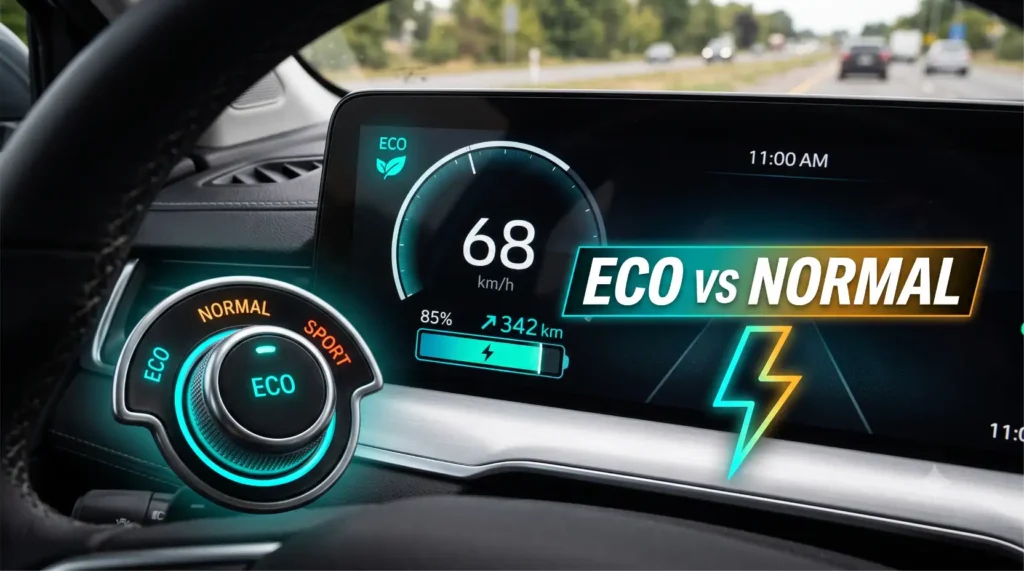
You’re staring at the dash, finger hovering over the drive-mode button. There’s “Eco,” there’s “Normal,” maybe a tempting “Sport.” The battery’s a little lower than you’d like, the next charger feels far away, and a small voice whispers: just press Eco and you’ll be fine. 🚗
So you press it. The car feels a touch gentler off the line. The range estimate ticks up a few miles. Magic, right? Free range, just for tapping a button?
Well — sort of. There’s real truth in that little range bump, but there’s also a big asterisk most people miss. Eco mode doesn’t conjure energy out of thin air, and it won’t rescue a road trip on its own. ⚡
The honest story behind EV eco mode range is more interesting than “press button, get miles.” It’s really a story about your driving — and how eco mode quietly nudges you into better habits. Let’s pull back the curtain and see what’s actually happening. 👇
⚡ The Short Answer
If you only read one section, read this:
- 🔋 Eco mode does save range — but modestly. Think a few percent in most conditions, not a dramatic transformation.
- 🦶 The real saving comes from behavior. Eco mostly works by making you accelerate gently and drive smoothly.
- 🌡️ Climate is the bigger lever. Eco often caps your AC or heater, and that’s where a chunk of the savings hides.
- 🐢 You can match eco mode in Normal — if you’re disciplined with the pedal and the climate controls.
- 🛣️ Speed still beats eco. No drive mode undoes the highway-speed range penalty; slowing down does more than any button.
- 🎯 Best use: low battery, city traffic, or hot/cold days when you want every electron working hard.
Now let’s get honest about what that button actually does. ⚙️
📊 What Eco Mode Changes — At a Glance
Different brands tune eco mode differently, but the core changes are remarkably consistent across EVs. Here’s the typical eco-mode recipe and roughly how each ingredient affects your range. 📈
| What Eco Mode Changes | What It Actually Does | Range Effect |
|---|---|---|
| ⚡ Power / accel limit | Caps peak motor power; slower 0–60 | Indirect — discourages hard launches |
| 🦶 Throttle softening | Same pedal travel = less power | Indirect — smooths your inputs |
| 🌡️ Climate cap | Limits AC/heater output or fan speed | Direct — real kWh saved |
| 🔄 Regen tuning | Often stronger or earlier regen | Small direct gain in stop-go |
| 🚗 Top-speed limit | Some EVs cap max speed in eco | Situational — only matters at speed |
(These are typical behaviors — your exact EV may do all, some, or only a couple of these. Check your owner’s manual to see what your car’s eco mode really touches.)
Notice the pattern: most of eco mode’s effects are indirect. They don’t make the car magically efficient — they make you drive in a more efficient way. That distinction is the whole article. 🧠
⚙️ What Eco Mode Actually Does Under the Hood
Let’s strip away the marketing. When you tap Eco, your EV isn’t unlocking some secret efficiency reserve. It’s mostly putting polite limits on how aggressively you and the car can behave. 🚦
First, it limits power and softens the throttle. In Normal or Sport, a stab of the accelerator delivers instant, neck-snapping torque. In Eco, the same pedal press gives you a gentler, more gradual response. The car still can go — but it makes you ask nicely. This single change quietly prevents the energy-guzzling hard launches that drain batteries fastest.
Second, it caps the climate system. Air conditioning and cabin heating are some of the biggest non-driving energy draws in an EV. Eco mode often reins them in — lowering fan speed, easing the target temperature, or limiting how hard the compressor works. 🌡️
Third, it may tweak regen and top speed. Some EVs dial up regenerative braking in eco for better energy recovery, and a few cap your maximum speed to keep you out of the high-drag danger zone. None of this is dramatic on its own — but stacked together, it adds up to a measurably better EV eco mode range than careless Normal-mode driving. ✅
🤔 Does Eco Mode Really Save Range? (The Honest Answer)
Time for the question everyone actually wants answered: yes, eco mode saves range — but probably less than you hope, and for reasons you might not expect. 🎯
In real-world testing across many EVs, switching from Normal to Eco typically nets you somewhere in the range of 3% to 8% more miles, depending on the car, the conditions, and crucially, how you were driving before. On a 250-mile (≈400 km) EV, that’s maybe 10 to 20 miles (≈16 to 32 km) — useful, but not a road-trip rescue. 🔋
Here’s the twist that surprises people: most of that saving isn’t the car being smarter — it’s eco mode stopping you from being wasteful. If you were already feathering the throttle and running the AC sparingly, eco mode has almost nothing left to give you. The button mostly helps lead-footed drivers by taking the lead foot away.
So the honest verdict on EV eco mode range? It’s a real, modest gain — a few percent of free miles for the price of a slightly less peppy drive. But it’s a behavior tool, not a battery upgrade. Understanding why unlocks the bigger savings. 🔑
💡 Want the complete range-stretching toolkit beyond drive modes? Read our companion guide: How to Maximize Your EV’s Range.
🦶 The Real Saving — Gentle Acceleration and Lower Speed
If eco mode’s power is mostly behavioral, let’s talk about the behavior that matters most: how you accelerate. 🚀
Every hard launch — every “let me show this petrol car what an EV can do” stoplight sprint — dumps a big slug of energy into pure acceleration. Some of that comes back via regen when you slow down, but plenty just vanishes as heat and motion. Stack up dozens of aggressive launches over a day and you’ve quietly burned a meaningful chunk of range. ⚡
Eco mode fixes this by making hard launches harder to do. With the throttle softened, your usual aggressive pedal press now produces a calm, gradual pull-away. You’re driving gently whether you meant to or not — and gentle, smooth acceleration is one of the single biggest levers in real-world efficiency.
But here’s the honest caveat: eco mode does not slow you down on the highway. Once you’re cruising at 75 mph (≈120 km/h), aerodynamic drag — not your launch style — is the dominant range killer, and no drive mode cancels physics. If you want big highway savings, you have to actually ease off the speed. That’s a you decision, not a button. 🛣️
💡 Speed is the real range thief at cruising pace — see exactly how much in How Highway Speed Kills EV Range.
🌡️ Climate Limiting in Eco Mode
Here’s where eco mode delivers some of its most direct savings — and where the trade-offs get personal. 🌡️
Climate control is a genuine energy hog. Blasting the AC on a 40°C (104°F) afternoon or cranking the heater on a freezing morning can draw real, range-eating power — sometimes shaving double-digit percentages off your range in extreme weather. So when eco mode caps the climate system, it’s targeting a fat, juicy energy expense. ❄️🔥
What eco actually does varies: it might limit how hard the AC compressor runs, lower the fan speed, nudge the target temperature toward “tolerable” instead of “perfect,” or lean more heavily on energy-sipping features like seat heaters over cabin heat. The result is real kWh saved — and a noticeable bump to your EV eco mode range on extreme-weather days.
The catch? Comfort. On a brutally hot or cold day, eco’s climate cap can leave the cabin a little less cozy than you’d like. That’s the honest trade: you’re swapping a few degrees of comfort for a few miles of range. On a desperate low-battery crawl to the charger, it’s a great deal. On a relaxed daily commute, you might prefer Normal and full AC. Your call. 🚗
🔄 Regen and One-Pedal Driving in Eco
Regenerative braking is an EV’s secret weapon — it turns slowing down into free range by recovering energy back into the battery. So how does eco mode play with it? 🔋
On many EVs, eco mode dials regen up — applying stronger or earlier braking energy recovery when you lift off the accelerator. That’s a quiet win, especially in city stop-and-go where you’re constantly slowing for lights and traffic. More aggressive regen means more energy clawed back into the pack instead of lost as heat. ✅
This pairs beautifully with one-pedal driving — the technique where lifting off the accelerator slows the car strongly enough that you rarely touch the brake pedal. One-pedal driving maximizes regen because you’re recovering energy on every deceleration instead of coasting or braking conventionally. In eco mode, with regen often turned up, the effect is even more pronounced. 🦶
Here’s the honest nuance, though: regen recovers energy you already spent — it doesn’t create surplus. It softens the cost of city driving rather than handing you free miles. And on a steady highway cruise where you barely brake, regen barely matters, eco or not. So one-pedal eco driving shines in the city and on hilly descents, but it’s no magic bullet on the open road. 🛣️
⚖️ Eco Mode vs Just Driving Gently in Normal
Now for the question that exposes eco mode’s true nature: can you match eco mode while driving in Normal? The honest answer is — pretty much, yes, if you’re disciplined. 🎯
Remember, most of eco mode’s savings are behavioral. If you accelerate gently, anticipate slowdowns to maximize regen, keep your speed sensible, and run the climate moderately — you’re doing by choice exactly what eco mode forces. A disciplined Normal-mode driver and an eco-mode driver often end the day with nearly identical efficiency numbers. 🧠
So why use eco at all? Two reasons. One: it removes the temptation. Even careful drivers occasionally indulge a fun launch or crank the AC without thinking. Eco mode quietly polices those impulses, making good habits the path of least resistance. Two: the climate cap. That’s the one piece you can’t fully replicate by willpower alone — eco’s systematic climate limiting catches savings you might forget to chase manually. 🌡️
The takeaway is liberating: you’re not dependent on a button. The real driver of EV eco mode range is your own right foot and your climate habits. Eco mode is training wheels for efficient driving — genuinely helpful, but you can ride without them once the habits stick. 🚲
🎚️ When to Use Eco vs Normal vs Sport
Drive modes aren’t a “set and forget” decision — the smart move is matching the mode to the moment. Here’s a practical playbook. ⚙️
Reach for Eco when range is tight or precious. Low battery and a charger that feels far away? Eco. Crawling through hot city traffic where every electron counts? Eco. Extreme heat or cold draining your range through the climate system? Eco’s caps earn their keep. This is exactly when squeezing out that 3–8% genuinely matters. 🔋
Stick with Normal for everyday driving. For most daily commutes with comfortable range to spare, Normal gives you responsive, natural driving with full climate comfort — and if you drive smoothly, your efficiency barely differs from eco anyway. There’s no shame in Normal; a relaxed, gentle Normal-mode driver is already winning. 🚗
Save Sport for when you actually want fun — and don’t mind the cost. Sport sharpens throttle response and unleashes full power. It’s a blast, but every aggressive launch spends range faster. Use it when you’re enjoying the drive and range isn’t a worry, not as your default. The honest math: Sport is a treat, not a habit, if you care about miles. 🏁
🇮🇳 India Eco Mode Context
The EV eco mode range story has a distinctly Indian flavor — and in many ways, India is where eco mode shines brightest. 🇮🇳
Start with the heat. Indian summers are punishing, and AC is non-negotiable for most of the year. Since eco mode’s climate cap targets exactly that heavy AC draw, the savings can be more noticeable here than in milder climates. On a sweltering Delhi or Chennai afternoon, eco mode’s gentler cooling can claw back real range — though you’ll feel the comfort trade-off keenly, so it’s a personal call. 🌡️
Then there’s the driving environment. Indian city traffic is dense, slow, and stop-and-go — which is exactly where eco mode’s softened throttle and stronger regen pay off most. You’re rarely flooring it on a crowded Bengaluru road anyway, so eco mode’s power limit costs you almost nothing while its regen and climate savings stack up. 🛵
The charging network is the clincher. Fast chargers are spreading across India fast, but corridors are still thinner than in the US, so stretching every charge matters more. On a long inter-city run with a sparse charger map, flicking to eco mode for that extra buffer can be the difference between arriving relaxed and sweating the final kilometers. Here, a few percent really counts. 🔌
📈 2026: Smarter Drive Modes
Drive modes used to be blunt instruments — a fixed power cap and a softer pedal. In 2026, they’re getting genuinely clever, and the EV eco mode range gains are getting smarter with them. 🤖
First, eco modes are going adaptive. Newer EVs blend navigation, traffic, and even weather data into how the car manages energy. Heading uphill? The car prepares. Charger 30 miles out and battery getting low? Some EVs now suggest — or automatically apply — efficiency tweaks to make sure you arrive. It’s eco mode that thinks ahead. 🗺️
Second, climate is getting smarter, not just weaker. Heat pumps, pre-conditioning while plugged in, and zonal climate (heating only the seats you’re using) mean newer EVs save climate energy without the same comfort penalty. Eco mode’s climate cap stings less than it used to. ❄️
Third, one-pedal and regen tuning are more configurable. Drivers can increasingly fine-tune regen strength independently of drive mode, so you can build your own “personal eco” without giving up throttle response. The line between Eco and Normal is blurring — in a good way. The trend is clear: 2026’s drive modes give you more savings with fewer compromises. 📈
✅ 5 Tips to Maximize Eco Mode
- Switch to Eco before you need it. 🎯 Don’t wait for a range scare — engaging eco early on a long trip banks more savings than a last-minute panic flip.
- Pair Eco with a sensible speed. Eco won’t fix the highway-speed penalty. Ease off to 60–65 mph (≈100–105 km/h) and eco mode’s gains compound. 🛣️
- Lean into regen and one-pedal driving. 🔄 Anticipate slowdowns, lift off early, and let eco’s stronger regen recover energy on every deceleration.
- Accept the climate trade — selectively. Use seat heaters over cabin heat, pre-condition while plugged in, and let eco cap the AC when range matters more than perfect comfort. 🌡️
- Keep your tires inflated and load light. 🛶️ Eco mode can’t outrun under-inflated tires or a roof box. Cover the basics and eco’s savings sit on top.
🛒 Shop This Post
Gear and tools that make every drive mode work harder. 😍
1. EV Route & Charging Planner Tool 🗺️
A smart planner factors in your real driving, weather, and battery so you know exactly when to flip to eco — and when you don’t need to. Confidence beats range anxiety.
👉 Shop EV trip planning tools & subscriptions
2. Digital Tyre Inflator / Air Compressor 🛶️
Correct tire pressure is free range that eco mode can’t replicate. A compact rechargeable inflator keeps every tire dialed in — the cheapest efficiency upgrade there is.
👉 Shop portable tyre inflators
3. EV Cabin Comfort Accessories 🌡️
Seat cushions, sunshades, and windshield covers that reduce how hard your climate system has to work — so eco mode’s climate cap stings far less.
👉 Shop EV comfort & interior accessories
🛍️ Disclosure: These are affiliate picks — buying through them costs you nothing extra and helps support EVs Mirror. 🙏
🎯 Quick Quiz: Should You Be in Eco Mode Right Now?
- How’s your battery and charger situation? 🅐 Low battery, charger far 🅑 Plenty of range to spare
- What kind of driving are you doing? 🅐 Hot/cold city stop-and-go 🅑 Relaxed cruise, mild weather
- What matters more this trip? 🅐 Squeezing out every mile 🅑 Full comfort and responsiveness
Mostly 🅐: Flip to Eco. This is exactly the situation where the climate cap and gentle throttle earn their keep. 🔋
Mostly 🅑: Stay in Normal and enjoy it. Drive smoothly and your efficiency will rival eco anyway — no button required. 🚗
📋 Eco Mode Range Checklist
- [ ] Engage Eco early on long or low-battery trips, not at the last minute
- [ ] Ease off highway speed — eco won’t fix the drag penalty
- [ ] Use one-pedal driving to maximize eco’s stronger regen
- [ ] Pre-condition the cabin while plugged in to ease the climate cap
- [ ] Choose seat heaters over full cabin heat in cold weather
- [ ] Accept eco’s climate trade-off only when range beats comfort
- [ ] Keep tires properly inflated before relying on any drive mode
- [ ] Remember: in mild conditions, gentle Normal driving nearly matches eco ⚡
🤔 People Also Ask
Q: Does EV eco mode range really improve over normal mode?
A: Yes, but modestly — typically a 3–8% gain depending on the car and conditions. The bigger truth is that most of the EV eco mode range benefit comes from changing your behavior: eco softens the throttle and caps climate, forcing the gentle, efficient driving that saves the most energy.
Q: How much range does eco mode actually add?
A: On a 250-mile (≈400 km) EV, expect roughly 10–20 miles (≈16–32 km) of extra range in most conditions. It’s genuinely useful for stretching a tight battery to the next charger, but it won’t transform a road trip on its own.
Q: Can I save the same range without using eco mode?
A: Largely, yes. If you accelerate gently, drive at sensible speeds, maximize regen, and run climate moderately, a disciplined Normal-mode driver matches most of eco mode’s efficiency. The one piece eco does automatically is the climate cap, which is easy to forget manually.
Q: Does eco mode limit my EV’s speed or power?
A: It usually softens throttle response and caps peak power, and some EVs limit top speed too. You can still drive normally and merge safely — the car just delivers power more gradually, which discourages the hard launches that waste energy.
Q: Is eco mode worth using in hot or cold weather?
A: Often yes. Eco mode’s climate cap targets the AC and heater — among the biggest energy draws in extreme weather. The trade-off is a slightly less comfortable cabin, so it’s most worth it when range matters more than perfect comfort, like a low-battery run to the charger.
Q: Does eco mode affect regenerative braking?
A: On many EVs, eco mode strengthens regen, recovering more energy when you lift off the accelerator. Paired with one-pedal driving, it shines in city stop-and-go and on downhill stretches — though regen recovers energy you already spent rather than creating free miles, and matters little on steady highway cruising.
🚀 The Bottom Line
So, does eco mode save range? Yes — modestly and honestly. You’ll typically gain a few percent of extra miles, which can genuinely rescue a tight battery on the way to a charger. But the magic isn’t in the button. The real engine behind EV eco mode range is you: gentle acceleration, smart regen, sensible speed, and disciplined climate use. 🔋
Eco mode is best understood as training wheels for efficient driving. It quietly enforces the good habits — softening your throttle, capping the AC, boosting regen — that you could choose to do yourself in Normal mode. Lean on it when range is precious: low battery, brutal heat or cold, dense city traffic. Skip it without guilt when you’ve got miles to spare and want the comfort. ⚙️
And never forget the limits. No drive mode cancels physics — speed is still the real range thief at highway pace, and no amount of eco mode undoes a heavy right foot at 75 mph (≈120 km/h). Press the button if it helps, but the biggest savings always come from how you drive. ⚡
💬 Do you drive in Eco or Normal? Tell us in the comments — and whether you’ve actually measured the difference.
📤 Know someone obsessing over their range estimate? Share this and settle the eco-mode debate for them.
🔖 Bookmark EVs Mirror for honest range guides — and for the full playbook, start with How to Maximize Your EV’s Range and see exactly how speed costs you in How Highway Speed Kills EV Range.