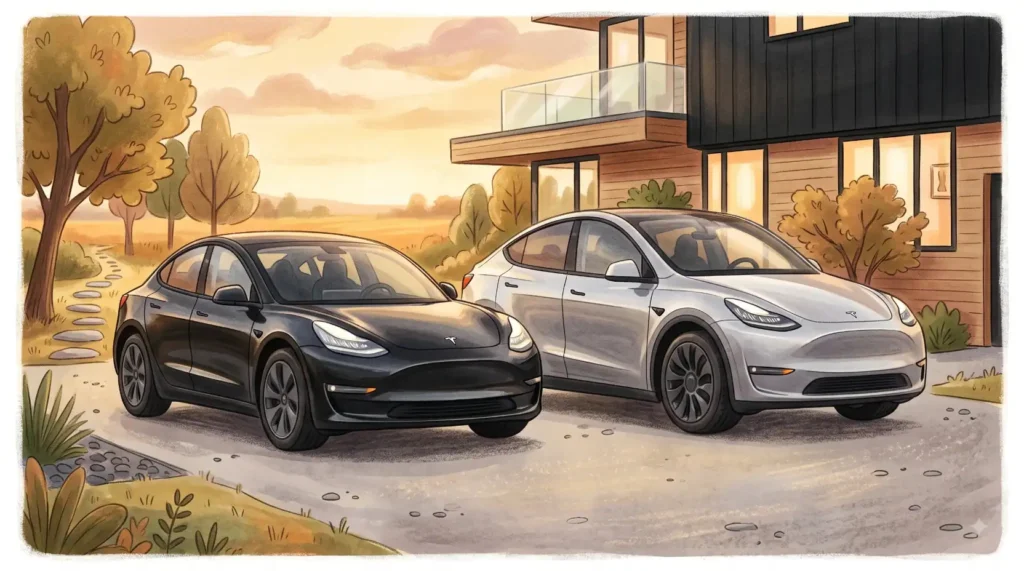
You’ve narrowed it down. It’s a Tesla. The badge, the screen, the Supercharger network — you’re in. ⚡
But now you’re stuck on the question that trips up almost everyone walking into this decision: do you go for the sleek, lower, cheaper sedan, or the taller, roomier, pricier crossover that costs a few thousand more and somehow feels like the “grown-up” choice?
Here’s the thing nobody tells you up front — these two cars are mechanically siblings. They share most of their guts, their software, their charging tech, and a huge chunk of their parts. So this isn’t a battle of good versus bad. It’s a battle of shape and priorities. 🚗
The honest answer to Tesla Model 3 vs Model Y comes down to how you actually live — where you park, who rides with you, how much stuff you haul, and whether you’d trade a little efficiency for a lot of headroom. Let’s break it all the way down. 👇
⚡ The Short Answer
No fluff. Here’s who wins what:
- 🚗 Buy the Model 3 if you mostly drive solo or as a couple, love a low sporty stance, want the best efficiency and range-per-dollar, and care about the lower price tag.
- 🚙 Buy the Model Y if you’ve got kids, dogs, bikes, luggage, or aging knees — the taller body and bigger cargo hold are genuinely life-changing for families.
- 💰 The price gap is real but modest — the Y typically asks a few thousand more ($ or ₹) than a comparable Model 3.
- 🔋 The 3 is the efficiency champ — it’s lighter and more aerodynamic, so it sips fewer kWh and squeezes more miles from the same battery.
- 🛣️ Both road-trip beautifully — same Supercharger access, same software, same easy long-haul experience.
- 🇮🇳 In India, availability and exact pricing are still firming up — treat any rupee figures as ballpark, not gospel.
If you don’t have kids or cargo, the Model 3 is the smarter buy. If you do, the Model Y earns every extra dollar. 🎯
📊 Model 3 vs Model Y: Head-to-Head (At a Glance)
Here’s the whole comparison on one screen. Screenshot this for later. 👇
| Factor | Tesla Model 3 (Sedan) | Tesla Model Y (Compact SUV) |
|---|---|---|
| 🚗 Body style | Low, sleek 4-door sedan | Taller crossover / hatchback SUV |
| 🔋 Range (illustrative) | Usually the longer of the two per variant | Slightly less due to weight/shape |
| 📦 Cargo & space | Generous sedan trunk + frunk | Bigger, hatch-style boot; folds flat; more headroom |
| 💰 Price band (illustrative) | ~$40K–$55K · ₹approx 60L+ (India TBD) | A few thousand more than the 3 |
| 🛣️ Ride feel | Lower, sportier, more planted | Taller, comfier, better visibility |
| 👀 Best for | Commuters, couples, efficiency lovers | Families, haulers, dog owners, taller drivers |
Figures are illustrative and vary by trim, region, and model year — always confirm current specs and pricing on Tesla’s site before you sign.
See the pattern already? The 3 wins on efficiency and price; the Y wins on space and practicality. The rest of this guide is about which of those matters more to you. 💡
🆚 The Core Difference: Sedan vs Crossover
Let’s start with the one thing that drives almost every other difference — the shape.
The Model 3 is a sedan. It’s low, it’s long, and it has a separate(ish) trunk opening at the back. You sit closer to the road, the roofline slopes, and the whole car feels like it wants to be driven. It’s the sportier silhouette of the pair. 🏎️
The Model Y is a compact SUV — really a tall hatchback wearing crossover clothes. It’s built on the same bones as the 3 but stretched upward. You sit higher, the roof is taller, and the rear opens as a big liftgate instead of a trunk lid. That single design choice — liftgate vs trunk — changes how much you can carry and how easily you can load it.
This is the heart of the Tesla Model 3 vs Model Y question. Everything else — range, price, ride, who it suits — flows from “low sleek sedan” versus “tall roomy crossover.” Get clear on which body style fits your life and the rest of the decision gets a lot easier. 🎯
📦 Space & Cargo: Where the Model Y Pulls Ahead
If you’re hauling people or stuff, this section might end the debate by itself.
The Model Y simply holds more. The taller roofline gives rear passengers noticeably more headroom, and the upright SUV shape means car seats, big dogs, and tall teenagers all fit more comfortably. Getting kids in and out of child seats is easier too — you’re not stooping down to a low sedan opening. 👨👩👧👦
Then there’s the boot. The Y’s liftgate hatch swallows strollers, suitcases, flat-pack furniture, and grocery runs in a way a sedan trunk just can’t. Fold the rear seats and you get a long, flat load floor — great for bikes, camping gear, or that one giant IKEA trip everyone underestimates. 📦
The Model 3 is no slouch, mind you. It has a surprisingly deep trunk plus a front trunk (frunk), and the rear seats fold too. For a couple or a small family with normal luggage, it’s plenty. But “plenty” and “I never have to play luggage Tetris again” are different feelings — and the Y delivers the second one.
If you’re shopping family EVs in general, it’s worth widening the net before you commit — our roundup of the best electric SUVs for families in 2026 puts the Model Y next to its rivals so you can see exactly where it lands. 🚙
🔋 Range & Efficiency: The Model 3’s Quiet Win
Here’s where the sedan claws back some points.
Physics doesn’t care about your feelings. The Model 3 is lighter and more aerodynamic — that low, slippery shape cuts through air with less drag than the taller Y. The practical result: for any given battery and trim, the Model 3 is usually the more efficient car, using fewer kWh per mile and squeezing out a bit more range. ⚡
That efficiency edge shows up in two places you’ll actually feel. First, range — comparable Model 3 variants typically post a slightly higher EPA (or WLTP) figure than their Model Y counterparts. Second, running cost — fewer kWh per mile means a little less money spent charging over the years, whether you’re paying in dollars or rupees. 💰
The Model Y isn’t inefficient — it’s one of the most efficient SUVs you can buy, and the gap to the 3 is modest, not dramatic. But if maximizing range-per-dollar and minimizing charging stops is high on your list, the 3 has the edge.
Just remember: real-world range swings with weather, speed, and how you drive far more than the badge on the boot. Cold winters and highway speeds shrink both cars’ numbers. Keep that in mind when you compare illustrative spec sheets — they’re a starting point, not a promise. 🌡️
💰 The Price Gap & Value
Money time. For most buyers, the Model 3 is the cheaper way into a Tesla, full stop.
Across comparable trims, the Model Y typically asks a few thousand more than the equivalent Model 3 — in the US that’s often in the low-thousands-of-dollars range, and in markets like India the rupee gap follows a similar pattern (exact figures still settling). You’re paying extra for the body, the space, and the SUV positioning. 💵
So is the Y worth the premium? It depends entirely on whether you’ll use the space. If you’ve got a family, the extra few thousand buys real, daily, tangible utility — easier loading, more headroom, more flexibility. That’s money well spent.
But if you’re a solo commuter or a couple who rarely fills the back seat, that premium buys you… a taller car you don’t need. In that case the Model 3 is the smarter financial move — lower sticker, better efficiency, and often slightly stronger range. 🎯
One more value angle: depreciation and the used market. Both hold value reasonably for EVs, and the used Model 3 in particular has matured into a savvy buy. If you’re open to second-hand, our guide to the best years to buy a used Tesla Model 3 can save you a serious chunk versus buying new. 💡
🛣️ Ride & Handling: Two Different Personalities
Same DNA, different feel behind the wheel.
The Model 3 sits lower, with a sportier center of gravity. It feels planted and eager in corners, steers crisply, and gives you that fun, connected-to-the-road sensation. If you enjoy driving — not just getting there — the 3 is the more entertaining of the two. 🏎️
The Model Y rides higher and softer. You get a commanding view of the road, easier entry and exit (great for taller folks and anyone with cranky knees), and a more relaxed, cushioned ride over bumps. It trades a touch of sportiness for comfort and visibility — exactly the tradeoff most SUV buyers want. 🪩
Neither is “better” — they’re tuned for different people. Test-drive both back-to-back if you possibly can, because this difference is something you feel in the first five minutes and live with for years. The spec sheet can’t capture it. 👀
The taller Model Y also gives you a bit more ground clearance, which helps with rough roads, speed breakers, and unpaved driveways — a real consideration in parts of India and rural US alike. 🛸
🏙️ Which One for City vs Road-Trip vs Family?
Let’s match the car to the mission. Because the right answer genuinely changes with your life.
City driving 🏙️ — The Model 3 is the easier urban companion. It’s lower, slightly smaller in footprint, easier to slot into tight parking, and more efficient in stop-start traffic. Couples and solo commuters living downtown will love it.
Road trips 🛣️ — Honestly? It’s close to a tie. Both cars get the exact same Supercharger access and the same effortless long-haul software. The Model 3’s better efficiency means marginally fewer stops, but the Model Y’s extra space makes those long hours more comfortable for passengers and gear. Pick based on how many people and bags come along.
Family life 👨👩👧👦 — The Model Y, no contest. More headroom, easier car-seat access, a massive hatch for all the family chaos, and a higher seating position that parents love. If kids and cargo are your reality, this is the one.
So when you frame Tesla Model 3 vs Model Y around your actual missions, the fog usually clears fast. ✨
🔌 Charging & Ownership: A Shared Ecosystem
Here’s the good news that makes this an easy decision in one respect — the ownership experience is nearly identical.
Both cars plug into the same massive Supercharger network, use the same connector standard for their region, and charge at broadly similar speeds. Both get the same over-the-air software updates, the same app, the same minimalist interior philosophy, and the same low-maintenance EV mechanicals (no oil changes, regen braking that saves your pads, etc.). 🔋
That means whichever you pick, your home charging setup is the same. A solid Level 2 home charger turns either car into a “leave-home-full-every-morning” machine, and the right adapter keeps you flexible on public networks and road trips. The accessories ecosystem — chargers, adapters, mats, organizers — overlaps almost completely between the two.
Ownership quirks are shared too: both reward a home wallbox over relying on public charging, both benefit from keeping software current, and both are simple to monitor if you like data. An OBD-style app or compatible dongle can surface battery health and efficiency stats so you actually know how your car’s doing rather than guessing. 📲
Bottom line — charging and ownership shouldn’t tip your decision. Focus on body style, space, range, and price. The plug-in life feels the same either way. ✅
🇮🇳 India Availability & Pricing Context
A quick, honest note for our India readers. 🇮🇳
Tesla’s India story has been a long slow-burn of anticipation, shifting import-duty conversations, and on-again-off-again launch chatter. As of 2026, availability, official pricing, and the variant lineup are still firming up — so anyone quoting you an exact, confident rupee figure for a specific trim is guessing. ⚠️
Here’s what you can reasonably expect. Whenever the Model 3 and Model Y land properly, the same logic applies: the Model 3 sedan will be the more affordable, more efficient entry point, and the Model Y will command a premium for its space and SUV practicality. India’s road conditions — speed breakers, patchy surfaces, monsoon flooding in some cities — also nudge many buyers toward the Model Y’s higher ground clearance and commanding seating position. 🛸
Charging infrastructure is growing fast in metros but still patchy on highways, which makes a home charger even more essential in the Indian context than the US one. If you’re an early Tesla adopter in India, budget for a proper home setup and treat public charging as a bonus, not a backbone.
So in rupee terms: expect the Model Y to sit a meaningful step above the Model 3, with both positioned as premium cars. Confirm the live, official numbers at purchase time — don’t lock your budget to any illustrative figure, including ours. 💰
📈 2026: How the 3 vs Y Choice Is Shifting
The decision isn’t frozen in amber — a few 2026 trends are quietly tilting it. 📊
SUVs keep winning hearts. Globally, buyers keep migrating toward crossovers, and the Model Y rides that wave. Higher seating, more space, and “SUV feel” are exactly what the mass market wants, which is why the Y has become one of the best-selling vehicles period in several regions. That popularity also means a deeper used-Y market over time. 🚙
The price gap is narrowing in feel. As trims, incentives, and regional pricing shift, the real-world dollar (or rupee) difference between a sensible Model 3 and a sensible Model Y can feel smaller than the spec sheet suggests — making the Y’s extra space an easier “yes” for families on the fence. 💰
Efficiency still favors the 3. No trend changes physics. The lighter, slipperier sedan remains the efficiency and range-per-dollar champ, which keeps it the rational pick for high-mileage commuters and anyone obsessed with squeezing every kWh. ⚡
India is the wildcard. If and as Tesla scales up locally, pricing and availability could shift the calculus fast — keep an eye on official announcements rather than rumors. 🇮🇳
Net takeaway: the Tesla Model 3 vs Model Y decision is moving slightly in the Y’s favor for families, while the 3 holds firm as the efficiency-and-value play. Your needs still decide it. 🎯
✅ 5 Tips to Decide
Stuck at the finish line? Run through these five. 👇
- Count your passengers and cargo honestly. Not “what if” — what’s your typical week? Mostly solo? Model 3. Kids, dogs, gear? Model Y. 📦
- Test-drive both back-to-back. The sporty-low vs tall-comfy difference is something you feel instantly. Don’t decide on a spec sheet alone. 🏎️
- Map your parking and roads. Tight city spaces favor the 3; rough roads and speed breakers favor the Y’s clearance. 🛣️
- Do the real math on the price gap. Add up the premium, then ask: will I actually use the space enough to justify it? Be honest. 💰
- Match it to your driving missions. City commuter, road-tripper, or family hauler — let your most common trip pick the body style. 🎯
Nail these and the answer usually picks itself. ✅
🛒 Shop This Post
Whichever Tesla wins, these three make ownership smoother from day one. 👇
- 🔌 A Level 2 home charger — the single best upgrade for either car. Wake up to a full battery every morning and skip most public charging entirely. Works identically for the 3 and the Y.
- 🔄 A charging adapter kit — keeps you flexible across public networks and road-trip stops so a non-Tesla plug never strands you. Cheap insurance for long drives.
- 📲 An OBD-style monitoring app + dongle — surface real battery health, efficiency, and range data so you actually know how your car’s performing instead of guessing.
Disclosure: Some links in this post are affiliate links. If you buy through them, evsmirror.com may earn a small commission at no extra cost to you. We only recommend gear we’d genuinely use ourselves. 🙏
🎯 Quick Quiz: Model 3 or Model Y?
Answer honestly and tally your letters. 👇
1. Who’s usually in the car?
A) Just me or me + one · B) Kids, dogs, a crowd
2. What do you haul?
A) A backpack and groceries · B) Strollers, bikes, luggage, chaos
3. What matters more?
A) Sporty handling + max efficiency · B) Space, comfort, easy loading
4. Your roads?
A) Smooth city streets · B) Bumpy, speed breakers, unpaved bits
Mostly A? → The Model 3 is your car. Cheaper, sleeker, more efficient. 🚗
Mostly B? → The Model Y is your car. Roomier, taller, family-ready. 🚙
📋 Decision Checklist
Print this, take it to the showroom. ✅
- [ ] Counted my typical passengers and cargo (not the rare exception)
- [ ] Test-drove both cars back-to-back
- [ ] Checked that my parking spots fit the body I want
- [ ] Compared current, official range figures (not illustrative ones)
- [ ] Calculated the real price gap for my chosen trims
- [ ] Confirmed home charging setup and costs
- [ ] (India) Verified live availability and official pricing
- [ ] Matched the car to my most common driving mission
Tick all eight and you’re buying with your eyes open. 👀
🤔 People Also Ask
Is the Model Y just a taller Model 3?
Pretty much, yes — and that’s a feature, not a flaw. The two share most mechanicals, software, and parts. The Model Y is essentially the Model 3 platform stretched into a taller crossover with a hatchback liftgate, more headroom, and a bigger cargo area. Same soul, different shape. 🚙
In the Tesla Model 3 vs Model Y debate, which has better range?
For comparable trims, the Model 3 usually edges ahead on range. It’s lighter and more aerodynamic, so it’s more efficient and squeezes a bit more distance from the same battery. The gap is modest, not huge — and real-world weather and speed affect both more than the spec sheet does. 🔋
Which is cheaper, the Model 3 or the Model Y?
The Model 3 is the cheaper way into a Tesla. Across equivalent trims, the Model Y typically costs a few thousand more (in dollars or rupees) — you’re paying the premium for the extra space and SUV body. Confirm live pricing, as it shifts by region and model year. 💰
Is the Model Y worth the extra money over the Model 3?
Only if you’ll use the space. For families hauling kids, dogs, and gear, the extra few thousand buys real daily utility and is easily worth it. For solo commuters or couples, the Model 3 is the smarter, more efficient, better-value pick. It comes down to your life, not the badge. 🎯
Is the Model 3 or Model Y better for a family?
The Model Y, comfortably. More headroom, easier car-seat access, a huge liftgate boot, a flat-folding load floor, and a higher seating position parents love. The Model 3 can work for a small family, but the Y is purpose-built for family chaos. 👨👩👧👦
Are the Model 3 and Model Y available in India?
Availability and official pricing in India are still firming up as of 2026, so treat any specific rupee figures as ballpark. Expect the same logic to hold: the Model 3 as the more affordable, efficient option and the Model Y commanding a premium — with the Y’s higher ground clearance appealing to India’s varied road conditions. 🇮🇳
🚀 The Bottom Line
So, Tesla Model 3 vs Model Y — which should you buy? Strip away the noise and it’s wonderfully simple. 🎯
Choose the Model 3 if you’re a commuter, a couple, or an efficiency nerd who wants the best range-per-dollar, the sportiest drive, and the lower price. Choose the Model Y if you’ve got kids, cargo, dogs, or a body that appreciates sitting up high — the space and practicality are worth every extra dollar (or rupee).
They’re siblings with the same heart, the same charging network, and the same easy ownership. You won’t pick “wrong.” You’ll just pick the shape that fits your life. And once you do, the rest takes care of itself. ⚡
Ready to dig deeper? If you’re tempted to save big, check our best years to buy a used Tesla Model 3 — and if family space is your priority, see how the Y stacks up in our best electric SUVs for families in 2026 guide. Then go book those two test drives. 🚗💨