You’re scrolling listings and one car stops you cold: a tidy used EV, fair price, decent miles — and the seller casually mentions, “Oh, and the battery was replaced last year.” 🤔
Your gut does two things at once. Part of you lights up — a fresh pack? That could mean another decade of healthy range. The other part tenses up — why did it need replacing, and what aren’t they telling you? 😬
Both instincts are right. A replaced pack can be the best thing about a car or the scariest, and the difference comes down to a handful of facts you can actually verify. This is your full playbook for evaluating a used EV with replaced battery before you hand over a rupee or a dollar. 👇
⚠️ A quick note up front: Warranty terms, replacement policies, and “fresh clock” rules vary wildly by brand, model year, and country — and they change. Every figure here is typical or illustrative. Confirm the exact terms in writing with the manufacturer (or an authorized dealer) for the specific VIN/chassis number before you buy. Treat this as a roadmap, not the final word on your particular car. ✅
- ⚡ The Short Answer
- 🟢 vs 🔴 A Replaced Battery: The Honest Trade-Off
- 🔧 Why Does an EV Battery Get Replaced in the First Place?
- ✨ The Upside Nobody Talks About: A Fresh SoH Clock
- ❓ The Questions to Ask Before You Get Excited
- 🛡️ What Happens to the Warranty on the New Battery?
- 🔎 How to Verify the Replacement Is Actually Legit
- 🚩 The Red Flags That Should Make You Walk
- 💰 Price Implications: What Should You Actually Pay?
- 🇮🇳 The India Context: Swaps, Replacements & a Maturing Scene
- 📈 2026: Battery Replacements Are Becoming More Common
- ✅ 5 Tips Before Buying a Used EV With a Replaced Battery
- 🛒 Shop This Post
- 🎯 Quick Quiz: Should You Buy This One?
- 📋 Replaced-Battery Buying Checklist
- 🤔 People Also Ask
- 🚀 The Bottom Line
⚡ The Short Answer
Buying a used EV with replaced battery can be a genuinely smart move — if the replacement checks out. Here’s the gist:
- 🟢 A legit OEM replacement is often a plus — you may be getting a near-new pack with a fresh State-of-Health clock.
- 📄 Documentation is everything — invoice, work order, part number, and date. No paper, no deal.
- 🔋 Read the actual SoH — a replacement should test high; if it doesn’t, something’s off.
- ⚠️ Non-OEM, undocumented, or salvage-linked swaps are red flags — discount hard or walk.
- 🛡️ Find out the new pack’s warranty — sometimes it resets, sometimes it’s separate, sometimes it’s nothing.
Done right, a replaced battery can hand you a long-life EV at a discount price. Done blind, it can hide the exact failure that scared off the last owner. The whole game is telling those two apart. 🎯
🟢 vs 🔴 A Replaced Battery: The Honest Trade-Off
Before we go deep, here’s the at-a-glance picture. A used EV with replaced battery isn’t automatically good or bad — it’s a bundle of upsides and risks you weigh together. 👇
| ✅ The Upside | ⚠️ The Risk |
|---|---|
| Fresh or near-fresh pack = more usable years | You don’t always know why it was replaced |
| SoH clock may effectively reset to ~100% | Non-OEM/refurb packs can underperform OEM |
| Sometimes a fresh warranty on the new pack | New-pack warranty may be short or non-existent |
| Often priced below a “fresh battery” should be | Undocumented swap hides salvage or accident history |
| Known degradation risk is removed | BMS/calibration may not match the new pack |
| Original pain (range loss) is already solved | Resale buyers may distrust a swapped car too |
Read that table twice. Every “upside” on the left has a matching “risk” on the right that only documentation and a State-of-Health reading can settle. That’s the theme of this entire guide. 🔍
🔧 Why Does an EV Battery Get Replaced in the First Place?
You can’t judge a replacement until you know why it happened. There are four common reasons, and they range from “great news” to “run away.” 🏃
1. Warranty claim. The most reassuring reason. The pack degraded below the guaranteed capacity floor (often around 70%) or failed within the coverage window, so the manufacturer replaced it free or cheap. This usually means a genuine OEM pack and a documented dealer job. 🟢
2. Outright failure. A module died, a cell shorted, or the pack threw a fault that couldn’t be repaired. If it was fixed properly with an OEM or quality pack and documented, fine. If it was a cheap patch job, less fine. ⚠️
3. Recall or campaign. Some EVs had battery recalls (fire risk, faulty modules, software-plus-hardware fixes). A recall replacement is good news — it’s a brand-new OEM pack installed by the manufacturer, fully papered. 📋
4. Accident or damage. The original pack was damaged in a crash or by water/flooding, and got swapped. This is the one to scrutinize hardest, because it can be tangled up with a salvage title and structural damage. 🔴
So the very first question for any used EV with replaced battery is simple: Which of these four was it? The answer reframes everything that follows.
🔗 Whatever the reason, you’ll want to independently confirm the pack’s condition. Our deep-dive on how to check battery health on a used EV walks through the exact OBD2 + SoH process step by step.
✨ The Upside Nobody Talks About: A Fresh SoH Clock
Here’s the part that makes savvy buyers smile. 😍
Every EV battery degrades from day one. A normal 5-year-old EV might sit at 85–90% State of Health — still good, but the clock has been ticking. Now picture the same car, same age, same miles — but the pack was replaced two years ago under warranty. That newer pack might read 98–100% SoH. ⏳
In effect, you’re buying a 5-year-old car with a 2-year-old battery. The single most expensive, most degradation-prone component just got its clock reset. For the part that actually determines how long the car stays useful, you’re years ahead of the listing’s age.
And here’s the kicker: the market often doesn’t fully price this in. 💸
Plenty of buyers see “battery was replaced” and get nervous, assuming the worst. That nervousness pushes the price down. So a well-documented OEM replacement can leave you paying a “scared-buyer discount” for what is genuinely a better, longer-lived car. A verified used EV with replaced battery can be one of the best value plays in the entire used-EV market. 🟢
The catch, of course, is the word verified. Which brings us to the questions. 👇
❓ The Questions to Ask Before You Get Excited
A replacement is only an upside if it’s the right kind of replacement. Before you fall in love, get straight answers to these. 🗣️
Was it OEM, refurbished, or third-party? This is the big one.
- 🟢 OEM (genuine manufacturer pack): the gold standard. New cells, factory spec, proper BMS integration.
- 🟡 Refurbished/reconditioned: a rebuilt pack — sometimes good modules from other packs, sometimes new cells. Quality varies enormously. Acceptable if documented and warrantied.
- 🔴 Third-party / aftermarket: an independent shop’s pack. Can be fine, can be a fire risk. Demand proof of who built it and what’s inside.
Who actually did the work? A franchised dealer or authorized service center is far more reassuring than “a guy my cousin knows.” Authorized work means proper calibration, BMS matching, and a paper trail.
Is there documentation? Invoice, work order, part number, install date, mileage at install. If the seller waves this away with “trust me,” that’s your answer. 📄
Does the BMS recognize the new pack? A correctly installed replacement should be properly registered with the battery management system. A mismatched or un-calibrated BMS can cause range errors and even faults.
These four questions sort the bargains from the headaches faster than anything else. Don’t skip them because the car drives nicely. 🚗
🛡️ What Happens to the Warranty on the New Battery?
This trips up almost everyone, so let’s untangle it. The warranty on a replaced pack can work three very different ways. 🤷
1. The warranty effectively resets. Some manufacturers give the new battery its own fresh coverage term from the install date. Best-case scenario — you may have most of a full 8-year battery warranty ahead of you. 🟢
2. It inherits the remaining original coverage. Many brands treat a warranty-replacement pack as covered only for whatever was left on the original battery warranty (e.g., the original 8 years / 100,000 miles from the first in-service date). So a fresh pack but an old clock. 🟡
3. There’s no manufacturer warranty at all. If the swap was a non-OEM or out-of-warranty job, the new pack may carry only the installing shop’s warranty — which could be 1 year, 90 days, or nothing. 🔴
You cannot guess which applies. You have to confirm it for the specific VIN/chassis with the manufacturer or dealer, in writing. The difference between case 1 and case 3 can be worth $10,000–$20,000 in the US or ₹6–₹12 lakh in India — the cost of replacing the pack again down the road. 💸
🔗 Because warranty status is make-or-break here, run our full used EV battery warranty transfer check for the exact in-service-date, transferability, and voiding-factor steps. A replaced pack changes the math, so verify it line by line.
Don’t ever let “the battery’s new, so it’s covered” stand as a fact. New and covered are two separate questions. 🧠
🔎 How to Verify the Replacement Is Actually Legit
Talk is cheap; the paper trail and the data aren’t. Here’s how to prove a replaced pack is the real deal. ✅
1. Read the documents. Get the original replacement invoice or work order. It should show the date, mileage at install, the part number, the type of pack (OEM/refurb), and the installer’s name. Cross-check the part number with the dealer if you can.
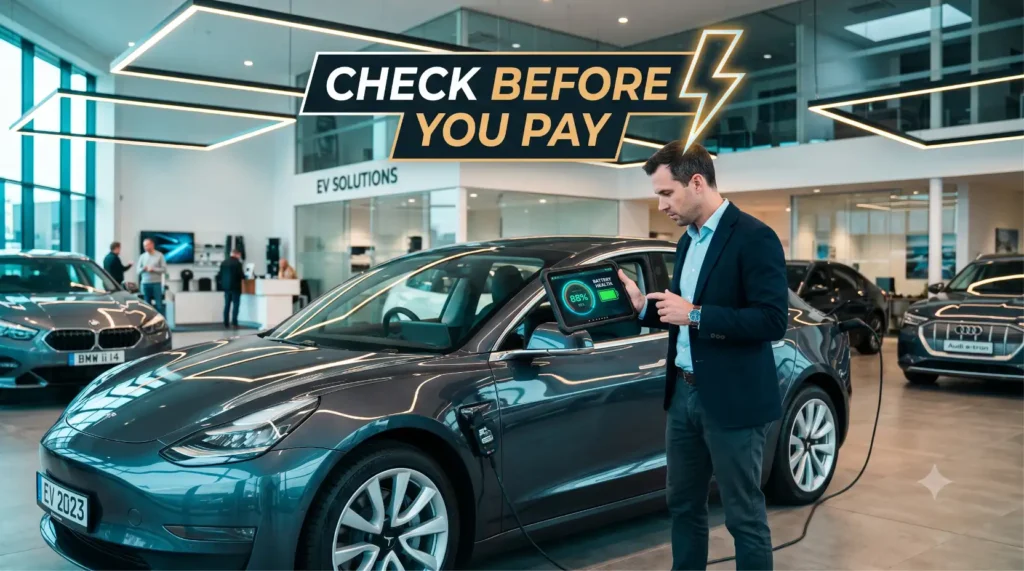
2. Pull the BMS and SoH data. Plug in a Bluetooth OBD2 scanner with a model-specific app and read the State of Health. A legitimately replaced pack should read high — typically mid-90s to ~100% if it was swapped recently. Check cell voltages are balanced and there are no stored fault codes. 🔋
3. Confirm with the manufacturer. A dealer or service center can often verify a battery replacement against the VIN — especially warranty and recall jobs, which are logged in the brand’s system. This is the single most powerful confirmation you can get.
4. Match the story to the data. If the seller says “replaced last year under warranty” but the SoH reads 84%, the story doesn’t add up. A recent OEM pack shouldn’t have aged that much. Contradictions are clues. 🕵️
5. Check the title and history report. Make sure an “accident replacement” isn’t hiding a salvage or rebuilt title. Run the VIN through a history service.
If all five line up, you’ve likely found a quietly excellent car. If two or more don’t, you’ve dodged a problem. 🎯
🚩 The Red Flags That Should Make You Walk
Some signs aren’t just “negotiate harder” — they’re “say thank you and leave.” For a used EV with replaced battery, watch for these. 🔴
Undocumented swap. “The battery was replaced” with zero paperwork is the biggest red flag of all. No invoice, no part number, no installer — you’re trusting a stranger on the most expensive component in the car. Walk. 🚶
Non-OEM pack with no warranty. An aftermarket pack from an unnamed shop, with no warranty and no build details, is a gamble with your safety and your wallet.
Salvage or rebuilt title. If the replacement traces back to a crash or flood and the car carries a salvage/rebuilt title, factor in the structural unknowns, not just the battery. Insurance and resale both get harder too.
Freshly cleared fault codes. A scanner that shows codes were wiped right before your visit suggests someone hid a problem. Re-scan after a test drive. ⚠️
Range that contradicts the SoH. App says 99%, but the car barely delivers half its rated range? The numbers are lying somewhere. 🤔
A seller who gets cagey when you ask for documents. Honest sellers of a legit replacement are proud of it — they hand you the invoice. Evasion is information.
Any single flag here might be survivable with a steep discount. Stack two or three and the “bargain” is a trap. 🪤
💰 Price Implications: What Should You Actually Pay?
So how does a replaced battery move the price? It depends entirely on which version you’re looking at. 💵
Documented OEM replacement, fresh-ish warranty: this should arguably cost more than an equivalent car with an original aging pack — you’re getting more battery life. In practice, market nervousness often keeps it priced similar or slightly lower, which is your opportunity. Pay at or near a comparable healthy car’s price and you’ve won. 🟢
Documented refurbished pack with some warranty: discount versus an OEM-replacement car. Reasonable to pay below market, because the pack quality is a notch down and resale will be softer.
Undocumented or non-OEM swap: discount heavily — to the point where you’re effectively pricing in replacing the pack yourself someday. In the US that’s $10,000–$20,000; in India, roughly ₹6–₹12 lakh. If the price doesn’t reflect that risk, skip it. 🔴
Salvage-title car with replaced pack: these trade at deep discounts (often 30–50% below clean-title equivalents) for good reason. Only for buyers who fully understand salvage risk and have the car independently inspected.
The mental model: a verified replacement should add value; an unverified one should subtract it. Price the car for the version you can actually prove. ⚖️
🇮🇳 The India Context: Swaps, Replacements & a Maturing Scene
India’s used-EV battery picture has its own flavor, and it’s evolving fast. 🌏
First, battery swapping (mostly in the two- and three-wheeler world — think fleets and delivery e-scooters) is a thriving, organized system here, where you literally swap depleted packs for charged ones at a station. That’s different from a replacement, but it means Indian buyers hear “battery swap” a lot — don’t confuse a swap-network scooter with a four-wheeler that had its pack permanently replaced. 🛵
For used EV cars (Nexon EV, MG ZS EV, Tiago EV and friends), a used EV with replaced battery usually means a warranty or failure replacement at an authorized service center. The good news: OEM service networks from Tata, MG, and Mahindra are expanding, and battery jobs are increasingly logged against the chassis number. 🇮🇳
Two India-specific cautions. Heat is the local battery killer — sustained 40–45°C summers stress packs hard, so a replacement that happened in a hot region deserves an extra-careful SoH read. And the third-party refurbished pack market is growing for older/budget EVs; some shops do solid work, but documentation and warranty standards vary, so demand proof of who built the pack and what’s inside.
Bottom line for India: insist on authorized-service documentation, verify the job against the chassis number, and weight the SoH check heavily given the climate. ✅
📈 2026: Battery Replacements Are Becoming More Common
Here’s a shift worth understanding — replaced packs aren’t an oddity anymore, and that changes how you should think about them. 📊
The first big wave of mass-market EVs (2016–2020) is now hitting the age where early packs reach warranty-replacement territory or recall remedies. Simply put: there are more cars on the used market with replaced batteries than ever before, and that number climbs every year. 🔋
Globally, OEM remanufactured-pack programs have scaled up, third-party SoH certification has spread, and replacement documentation has gotten more standardized. A replaced pack is no longer automatically suspicious — it’s increasingly a normal part of an EV’s life cycle, like a timing belt on a petrol car.
In the US, recall-driven replacements (notably across several big launches) put thousands of brand-new packs into otherwise older cars — many of which are now changing hands as quietly excellent used buys. CPO programs increasingly note battery replacement history.
In India, the maturing service networks and the rise of certified pre-owned EV platforms mean replacement records are getting easier to verify against the chassis number.
The takeaway: don’t let “replaced battery” trigger an automatic flinch. In 2026 it’s common, often good, and entirely verifiable. The smart buyer treats it as a question to answer, not a verdict to fear. 🎯
✅ 5 Tips Before Buying a Used EV With a Replaced Battery
Here’s the clean, repeatable game plan — run these in order. 👇
- Get the paperwork first. Invoice, part number, install date, installer. No documents = no deal. 📄
- Confirm OEM vs refurb vs third-party. Know exactly what pack is in the car before you negotiate. 🔍
- Scan the SoH yourself. Plug in an OBD2 reader; a recent replacement should read high and balanced. 🔋
- Verify the warranty in writing. Reset, remaining, or none — confirm it with the manufacturer for the VIN. 🛡️
- Check the title and history. Rule out salvage/flood hiding behind that “accident replacement.” 📋
Five steps, maybe an afternoon. That’s all that stands between a great-value EV and inheriting someone else’s nightmare. ✅
🛒 Shop This Post
The gear that turns “the seller says it’s fine” into “I checked it myself.” 😍
1. A Bluetooth EV OBD2 Scanner 🔋
The core tool to read State of Health on the replaced pack, check cell balance, and catch hidden fault codes. EV-compatible only.
👉 Shop OBD2 battery scanners
2. An Extended EV Warranty / Coverage Plan 🛡️
If the replaced pack’s manufacturer warranty is thin, a solid third-party plan can backstop the most expensive component.
👉 Shop extended EV warranty plans
3. A Smart Home Charger ⚡
Once you buy, gentle scheduled charging protects the (newer) battery you just verified — and keeps the SoH clock ticking slowly.
👉 Shop smart Level 2 / 7kW chargers
🛍️ Shop This Post: (Affiliate picks — no extra cost to you, and they keep EVs Mirror running. 🙏)
🎯 Quick Quiz: Should You Buy This One?
- Does the seller have replacement documentation (invoice + part number)? 🅐 Yes 🅑 No
- Did an OBD2 scan show high, balanced SoH? 🅐 Yes 🅑 No / didn’t check
- Did you confirm the new pack’s warranty status? 🅐 Yes 🅑 No
Mostly 🅐: 🟢 Strong candidate — a verified replacement can be a real bargain. Negotiate and buy with confidence.
Mostly 🅑: 🔴 Pump the brakes. Get the docs, scan the pack, and confirm the warranty before any money moves.
📋 Replaced-Battery Buying Checklist
- [ ] Confirm why the battery was replaced (warranty / failure / recall / accident)
- [ ] Get the replacement invoice, work order, and part number
- [ ] Identify OEM vs refurbished vs third-party pack
- [ ] Confirm an authorized center did the work (ideally)
- [ ] Plug in an OBD2 scanner and read the SoH
- [ ] Check cell-voltage balance and stored fault codes
- [ ] Verify the new pack’s warranty status with the manufacturer
- [ ] Run the VIN/chassis through a title & history check
- [ ] Make sure the price reflects what you can actually prove ⚡
🤔 People Also Ask
Q: Is it safe to buy a used EV with a replaced battery?
A: Yes — a used EV with replaced battery can be perfectly safe and even a smart buy, if the replacement is documented, ideally OEM, installed by an authorized center, and confirmed with a high State-of-Health reading. The risk lies in undocumented, non-OEM, or salvage-linked swaps.
Q: Does replacing an EV battery reset the warranty?
A: Sometimes. Some manufacturers give the new pack a fresh warranty from the install date; others cover it only for the remaining term of the original battery warranty; non-OEM swaps may carry just the installing shop’s warranty or none. Always confirm in writing for the specific VIN.
Q: How do I know if a used EV’s replaced battery is OEM or aftermarket?
A: Ask for the invoice and part number, then cross-check it with a dealer. An OEM pack will match a genuine manufacturer part number and ideally show an authorized-service work order. No paperwork on a used EV with replaced battery is your cue to be very cautious.
Q: Should a replaced battery make the car cost more or less?
A: A documented OEM replacement arguably makes a used EV with a replaced pack worth more, since you’re getting more battery life — yet market nervousness often keeps the price similar or lower, which is your opportunity. Undocumented or non-OEM swaps should knock the price down significantly.
Q: What State of Health should a recently replaced EV battery show?
A: A genuinely recent OEM replacement should read in the mid-90s to roughly 100% SoH with balanced cell voltages. If a “recently replaced” pack reads in the low 80s or shows imbalance, the story and the data don’t match — investigate before buying.
Q: Can a replaced battery hide that the car was in an accident?
A: It can. A pack replaced after a crash or flood may come with a salvage or rebuilt title and structural unknowns. Always run the VIN/chassis through a history report and inspect the body, not just the battery, on any accident-related replacement.
🚀 The Bottom Line
A replaced battery is one of the most misunderstood things on the used-EV market. Half of buyers flinch at it; the other half don’t dig deep enough. The truth sits in between — and it’s entirely knowable. ⚡
A documented, OEM, warranty- or recall-driven replacement can hand you a car that’s years younger where it counts, often at a price softened by other buyers’ fear. An undocumented, non-OEM, or salvage-linked swap can bury the exact failure that scared off the last owner. The difference is paperwork, an OBD2 scan, and one phone call to the manufacturer.
So when you spot a used EV with replaced battery, don’t react — investigate. Get the documents, read the SoH yourself, confirm the warranty, and check the title. Do that and you flip the unknown into your favor, turning a scary-sounding listing into possibly the best value on the lot. 🔋
💬 Bought a used EV with a replaced pack? Drop the model, SoH, and what you paid in the comments to help other buyers benchmark!
📤 Know someone EV-shopping? Send them this guide before they pay. 🙏
🔖 Bookmark EVs Mirror for honest used-EV buying advice.
👉 Up next: How to Check Battery Health on a Used EV and How to Verify a Used EV’s Battery Warranty Transfer