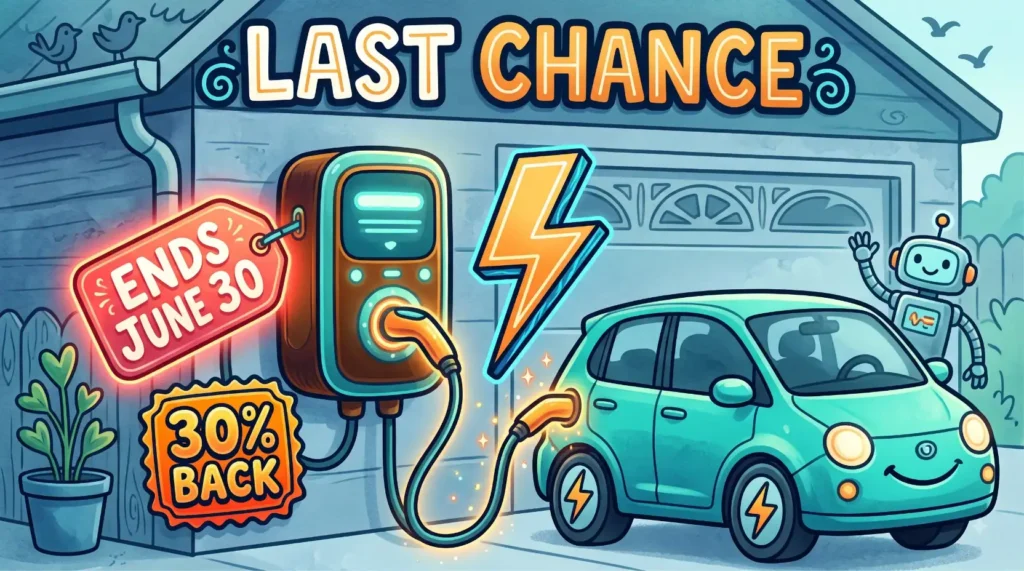
Here’s the news that should be lighting up every EV owner’s group chat this week: the federal credit that pays you back 30% of a home EV charger install is about to disappear. ⚡
Under Public Law 119-21, the Section 30C credit — the one that returns up to $1,000 on a residential charger plus installation — is still alive in 2026, but it’s been handed a hard expiration date.
That date is June 30, 2026. As of this writing, that’s days away, not months. If you’ve been “thinking about” a Level 2 charger, the math just got urgent.
This is your plain-English breakdown of the home EV charger tax credit deadline — what’s ending, the location catch that trips people up, and exactly how to beat the clock. 👇
⚠️ Read this first — YMYL disclaimer: This is a Your-Money-Your-Life tax topic, so let’s be straight. This article is general information, not financial or tax advice. Eligibility rules — including the census-tract location requirement — and deadlines vary and can change. The 30% rate, the $1,000 residential cap, the June 30, 2026 deadline, and the figures below are framed as general guidance, current as of June 2026. Always verify on IRS.gov and confirm your situation with a qualified tax professional before you buy, install, or file. 🧾
⚡ The Short Answer
If you only read one section, read this one:
- 💵 The Section 30C credit returns 30% of your home charger’s hardware + installation cost.
- 🧢 For homes, it’s capped at $1,000 per charging unit.
- ⏳ It ends June 30, 2026 — property must be placed in service by that date (per Public Law 119-21).
- 📍 Your home must sit in an eligible census tract (the big catch — more below).
- 🧾 You claim it on IRS Form 8911 with your federal return.
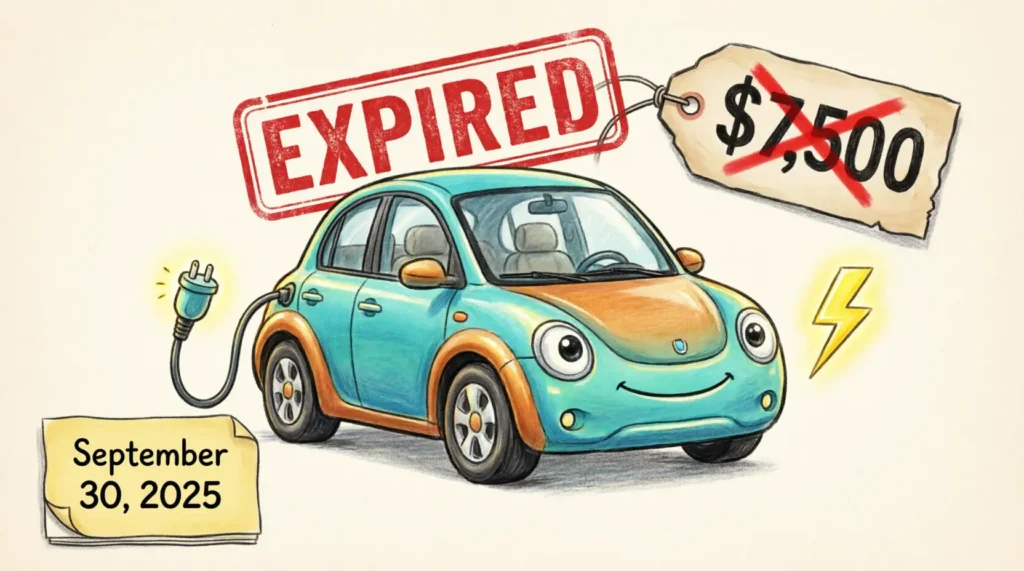
- 🚗 The federal EV purchase credit already expired on September 30, 2025 — the charger credit is what’s left.
- ✅ “Placed in service” generally means installed and ready to use, not just ordered.
Translation: this is genuinely a last-chance window. Move fast, document everything, and verify the current rules with the IRS. 😎
📊 Beat-the-Deadline Action Plan — At a Glance
Here’s the whole urgency in one table. Treat these as the general framework — confirm exact dates and figures on IRS.gov. 👇
| Step | Deadline-driven action | Why it matters |
|---|---|---|
| 📍 Check your census tract | Do this first, today | If your address isn’t eligible, nothing else matters |
| 🛒 Buy the charger | ASAP — don’t wait for sales | Shipping delays can blow the install date |
| 🔧 Book the electrician | Schedule immediately | Licensed installers book out; June is crunch time |
| ⚡ Get it “placed in service” | On or before June 30, 2026 | This is the legal trigger — not the order date |
| 🧾 Save itemized receipts | At time of purchase + install | No paper trail, no clean Form 8911 claim |
| 📄 File Form 8911 | With your federal return | This is where the 30% actually lands |
The headline takeaway: the clock is on the install date, not the purchase date. That changes everything about how you plan. 🎯
🔌 What the Section 30C Home Charger Credit Actually Is
Let’s name it properly. The thing people call the “home EV charger tax credit” is officially the Alternative Fuel Vehicle Refueling Property Credit, found in Section 30C of the tax code. 📜
It’s a federal income-tax credit for installing equipment that “refuels” alternative-fuel vehicles — and electricity counts, so your home EV charger qualifies as refueling property.
A credit is not a deduction. A deduction shaves your taxable income; a credit cuts your actual tax bill dollar-for-dollar. That makes it worth far more than the same number as a write-off. 💪
For a home install, the deal is simple to state: 30% of your eligible cost, capped at $1,000 per charging unit. Spend $3,000 on hardware plus install, and 30% is $900 — comfortably under the cap. Spend $5,000, and the cap clips your credit to $1,000.
One important nuance: this credit is nonrefundable. It can reduce your tax owed down to zero, but it won’t generate a refund check beyond what you already paid in. No tax liability that year, no benefit. ⚖️
💡 New to all of this? Our companion guide The 30% EV Charger Tax Credit Explained (2026) covers the mechanics in depth — this article is specifically about the deadline.
⏳ The Hard Deadline: Placed in Service by June 30, 2026
This is the heart of the story, so let’s slow down. Under Public Law 119-21, the Section 30C credit gets a firm end date: the property generally must be placed in service on or before June 30, 2026. ⏳
“Placed in service” is the phrase that matters most, and it trips people up constantly. It does not mean the day you ordered the charger. It does not mean the day it arrived in the box on your porch.
In general, placed in service means the charger is installed, connected, and ready and available for use. The electrician finished, the breaker is in, the unit powers up and can actually charge a car.
Why does this distinction matter so much right now? Because the home EV charger tax credit deadline is measured against that install-and-ready date — and installs take time. 🛠️
Think about the realistic chain: you research, you buy, the unit ships, you find a licensed electrician, they quote you, they schedule you, they do the work, maybe you need a permit or an inspection. Each link eats days.
⚠️ The trap: ordering a charger on June 28 does not lock in the credit if it’s not installed and operational by June 30. Plan backward from the deadline, not forward from your impulse to buy. 🎯
Confirm the exact “placed in service” definition and the June 30, 2026 cutoff on IRS.gov — this is precisely the kind of detail where the official wording governs, not a blog summary. 🧾
📍 The Eligibility Catch: The Census-Tract Requirement
This is the section most “30% back!” headlines conveniently skip — and it’s the one that disqualifies a lot of people before they even start. 📍
Under the Section 30C rules, the charger credit only applies if your installation address sits in an eligible census tract. Broadly, those are tracts that qualify as low-income communities or non-urban (rural) areas. 🗺️
In plain terms: the program was deliberately targeted to push charging infrastructure into underserved and rural areas — not every suburban driveway in the country automatically qualifies. Your address can be the single deciding factor.
So before you spend a dollar in this final stretch, do the location check first. It’s the cheapest, fastest step, and it can save you from buying a charger expecting a credit you were never going to get.
How do you check? The IRS and the Department of Energy have pointed taxpayers to mapping tools where you punch in an address (or its census-tract ID) and see whether it falls in an eligible tract. Your tax software or tax pro can also run this check.
⚠️ Don’t skip this — especially under deadline pressure. Rushing to install by June 30 means nothing if your tract isn’t eligible. Confirm eligibility before you assume you’ll get the credit, and verify the current map and definitions on IRS.gov, because the eligible-tract rules can shift. 🎯
Bottom line: the census-tract requirement genuinely limits who qualifies. It’s the biggest reason an otherwise-perfect, beat-the-deadline claim still gets denied. ⚠️
🧾 How to Claim It: IRS Form 8911
The form that turns all of this into a real claim is IRS Form 8911, “Alternative Fuel Vehicle Refueling Property Credit.” 🧾
At a high level, Form 8911 walks you through:
- 📍 Confirming the property is in an eligible census tract.
- 💵 Reporting the total cost of the charger plus installation.
- 🔢 Calculating 30% of that cost.
- 🧢 Applying the $1,000 residential cap.
- ⚖️ Reconciling against your tax liability, since the credit is nonrefundable.
You’ll attach it to your federal return (Form 1040 for individuals), and the result flows through to reduce your tax owed. 🧮
Here’s the timing twist that confuses people: you install by June 30, 2026, but you file Form 8911 later — on the tax return covering that year. The deadline is on the install; the paperwork follows on schedule.
A few practical pointers:
- 🗂️ Have your itemized invoices ready — hardware and labor split out cleanly.
- 🏠 Note the install address and census-tract status.
- 💻 Good tax software with energy-credit support will usually handle Form 8911 and run the tract check.
💡 The exact form, lines, and worksheets can change year to year. Pull the current Form 8911 and instructions straight from IRS.gov before you file. 🎯
🔧 What Counts: Charger + Installation + Panel Work
Here’s the part that surprises people — and it’s where a lot of the value lives, so it’s worth getting right before the home EV charger tax credit deadline. 🔌
The Section 30C credit doesn’t just cover the shiny wall box. It has generally applied to both the charging equipment and the cost of installing it. That bundle typically includes:
- ⚡ The charger itself (the EVSE / Level 2 unit).
- 🔧 The electrician’s labor to mount and wire it.
- 🧰 Associated electrical work — new circuits, conduit, a dedicated breaker.
- 🔌 In many cases, the panel upgrade if your home needed more capacity.
- 📋 Permits and certain materials tied to the install.
Why does this matter so much? Because installation is frequently the bigger line item. A Level 2 charger might run a few hundred dollars, but if your panel is maxed out and the run to the garage is long, the install can dwarf the hardware. 😅
Since the credit is 30% of the combined cost, those install dollars pull real weight. Keep every receipt and invoice — itemized, dated, and clearly tied to the charger project. That paper trail is what makes or breaks your claim. 📄
One deadline-specific reminder: the panel upgrade and permit/inspection steps are often what delay an install. If your home needs panel work, that adds time — yet another reason to start now, not the last week of June. ⏳
🛠️ How to Actually Get It Done Before the Deadline
Knowing the rules is one thing. Beating a real calendar date is another. Here’s the realistic playbook for getting it installed and placed in service in time. 🏃
1. Check the census tract today. Before anything else. If your address isn’t eligible, you’ve just saved yourself a scramble. 📍
2. Buy the charger now — don’t wait for the perfect sale. A few dollars saved on hardware means nothing if shipping delays push your install past June 30. Pick a quality Level 2 unit and order it. 🛒
3. Book a licensed electrician immediately. June is crunch time; the good installers get booked solid as deadlines approach. Get on the calendar even before the unit arrives. 🔧
4. Plan for panel work and permits. If your panel is full or your jurisdiction requires a permit and inspection, build that extra time in. This is the most common cause of a missed deadline. 🧰
5. Confirm “placed in service.” The job isn’t done until the unit is installed, energized, and ready to charge — and you have a dated, itemized invoice proving it. ⚡
🔗 Not sure how a home install actually works step by step? Read our full walkthrough: How to Install a Home EV Charger. It covers the wiring, the permit, and the timeline — exactly what you need to map against this deadline.
The single biggest mistake right now is assuming you have more time than you do. Plan backward from June 30, 2026, and give yourself a buffer. 🎯
🛑 Avoiding Charger Buying Mistakes While Rushing
Here’s the danger of a deadline: it makes people buy badly. When the clock is ticking, it’s tempting to grab the cheapest box on the shelf or skip the homework — and that’s exactly how a “money-saving” credit turns into a money-losing purchase. 😬
A few rush-driven traps to dodge:
- ⚠️ Buying an underpowered or non-future-proof unit just because it’s in stock. You’ll live with this charger for years.
- 🔌 Grabbing a plug-in unit when you needed hardwired (or vice versa) for your install and electrical setup.
- 🧰 Forgetting your panel can’t handle it, then discovering it mid-install — a classic deadline-killer.
- 💸 Skipping the amperage and connector check, then paying for a do-over.
- 📄 Not getting an itemized invoice, which weakens your Form 8911 claim.
The credit gives you 30% back, but only on a charger you actually want to keep. Buying the wrong unit to “save money” can cost you far more than the credit returns. 🤔
🔗 Before you rush-buy, take five minutes with EV Charger Buying Mistakes That Cost You Hundreds. It’s the fastest way to avoid an expensive deadline-panic purchase.
Speed and smarts aren’t mutually exclusive. Move quickly, but buy the right charger — the deadline rewards being fast, not being careless. 🎯
🗺️ What’s Left After June 30: State and Utility Rebates
So the federal home EV charger tax credit deadline passes — then what? The good news: the federal credit was never the only game in town. 🧱
After June 30, 2026, your best remaining levers are typically state programs and utility rebates, and many of those run on their own timelines that have nothing to do with the federal sunset.
Utility rebates. A large number of electric utilities offer rebates for installing a Level 2 charger — sometimes a flat dollar amount, sometimes a credit for enrolling in an off-peak or managed-charging program. These vary wildly by provider, so check yours directly. ⚡
State and local programs. Some states and municipalities run their own charger-install incentives, time-of-use rate plans, or rebates tied to income or location. These are independent of Section 30C and may well outlive it.
💡 Want the deeper dive? See our companion piece on utility home-charger rebates — it walks through how to find and stack what your provider offers.
One reminder for the next tax season: the federal EV purchase credit (the credit on the car itself) already expired on September 30, 2025. So the landscape after June 30, 2026 is largely state, local, and utility-driven — federal charger support is what’s sunsetting now. Verify everything locally before you count on it. 🎯
🇮🇳 India Contrast: PM E-DRIVE and State Charger Support
For our India readers, the picture looks different — and in some ways, more forward-leaning right now. 🇮🇳
The US is sunsetting its federal home-charger credit at the end of June 2026. India, by contrast, is still building out its support framework, with charging infrastructure treated as a national priority rather than an expiring perk.
The PM E-DRIVE scheme is the headline program, with allocations aimed at expanding public and shared charging infrastructure across cities and highways. It’s part of a broader push to make charging access — not just vehicle subsidies — a pillar of EV adoption. 🔌
On top of that, several state EV policies offer their own charger and infrastructure support: capital subsidies, land or electricity-tariff concessions for public chargers, and incentives that vary state to state.
The contrast is instructive. A US homeowner reading this should feel the urgency of a closing window; an India reader is watching an expanding one. Either way — verify the live terms, because Indian state policies and central scheme rules change frequently too. ₹/🎯
📈 2026: Post-Deadline Charger Incentive Trends
Here’s the honest read on where things head after June 30, 2026. 📅
- 🔻 Federal pullback. With Section 30C sunsetting and the vehicle credit already gone, the federal layer of EV support thins out considerably. The center of gravity shifts to states and utilities.
- ⚡ Utilities step up. Expect more utility-led managed-charging rebates and time-of-use rate incentives, since grid operators have a direct interest in shaping when EVs charge.
- 🗺️ State patchwork grows. With less federal cover, state and city programs become the main story — and the gap between EV-friendly and EV-indifferent states widens.
- 💡 Bundling and financing. Watch for installers and automakers bundling charger costs into financing or lease deals to soften the loss of the federal credit.
- 🌍 Global divergence. As the US trims, markets like India keep expanding infrastructure support — a reminder that incentive timelines are political and local.
The practical move: don’t assume the federal credit comes back. If you qualify now, claim it now. After the deadline, your homework shifts to your state and your utility. 🎯
💵 If you’re financing a charger or an EV around these changes, weigh the numbers carefully — incentive timing can meaningfully shift the total cost of ownership.
✅ 5 Steps to Claim It in Time
- Check your census tract today — make-or-break, do it first. 📍
- Buy the charger and book a licensed electrician now — don’t wait. 🛒🔧
- Get it placed in service on or before June 30, 2026 — installed and ready. ⚡
- Save every itemized hardware + installation receipt. 🧾
- File IRS Form 8911 with your federal return and consult a tax pro. 📄
🛒 Shop This Post
Gear and tools to beat the home EV charger tax credit deadline. 😍
1. A Smart Level 2 Home Charger ⚡
The hardware cost is the first thing that counts toward your 30%. With the clock ticking, pick a quality, in-stock Level 2 unit you’ll actually want to keep for years.
👉 Shop smart Level 2 home chargers
2. A Licensed Electrician / Installer Finder 🔧
“Placed in service” means professionally installed and ready — and June books out fast. Use a finder tool to lock in a vetted, licensed pro who gives you an itemized invoice.
👉 Find a licensed EV charger installer
3. Tax Software With Energy-Credit Support 🧾
The right software handles Form 8911, runs the census-tract check, and helps you avoid leaving the credit on the table before it expires.
👉 Shop tax software with energy-credit support
🛍️ Affiliate disclosure: Some links above are affiliate links. If you buy through them, EVs Mirror may earn a small commission at no extra cost to you — it helps keep our money guides free. 🙏
🎯 Quick Quiz: Can You Still Beat the Deadline?
- Is your home address in an eligible census tract? 🅐 Yes 🅑 No / Not sure
- Can the charger realistically be installed and ready by June 30, 2026? 🅐 Yes 🅑 No
- Have you (or will you) book a licensed electrician with an itemized invoice? 🅐 Yes 🅑 No
- Will you have enough tax liability to absorb a nonrefundable credit? 🅐 Yes 🅑 No
Mostly 🅐: 🟢 You’re in striking distance — move now and file Form 8911.
Mostly 🅑: 🟡 Start with the census-tract check and an installer call today before you assume anything.
📋 Last-Chance Checklist
- [ ] Confirmed my address is in an eligible census tract
- [ ] Confirmed the current rate (30%) and cap ($1,000 residential)
- [ ] Bought the charger with shipping that beats the deadline
- [ ] Booked a licensed electrician (and accounted for permits/panel work)
- [ ] Charger is placed in service on or before June 30, 2026
- [ ] Saved the itemized hardware receipt
- [ ] Saved the installation + panel-work invoice
- [ ] Saved permit and materials documentation
- [ ] Planned to file IRS Form 8911 with my federal return
- [ ] Consulted a tax professional ⚡
🤔 People Also Ask
Q: When is the home EV charger tax credit deadline?
A: The home EV charger tax credit deadline is June 30, 2026, per Public Law 119-21. The Section 30C credit returns 30% of a home charger plus installation (up to $1,000 for homes), but the property must generally be placed in service — installed and ready to use — on or before that date. Verify current rules with the IRS.
Q: What does “placed in service” mean for the charger deadline?
A: “Placed in service” generally means the charger is installed, connected, and ready and available to use — not just ordered or delivered. For the home EV charger tax credit deadline, the install-and-ready date is what counts, so ordering on June 28 won’t help if it isn’t operational by June 30, 2026.
Q: Did the federal EV tax credit already expire?
A: The federal EV purchase credit (the credit on the car) expired on September 30, 2025. The Section 30C charger credit is separate and is still available in 2026 — but it ends June 30, 2026. They’re two different credits on two different forms, with two different timelines.
Q: Does my home’s location affect whether I qualify?
A: Yes, significantly. The Section 30C credit applies only if your install address sits in an eligible census tract — generally low-income or non-urban areas. This genuinely limits who qualifies, so check your address on an IRS/DOE mapping tool before you buy a charger expecting the credit.
Q: How much is the home charger credit worth?
A: It’s 30% of the combined cost of the charger hardware plus installation, capped at $1,000 per charging unit for homes. So once your eligible spend hits roughly $3,300, you’ve maxed the residential cap. It’s also nonrefundable, so you need enough tax liability to use it.
Q: What happens to charger incentives after June 30, 2026?
A: After the federal Section 30C deadline, your main remaining levers are state programs and utility rebates, which run on their own timelines. Many utilities offer Level 2 charger rebates or managed-charging incentives. Check your state and provider directly, since these vary widely.
🚀 The Bottom Line
The home EV charger tax credit deadline is real, it’s close, and it rewards people who act now. Under Public Law 119-21, the Section 30C credit — 30% of your home charger plus installation, up to $1,000 — ends June 30, 2026. ⏳
The catches are equally real. Your address has to sit in an eligible census tract, the charger has to be placed in service (installed and ready) by the deadline, you need enough tax liability to use a nonrefundable credit, and you’ll file Form 8911 with clean, itemized receipts.
So plan backward from June 30: check your tract first, buy and install quickly without buying the wrong unit, document everything, and confirm the current rules on IRS.gov with a tax professional. Then claim the slice of your charging setup that’s rightfully yours — before the window closes. ⚡
💬 Racing the deadline? Tell us how your install is going in the comments!
📤 Know someone still “thinking about” a charger? Send them this before June 30. 🙏
🔖 Bookmark EVs Mirror for honest, no-hype EV money guides.
👉 Up next: How to Install a Home EV Charger — map the install timeline against the deadline.
This article is general information, not financial or tax advice. Eligibility (including census-tract location rules) and deadlines vary — the Section 30C Alternative Fuel Vehicle Refueling Property Credit can change or expire. Verify current rules with the IRS and a qualified tax professional. Figures current as of June 2026.