Let’s get one thing out of the way: the loudest myth in the EV world is that you need a garage and a wall charger to own one. You don’t. Millions of people park on the street, in a shared lot, or in an apartment basement with zero outlets — and they drive electric just fine.
The trick isn’t owning the perfect parking spot. It’s owning the right car and having a smart charging plan. Some EVs are practically built for people without a driveway: they sip energy, gulp down DC fast charging in 20 minutes, and have enough range that you only top up once or twice a week. Others will leave you sweating in a charging-station queue every other day.
That difference is everything. So if you live in a flat, a walk-up, or a high-rise and you’ve been wondering whether going electric is even realistic, this guide is for you. We’re going to break down exactly what to look for and name the best EV for apartment living in 2026.
- ⚡ The Short Answer
- 🔋 6 Apartment-Friendly EVs at a Glance
- The Apartment EV Challenge: No Overnight Charging
- What Makes an EV Apartment-Friendly?
- The Best Picks: Cars That Charge Fast or Go Far
- Public Charging Strategy for Apartment Dwellers
- Workplace & Destination Charging: Your Secret Weapon
- Getting a Charger Installed: Right-to-Charge Laws
- The Portable Charger as Your Backup Plan
- The India Apartment & Society Charging Reality
- 📈 2026: Apartment Charging Is Getting Easier
- ✅ 5 Tips for Apartment EV Owners
- 🛒 Shop This Post
- 🎯 Quick Quiz: Is an EV Right for Your Apartment Life?
- 📋 Apartment EV Buyer's Checklist
- 🤔 People Also Ask
- 🚀 The Bottom Line
⚡ The Short Answer
If you’re short on time, here’s the quick version:
- Efficiency beats raw range. A car that does 4+ miles per kWh (or ~6 km/kWh) means less time charging, period.
- Fast-charging speed is king. Look for 150 kW+ DC charging and a 10–80% time under 30 minutes.
- A 250+ mile / 400+ km real-world range gives you a buffer so you’re not charging constantly.
- Top picks: efficient compact EVs and well-engineered sedans/crossovers like the Tesla Model 3, Hyundai Ioniq 6, Tata Curvr.EV (India), and the Chevy Equinox EV.
- Your charging plan matters as much as the car — mix public DC fast chargers, workplace outlets, and a portable charger as backup.
- You do not need home charging to own an EV. You need a good car and a routine.
🔋 6 Apartment-Friendly EVs at a Glance
Prices and specs below are illustrative for 2026 and vary by trim and region.
| EV (Archetype) | Efficiency | Fast-Charge Speed | Real Range | Why It’s Apartment-Friendly |
|---|---|---|---|---|
| Efficient Sedan (e.g. Hyundai Ioniq 6) | ~4.4 mi/kWh (~7 km/kWh) | 350 kW peak, 10–80% in ~18 min | 290 mi / 470 km | Sips energy + ultra-fast charging = fewer stops |
| Mainstream Sedan (e.g. Tesla Model 3) | ~4.2 mi/kWh (~6.7 km/kWh) | 250 kW, 10–80% in ~25 min | 270 mi / 435 km | Huge Supercharger network = easy public charging |
| Compact Crossover (e.g. Chevy Equinox EV) | ~3.6 mi/kWh (~5.8 km/kWh) | 150 kW, 10–80% in ~30 min | 300 mi / 480 km | Long range buffer means weekly charging only |
| City Hatchback (e.g. BYD Dolphin) | ~4.5 mi/kWh (~7.2 km/kWh) | 88 kW, 10–80% in ~32 min | 200 mi / 320 km | Tiny battery charges fast; cheap to run |
| India Compact SUV (e.g. Tata Curvv.EV) | ~6 km/kWh | 70 kW, 10–80% in ~40 min | 400 km (claimed) | Affordable + growing DC network support |
| Premium Crossover (e.g. Kia EV6) | ~3.8 mi/kWh (~6.1 km/kWh) | 240 kW, 10–80% in ~18 min | 280 mi / 450 km | 800V architecture = blistering charge speeds |
The Apartment EV Challenge: No Overnight Charging
Here’s the core problem. The whole convenience pitch of an EV — “plug in at night, wake up full” — assumes you have a wall socket near your car. For apartment dwellers, that’s often a fantasy.
Maybe your building’s parking is a shared open lot with no outlets. Maybe you park on the street and the nearest cable would have to cross a sidewalk. Maybe your society’s underground parking technically has power, but the management committee won’t approve a charger. Sound familiar?
This is the single biggest reason renters hesitate to go electric. And honestly, it’s a fair concern. Without that overnight top-up, you have to think about where and when you’ll charge — the way drivers once thought about gas stations.
But here’s the good news. The charging world has changed dramatically. Public DC fast chargers are now common in cities, malls, and along highways. Workplaces are adding stations. And the cars themselves have gotten so efficient that you simply don’t need to charge as often. The best EV for apartment living turns “no home charging” from a dealbreaker into a minor scheduling habit.
What Makes an EV Apartment-Friendly?
Not all EVs are equal when you can’t plug in at home. Three traits separate the winners from the headaches.
1. Efficiency. This is the most overlooked spec. An efficient EV that does 4+ miles per kWh (roughly 6.5+ km/kWh) stretches every charging session further. If you only charge in public — where you’re paying premium rates and burning your own time — efficiency directly saves you money and minutes.
2. Fast-charging speed. When you can’t trickle-charge overnight, you want to be in and out. Look for a peak DC rate of 150 kW or higher and a 10–80% time under 30 minutes. Cars on 800-volt architecture (Kia EV6, Hyundai Ioniq 6) can hit 80% in under 20 minutes — that’s a coffee break, not a chore.
3. Range buffer. You don’t need 400 miles. But a comfortable 250+ mile (400+ km) real-world range means you charge once or twice a week instead of every other day. Fewer sessions = fewer trips to the charger = a happier you.
Get these three right and apartment ownership feels almost effortless. Get them wrong — a slow-charging, inefficient car with mediocre range — and you’ll resent every charging stop.
The Best Picks: Cars That Charge Fast or Go Far
Let’s translate those traits into actual cars. These archetypes consistently win for people without a driveway.
The efficiency champion — Hyundai Ioniq 6. This sleek sedan is one of the most efficient EVs you can buy, sipping energy thanks to its slippery aerodynamic shape. Pair that with 350 kW peak charging and you get a 10–80% top-up in roughly 18 minutes. For an apartment dweller, that’s the dream combo: rare charging stops that are also blazing fast. Around $43,000 / ₹62 lakh equivalent.
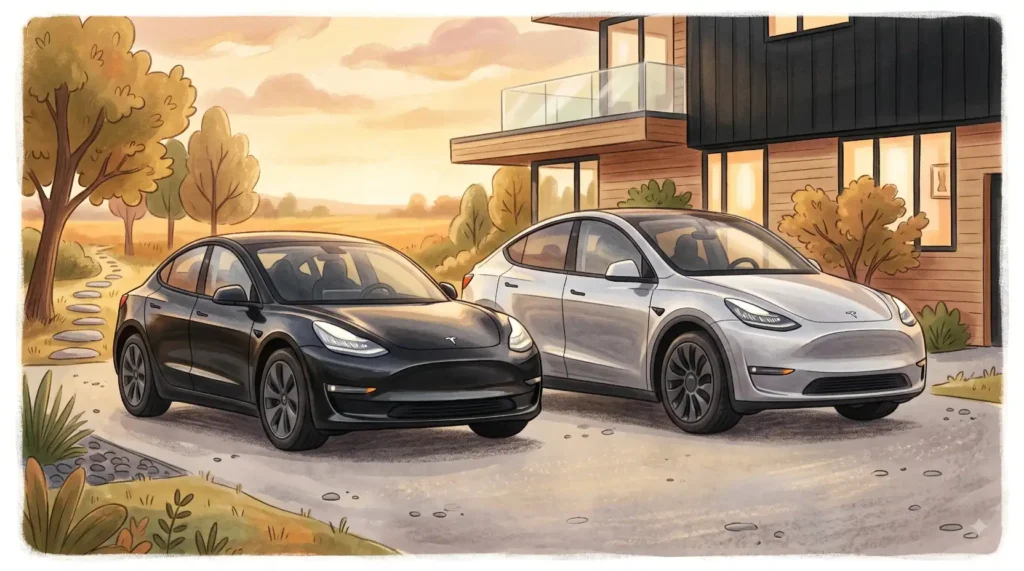
The network king — Tesla Model 3. The car itself is excellent — efficient, ~270 miles of range, solid 250 kW charging. But the real draw is the Supercharger network, the most reliable and widespread fast-charging system on Earth. If your peace of mind depends on always finding a working charger, this matters enormously. From about $40,000 / ₹58 lakh.
The range cushion — Chevy Equinox EV. At roughly $35,000, it offers an honest 300-mile range at a fair price. The charging isn’t the fastest (150 kW), but with that much range you simply charge less often — sometimes just once a week. Great value for US apartment renters.
The city sipper — BYD Dolphin. Small battery, high efficiency, and affordable. It won’t win range contests, but its little pack fills up fast and costs almost nothing to run — ideal for urban dwellers who mostly drive short distances.
For India, the Tata Curvv.EV and similar compact electric SUVs hit the sweet spot of affordability and a growing DC fast-charge network — more on the India reality below.
Public Charging Strategy for Apartment Dwellers
Owning the right car is half the battle. The other half is building a charging routine you barely have to think about. Here’s how successful no-home-charging EV owners do it.
Anchor to one reliable fast charger. Find a DC fast charger you trust — near your gym, grocery store, or commute — and make it your home base. Charging becomes “the thing I do while I shop on Sundays” instead of a special errand.
Charge to 80%, not 100%. DC charging slows dramatically past 80%. Stopping there keeps each session short and is gentler on the battery. Top up more often, briefly, rather than waiting for a long full charge.
Use apps to scout ahead. Tools like PlugShare, A Better Route Planner, and your car’s native map show real-time charger availability and reliability ratings. A 30-second check saves you from arriving at a broken or occupied station.
Off-peak when you can. Many networks charge less at off-peak hours. If you can shift your weekly session to a quieter, cheaper window, your running costs drop noticeably.
Do this for two weeks and it stops being a “strategy.” It’s just your routine — and it takes less total time than you’d think.
Workplace & Destination Charging: Your Secret Weapon
Here’s a tip that quietly transforms apartment EV ownership: charge where you already spend time.
Workplace charging is the closest thing to home charging an apartment dweller can get. If your office has even a slow Level 2 charger, plugging in during an 8-hour workday means you arrive home effectively full — no separate charging trip at all. Don’t have chargers at work? It’s worth asking facilities. Employers are adding them fast as an employee perk, and the install is often subsidized.
Destination charging is the other half. Malls, supermarkets, cinemas, hotels, and restaurants increasingly offer chargers, often free or cheap, while you do something else anyway. Park, plug in, go about your business, and return to extra range you got “for free” time-wise.
Stack these two and many apartment owners barely touch a paid DC fast charger. Your car charges while you work, shop, and dine. That’s the magic of decoupling charging from where you sleep.
Getting a Charger Installed: Right-to-Charge Laws
Don’t assume your building is a permanent no. Things are shifting in your favor.
In the US, a growing number of states have right-to-charge laws that prevent landlords and homeowners’ associations from unreasonably blocking a tenant or owner from installing an EV charger at their own parking space (usually at their own cost). California, Colorado, Florida, New York, and others have versions of this. If you own a condo, this can be a powerful lever — your HOA may be legally required to allow it.
Even where laws don’t apply, it’s worth a polite conversation with building management. Pitch it as a property value upgrade: EV chargers make units more attractive to future renters and buyers. Some buildings will install shared chargers if a few residents request them, splitting the cost or running it through billing.
For renters, the math is trickier since you may not want to fund an install you’ll leave behind. But shared building chargers, billed per use, are increasingly common — and absolutely worth lobbying your landlord for. The best EV for apartment living is even better when your building meets you halfway.
The Portable Charger as Your Backup Plan
Even with a great public-charging routine, every apartment EV owner should carry one piece of insurance: a portable charger.
A good portable EV charger lives in your trunk and plugs into a regular wall outlet (Level 1) or a 240V outlet (Level 2) if you can find one. It won’t fast-charge — Level 1 adds maybe 3–5 miles of range per hour — but that’s not the point. The point is options.
Visiting family with a garage? Plug in overnight. Found a standard outlet near your parking spot the building doesn’t mind you using? Slow-trickle while you sleep. Stuck low on a weekend with every fast charger busy? A few hours on any outlet gets you to the next station.
Think of it as a charging safety net. It turns any ordinary socket — anywhere you happen to be — into a backup charging point. For people without dedicated home charging, that flexibility is genuinely priceless. We dig into the best options in our guide to the Best Portable EV Chargers You Can Keep in the Trunk.
The India Apartment & Society Charging Reality
India’s apartment situation deserves its own honest look, because the dynamics are different.
Most urban Indians live in apartment complexes or “societies” governed by a Resident Welfare Association (RWA) or management committee. Getting a charger approved in shared parking can mean navigating committee politics, electrical load concerns, and metering questions. It’s doable, but it takes patience.
The good news: India’s public charging network is expanding rapidly. Tata Power, Statiq, Ather Grid, and others are blanketing metros and highways with DC fast chargers. Many malls and tech parks now offer charging. And government policy increasingly requires new residential projects to include EV-ready parking provisions.
The practical move in India is a hybrid approach. Push your RWA for at least a metered slow charger in your parking spot — many societies now allow this with a dedicated sub-meter so you pay your own electricity. Meanwhile, lean on the growing public network for faster top-ups. Efficient cars like the Tata Curvv.EV or MG Comet (for short city hops) make this routine painless because they need charging less often. Running costs stay low — often ₹1–2 per km versus ₹7–8 for petrol.
📈 2026: Apartment Charging Is Getting Easier
If there were ever a year to stop worrying about this, it’s now. The trend lines all point the same direction.
Public chargers are multiplying. Both the US and India are adding DC fast chargers at a record pace, with better reliability and higher speeds (350 kW sites are spreading).
Curbside and lamppost charging is arriving. Cities are installing slow chargers right into street parking and streetlights — a game-changer for people who park on the road.
Right-to-charge protections are expanding. More states and Indian municipal codes are mandating EV-ready buildings and protecting residents’ right to install.
Cars keep getting more efficient. Each new model year squeezes more miles from every kWh, meaning fewer charging stops for everyone.
The apartment charging gap that scared people in 2021 is closing fast. Waiting another year only means the infrastructure gets better while you keep buying petrol.
✅ 5 Tips for Apartment EV Owners
- Prioritize efficiency over range. A frugal EV charges less often and cheaper. It’s the single best apartment-friendly trait.
- Find your “home” fast charger. Pick one reliable DC station near your routine and anchor everything around it.
- Exploit workplace and destination charging. Plug in while you work, shop, or dine — it’s the closest thing to a home charger.
- Keep a portable charger in the trunk. Any outlet becomes a backup. Cheap insurance for total peace of mind.
- Lobby your building or RWA. Right-to-charge laws and growing demand are on your side — ask about a shared or dedicated charger.
🛒 Shop This Post
A few accessories make apartment EV life dramatically smoother:
- Portable Level 1/2 EV charger — Your trunk-based backup that turns any outlet into a charging point. Non-negotiable for no-home-charging owners.
- Charging cable organizer & storage bag — Keeps your cable clean, tangle-free, and easy to grab at public stations.
- Home/portable Level 2 charger — If you ever get building approval or visit a 240V outlet, this slashes charge times to a few hours.
Disclosure: This post contains affiliate links. If you buy through them, we may earn a small commission at no extra cost to you. We only recommend gear we’d actually use.
🎯 Quick Quiz: Is an EV Right for Your Apartment Life?
Answer yes/no:
- Is there a DC fast charger within 10 minutes of your home, work, or regular errands?
- Does your workplace or a place you visit weekly have any charging at all?
- Do you typically drive under 200 miles (320 km) per week?
- Are you okay charging once or twice a week instead of nightly?
3–4 yes: You’re absolutely ready — go electric with confidence. 1–2 yes: Doable with a solid routine and a portable charger. 0 yes: Scout local charging first, but the network is growing fast.
📋 Apartment EV Buyer’s Checklist
- [ ] Chosen an efficient EV (4+ mi/kWh or 6+ km/kWh)
- [ ] Confirmed fast-charge speed (150 kW+, 10–80% under 30 min)
- [ ] Verified a 250+ mi / 400+ km real-world range
- [ ] Mapped reliable public chargers near your routine
- [ ] Checked for workplace/destination charging
- [ ] Bought a portable charger for backup
- [ ] Asked building/RWA about charger installation
- [ ] Downloaded charging apps (PlugShare, ABRP, network apps)
🤔 People Also Ask
Can you own an electric car without home charging?
Yes, absolutely. The best EV for apartment living is designed for exactly this — high efficiency and fast charging mean you only top up at public stations once or twice a week. Millions of renters and apartment dwellers drive electric with no home charger at all.
What is the best EV for apartment living in 2026?
Efficient, fast-charging models lead the pack: the Hyundai Ioniq 6, Tesla Model 3, and Chevy Equinox EV in the US, and the Tata Curvv.EV in India. The common thread is energy efficiency plus quick DC charging, which minimizes how often you need a charger.
How often will I need to charge if I rely on public charging?
With an efficient EV and average driving (under 200 miles/320 km a week), most apartment owners charge just once or twice weekly. A single 20–30 minute DC fast-charge session per week is realistic for many.
Is public charging more expensive than home charging?
Usually yes — DC fast charging costs more per kWh than home electricity. But it’s still typically cheaper than petrol or diesel per mile, especially if you use off-peak rates, free destination chargers, and an efficient car.
Can my landlord stop me from installing an EV charger?
It depends on your location. Many US states have right-to-charge laws limiting how much landlords or HOAs can block installs. Renters face more hurdles than owners, but shared building chargers are an increasingly common middle ground.
Do I need a fast-charging EV if I live in an apartment?
It helps a lot. Without overnight home charging, fast DC charging (150 kW+) means shorter, less frequent stops. A slow-charging EV is workable but far less convenient when every charge happens in public.
🚀 The Bottom Line
Living in an apartment doesn’t shut you out of the EV revolution — it just changes the playbook. Pick a car built for the job: efficient, quick to charge, and with enough range that charging is a weekly habit, not a daily chore. Add a smart public-charging routine, lean on workplace and destination chargers, and keep a portable charger in the trunk as backup.
Do that, and “no home charging” becomes a non-issue. The infrastructure is improving every single month, the cars keep getting better, and the savings over petrol are real. The best EV for apartment living is the one that fits your routine — and in 2026, more of them than ever do.
Ready to pick yours? Start with our roundup of the Best Electric Cars for First-Time Buyers in 2026, then grab a portable charger for your trunk so you’re covered anywhere. Your apartment is no excuse — your next car can absolutely be electric. ⚡