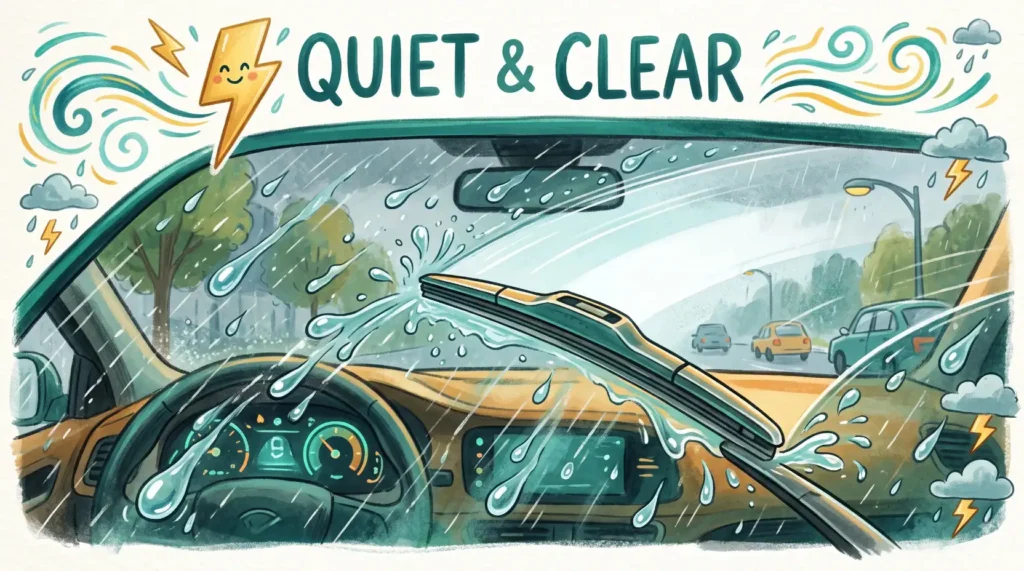
Here’s something nobody warns you about when you switch to electric. 🤫 In a gas car, the engine drone masks a hundred little noises — including the chatter, squeak, and judder of tired wiper blades. In an EV? That cabin is library-quiet. So when your wipers start skipping across the glass on a drizzly morning, every stutter sounds like nails on a chalkboard.
That’s exactly why so many EV owners end up shopping for new blades way sooner than they expected — not because the old ones stopped working, but because they got annoying. 😅 A cheap, noisy blade that you’d never notice in a rumbling SUV becomes the loudest thing in your silent EV.
The good news? Picking the right blade fixes it for years. This guide walks through every wiper type, what actually makes one quiet and long-lasting, plus how to swap them yourself in five minutes. By the end, you’ll know exactly which are the best wiper blades EV drivers should buy in 2026 — for US winters and Indian monsoons alike. 👇
⚡ The Short Answer
Short on time? Here’s the quick version. 🏁
- 🥇 Beam (flat) blades are the best all-around pick for EVs — quiet, aerodynamic, and even-pressure.
- 🌧️ Hybrid blades are the durability champs — great for harsh sun, dust, and heavy rain.
- 💸 Conventional blades are the cheapest, but the noisiest and shortest-lived.
- ❄️ Heated wipers are worth it if you park outside in snow or ice country.
- 🇮🇳 For India’s monsoon, prioritize a graphite/silicone edge and a strong, even sweep.
- 🔧 Replacing them is a genuine 5-minute DIY — no tools, no mechanic, no appointment.
- 💧 Pair new blades with rain repellent + good washer fluid for the quietest, clearest result.
Now let’s get into the details so you can buy once and forget about it — and pick the best wiper blades EV ownership deserves. 😎
📊 EV Wiper Blade Types Compared (2026)
A quick at-a-glance table. Prices are illustrative ranges per blade and vary by size, brand, and retailer. 👇
| Wiper Type | Quietness | Durability | Best Climate | Price Band (illustrative) |
|---|---|---|---|---|
| 🥇 Beam / Flat | Excellent | High | Mixed, windy, cold | $18–$40 • ₹900–₹2,200 |
| 🥈 Hybrid | Very Good | Very High | Hot sun, dust, heavy rain | $15–$35 • ₹800–₹1,800 |
| 🥉 Conventional | Fair | Low–Medium | Mild, dry, budget use | $6–$15 • ₹250–₹700 |
| ❄️ Heated / Winter | Good | High | Snow, ice, freezing | $25–$60 • ₹2,500–₹5,000 |
| 💎 Silicone-Edge | Excellent | Very High | Intense UV, long life | $20–$45 • ₹1,200–₹2,500 |
| 🌧️ Monsoon Heavy-Duty | Good | High | Tropical, heavy rain | $12–$28 • ₹600–₹1,400 |
(Beam and hybrid blades cover the vast majority of EV owners. Pick by your weather, not just price.)
🔇 Why Wiper Choice Matters More on an EV
Let’s start with the thing that makes this guide different from a normal wiper article. 🤔
In an internal-combustion car, the cabin is full of competing sound — engine vibration, exhaust note, transmission hum. Wiper noise hides inside all of that. You could be running ten-dollar blades that squeak on every pass and barely register it over the engine.
An EV strips all that away. ⚡ With no engine and minimal road noise at low speeds, the cabin is eerily quiet — which is one of the best parts of EV ownership. But silence cuts both ways. Every rattle, every squeak, every wiper judder suddenly has center stage.
That’s why the best wiper blades EV owners choose are judged first on quietness, not just cleaning. A blade that smears or chatters in an EV feels far more intrusive than the same blade in a gas car. It’s the difference between a serene rainy-day drive and one where you wince every two seconds. 😬
There’s a second, subtler reason too. EVs are heavy and aerodynamic, and many owners drive them long distances on a single charge — meaning more highway time at speed, where wind lift can peel a poorly designed blade off the glass. A low-profile, aerodynamic blade stays planted at 70 mph (110 km/h) and keeps your view clear without that annoying high-speed flutter. 🧵
So when you shop, think quiet and stable first, then everything else. That single shift in priorities is what separates a satisfying EV upgrade from a frustrating one.
🥇 Beam (Flat) Blades — The Best Match for EVs
If you read nothing else, read this. Beam blades — also called flat blades — are the modern standard, and they’re the best fit for electric cars. 🎯
A beam blade has no exposed external frame. Instead, a curved spring steel spine runs the full length of the blade, distributing pressure evenly across the entire windshield. That even pressure is the secret to a quiet, streak-free, chatter-free wipe. 😌
Here’s why that matters so much in an EV:
- 🔇 They’re quiet. Even pressure means no skipping or juddering — the noise problem solved at the source.
- 🌬️ They’re aerodynamic. The low, sleek profile resists wind lift at highway speed, so no flutter on long trips.
- ❄️ They shed snow and ice better. With no external frame full of joints, there’s nothing for snow and ice to clog.
- 👀 They just look right on a sleek modern EV. Most EVs ship with beam blades from the factory for exactly these reasons.
The trade-off is price — beam blades cost more than conventional ones. But for the price of a couple of lunches ($18–$40 / ₹900–₹2,200 per blade), you get the quietest, most stable wipe available. For most EV drivers, this is the obvious choice and where I’d start — genuinely the best wiper blades EV owners can put on the glass. ✅
🥈 Hybrid Blades — The Durability Champion
Hybrid blades are the clever middle ground, and they’re criminally underrated. 💪
A hybrid blade takes a conventional frame and wraps it in an aerodynamic plastic shell. You get much of the sleek look and wind resistance of a beam blade, plus the rugged, even-contact reliability of a framed design underneath.
Where hybrids really shine is longevity in harsh conditions. 🌡️ That protective shell shields the internal mechanism from sun, dust, and grime — the exact things that destroy blades fastest in hot, dusty climates. If you live somewhere with brutal UV or gritty air, a hybrid often outlasts everything else on the glass.
- ☀️ Excellent in intense sun and heat — the shell protects the rubber and frame.
- 🌫️ Great with dust and grit — fewer exposed joints to clog up.
- 🌧️ Strong in heavy rain — solid, even contact clears big water volumes.
- 💰 Often cheaper than beam blades while lasting as long or longer.
For Indian buyers especially — where heat, dust, and monsoon all hit the same windshield — hybrid blades are frequently the smartest long-term value. 🇮🇳 At roughly $15–$35 / ₹800–₹1,800 per blade, they’re an easy recommendation if durability is your top concern.
🥉 Conventional Blades — Cheap, But Know the Trade-offs
Conventional (traditional) blades are the original design: a metal frame with multiple pressure points holding a rubber strip against the glass. They’re everywhere, and they’re cheap. 💸
There’s nothing wrong with them, exactly — they clear water. But they come with real downsides that matter more in an EV:
- 🔊 Noisier. The multi-point frame is more prone to skipping and chatter — the last thing you want in a silent cabin.
- 🌬️ Less aerodynamic. That exposed frame catches wind and can lift at highway speed.
- ⏳ Shorter lifespan. More exposed parts mean more wear, dirt, and earlier replacement.
- ❄️ Clog with snow and ice. Frame joints pack with ice in winter and stop sealing.
When do they make sense? On a tight budget ($6–$15 / ₹250–₹700 per blade), as a short-term stopgap, or for a second car you barely drive in mild, dry weather. But for your daily EV — the one where you’ll hear every squeak — I’d spend a little more and go beam or hybrid. Your ears will thank you. 🙉
❄️ Heated Wipers — A Game-Changer for Cold Climates
If you live where winter means real snow and ice, heated wipers deserve a serious look. 🥶
Heated blades contain a low-draw heating element that warms the blade and its contact edge. This keeps the rubber pliable in freezing temps, prevents ice from caking onto the blade, and stops that frustrating frozen-to-the-glass situation on cold mornings.
For EVs, there’s a nice bonus: many electric cars already have heated windshield washer systems or heat-pump cabins, so adding heated blades fits naturally into the cold-weather toolkit. ⚡ And because EVs precondition well, a warm windshield plus warm blades means you start your drive with clear glass instead of scraping in the cold.
- 🧊 No more ice-clogged blades that smear instead of clear.
- 🌡️ Rubber stays flexible in sub-freezing temps, so it actually seals.
- 🚗 Pairs perfectly with EV preconditioning for a clear windshield before you even sit down.
The catch is cost and installation — heated blades run $25–$60 / ₹2,500–₹5,000 and some need a wiring connection. For drivers in mild or tropical regions (most of India, the US Sunbelt), they’re overkill. For snow-country owners in the US Northeast, Midwest, or mountain states, they can be genuinely transformative. 🏔️
🔧 Cold weather hits more than your wipers. See the full seasonal rundown in our EV Maintenance Schedule: What to Do and When.
🔍 What to Look For in the Best Wiper Blades for EVs
Type matters, but so do the details. Here’s what actually separates the best wiper blades EV owners love from the ones they return. 🧐
1. Exact fit and connector type. 🎯 This is the number-one mistake. Blades come in specific lengths (often different left vs. right) and use different connector clips — J-hook, pinch-tab, bayonet, side-lock, and more. Check your owner’s manual or an online fitment lookup by make, model, and year before buying. A perfect blade in the wrong size is useless.
2. Quietness. 🔇 In an EV, this is non-negotiable. Look for even-pressure beam designs and reviews that specifically mention silent or chatter-free operation. Read between the lines of reviews — if multiple owners mention squeaking, walk away.
3. Durability and edge material. 💪 The rubber (or silicone) edge does all the work. Two upgrades matter:
– Graphite-coated rubber glides more quietly and resists wear better than bare rubber.
– Silicone edges last dramatically longer than rubber and resist UV breakdown — ideal for intense-sun regions. They cost more up front but can outlast two or three rubber sets.
4. Aerodynamics. 🌬️ A low-profile blade with a built-in spoiler resists wind lift at highway speed — important for EVs that cruise long distances. No flutter, no smearing at 70 mph / 110 km/h.
5. Easy installation. 🔧 The best blades come with pre-attached, universal adapters and tool-free clips. You want a swap that takes minutes, not a puzzle.
Nail these five and you’ve got a blade that’s quiet, clear, and built to last. ✅
🔧 How to Replace Your EV Wiper Blades Yourself (Easy DIY)
Here’s the part that saves you money and a trip to the service center: replacing wiper blades is one of the easiest car jobs there is. No tools, no grease, about five minutes. 🙌
Step 1 — Confirm your size. 📏 Check your manual or a fitment lookup. Many cars use two different lengths, so note both.
Step 2 — Lift the wiper arm. ☝️ Gently pull the arm away from the windshield until it locks upright. Lay a towel on the glass first — if the arm snaps back without a blade, it can crack the windshield. (That towel has saved a lot of people.)
Step 3 — Release the old blade. 🔓 Find the small tab or clip where the blade meets the arm. Press it, then slide or pivot the blade off the hook. It’ll feel snug, then suddenly let go.
Step 4 — Attach the new blade. ✅ Line up the connector and push until you hear a firm click. That click means it’s locked. Give it a gentle tug to confirm.
Step 5 — Lower the arm gently and repeat on the other side. 👇
Step 6 — Test it. 💧 Spray washer fluid and run the wipers. Watch for clean, streak-free, quiet sweeps. If you hear chatter, the blade may be reversed or seated wrong — re-check the clip.
That’s it. You just did a job dealerships sometimes charge a premium for, in less time than it takes to make coffee. ☕ While you’re in a DIY mood, this pairs perfectly with another five-minute job: How to Replace EV Cabin Air Filters Yourself.
🌧️ India Monsoon Wiper Considerations
If you drive in India, the monsoon changes everything about how you pick blades. 🇮🇳 This isn’t drizzle — it’s sheets of water, road grime, and visibility that drops to near zero in seconds.
For monsoon performance, prioritize these:
- 💪 Strong, even sweep. You need blades that clear large volumes of water in one pass without leaving a film. Beam and quality hybrid blades win here.
- 🛡️ Graphite or silicone edge. These glide smoothly through heavy water and resist the grit that monsoon roads throw at your glass.
- 🌡️ Heat-and-sun resistance. India’s wipers bake under brutal UV between rains. Blades that survive the dry season clear better in the wet one — which is why hybrids and silicone-edge blades shine in this market.
- 🔄 Replace before the season, not during. A blade that was fine all summer often hardens and cracks under UV. Swapping in fresh blades right before monsoon is one of the cheapest safety upgrades you can make.
One more monsoon tip that has nothing to do with the blade itself: rain repellent. 💧 A good hydrophobic glass treatment makes water bead and roll off at speed, dramatically improving visibility and reducing how hard your wipers have to work. Pair it with quality washer fluid and even an affordable blade performs above its price. 🌧️
Heated wipers, by the way, are unnecessary for almost all of India — save your money for a better hybrid or silicone-edge set instead. ✅
📈 2026: Smarter Wiper Tech
Wiper technology is quietly getting more interesting, and EVs are leading some of it. 🚀
Globally, silicone-edge blades are going mainstream as prices drop — offering far longer life and quieter operation than rubber. Aerodynamic beam designs keep improving, with better spoilers tuned for high-speed stability. And automakers are integrating rain-sensing wipers and camera-based systems that adjust speed automatically, plus heated washer nozzles that work seamlessly with EV climate systems. ⚡
A growing trend in newer EVs is camera-aware wiper logic — because so many EVs rely on windshield-mounted cameras for driver assistance, keeping that exact patch of glass crystal clear matters more than ever. Expect blade quality near the camera zone to become a bigger deal.
In India, the range of model-specific beam and hybrid blades on Amazon.in and local sellers keeps expanding, including monsoon-ready heavy-duty options that used to be hard to find. 🇮🇳 Silicone-edge blades are increasingly available at fair prices, which is great news in a country with such intense UV.
The takeaway: blades are better, quieter, and longer-lasting than they were even a couple of years ago. There’s never been a better time to upgrade. 😎
✅ 5 Tips for EV Wipers
Quick wins to get the most from your blades. 🎯
- Go beam or hybrid for your daily EV — quiet and durable beat cheap. 🥇
- Match size and connector exactly before you buy. 📏
- Add rain repellent for clearer glass and less wiper work. 💧
- Use quality washer fluid — winter formula in the cold, bug/grime formula in summer. 🧼
- Replace blades every 6–12 months or sooner if they squeak, streak, or skip. 🔄
Small habits, big difference in clarity and quiet. ⚡
🛒 Shop This Post
Affiliate-friendly picks to make your EV’s glass clear and your cabin quiet. 😍
1. Premium Beam (Flat) Wiper Blades 🥇
Even-pressure, aerodynamic, and whisper-quiet — the best all-around match for an EV. Confirm your size and connector.
👉 Shop beam wiper blades
2. Hydrophobic Rain Repellent Treatment 💧
Makes rain bead and roll off at speed, boosts visibility, and lets your wipers work less. A monsoon and highway must-have.
👉 Shop rain repellent
3. All-Season Windshield Washer Fluid 🧼
Quality fluid clears bugs, grime, and winter salt — and protects your blades by cutting friction.
👉 Shop washer fluid
🛍️ Shop This Post: (Affiliate picks — no extra cost to you, and they support EVs Mirror. 🙏)
🎯 Quick Quiz: Which Wipers Fit Your EV?
Answer three quick questions. 👇
- Snow and ice winters? 🅐 Yes 🅑 Rarely
- Intense sun, dust, or monsoon? 🅐 Yes 🅑 Mostly mild
- Budget priority? 🅐 Lowest price 🅑 Buy-once value
Mostly 🅐 (with snow): Heated or winter beam blades.
Mostly 🅐 (sun/dust/monsoon): Hybrid or silicone-edge blades.
Mostly 🅑 with value focus: Premium beam blades — the all-around best wiper blades EV drivers love. ✅
📋 EV Wiper Checklist
- [ ] Look up exact blade sizes (both arms)
- [ ] Confirm your connector/clip type
- [ ] Choose beam or hybrid for quiet daily driving
- [ ] Consider heated blades if you park in snow
- [ ] Pick a graphite or silicone edge for longevity
- [ ] Buy rain repellent for clearer wet-weather visibility
- [ ] Top up with quality washer fluid
- [ ] Replace before monsoon/winter, not during
- [ ] Test for streak-free, quiet sweeps after install ⚡
🤔 People Also Ask
Q: What are the best wiper blades for an EV?
A: The best wiper blades EV drivers can buy are beam (flat) blades for most people — they’re quiet, aerodynamic, and apply even pressure for a chatter-free wipe that suits an EV’s silent cabin. Hybrid blades are the top pick for harsh sun, dust, or heavy monsoon rain thanks to their protective shell and longer life. Heated blades win in snow country. Always match your exact size and connector.
Q: Why are wipers noisier in an electric car?
A: They’re not actually louder — you just notice them more. An EV has no engine noise to mask wiper chatter, squeak, or skipping, so the same blade that was silent in a gas car can sound intrusive in a quiet EV cabin. That’s why quietness should be your top priority when choosing blades for an electric vehicle.
Q: Are beam blades better than conventional blades?
A: For most EVs, yes. Beam blades have no exposed frame, so they apply even pressure across the whole windshield — meaning quieter, streak-free wipes, better high-speed stability, and superior snow shedding. Conventional blades are cheaper but noisier, less aerodynamic, and shorter-lived.
Q: How often should I replace EV wiper blades?
A: Plan on every 6 to 12 months, or sooner if you notice streaking, skipping, squeaking, or smearing. UV and heat age rubber faster, so intense-sun and monsoon regions may need more frequent swaps. Replacing before winter or monsoon season is a cheap safety upgrade.
Q: Do heated wipers make sense for EVs?
A: Yes, if you regularly park outside in snow or ice. Heated blades keep rubber flexible and stop ice buildup, and they pair well with EV preconditioning for a clear windshield before you drive. For mild or tropical climates like most of India, they’re unnecessary — spend the money on a better hybrid or silicone-edge blade instead.
Q: Can I replace EV wiper blades myself?
A: Absolutely — it’s one of the easiest DIY car jobs, taking about five minutes with no tools. Lift the arm (lay a towel down to protect the glass), release the old blade’s clip, click the new one into place until it locks, and test with washer fluid. Just confirm your exact blade size and connector type first.
🚀 The Bottom Line
In a gas car, wiper blades are an afterthought. In an EV, they’re front and center — because your silent cabin amplifies every squeak and skip. 🔇 That’s why the best wiper blades EV owners choose are judged on quietness and stability first, then durability and fit.
For most drivers, beam (flat) blades are the clear winner: quiet, aerodynamic, and even-pressured. Go hybrid or silicone-edge if you battle harsh sun, dust, or monsoon. Add heated blades only if you park in real snow. Whatever you pick, match your size and connector, pair it with rain repellent and good washer fluid, and swap it yourself in five easy minutes. Clear glass, quiet cabin, sorted for years. ⚡
💬 Which blades are on your EV? Drop your pick in the comments!
📤 Know an EV owner driving on squeaky old wipers? Send them this. 🙏
🔖 Bookmark EVs Mirror for honest, no-nonsense EV gear and maintenance guides.
👉 Related: EV Maintenance Schedule: What to Do and When • How to Replace EV Cabin Air Filters Yourself