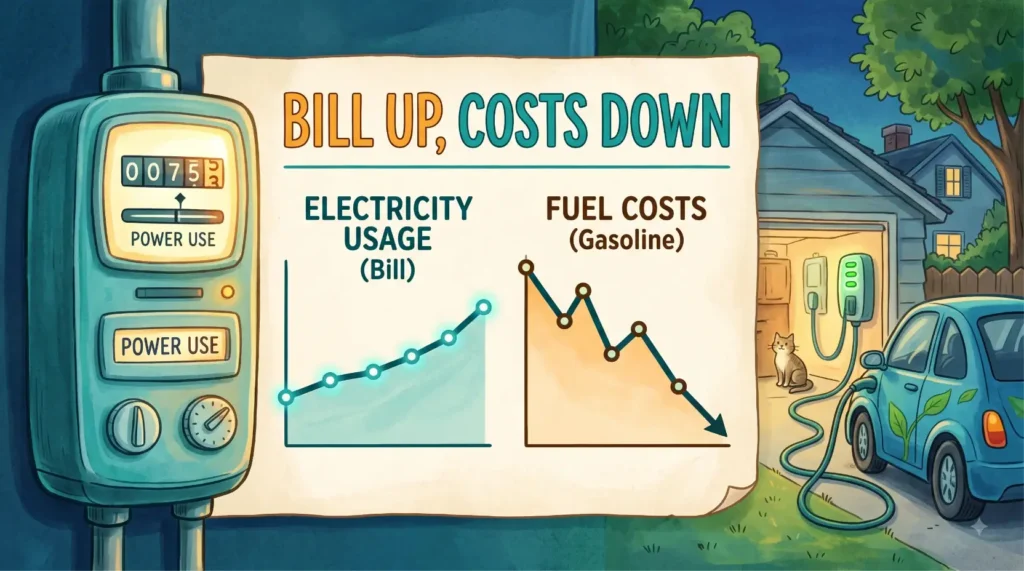
Picture the moment your very first post-EV electricity bill lands in your inbox. 😬 Your thumb hovers over the notification like it’s a horror-movie jump scare. “Did I just plug a money pit into my garage wall?”
Take a breath. Unclench the jaw. That spike you’re dreading? It’s real — but it is nowhere near the financial bloodbath your imagination is painting at 2 a.m.
Here’s the thing nobody tells you at the dealership: the cost didn’t vanish, and it didn’t multiply. It just moved house. It packed its bags, left the petrol pump, and quietly moved into your electricity meter — and it got a whole lot smaller in the process.
In this guide, we’ll break down exactly what the electricity bill increase with an EV looks like in 2026 for both US and Indian homes. 👇
⚡ The Short Answer
If you’re skimming on your lunch break, here’s the whole thing in three bullets:
- 🇺🇸 US: roughly $40–$55/month extra on the power bill for a typical commuter.
- 🇮🇳 India: roughly ₹1,000–₹1,500/month extra for a typical commuter.
- 💸 Net result: your fuel spending drops by far more than your electricity rises — so your total transport cost actually falls.
Yes, the number on your power bill goes up. No, your house is not haunted. Your wallet is, in fact, quietly celebrating. 😎
📊 Bill Increase by Distance (US + India)
Curious where you land on the scale? Here’s the typical monthly bump for a mid-efficiency EV, before any clever off-peak tricks. 👇
| Monthly Distance | 🇺🇸 US Increase | 🇮🇳 India Increase |
|---|---|---|
| 500 mi / 800 km | ~$22 | ~₹680 |
| 1,000 mi / 1,600 km | ~$45 | ~₹1,350 |
| 1,500 mi / 2,400 km | ~$68 | ~₹2,030 |
| 2,000 mi / 3,200 km | ~$90 | ~₹2,700 |
Notice how it scales cleanly with distance — there’s no scary cliff where the bill suddenly explodes. It’s a straight line, and a fairly gentle one.
Now here’s the cheat code: on an off-peak or dedicated EV tariff, you can shave 30–40% off every number in that table. So that “$45” can quietly become “$28,” and that “₹1,350” can slide toward “₹850.” The bump is very much yours to control. ⏰
🧮 How to Calculate Your Bill Increase
You don’t need a spreadsheet wizard or an engineering degree for this. There’s one tidy little formula that does all the heavy lifting. 👇
Monthly distance ÷ efficiency × electricity rate = added bill
That’s it. Three numbers in, one number out. Let’s walk it through for both markets so you can plug in your own.
🇺🇸 US example:
Say you drive 1,000 miles a month. A typical EV does about 3.5 miles per kWh.
1,000 ÷ 3.5 = 286 kWh of charging.
At the US average of about $0.16/kWh: 286 × $0.16 = ~$46/month. ⚡
🇮🇳 India example:
Say you drive 1,600 km a month. A typical EV does about 7 km per kWh.
1,600 ÷ 7 = 229 kWh of charging.
At a typical residential slab of around ₹6/kWh: 229 × ₹6 = ~₹1,370/month. 🇮🇳
That output number — the $46 or the ₹1,370 — is your monthly bump. Knock 30–40% off if you charge off-peak, and you’ve got your real-world figure. 🎯
💡 Read: EV Charging Cost Calculator: What You’ll Pay Monthly
🔌 What Drives Your Bill Increase Up or Down
Two people can buy the same EV and end up with wildly different power bills. Why? Because a handful of levers quietly decide the final number. Here’s what’s actually pulling the strings:
- 🚗 How much you drive. This is the big one. More miles or kilometres means more kWh, full stop. A weekend warrior and a 50-mile daily commuter live in different bill universes.
- ⏰ When you charge. Plug in at 2 a.m. on an off-peak rate and you might pay half of what you’d pay at 6 p.m. dinner-time peak. Same energy, very different price.
- 🌡️ The weather. Cold winters and blasting AC both eat range, which quietly nudges your kWh up. Your January bill will out-eat your October bill — that’s normal, not a malfunction.
- 🔋 Your EV’s efficiency. A featherweight compact hatch sips electrons. A two-tonne electric SUV with 22-inch wheels gulps them. The badge on the back changes the math.
- 🏠 Home vs public charging. Every kWh you grab at a public or workplace charger is a kWh that never touches your home meter — though public charging usually costs more per unit overall.
Get these working in your favour and your home bill barely flinches. Ignore them and, well, you’ll feel it. 😎
💰 The Increase vs the Fuel Savings (The Part That Matters)
Okay. Deep breath. This is the section that reframes the entire conversation, so don’t skim it.
Staring at the electricity bill increase with an EV in isolation is like reading one line of a two-line budget. The power bill going up is only half the story — and it’s the smaller half. The other half is the petrol or diesel bill that just fell off a cliff. 💸
Let’s put both halves on the table, side by side, for a real driver.
🇺🇸 US driver — 1,000 miles/month:
– ⚡ Electricity bill up: ~$46/month
– ⛽ Gasoline bill down: ~$115/month
– ✅ Net saving: ~$69/month (that’s ~$830/year ☕☕☕)
🇮🇳 India driver — 1,600 km/month:
– ⚡ Electricity bill up: ~₹1,370/month
– ⛽ Petrol bill down: ~₹6,200/month
– ✅ Net saving: ~₹4,830/month (roughly ₹58,000/year 🤑)
See what happened there? The power bill rose by one small step and the fuel bill fell off a balcony. Your total cost of getting around dropped — it just looks different now because the spending shifted from a pump you visited weekly to a meter you read monthly.
This is the single most important mental flip to make. Don’t compare your new electricity bill to your old electricity bill. Compare your new electricity bill to your old fuel bill. That’s the comparison that tells the truth. 🎯
⏰ Off-Peak Rates and the Dedicated EV Meter Effect
If there’s one magic button in this whole article, this is it. The when of charging matters almost as much as the how much.
🇺🇸 In the US — Time-of-Use (TOU) plans.
Most utilities now offer a TOU plan where overnight electricity is dramatically cheaper than daytime peak. We’re talking rates that can dip to $0.10/kWh or lower in the small hours, versus $0.30+ during peak. Set your EV to start charging at midnight, go to sleep, and wake up to a tank full of cheap electrons. Your monthly increase can quietly shrink by a third or more.
🇮🇳 In India — the dedicated EV meter.
This is the heavyweight champion of bill control. Many state DISCOMs now offer concessional EV tariffs — often in the ₹4.50–₹6.50/kWh range — on a separate, dedicated meter just for charging. Instead of your EV charging on your top residential slab (which can climb toward ₹8–₹10/kWh), it runs on a discounted rate built specifically for EVs.
Setting up that dedicated meter is genuinely the biggest single lever an Indian EV owner has. It can turn a ₹1,500 bump into something closer to ₹950 without you changing a single driving habit. ⚡
The lesson for both markets is identical: don’t just charge — charge smart. Same kilometres, same comfort, meaningfully smaller bill.
📈 2026 Trends Affecting Your Bill
The numbers above aren’t frozen in time. A few 2026 forces are nudging the electricity bill increase with an EV in different directions, so it’s worth knowing which way the wind’s blowing.
🇺🇸 US — rates have crept up. Residential electricity prices have climbed meaningfully over the past few years, which means the same charging session costs a touch more than it did in, say, 2022. The good news? TOU and EV-specific plans have spread fast, so the tools to fight that increase have grown right alongside it.
🇮🇳 India — tariffs are getting friendlier. This is the happier trend. Concessional EV tariffs and dedicated-meter schemes are rolling out across more states every year, actively pulling down the bill increase for owners who set them up. India is one of the few places where the EV charging math is getting cheaper, not pricier.
🌍 Both markets — smarter charging hardware. Schedulers, energy monitors, and app-controlled chargers have become cheap and mainstream, which means automating off-peak charging is now a one-time setup, not a nightly chore. Tech is quietly doing the bill-shaving for you.
📉 Will an EV Double My Bill? (Spoiler: No)
This is the myth that keeps people up at night, so let’s put it down gently but firmly. No, an EV almost never doubles your electricity bill. 🙅
Let’s do the back-of-the-napkin math on why. A typical US household uses around 850–900 kWh a month already. A 1,000-mile-a-month EV adds roughly 286 kWh on top. That’s about a 30% increase to total household consumption — meaningful, sure, but a far cry from doubling.
In India, a household using 300–400 kWh a month that adds ~229 kWh for charging sees a larger percentage jump, but it still rarely doubles the bill — and the concessional EV tariff softens the blow on the charging portion specifically.
The “EVs will double your bill!” line usually comes from someone imagining a huge SUV, charging at peak rates, driving enormous distances, with zero off-peak strategy. For a normal human with a normal commute and a midnight charge schedule? It’s a moderate, predictable bump. The doubling story is a campfire ghost tale, not a budget reality. 👻
📊 Monitoring Your Usage (Knowledge Is Cheaper Power)
Here’s a quiet truth: you can’t manage what you can’t see. For your first few months as an EV owner, your secret weapon is simply watching the numbers.
A smart energy monitor or a sub-meter on your charger circuit shows you, in real time, exactly how many kWh your car is pulling and what it’s costing you. No more guessing whether that scary bill was the EV or the new air fryer. 📊
Once you can see it, three things happen. First, the anxiety evaporates — real numbers are always less scary than imagined ones. Second, you start spotting easy wins, like that one expensive peak-hour top-up you didn’t need. Third, you can prove to yourself (and that one skeptical relative) exactly how the math is working out.
Most owners find that after one or two billing cycles of watching the meter, they relax completely and stop thinking about it. The mystery — and the dread — only lasts as long as the data stays hidden. 🔍
🆓 Free Charging: Offsetting the Increase Entirely
Now for everyone’s favourite four-letter word: free. 🆓
Plenty of EV owners quietly knock a chunk off their home bill by grabbing electrons they don’t pay for. Every kWh you collect somewhere else is a kWh that never lands on your meter.
- 🏢 Workplace charging. A growing number of employers offer free or heavily subsidised charging. Top up during your 9-to-5 and you might roll home with most of your week’s range already covered.
- 🛒 Retail and mall chargers. Some shopping centres, grocery stores, and hotels offer complimentary charging while you shop, eat, or sleep. It’s slow, but it’s free, and slow-and-free is a beautiful combination.
- ☀️ Rooftop solar. If you’ve got panels, daytime charging from your own roof is about as close to “free fuel” as transport gets. The sun bills nobody.
For some owners, between workplace charging and the odd free public top-up, the electricity bill increase with an EV at home shrinks to almost nothing. Your mileage — quite literally — may vary, but it’s worth hunting down the free juice near you. 😍
✅ 5 Tips to Keep the Increase Low
Ready for the action list? Tape this to the fridge.
- ⏰ Charge overnight on off-peak rates. The single biggest, easiest saving. Set it and forget it.
- 🔌 Set up the right tariff. A dedicated EV meter (India) or a TOU plan (US) can cut the charging portion of your bill by a third.
- 🔋 Use an 80% daily charge limit. The last 20% charges slowly and less efficiently — skip it for daily driving and save kWh.
- 🚗 Drive smoothly. Gentle acceleration and steady speeds stretch every kWh further, especially on the highway.
- 🆓 Hunt for free charging. Workplace, retail, and solar top-ups keep load off your home meter entirely.
Stack even two or three of these and your monthly bump goes from “noticeable” to “barely there.” 🎯
🛒 Shop This Post
A few tools that pay for themselves by keeping your bill honest and low. 😍
1. A Smart Energy Monitor 📊
Clamp it on and watch exactly what your EV adds to the bill each month — no more guessing, no more dread.
👉 Shop energy monitors
2. A Smart Level 2 Charger With Scheduling ⚡
Automate off-peak charging so your car always sips the cheapest electrons while you sleep.
👉 Shop smart Level 2 chargers
3. A Smart Plug / Sub-Meter 🔌
Isolate and measure your EV’s exact consumption down to the kWh — perfect for tracking and for proving the math.
👉 Shop smart plugs & sub-meters
🛒 Disclosure: These are affiliate picks — they cost you nothing extra, and they help keep EVs Mirror running. 🙏
🎯 Quick Quiz: How Big Will Your Jump Be?
Three quick questions. Be honest. 👇
- Monthly distance? 🅐 Under 800 mi/km 🅑 Over 1,500 mi/km
- Off-peak rate or EV tariff set up? 🅐 Yes 🅑 No, full-price all day
- What’s in the garage? 🅐 Efficient compact 🅑 Big heavy SUV
Mostly 🅐: 🟢 A small, easily-absorbed bump. Your bill will barely notice.
Mostly 🅑: 🟡 A bigger jump — but it’s fixable. Sort out off-peak charging first.
📋 Bill-Increase Checklist
- [ ] Estimate your monthly kWh (distance ÷ efficiency)
- [ ] Multiply by your electricity rate for your baseline bump
- [ ] Check whether you qualify for an off-peak / TOU plan
- [ ] Set up a dedicated EV meter (India) if available
- [ ] Compare the increase to your OLD fuel bill, not your old power bill
- [ ] Set an 80% daily charge limit on the car
- [ ] Install an energy monitor and watch month one’s real usage
- [ ] Scope out free workplace or retail charging nearby ⚡
🤔 People Also Ask
Q: How much is the electricity bill increase with an EV?
A: For a typical commuter, about $40–$55/month in the US or ₹1,000–₹1,500/month in India. Off-peak rates and dedicated EV tariffs can shrink that by 30–40%.
Q: Does charging an EV use a lot of electricity?
A: It’s noticeable but manageable — usually a few hundred kWh a month, adding roughly 25–35% to a typical home’s usage. That’s far less than the fuel cost it replaces.
Q: Will an EV double my electricity bill?
A: Almost never. For a normal commute with smart charging, the increase is a moderate fraction of your total bill — not a doubling. That “doubling” claim assumes a huge SUV charging at peak rates.
Q: How can I reduce the electricity bill increase with an EV?
A: Charge overnight on off-peak rates, set up a dedicated EV meter or TOU plan, use an 80% daily limit, drive smoothly, and grab free workplace or solar charging when you can.
Q: Does the bill increase make EVs not worth it?
A: No. The electricity increase is far smaller than the petrol or diesel savings it replaces, so your total transport cost drops even as your power bill rises.
Q: How do I track exactly how much my EV adds to the bill?
A: A smart energy monitor or sub-meter on your charger circuit shows your EV’s kWh and cost in real time, so you can separate charging from the rest of the household.
🚀 The Bottom Line
The electricity bill increase with an EV is real, but it’s modest and entirely predictable — roughly $40–$55/month in the US or ₹1,000–₹1,500/month in India for a typical driver. ⚡
The trick is to stop staring at it in isolation. Set it next to the fuel bill it replaced and the whole picture flips: your power bill rises by a little, your fuel spending falls by a lot, and your total cost of getting around drops. Charge off-peak, sort out the right tariff, watch your first month’s meter, and that bump stays small while your savings stay big.
💬 How much did your bill actually change after going electric? Drop your real numbers in the comments — they help other readers more than any average ever could!
📤 Know someone terrified of the power bill? Share this and put their mind at ease. 🙏
🔖 Bookmark EVs Mirror for honest, practical EV money guides.