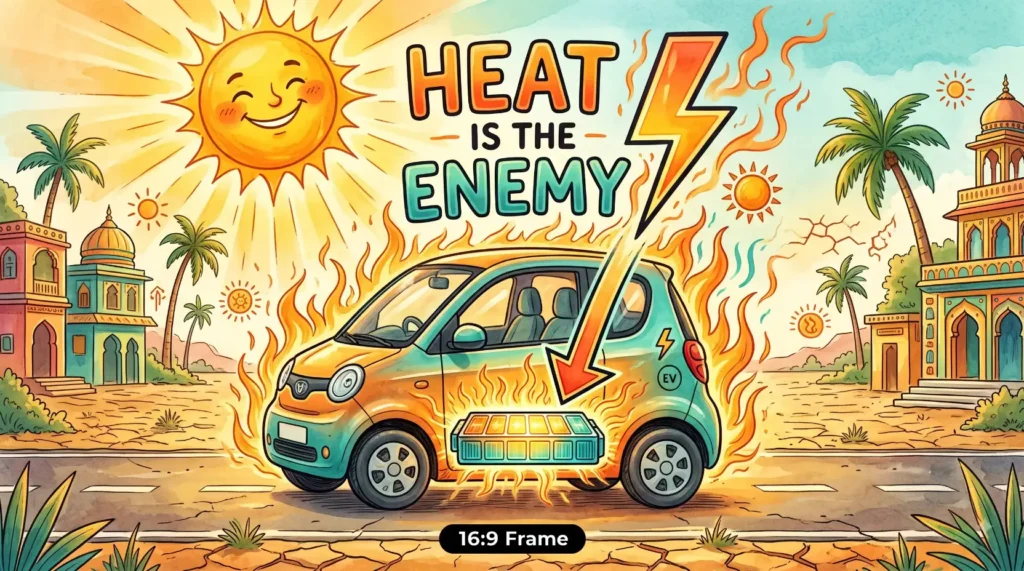
Picture a Delhi parking lot in May. ☀️ It’s 2 PM, the tarmac is shimmering, and a row of EVs is quietly cooking in 45°C sun. Their owners are inside, sipping cold coffee, blissfully unaware that something invisible is happening under the floor of each car.
The battery packs are baking. And every degree of that heat is shaving a little life off them — permanently.
This is the part nobody warns you about when you buy your first electric car in India. Abroad, the headlines scream about freezing winters and shrinking range in the snow. Here, the story is flipped on its head. In India, heat — not cold — is the real enemy of your battery. 🔥
While owners in Norway or Canada nurse their packs through icy mornings, you and I are fighting a slower, sneakier battle against months of relentless sun. And it’s a battle you absolutely can win, once you understand what’s actually going on.
So let’s pull back the curtain on EV battery heat damage — what it is, why it’s so much worse than cold, and exactly how to protect your pack through an Indian summer. 👇
⚡ The Short Answer
If you only read one section, read this. Here’s the deal in plain terms:
- 🔥 Sustained heat speeds up degradation — roughly 0.4% faster capacity loss per year in hot climates compared to mild ones.
- ☀️ Sun parking and fast charging in heat are the two biggest accelerators you control.
- 🚫 Heat damage is permanent. Unlike cold-weather range loss (which comes right back when it warms up), heat-driven capacity loss never returns.
- 🛡️ Shade, cool-hour charging, and an 80% daily limit are cheap, simple, and shockingly effective.
- 🌡️ Active liquid cooling beats passive air cooling by a mile in Indian conditions.
Heat is the number one battery threat in our climate — but the good news is it’s also one of the most manageable. 😎
📊 EV Battery Heat Stressors — At a Glance
Not all heat exposure is equal. Some habits barely matter; others quietly destroy your pack. Here’s how the big stressors stack up. 👇
| Heat Stressor | Why It Hurts | Severity | The Fix |
|---|---|---|---|
| ☀️ Sun parking | Pack heats far above ambient, all day | 🔴 High | Park in shade, garage, or covered lot |
| ⚡ Fast charging in heat | Charging heat stacks on ambient heat | 🔴 High | Charge in cooler hours, slower if possible |
| 🔋 Sitting at 100% in heat | High charge + high temp = peak stress | 🔴 High | Keep a ~80% daily limit |
| 🌡️ No thermal management | Passive-cooled packs can’t shed heat | 🟠 Medium | Choose EVs with active cooling |
| 🏜️ Months of heat exposure | Calendar aging compounds over time | 🟡 Cumulative | Garage, car cover, smart habits |
See the pattern? The worst combination is heat + a full battery + fast charging, all at once. That’s the trifecta you want to avoid on a scorching afternoon. 🎯
🔥 Why Heat Actually Hurts Your Battery (The Chemistry)
To understand the damage, you have to peek inside the cell. Don’t worry, no chemistry degree required. 🧪
Your EV battery is a giant collection of lithium-ion cells, and inside each one, ions shuffle back and forth as you charge and discharge. That shuffling is normal. The problem is that heat speeds up every chemical reaction in there — including the unwanted, destructive ones.
Think of it like milk in your fridge versus milk left on the counter in June. Cold slows spoilage; heat accelerates it. Battery aging works the same way.
When cells run hot, a few nasty things happen at once:
- 🔬 The protective layer inside each cell (the SEI) keeps growing, locking away lithium that can no longer carry charge.
- 💧 The electrolyte breaks down faster, becoming less efficient at moving ions.
- ⚙️ The electrode materials themselves degrade and lose structure over time.
Every one of these is a one-way street. You don’t get that lithium or capacity back. That’s the brutal truth at the heart of heat damage — it’s cumulative, and it’s forever.
The thing most people miss: calendar aging
Here’s a concept that flips how you think about your battery. There are two ways a pack ages: cycle aging (from charging and driving) and calendar aging (from simply existing over time).
Calendar aging happens whether you drive 50 km a day or leave the car parked all week. And calendar aging is massively sped up by heat.
This is why a Phoenix or Jodhpur EV that mostly sits in a sunny driveway can degrade faster than a heavily-driven car in a cool city. The car wasn’t even moving — it was just hot. 🌡️
So when we talk about that extra ~0.4% per year of degradation in hot climates, a big chunk of it is calendar aging quietly ticking away while your car does nothing at all. Sobering, right?
💡 New to the topic of degradation? Start here: What Is a Normal EV Battery Degradation Rate?
☀️ The Sun-Parking Problem (India’s Silent Killer)
If I had to point to the single most common cause of EV battery heat damage in India, it would be this: parking in direct sun. Every single day. ☀️
Here’s why it’s so brutal. When the air temperature hits 42°C, a dark-colored car baking in direct sun can see surface and cabin temperatures climb well past 60°C. The battery pack, sitting in the floor, soaks up that heat and holds onto it for hours — long after you’ve driven away.
Now multiply that by an entire summer. April to July, day after day, your pack spends six to eight hours a day cooking. That’s not a one-off stress — that’s a sustained, months-long bake. 🏜️
Surface parking lots, open driveways, and roadside parking are the worst offenders. The car has nowhere to hide.
The fix is wonderfully low-tech:
- 🌳 Park in shade — under a tree, awning, or building overhang — whenever you can.
- 🏢 Prefer covered or basement parking at malls, offices, and apartments.
- 🛡️ When shade isn’t an option, throw on a windshield sunshade and car cover to block direct sun and cut the heat soak.
None of this requires spending big money or buying a new car. It’s a habit. And it’s probably the single highest-impact change you can make this summer.
⚡ Summer Charging Mistakes That Cook Your Pack
Charging is where good intentions go wrong fast. The instinct to “top up whenever you can” is exactly backwards in peak Indian heat. ⚡
Let’s name the three biggest summer charging mistakes:
- 🚫 Fast charging an already-hot battery. DC fast charging generates serious heat on its own. Do it when your pack is already at 50°C from the sun, and you’re stacking heat on heat — one of the most stressful things you can do to a cell.
- 🚫 Charging right after a hard highway run. Your battery is hottest immediately after sustained fast driving. Plugging into a fast charger right then is double trouble.
- 🚫 Leaving the car at 100% in the heat all day. A fully charged cell sitting at high temperature is at peak stress. It’s the worst storage condition there is.
So what should you do instead? It’s simple stuff:
- 🌙 Charge during cooler hours — early morning or late at night when ambient temps drop.
- ❄️ Let a hot pack cool for 20–30 minutes before plugging into a fast charger.
- 🔋 Keep your daily limit around 80%. Only charge to 100% right before a long trip, then drive soon after.
A smart charger makes this almost automatic — you schedule charging for cool overnight hours and let it run while you sleep. Set it once, and you’ve quietly eliminated a whole category of heat stress. 😴
🌡️ Active Liquid Cooling vs Passive Air Cooling
Here’s where the EV you choose matters enormously — and where a lot of cheaper models quietly fall short in Indian heat. 🌡️
Battery thermal management comes in two broad flavors:
Passive (air) cooling relies on airflow — sometimes just the cabin air, sometimes a fan — to keep the pack cool. It’s cheap and simple. But in 45°C ambient heat, blowing hot air over a hot battery does very little. The pack basically rides at whatever temperature the environment dictates. 🥵
Active (liquid) cooling circulates coolant through the pack, actively pulling heat out and holding the cells in a safe window even when it’s brutal outside. This is the gold standard, and it makes a genuine difference to how a battery survives Indian summers. 🧊
Think of it like the difference between sitting under a ceiling fan in a heatwave versus sitting in an air-conditioned room. Both “do something.” Only one actually keeps you cool when it really counts.
If you’re buying an EV for a hot region, active liquid thermal management is one of the most important specs on the sheet. It’s easy to overlook next to range and price, but in our climate it directly protects your most expensive component. Ask the dealer point-blank: active liquid cooling, or just air? The answer tells you a lot. 🎯
🚫 Why Heat Damage Is PERMANENT (And Cold Isn’t)
This is the single most important idea in the whole article, so let me say it loudly: heat damage and cold damage are completely different beasts. ❄️🔥
When it’s freezing, your EV loses range — sometimes 20–30%. Scary in the moment. But that range loss is temporary. The chemistry inside slows down in the cold, the ions move sluggishly, and your usable range drops. The instant the battery warms back up, your full range returns. Nothing was actually lost. It was just paused.
Heat is the opposite, and that’s what makes it so much more dangerous over the long run.
When heat speeds up those destructive chemical reactions — the SEI growth, the electrolyte breakdown, the electrode degradation — that capacity is gone for good. There’s no warming up, no cooling down, no recovery. Each hot summer permanently nudges your real-world range a little lower, and it stays there. 📉
That’s the cruel asymmetry of climate and batteries:
- ❄️ Cold = temporary range loss. Annoying, recoverable, no lasting harm.
- 🔥 Heat = permanent capacity loss. Quiet, cumulative, irreversible.
It’s exactly why Indian owners need to think about this differently than the cold-climate advice you’ll find on most global EV sites. Our threat doesn’t bounce back when the season changes. It accumulates, summer after summer.
🥶 Curious how the cold side of the equation works? Read: How Cold Weather Affects EV Battery and Range
🇮🇳 The Real India Climate Angle
Let’s get specific about what Indian conditions actually do to a battery, because our climate isn’t just “hot” — it’s hot in several distinct and demanding ways. 🌍
Extreme peak temperatures. Large parts of north and central India — Delhi, Rajasthan, Gujarat, parts of UP and MP — regularly cross 45°C in summer. That’s well above the comfortable operating window of most lithium cells.
Duration, not just peaks. A single hot day doesn’t kill a battery. India’s problem is that the heat lasts for months. From late March through June, packs rarely get a proper cool-down. It’s that sustained exposure — that long, slow bake — that drives serious calendar aging. ⏳
Limited covered parking. Be honest: how many of us actually have garages? Most Indian EVs live on the street, in open society parking, or in uncovered lots. That makes the shade-parking advice harder to follow — and all the more valuable when you can pull it off.
Grid and charging timing. Daytime charging often coincides with peak heat and peak grid load. Shifting to cool-hour charging solves two problems at once — kinder to your battery and often cheaper on time-of-use tariffs. 💸
🌎 Quick US note: Sunbelt owners in Phoenix, Las Vegas, and Texas face nearly identical conditions — extreme, sustained heat with little natural shade. Everything in this guide applies just as much there. If you’ve ever seen a desert EV’s battery health report, you already know: heat is the great equalizer. 🤠
🌧️ A monsoon note (it’s not all bad news)
There’s a small silver lining baked into India’s climate, and it’s the monsoon. ⛈️
When the rains arrive, ambient temperatures drop sharply, and your battery finally gets a months-long break from the worst of the heat. The pack runs cooler, calendar aging slows, and the relentless summer bake eases off. 🌦️
That said, don’t get complacent. Humidity and the occasional waterlogged parking spot bring their own concerns — keep charging connectors clean and dry, and avoid charging in standing water. But on balance, the monsoon is your battery’s friend. It’s the seasonal reset that gives a hot-climate pack some breathing room before the next summer rolls around. 🌱
📈 How 2026 Trends Affect Heat Damage in India
The fight against EV battery heat damage is genuinely getting easier — and 2026 is a good year to own an EV in a hot country. Here’s what’s changed. 🇮🇳
Active cooling is going mainstream. Just a few years ago, liquid-cooled packs were reserved for premium EVs. In 2026, far more mainstream models — including affordable ones aimed squarely at Indian buyers — ship with active thermal management tuned for hot conditions. The “air-cooled only” category is shrinking, and that’s a win for everyone. 🧊
LFP chemistry handles heat better. A huge share of new Indian EVs now use LFP (lithium iron phosphate) batteries. LFP is inherently more heat-tolerant and thermally stable than older chemistries, and it shrugs off being kept at 100% better too. It’s not magic — it still benefits from shade and cool charging — but it gives hot-climate owners a more forgiving starting point. 🔋
Smarter BMS software. Manufacturers are tuning their battery management systems specifically for Indian heat, with more aggressive cooling logic and charge limits that protect the pack when temperatures spike. 🤖
Growing owner awareness. Communities, forums, and guides like this one mean owners now know to park in shade and charge in cool hours. That knowledge is the cheapest protection of all.
The takeaway: the hardware and software are improving fast, but your habits are still the single most cost-effective defense. Pair a 2026 EV’s better tech with smart routines, and you’ve got the best of both worlds. 😎
✅ 5 Ways to Prevent Heat Damage
Enough theory. Here’s the practical playbook — five habits that genuinely protect your pack through an Indian summer. 🛡️
- Park in shade or covered parking. ☀️➡️🌳 The single biggest lever. Tree, awning, garage, basement — anything that keeps the sun off the car keeps heat out of the battery.
- Charge during cooler hours. 🌙 Early morning or overnight, when ambient temps drop. A smart charger automates this so you never think about it.
- Avoid fast charging a hot battery. 🔥 Let the pack cool after a hard drive, and lean on slower charging in peak heat when you have the time.
- Keep a ~80% daily charge limit. 🔋 Only go to 100% right before a long trip — then drive soon after, don’t let it sit full in the sun.
- Use a sunshade and car cover. 🛡️ When shade parking isn’t possible, physical sun protection is your next best defense. Cheap insurance for an expensive battery.
Do all five and you’ll dramatically slow heat-driven degradation — without spending much at all. 💪
🛒 Shop This Post
Affiliate-friendly gear built for Indian summers — the stuff that actually moves the needle on heat protection. 😍
1. Car Cover + Windshield Sunshade ☀️
The simplest, cheapest defense. Blocks direct sun and cuts the heat soak into your cabin and battery when shade parking isn’t an option.
👉 Shop sunshades & car covers
2. Smart Charger (for Cool-Hour Scheduling) ⚡
Schedule charging for cool overnight hours automatically — kinder to your battery and easier on time-of-use tariffs. Set it once and forget it.
👉 Shop smart Level 2 chargers
3. OBD2 Battery-Health Scanner 📊
Track exactly how each summer affects your real capacity. Knowledge is power — and a scanner turns invisible degradation into numbers you can watch.
👉 Shop OBD2 battery scanners
🛒 Affiliate disclosure: These are affiliate picks. If you buy through them, EVs Mirror may earn a small commission at no extra cost to you — and it genuinely helps keep our India-focused guides free. 🙏
🎯 Quick Quiz: Is Heat Damaging Your Battery?
Be honest with yourself — three quick questions. 👀
- Where do you park most days? 🅐 Shade / garage / covered 🅑 Direct sun
- When do you charge in summer? 🅐 Cool morning / overnight 🅑 Afternoon heat
- Does your EV have active liquid cooling? 🅐 Yes 🅑 No / not sure
Mostly 🅐: 🟢 You’re protecting your pack like a pro. Keep it up — your future range will thank you.
Mostly 🅑: 🔴 Heat is quietly accelerating wear right now. The good news? Every fix is cheap and starts today.
📋 Heat-Protection Checklist
Save this. Run through it at the start of every summer. ✅
- [ ] Park in shade, a garage, or covered parking
- [ ] Charge during cooler hours (morning / overnight)
- [ ] Let a hot battery cool before fast charging
- [ ] Keep an 80% daily charge limit
- [ ] Avoid leaving the car at 100% in the sun
- [ ] Use a sunshade and car cover when parked in the open
- [ ] Prefer EVs with active liquid thermal management
- [ ] Track your battery health each summer with an OBD2 scanner ⚡
🤔 People Also Ask
Q: Does hot weather cause EV battery heat damage?
A: Yes — sustained hot weather is the leading cause of EV battery heat damage, accelerating capacity loss by roughly 0.4% more per year in hot climates. It’s especially harmful when combined with a full charge or fast charging, making it the top battery threat in places like India and the US Sunbelt.
Q: Is heat damage to an EV battery permanent?
A: Yes. This is the key difference between heat and cold. Cold-weather range loss is temporary and fully recovers when the battery warms up. Heat-driven capacity loss is permanent — those destructive chemical reactions don’t reverse, so each hot summer leaves a lasting mark.
Q: How do I protect my EV battery from heat in India?
A: Park in shade or covered parking, charge during cooler morning or overnight hours, avoid fast charging an already-hot pack, keep a ~80% daily charge limit, and use a sunshade and car cover when parking in the open.
Q: Is fast charging bad in hot weather?
A: It’s stressful, yes. Fast charging generates its own heat, so doing it when the battery is already hot from the sun or a hard drive stacks stress on stress. Let the pack cool first, and lean on slower charging during peak heat when you have the time.
Q: Do LFP batteries handle heat better?
A: Generally yes. LFP (lithium iron phosphate) chemistry — common in 2026 Indian EVs — is more thermally stable and heat-tolerant than older chemistries, and tolerates being kept at 100% better. It still benefits from shade and cool-hour charging, but it’s a more forgiving starting point in hot climates.
Q: Does my EV need active cooling for Indian summers?
A: It’s strongly recommended. EVs with active liquid thermal management hold the battery in a safe temperature window even in 45°C heat, while passive air-cooled packs largely ride at ambient temperature. In a hot region, active cooling is one of the most valuable specs you can buy.
🚀 The Bottom Line
In India, EV battery heat damage — not cold — is the real long-term threat to your pack. ☀️ Sustained heat permanently accelerates degradation, especially when paired with full charges and fast charging in the blazing afternoon sun. And unlike cold-weather range loss, this damage never comes back.
But here’s the empowering part: the defenses are simple, cheap, and entirely within your control. Park in shade. Charge in cool hours. Hold an 80% daily limit. Throw on a sunshade. Choose an EV with active liquid cooling. Do those things, and your battery will sail through Indian summers in great shape. 💪
Heat may be the enemy — but it’s an enemy you already know how to beat. 😎
💬 What’s your summer EV routine? Drop your shade-parking and charging tips in the comments — let’s help each other out!
📤 Know an EV owner whose car bakes in the sun all day? Send them this guide. 🙏
🔖 Bookmark EVs Mirror for honest, India-focused EV battery guides all year round.
👉 Up next: How Cold Weather Affects EV Battery and Range — and if you haven’t yet, brush up on What Is a Normal EV Battery Degradation Rate?