If you’ve shopped for an EV in the US lately, you’ve probably noticed something quietly seismic happened. 😮 The plug on the new cars isn’t the chunky one your neighbor’s 2022 model uses anymore. It’s slimmer, lighter, and — until recently — it was the thing only Teslas had.
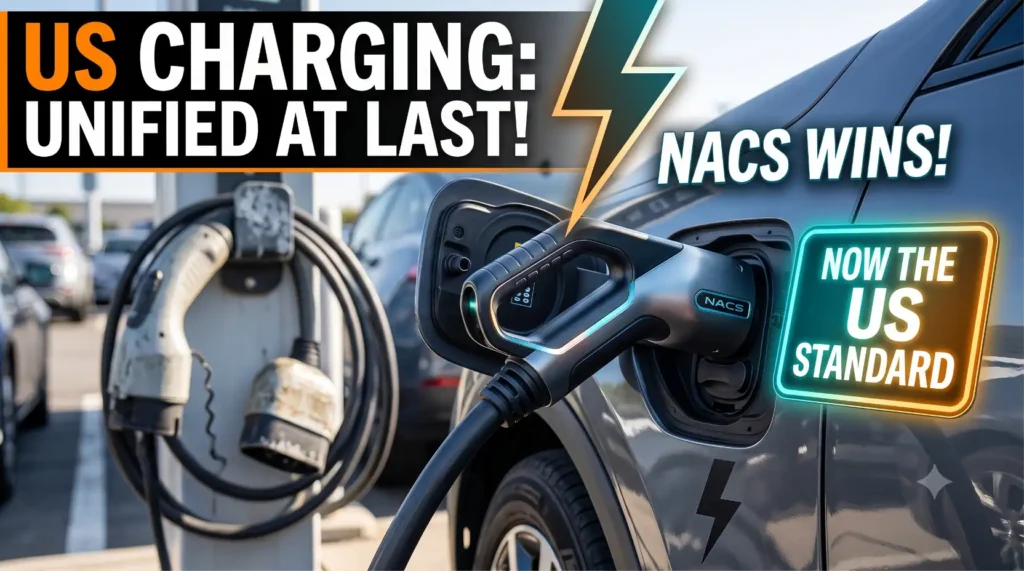
That plug is NACS, and as of 2026 it has stopped being “Tesla’s connector” and started being the connector. Nearly every major automaker has signed on. New EVs increasingly roll off the line with a NACS port baked in. The big Supercharger network is no longer a walled garden. 🚀
But here’s the thing nobody fully explains: a standard “winning” doesn’t instantly fix your specific car, your specific cable, or your next road trip. So let’s talk about what actually changed, what stayed the same, and exactly what you should do about it — a plain-English guide to the NACS charging standard 2026. 👇
⚡ The Short Answer
Short on time? Here’s the whole NACS charging standard 2026 situation in a few bullets. 🎯
- 🚀 NACS won. The North American Charging Standard (officially the J3400 connector, formerly the Tesla plug) is now the de-facto US charging standard — almost every major automaker has adopted it.
- 🔌 New EVs increasingly ship with a native NACS port, plugging straight into Tesla Superchargers with no extra gear.
- 🆘 CCS1 cars aren’t left behind. A NACS adapter bridges your older CCS1 port to the Supercharger network — millions of cars use this exact trick.
- 🪫 You are not stranded either way. Both port types can charge across most of the country in 2026; it’s just a question of how.
- 🇮🇳 India is a different story entirely. India runs on CCS2, so NACS is purely a US headline — Indian drivers can mostly skip the panic.
Now let’s unpack what that means for your driveway. 👇
📊 Your Car Type → Port → How You Charge Now
Before the deep dive, here’s the entire landscape in one table. Find your row and you’ll instantly know where you stand. 👇
| Your car type | Charging port | How you charge in 2026 |
|---|---|---|
| 🚗 Tesla (any recent model, US) | Native NACS | Plug straight into Superchargers; use a CCS1 adapter for older networks |
| 🆕 New non-Tesla EV (2025–26, US) | Native NACS (factory) | Plug straight into Superchargers; native NACS, no adapter for them |
| 🔌 Non-Tesla EV (2018–2024, US) | CCS1 | Carry a NACS adapter to unlock Superchargers; CCS networks still work natively |
| 🪦 Older Nissan Leaf-style EV (US) | CHAdeMO | Home charging + dwindling CHAdeMO stations; plan an upgrade eventually |
| 🇮🇳 Any mainstream EV (India) | CCS2 | Just plug into CCS2 fast chargers — NACS isn’t relevant for you |
Notice the pattern: nobody in the US is locked out. The difference is whether you charge natively or through an adapter. 😎 That single distinction drives almost every decision in this guide.
🔄 What “NACS Becoming the Standard” Actually Means
Let’s clear up the biggest misconception first. When people say NACS “won,” they don’t mean your old car suddenly turned into a brick. 🧱 They mean the industry picked a default — and that has knock-on effects worth understanding.
For years, the US had a messy two-track system. Tesla used its own sleek plug and its own excellent charging network. Everyone else used the chunkier CCS1 connector and a patchwork of third-party networks that were, frankly, hit or miss. Two ecosystems, almost no overlap. 😵
Then Tesla opened its connector design, renamed it the North American Charging Standard (and got it standardized as J3400), and the dominoes fell. Ford, GM, Rivian, Hyundai, Kia, Honda, Nissan, Volkswagen, Mercedes, and more all committed to it. That’s not a trend — that’s a consensus. 🤝
Why did they all jump? Two reasons. First, the plug is genuinely better hardware — smaller, lighter, and it does both AC and DC charging through fewer pins. Second, and far bigger: NACS is the key to the Tesla Supercharger network, the one network US drivers actually trust to work. 🎯
So “NACS is the standard” really means three things at once: new cars get the better plug, the best network opens to everyone, and the industry finally stops fragmenting. If you want the full plug-by-plug breakdown of how we got here, our CCS vs NACS vs CHAdeMO connector guide maps every standard side by side.
🔌 If You Have a CCS1 Car: Adapters Unlock Everything
This is the section most current EV owners need, because most EVs on US roads today still wear a CCS1 port. 🔌 If you bought a non-Tesla EV between roughly 2018 and 2024 — a Mach-E, an Ioniq 5, a Bolt, an ID.4 — that’s you.
Here’s the good news, and it’s genuinely good: you are not obsolete. Your CCS1 car still charges natively at every CCS network it always used. Nothing was taken away from you. ✅
What changed is that you can now also tap the Supercharger network — the big, reliable one — using a NACS adapter. It’s a short, sturdy dongle that bridges your CCS1 port to a NACS Supercharger cable. Plug the adapter onto your car, plug the Supercharger into the adapter, and you’re charging on a network you couldn’t touch a couple of years ago. 🚀
A few things to keep straight:
- ✅ Many automakers now provide or sell an approved adapter for their CCS1 cars. Use that one if you can — it’s matched to your vehicle and keeps warranties and network access clean.
- ✅ It must handle DC fast charging, not just slow AC, if you want it for road trips.
- 🔥 Quality matters a lot. A DC adapter passes serious power through a small piece of hardware — cheap, no-name units can overheat.
The adapter market exploded in 2026, and not all of them are real or safe. Before you buy anything, read our NACS adapter buying guide — it separates the legit, certified units from the scary knockoffs that flooded online marketplaces.
🆕 If You Have or Buy a NACS-Port Car: Native Access
Now the other camp — drivers with a native NACS port. That’s every recent Tesla, and a growing wave of brand-new non-Tesla EVs that ship with NACS straight from the factory. 🆕
For you, the Supercharger experience is beautifully boring: roll up, grab the cable, plug in, charge. No adapter, no dongle, no fumbling. It’s the whole reason automakers chased NACS in the first place — that frictionless, just-works flow. 😎
But there’s a flip side worth knowing. A native NACS car sometimes needs an adapter to use older CCS networks — the reverse of the CCS1 situation. During the transition, plenty of useful chargers out there are still CCS-only, and you’ll want to reach them on a long trip. So your kit is a NACS-to-CCS1 adapter (the opposite direction from the CCS1 crowd). 🔄
A quick reality check for new-car shoppers in 2026:
- 🔌 Ask explicitly what port the car ships with. “Native NACS” is now common, but confirm it — don’t assume.
- 🎒 Ask whether a CCS adapter is included so you can still hit older networks during the changeover.
- 🚀 Native NACS is the cleaner long-term bet in the US, because it matches where the network and the future are heading.
If you’re buying new, native NACS is the path of least resistance. If you already own a CCS1 car, don’t sweat it — the adapter route gets you the same network access today.
🏪 What Actually Changes at Public Chargers
Let’s get concrete about the experience at the plug, because the NACS charging standard 2026 rollout shows up most clearly right where theory meets your road trip. 🛣️
The first visible change: NACS cables are showing up everywhere. Tesla’s Supercharger sites opened to non-Tesla cars, and many third-party networks started adding NACS connectors alongside their CCS cables. Pull into a modern site in 2026 and you’ll often see both standards hanging there. 🔌
The second change is subtler but matters: the charging “handshake” and payment got more app-driven. When a CCS1 car uses a Supercharger via adapter, you typically set it up through the network’s app first — link your car, link your payment, then plug in. Native NACS cars often just plug-and-charge automatically. Knowing which flow you’re in saves you standing confused at a stall. 📱
A few practical realities of the dual-standard era:
- 🅿️ Stall length and parking can be awkward. Supercharger sites were laid out for Teslas, where the port sits at the rear-left. A CCS1 car with a front port sometimes has to park creatively. No big deal, just expect it.
- ⏳ Charging speed depends on your car, not the plug. The adapter doesn’t slow you down meaningfully — your battery’s max accept rate does.
- ✅ Not every Supercharger is open to non-Teslas yet. Coverage is wide and growing, but filter for “open to all” sites in your app before you rely on one.
The headline: public charging in 2026 is more open than it has ever been. You just need to know your flow before you arrive. 🎯
🆘 Do You Need an Adapter — and Which Kind?
Short answer: probably yes, during the transition — but which adapter depends entirely on your car’s port. This is where people buy the wrong thing, so read carefully. 🧠
If your car has a CCS1 port (most non-Tesla EVs from 2018–2024), you want a CCS1-to-NACS adapter. This unlocks the Supercharger network for you. It must be DC-capable for fast charging, and ideally approved by your automaker.
If your car has a native NACS port (Teslas and new non-Teslas), you want the opposite — a NACS-to-CCS1 adapter — so you can still use older CCS-only stations on long routes.
Now the safety part, because this genuinely matters. 🔥 A DC fast charger pushes a lot of power through that little adapter. Get this right:
- ✅ Buy certified, reputable, ideally automaker-sanctioned units. Look for proper safety listings and real heat management.
- 🚫 Avoid the suspiciously cheap “universal” dongles that promise to do everything. Many are unsafe or simply don’t deliver rated DC power.
- 🔌 Match the direction to your car’s port. A “CCS-to-NACS” adapter is not the same as a “NACS-to-CCS” one. This is the #1 mistake.
- 📅 Check it’s rated for the power you’ll actually use — some only do AC, which is useless for highway fast charging.
Because the marketplace filled up with junk overnight, do not freestyle this purchase. Our NACS adapter buying guide walks through exactly which units are real, certified, and worth your money. 🛒
⏳ The Transition Timeline and Its Growing Pains
Standards don’t flip overnight, and 2026 is smack in the middle of the messy-but-improving phase. Let’s be honest about the growing pains so nothing surprises you. 🌱
We are living through the dual-standard era. Millions of CCS1 cars are on the road and will be for a decade-plus. Networks aren’t ripping out CCS cables — they’re adding NACS alongside. New cars ship native NACS. So for several years, both standards coexist, and adapters are the glue holding it together. 🔗
The friction points are real but minor:
- 🅿️ Site layouts lag the cars. Some Supercharger stalls weren’t designed for non-Tesla port positions, leading to awkward parking until sites get reconfigured.
- 📱 Activation isn’t fully seamless yet for adapter users — apps, accounts, and plug-and-charge support are still catching up across networks.
- 🧩 Coverage is uneven. Not every Supercharger is open to all cars, and not every third-party site has added NACS. It’s improving fast, but check before you commit a long leg of a trip.
- 🔌 Adapter quality is inconsistent in the open market, which is exactly why certification matters.
The encouraging part? Every one of these gets better month over month. Site retrofits are happening, app integrations are improving, and “open to all” coverage keeps expanding. The NACS charging standard 2026 is the awkward-teenager phase of a system that’s clearly maturing into something far simpler. 📈
🛒 What to Buy Now vs What to Wait On
So what should you actually do with your money today? Here’s the practical sorting hat. 🎩
In the NACS charging standard 2026 landscape, the smart spend is small and targeted — here’s how it breaks down.
Buy now if you own a CCS1 car: a quality, DC-capable, automaker-approved NACS adapter. This is the single highest-value purchase you can make right now — it instantly multiplies the chargers available to you. Don’t wait; the road-trip value is immediate. 🚀
Buy now if you own a native NACS car: a NACS-to-CCS1 adapter for reaching older networks, plus a portable Level 1/2 charger as a universal backup. You’re mostly set, but these round out your kit. 🎒
What you can wait on:
- ⏳ Don’t rush a whole new car purely because of NACS — your current EV is fine with the right adapter.
- ⏳ Don’t buy three competing adapters “just in case.” One correct, certified unit for your port direction is enough.
- ⏳ Don’t overpay during launch hype. Prices and availability are stabilizing as more reputable brands ship certified units.
If you’re buying a brand-new EV in 2026, lean toward native NACS when you have the choice — it’s the cleanest long-term fit with the dominant US network. But a CCS1 car at a good price is still a perfectly smart buy; you just budget for an adapter. 😎
The golden rule: spend on the adapter that matches your port, skip the panic-buying, and let the rest of the ecosystem mature around you.
🇮🇳 India Contrast: CCS2 Is the Standard There
Everything above is a US story. If you’re reading from India, take a breath — the NACS charging standard 2026 drama mostly doesn’t apply to you. 🇮🇳
India standardized on CCS2 early, and it stuck. Your Tata, MG, Hyundai, Kia, or Mahindra EV almost certainly uses CCS2, and the public fast-charging network — the highway corridors, the city DC points — is built around CCS2. There’s no Supercharger ecosystem driving a NACS switch the way there is in the US. ✅
So for Indian drivers, the connector question is refreshingly boring: roll up to a CCS2 fast charger, plug in, charge. No adapter direction to memorize, no dual-standard confusion, no marketplace full of sketchy dongles. The thing US drivers are untangling in 2026, India settled years ago. 😌
The one thing worth knowing: NACS is a useful concept to understand if you follow global EV news or might one day import a US-spec vehicle, but for everyday Indian ownership, CCS2 is your whole world — and it’s a simple one. 🌍
📈 2026: US Charging Standardization Trends
Zoom out, and the NACS charging standard 2026 story is really a story of consolidation — and that’s great news for drivers. 📈
Native NACS is now the default on new cars. Automaker after automaker is shipping factory NACS ports, which means the slow drift toward a single plug is basically locked in for the US market. New buyers increasingly get Supercharger access on day one. 🚀
Third-party networks are going dual-standard. Rather than betting on one plug, major networks are adding NACS cables alongside CCS — hedging toward the standard while keeping existing CCS1 cars served. The result is more total compatible stalls for everyone. 🔌
The adapter ecosystem is maturing. What started as a flood of questionable dongles is sorting itself out, with reputable, certified, automaker-backed units becoming the norm. Safety and reliability are improving as the market grows up. 🔥
Plug-and-charge and app integration are catching up. The activation friction that annoyed early adapter users is being smoothed out network by network. The endgame is a system where you plug in and it just works — Tesla-style — regardless of brand. 🎯
The trend line is unmistakable: the US is collapsing a chaotic multi-plug mess into one dominant standard, with adapters bridging the gap during the changeover. 2026 is the year that future stopped being a prediction and started being the default.
✅ 5 Tips to Charge Anywhere During the Switch
Keep these five moves in your back pocket and the transition becomes a non-event. 🎯
- Know your port cold — CCS1 or native NACS. It’s the single fact that decides which adapter you need. 🔌
- Buy the correct adapter direction, certified. CCS1 car → NACS adapter; native NACS car → CCS1 adapter. Match it to your port, every time. 🆘
- Use your network app before you arrive. Set up payment, confirm “open to all,” and check the connector so you never get caught at a dead stall. 📱
- Carry a portable Level 1/2 charger as a universal backup. It works from a regular outlet no matter which fast standard your car uses. 🎒
- Filter chargers by compatibility on every road trip. A good route planner turns “will this work?” into a solved problem. 🗺️
🛒 Shop This Post
A few genuinely useful picks to make the NACS transition painless. 😍
1. A Certified NACS Adapter (for your port direction) 🔌
The single highest-value buy during the transition. CCS1 owners get a CCS1-to-NACS adapter to unlock Superchargers; native NACS owners get the reverse for older networks. Buy DC-capable, certified, automaker-friendly.
👉 Shop NACS charging adapters
2. A Route Planner App (Premium) 🗺️
Filters chargers by your exact connector and “open to all” status, then plans stops around real, compatible stalls. The fastest cure for transition-era anxiety.
👉 Shop EV route planner apps
3. A Portable Level 1/2 Charger (Backup) 🎒
Charges from a standard outlet regardless of which fast-charge standard your car uses. The safety net that gets you home when public DC lets you down.
👉 Shop portable EV chargers
🛍️ Disclosure: These are affiliate picks. They cost you nothing extra, and they help keep EVs Mirror running. 🙏
🎯 Quick Quiz: What’s Your NACS Move?
Answer three quick questions and find your path. 🧩
- Where do you drive? 🅐 United States 🅑 India
- What port does your car have? 🅐 CCS1 (older non-Tesla) 🅑 Native NACS (Tesla / new EV)
- Do you already carry the right adapter? 🅐 No 🅑 Yes
US + CCS1 + no adapter: Your top priority is a certified CCS1-to-NACS adapter — it instantly unlocks the Supercharger network.
US + native NACS: You’re mostly set; grab a NACS-to-CCS1 adapter for older networks and you’re covered everywhere.
India: Relax — CCS2 is your standard, and the NACS story barely touches you. Just confirm your car’s port and check chargers before trips.
📋 NACS Transition Checklist
Run this before your next charge, purchase, or road trip. ✅
- [ ] Identify your car’s exact port (CCS1 / native NACS / CCS2)
- [ ] Know which adapter direction your port needs
- [ ] Confirm the adapter is DC-capable and certified
- [ ] Use your network app to set up payment and confirm “open to all” sites
- [ ] Carry a portable Level 1/2 charger as a universal backup
- [ ] Filter chargers by connector before every long trip
- [ ] For new-car buyers: prefer native NACS in the US when you can
- [ ] India drivers: confirm CCS2 and skip the adapter drama ⚡
🤔 People Also Ask
Q: What does the NACS charging standard 2026 mean for my current EV?
A: It means the US picked a default plug, but your existing car is still fully usable. If you have a CCS1 car, a NACS adapter unlocks the Supercharger network while your old CCS networks keep working natively. If you have a native NACS car, you plug straight into Superchargers and may want a CCS adapter for older stations. Nobody’s stranded — it’s just a question of native access versus adapter access.
Q: Is NACS really the official US charging standard now?
A: Effectively yes. NACS — the former Tesla connector, standardized as J3400 — has been adopted by nearly every major automaker and is shipping as the native port on new EVs. It’s the de-facto US charging standard in 2026, with third-party networks adding NACS cables alongside CCS.
Q: Do I need a NACS adapter for my CCS1 car?
A: If you want to use the Tesla Supercharger network, yes. A DC-capable, certified CCS1-to-NACS adapter bridges your port to Supercharger cables. Your existing CCS networks still work without it — the adapter simply expands where you can charge.
Q: What’s the difference between a native NACS port and an adapter?
A: A native NACS port is built into the car, so it plugs directly into Superchargers with no extra hardware. An adapter is a dongle that lets a CCS1 car connect to NACS cables (or a NACS car connect to CCS stations). Native is seamless; adapters bridge the gap during the transition.
Q: Does NACS affect EV owners in India?
A: Barely. India runs on CCS2, which is its established fast-charging standard, and there’s no Supercharger ecosystem driving a NACS switch. Indian drivers just use CCS2 chargers and can largely ignore the US NACS story.
Q: Will my CCS car become obsolete because of NACS?
A: No. CCS1 cars remain widely supported through the long dual-standard transition, and a NACS adapter even gives them Supercharger access. The industry built the adapter bridge specifically so existing CCS owners stay fully usable for years.
🚀 The Bottom Line
The big shift is real: as of 2026, NACS is the de-facto US charging standard, new EVs increasingly ship with native NACS ports, and the Supercharger network is finally open to (almost) everyone. 🌅
But “the standard won” doesn’t change your move much — it just clarifies it. Know your port. Buy the correct certified adapter for that port’s direction. Use your network app before you arrive. And if you’re buying new in the US, lean native NACS. Do that, and the transition becomes background noise instead of a headache. 🎯
If you want the full plug-by-plug picture, start with our EV connector types explained guide — and before you spend a dollar on hardware, read the NACS adapter buying guide so you get a real, safe unit. The connector chaos is ending. You just have to point your wallet in the right direction. ⚡
💬 What port does your EV use — CCS1 or native NACS? Drop it in the comments and help a fellow driver!
📤 Know someone confused about the NACS switch? Send them this guide. 🙏
🔖 Bookmark EVs Mirror for clear, no-nonsense EV charging news.