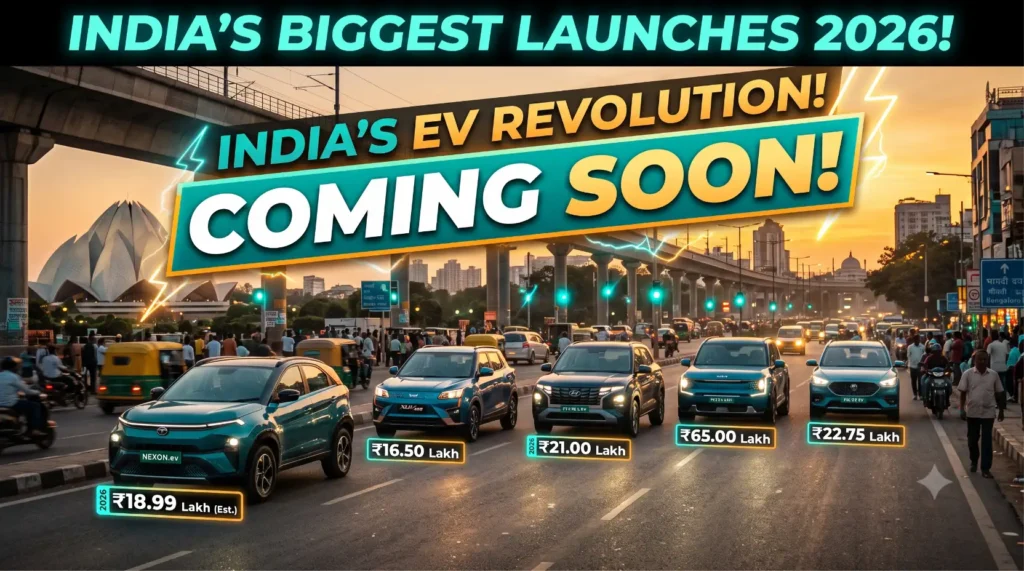
If you’ve been holding off on an EV all year, waiting for “the right one” to land — good news. The second half of 2026 is shaping up to be one of the busiest stretches the Indian EV market has ever seen. 🔥
There’s a Tata Sierra EV that’s reportedly going on sale at the end of June, a premium Tata Avinya that keeps inching closer, BYD’s first plug-in hybrid for India, and a steady drumbeat of new models from Mahindra, MG, and Hyundai. Showrooms are about to get crowded in the best possible way.
But here’s the thing you have to keep in your back pocket: a lot of what’s floating around online is reported or expected, not nailed-down official. Dates slip. Specs get tweaked. Prices land higher (or lower) than the rumour mill promised. 🤔
So treat this as your honest, no-hype field guide to the upcoming EV launches India 2026 buyers are watching most closely — what’s coming, roughly when, and exactly what to confirm before you sign anything. 👇
⚡ The Short Answer
Short on time? Here’s the whole late-2026 picture in a few bullets:
- 🚗 Tata Sierra EV is reported to go on sale around June 30, 2026, slotting between the Curvv EV and Harrier EV, with a larger pack said to deliver 500+ km of range (reported — confirm at launch).
- 💎 Tata Avinya — Tata’s premium “born-electric” model — is expected later in 2026, positioned well above the Sierra.
- 🔋 BYD is reportedly bringing its first PHEV (plug-in hybrid) to India, a notable shift from its pure-EV lineup here.
- 🏔️ Mahindra, MG, and Hyundai all have new or updated electric models in the pipeline across hatch, compact-SUV and mid-SUV segments.
- ⚠️ Almost every date, price and spec below is reported/expected — always confirm the final figures at the official launch.
In short: late 2026 finally gives Indian buyers genuine choice across price bands. The hard part isn’t finding an EV anymore — it’s deciding whether to grab one now or wait a few months for something better. 🇮🇳
📊 Late-2026 EV Launch Snapshot (Expected / Illustrative)
Here’s a quick-glance table of the headline models. Every figure here is reported or illustrative, gathered from public reports and brand chatter — none of it is final, official pricing or spec. Use it to orient yourself, not to budget to the rupee. 👇
| Model | Segment | Expected timing | Expected price band (illustrative) |
|---|---|---|---|
| Tata Sierra EV | Mid-size electric SUV | On sale ~June 30, 2026 (reported) | ~₹22–30 lakh (illustrative) |
| Tata Avinya | Premium / flagship EV | Later 2026 (expected) | ~₹40 lakh+ (illustrative) |
| BYD (first PHEV) | Plug-in hybrid SUV | 2026 (reported) | To be announced |
| Mahindra BE / XUV.e range | Compact–mid electric SUV | Rolling through 2026 (expected) | ~₹20–30 lakh (illustrative) |
| MG (new/updated EV) | Compact–mid SUV | 2026 (expected) | ~₹15–25 lakh (illustrative) |
| Hyundai (new EV entry) | Compact–mid SUV | 2026 (expected) | ~₹18–28 lakh (illustrative) |
⚠️ Reality check: Price bands above are illustrative ranges to help you plan, not quotes. Wait for the official price list before locking in a budget or a loan.
🚗 Tata Sierra EV — The One Everyone’s Watching
If there’s a single launch defining the upcoming EV launches India 2026 conversation, it’s the Sierra EV. The Sierra name carries serious nostalgia, and Tata bringing it back as an electric SUV has had enthusiasts buzzing for ages. 🤩
Reports point to it going on sale around June 30, 2026, which puts it right in the thick of the late-year action. Positioning-wise, it’s said to sit neatly between the Curvv EV below it and the Harrier EV above it — a mid-size electric SUV aimed squarely at the heart of the market.
The headline number flying around is range. The larger battery pack is reported to deliver 500+ km on a charge, which would put it firmly in long-trip-capable territory. 🔋 If that holds up in real-world driving (and not just on the test cycle), it changes the math for a lot of hesitant buyers.
Just remember: the on-sale date, the exact range, the battery sizes, and the price are all reported/expected at this stage. Tata has a habit of staggering variant launches and pricing too, so the “starting price” you see first may not be the trim you actually want.
🔗 Want the deeper dive on this one? We’ve broken it all down in Tata Sierra EV Is Here: Price, Range and Should You Buy It — start there if the Sierra is your top pick.
💎 Tata Avinya — The Premium Play
While the Sierra grabs the mainstream spotlight, the Tata Avinya is the one to watch if you’re shopping further up the ladder. It’s positioned as Tata’s premium, born-electric model — designed from a clean sheet as an EV rather than adapted from a petrol platform. 💎
The Avinya is expected later in 2026, sitting well above the Sierra in both price and ambition. Think bigger, more refined, more tech-forward — Tata’s statement that it can play in the premium space, not just the value end where it’s traditionally dominated.
For buyers, the Avinya matters even if you can’t afford it. Flagship models pull the whole brand upmarket and often trickle their tech down to cheaper cars over time. 🚀 So watching what the Avinya debuts with tells you where Tata’s EVs are heading next.
That said, “expected later in 2026” is doing a lot of heavy lifting here. Premium, ground-up models are exactly the kind that slip a quarter or two. Don’t plan a purchase around an Avinya date that isn’t officially confirmed — treat it as a “coming, eventually” rather than a fixed appointment.
🔋 BYD’s First PHEV — A Strategy Shift
Here’s a genuinely interesting wrinkle in the late-2026 story: BYD is reported to be bringing its first plug-in hybrid (PHEV) to India. 🔌
Up to now, BYD’s India presence has leaned on pure electric cars. A PHEV is a different animal — it pairs a battery and electric motor with a petrol engine, so you can run on electricity for daily commutes and fall back on fuel for long trips with zero range anxiety.
For a chunk of Indian buyers who love the idea of an EV but worry about charging gaps on highways, a well-priced PHEV could be the perfect bridge. 🌉 You get the cheap, quiet electric driving around town, plus the security of a fuel tank when the chargers thin out.
The catch, as always: details are reported, not confirmed. Which model, what electric-only range, what price, and when exactly — all of that is still firming up. But the strategic signal is clear: even committed EV brands are hedging toward plug-in hybrids to widen their appeal in India. Worth keeping on your radar.
🏔️ Mahindra, MG & Hyundai — The Momentum Players
Beyond the headline launches, three established names keep the pipeline full — and they’re arguably more relevant for everyday buyers.
Mahindra continues to push its electric SUV agenda. The XUV400 anchors the more affordable end, while the BE range (the “born electric” family) reaches toward more premium, design-led territory. Mahindra’s been aggressive about EVs, so expect new variants and trims rolling through 2026. 🏔️
MG has been one of the most consistent EV sellers in India and is expected to keep refreshing and expanding its electric lineup across the compact-to-mid SUV space — often hitting attractive price points that pull first-time EV buyers in.
Hyundai, meanwhile, brings serious global EV engineering and is expected to broaden its India EV entries into more accessible segments rather than only the premium end. For mainstream buyers, a sharper Hyundai EV could be a quiet game-changer.
None of these are single dramatic “launch day” events the way the Sierra is. They’re more of a steady wave — which actually means more real-world choice for you across the year. 🌊 As always, confirm each model’s final spec and price at its own launch.
🌊 What’s Driving This Wave of Launches
Why is so much landing at once? A few forces are converging — and understanding them helps you read the market better. 🇮🇳
📉 Incentives and policy support. Central and state EV incentives, road-tax exemptions, and lower GST on EVs versus petrol cars all keep electric attractive. That demand signal pulls launches forward.
📈 Genuine consumer demand. Petrol comfortably above ₹100 a litre, rising charging coverage, and falling battery costs mean ordinary buyers are actually asking for EVs now — not just early adopters. Brands are responding to a market that’s finally ready.
⚔️ Competition. Once Tata proved Indians will buy EVs at scale, everyone else had to follow. Each new model raises the bar on range, features and price, which is fantastic for buyers. 🤑
🔧 Maturing platforms. Born-electric architectures (like the one under the Avinya) let brands build better EVs faster. The early “convert a petrol car” era is giving way to purpose-built electrics.
Put together, this isn’t a one-off spike — it’s the market hitting its stride. The upcoming EV launches India 2026 are the visible tip of a structural shift that’ll keep accelerating.
🧭 Segment-by-Segment: Where the Action Is
Let’s slice the launches by what you can actually afford and need. 👇
🚙 Affordable hatch / compact. This is where mass adoption happens. Expect continued movement from Tata, MG and others at the value end — smaller batteries, city-focused range, sharper prices. If your budget is tighter and your driving is mostly urban, this segment is your friend, and 2026 keeps adding options.
🏔️ Mid-size SUV. The hottest battleground. The Tata Sierra EV plants a flag here, with Mahindra’s BE range, MG and Hyundai all circling. This is where most family buyers will land — enough range for weekend trips, enough space for the whole household. Competition here is brutal, which means better cars at better prices. 💰
💎 Premium. The Tata Avinya leads the home-grown premium charge, while BYD and others play in the upper bands. If you’ve got the budget, this segment debuts the newest tech first — but it’s also where dates are softest and “expected” means expected.
The takeaway: whatever your budget, late 2026 has something landing in your lane. Match the segment to your real needs before you fall for a spec sheet. 🎯
⏳ Buy Now or Wait? How to Actually Decide
The eternal EV dilemma. Here’s an honest framework instead of FOMO. 🤔
Wait if: your current car is fine, one of these specific launches (say, the Sierra EV or Avinya) genuinely fits your needs better than anything on sale today, and you can confirm the official launch is close. Waiting a quarter to get the right car is usually smart.
Buy now if: you need a car now, today’s models already meet your needs, and the “upcoming” option you’re tempted by is still on a reported/unconfirmed date. Waiting indefinitely for a maybe-car costs you months of fuel savings on a real one. ⚡
A useful rule of thumb: never wait for a launch whose date isn’t officially confirmed. Rumoured timing slips constantly. If the date is reported but not from the brand itself, plan as though it could move by months.
And remember — there’s always a better car coming next year. If you wait for perfection, you’ll wait forever. Buy when a genuinely good option meets a genuine need. 🎯
💰 Budgeting for a New EV (The 20/4/10 Rule)
Excitement aside, a new EV is a big financial commitment — and those illustrative price bands above can balloon once you add taxes, accessories and on-road costs. So before you fall in love with a launch, get the money math straight. 💸
A simple, battle-tested guardrail is the 20/4/10 rule: put down at least 20%, keep the loan term to 4 years or less, and ensure total monthly transport costs stay under 10% of your income. If a shiny new launch breaks those limits, it’s a signal to either size down or wait. 🧮
This matters even more with the upcoming EV launches India 2026, because premium models like the Avinya can tempt you well past your comfortable budget. A “born-electric” flagship is gorgeous — but not if it wrecks your monthly cash flow.
🔗 Not sure what you can comfortably spend? Run the numbers first with How Much EV Can You Afford? (The 20/4/10 Rule) — it’ll keep your excitement and your budget on the same page.
Do this before you walk into a showroom, not after. Salespeople sell up; a pre-set budget keeps you grounded. 🎯
✅ What to Confirm at Each Launch
Because so much right now is reported, here’s your verification checklist for any of these models when it actually drops. Don’t assume — confirm. 🔍
📅 The real on-sale date. “Reveal” and “on sale” are different. A car can be unveiled months before you can actually buy and take delivery.
💵 The full price list, not just the teaser. Brands love announcing a low “starting from” price for a base trim nobody wants. Get the price of your preferred variant, on-road, in your city.
🔋 Real range, not just the headline. That “500+ km” figure is usually a test-cycle number. Ask about real-world range and which battery pack delivers it.
🔌 Charging specs. Max DC fast-charging speed, 10–80% times, and the cable/connector type all affect daily life. Confirm them.
🛡️ Warranty and battery coverage. Years, kilometres, and what’s actually covered on the battery — the single most expensive component.
Tick all five before you put money down, and you’ll dodge the most common buyer regrets. ✅
🔌 The India Charging & Incentive Backdrop
A launch is only as good as the ecosystem around it — and India’s is maturing fast, which is partly why this launch wave makes sense. 🇮🇳
On charging: India has pushed well past tens of thousands of public charging points, and the network keeps expanding along highways and in cities. Home charging remains the cheapest, most convenient option for daily use, with public fast charging filling in for long trips. The range anxiety that once killed EV sales is steadily fading.
On incentives: EVs benefit from lower GST than petrol cars, road-tax exemptions in many states, and assorted state-level perks. These don’t always show up in the sticker price, so factor them into your total cost — they can meaningfully tilt the value equation. 💡
The practical point: the infrastructure and policy backdrop is now solid enough that buying one of these new EVs isn’t a leap of faith anymore. It’s a reasonable, increasingly mainstream choice. That confidence is exactly what’s emboldening brands to launch so aggressively.
🎯 Picks by Buyer Type
Let’s make it personal. Here’s a rough steer based on who you are. 👇
👨👩👧 The family buyer. The Tata Sierra EV is the obvious one to watch — mid-size, reported 500+ km range, a trusted name. Cross-shop the Mahindra BE range and Hyundai’s mid-SUV entries before deciding.
🌆 The city commuter on a budget. Look to the affordable hatch/compact segment — MG and Tata’s value end. You don’t need 500 km for a 30 km daily commute; a smaller, cheaper EV is the smarter buy. 💰
💎 The premium seeker. Keep an eye on the Tata Avinya and BYD’s upper lineup. Just be patient — premium dates are the softest, so don’t rush.
🫣 The highway-anxious buyer. BYD’s reported first PHEV could be your sweet spot — electric around town, petrol for the long hauls, zero charging worries. 🔌
🤷 The “just want a good EV now” buyer. Honestly? Don’t wait. Plenty of excellent EVs are already on sale today. Match one to your needs and start saving on fuel immediately. ⚡
📈 2026: India EV Launch Trends
A few patterns worth naming as you read the year:
- 🚙 Mid-size SUVs are the battleground. Most major launches cluster here because that’s where Indian families spend. Expect the fiercest pricing here.
- 🔋 Bigger batteries, longer range. The “500+ km” narrative around the Sierra reflects a broader push past the old 300–400 km norm.
- 🌉 PHEVs entering the conversation. BYD’s reported PHEV signals brands hedging toward plug-in hybrids to ease charging worries.
- 💎 Home-grown premium rising. The Avinya shows Indian brands aiming upmarket, not just defending the value end.
- ⚡ More choice, sharper prices. Competition keeps multiplying options and pressuring prices downward — a win for buyers.
The through-line: India’s EV market is graduating from “a few options” to “real, segmented choice.” That’s the big 2026 story. 🇮🇳
✅ 5 Tips if You’re Waiting for a 2026 Launch
- 🔔 Track official channels, not just rumours. Follow the brand’s own announcements for dates and prices — reported figures shift constantly.
- 💰 Pre-set your budget with the 20/4/10 rule before you fall for any launch, so excitement doesn’t blow your finances.
- 📅 Don’t bank on unconfirmed dates. If the on-sale date isn’t from the brand, assume it could slip by months and plan accordingly.
- 🚗 Keep your current car running well while you wait — a surprise breakdown can force a rushed, worse decision.
- 🔍 Build your “confirm at launch” list now (price, real range, charging, warranty) so you can act fast and smart on launch day. ⚡
🛒 Shop This Post
While you wait for the right launch, a few smart buys make EV ownership smoother from day one. 😍
1. A Portable Level-2 EV Charger 🔌
A compact home charger means you’re ready the moment your new EV arrives — no scrambling for installation later.
👉 Shop portable EV chargers
2. A Bluetooth OBD2 Scanner 📊
Pair it with an app to monitor your new EV’s battery health and real efficiency from week one — peace of mind on a big purchase.
👉 Shop OBD2 scanners
3. A Tyre Inflator with Digital Gauge 🛠️
Correct tyre pressure protects your range and your tyres — a cheap, essential bit of kit for any new EV owner.
👉 Shop tyre inflators
🛒️ Disclosure: These are affiliate picks. If you buy through our links, EVs Mirror may earn a small commission at no extra cost to you — it helps keep these guides free. 🙏
🎯 Quick Quiz: Should You Wait or Buy Now?
Answer these three and tally your letters:
- Is your current car still reliable? 🅐 Yes, it’s fine 🅑 No, it’s on its last legs
- Is the launch you want officially confirmed? 🅐 Yes, date’s locked 🅑 No, just reported
- Does a car on sale today already meet your needs? 🅐 Not really 🅑 Yes, basically
Mostly 🅐: 🟢 Waiting makes sense — the right launch fits you and your current ride can hold on. Just confirm the date stays put.
Mostly 🅑: 🟡 Don’t wait for a maybe-car. A great EV is already on sale — buy it and start saving now. ⚡
📋 Pre-Launch Checklist
- [ ] Note the official on-sale date (from the brand, not rumours)
- [ ] Set your budget using the 20/4/10 rule
- [ ] Confirm the price of your preferred variant, on-road
- [ ] Verify real-world range, not just the test-cycle figure
- [ ] Check DC fast-charging speed and connector type
- [ ] Confirm battery warranty (years + km)
- [ ] Check available state incentives and road-tax exemptions
- [ ] Compare against EVs already on sale today ⚡
🤔 People Also Ask
Q: What are the most anticipated upcoming EV launches India 2026 buyers should watch?
A: The headliners are the Tata Sierra EV (reported on sale around June 30, 2026), the premium Tata Avinya (expected later in 2026), and BYD’s first PHEV for India, alongside new models from Mahindra, MG and Hyundai. All dates and specs are reported/expected — confirm at each official launch.
Q: When is the Tata Sierra EV going on sale in India?
A: Reports point to an on-sale date around June 30, 2026, positioned between the Curvv EV and Harrier EV, with a larger pack said to offer 500+ km of range. This is reported, not officially confirmed — verify the final date, price and range at launch.
Q: How much will these new 2026 EVs cost?
A: We won’t quote exact figures because none are official yet. Illustrative bands run roughly ₹15–30 lakh for mid-segment SUVs and ₹40 lakh+ for premium models like the Avinya. Treat these as planning estimates only and wait for the official price list.
Q: Is the Tata Avinya launching in 2026?
A: It’s expected later in 2026 as Tata’s premium, born-electric flagship. But premium, ground-up models often slip — so don’t plan a purchase around an Avinya date until it’s officially confirmed by Tata.
Q: Should I wait for a 2026 launch or buy an EV now?
A: Wait only if a specific upcoming model genuinely fits your needs better and its date is officially confirmed. If you need a car now and today’s EVs meet your needs, buy now — chasing unconfirmed launch dates can cost you months of savings.
Q: What’s notable about BYD’s plans among the upcoming EV launches India 2026?
A: BYD is reported to be launching its first plug-in hybrid (PHEV) in India, a shift from its pure-EV lineup. A PHEV blends electric city driving with a petrol backup for long trips — appealing for buyers worried about highway charging. Details remain reported, not confirmed.
🚀 The Bottom Line
Late 2026 is genuinely exciting for Indian EV buyers. The Tata Sierra EV reportedly arrives at the end of June, the premium Avinya looms later in the year, BYD adds a PHEV twist, and Mahindra, MG and Hyundai keep the pipeline flowing. After years of limited choice, you finally have real options across every budget. 🇮🇳
But keep your feet on the ground: dates, prices and specs are reported or expected, not gospel. Confirm everything at the official launch, set your budget with the 20/4/10 rule, and never wait indefinitely for an unconfirmed car when a great EV is already on sale today. ⚡
The smartest buyers in 2026 won’t be the ones chasing every rumour — they’ll be the ones who match a real car to a real need, on solid numbers. 🎯
💬 Which of these 2026 launches are you most excited for? Tell us in the comments!
📤 Know someone waiting on a new EV? Forward them this guide. 🙏
🔖 Bookmark EVs Mirror for honest, India-focused EV launch coverage.
👉 Ready to dig into the big one? Read Tata Sierra EV Is Here: Price, Range and Should You Buy It next.