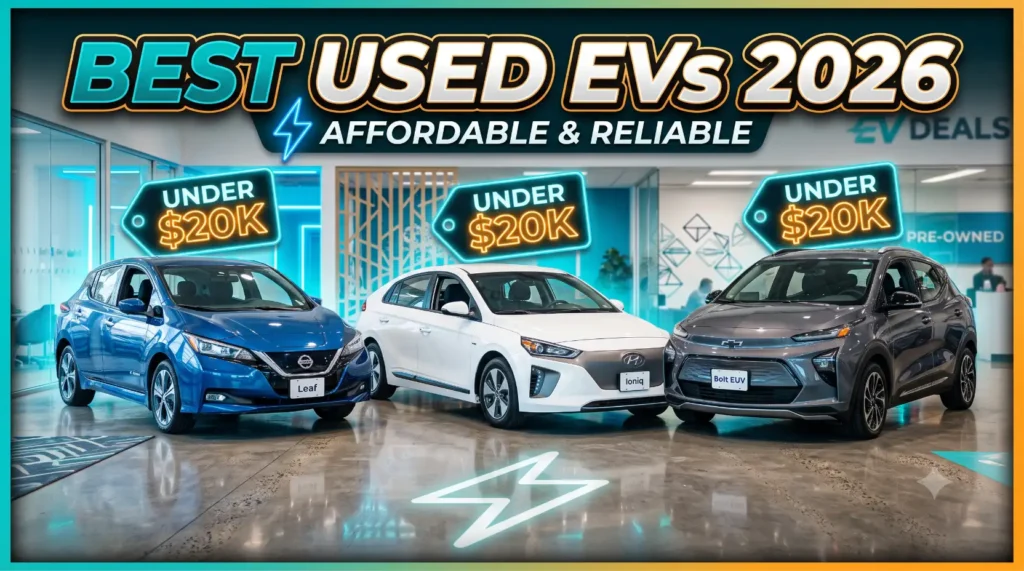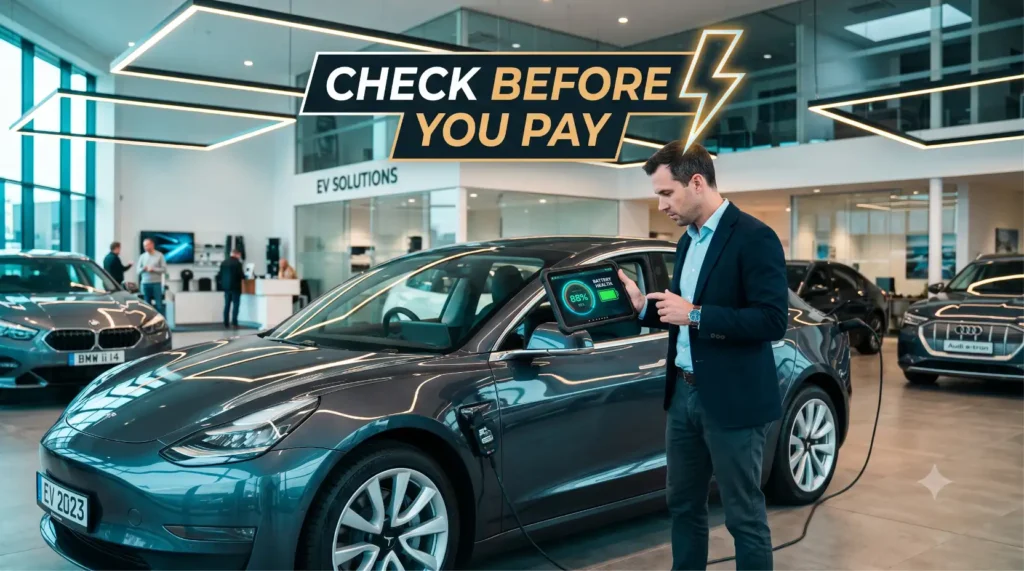
You found it. The used electric car of your dreams, sitting in a listing that looks almost too good — low miles, shiny paint, a price that makes you grin like you’ve gotten away with something. ⚡
Then a quiet little voice in the back of your head pipes up: “How do I actually know this thing is healthy?”
Good. Listen to that voice. Because a used EV isn’t a used petrol car wearing different clothes — it’s a rolling battery with wheels, and the one part that matters most is the one you can’t see by kicking the tyres. 🔋
Buying second-hand electric can be one of the smartest money moves of 2026. Prices have softened, choice has exploded, and the early depreciation hit has already been absorbed by the first owner. But “smart” only happens if you check the right things, in the right order, before you pay a single dollar or rupee. That’s exactly what this used EV buying guide is for. 👇
⚡ The Short Answer
No fluff. Before you pay for any used EV, check these — in this order:
- 🔋 Battery State of Health (SoH) — the single most important number. Anything above ~85% is healthy for most cars.
- 🔌 Charging works on AC and DC fast — test both if you possibly can.
- 📄 Service history + open recalls/software — a clean, documented record beats a cheap price.
- 🛡️ Warranty transfer — confirm the battery warranty actually carries over to you.
- 🛸 Tyres, brakes/regen, suspension — EVs are heavy; tyres wear faster than you’d think.
- 💰 Price vs SoH — negotiate using the battery number, not the odometer.
Get those six right and you’ve dodged 90% of the heartbreak. Get them wrong and a “bargain” can turn into a five-figure repair. 😬
📊 The Used EV Pre-Purchase Checklist (At a Glance)
Before the deep dive, here’s the whole inspection on one screen. Screenshot this and take it to the viewing. 👇
| What to Check | Why It Matters | Pass / Walk-Away Signal |
|---|---|---|
| 🔋 Battery health (SoH) | The most expensive part — sets real value | ✅ 85%+ healthy · ⚠️ under 80% negotiate hard |
| 🔌 Charging test (AC + DC) | Confirms onboard charger & port work | ✅ Both charge cleanly · ❌ errors or no DC |
| 📄 Service history | Shows real care & accident clues | ✅ Documented · ❌ gaps or “lost it” |
| 🛡️ Warranty transfer | Battery cover can be worth thousands | ✅ Transfers to you · ❌ owner-locked |
| 🛸 Tyres & brakes/regen | Heavy cars eat tyres; regen test | ✅ Even wear · ⚠️ mismatched/cupped |
| 💻 Software & recalls | Fixes range, charging, safety bugs | ✅ Up to date · ❌ pending recalls |
See the right-hand column? Those are your walk-away triggers. The rest of this guide explains how to spot each one. 💡
🆚 Why Buying a Used EV Is Different From a Used Petrol Car
Let’s clear this up first, because it changes everything about how you inspect.
With a used petrol car, the engine and gearbox are the worry. You listen for knocks, check for oil leaks, sniff for burnt clutch, and count the miles. The fuel tank? Nobody cares — it’s a cheap metal box.
An EV flips that entirely. There’s no engine to seize, no clutch to slip, no timing belt ticking toward doom. 🔋 The drivetrain is almost laughably simple and tends to outlast everything around it.
Instead, the whole game is the battery pack — a component that can cost $8,000–$20,000 (₹6–18 lakh) to replace if it’s badly degraded. That’s not a tune-up. That’s a “buy a different car” number.
So the skills that made you a savvy petrol-car buyer barely transfer. Low mileage is reassuring but not the whole story — a 30,000-mile EV that lived on DC fast chargers in desert heat can be worse than a 60,000-mile one that sipped gently from a home wallbox. The battery remembers how it was treated. That’s why this used EV buying guide puts battery health front and centre and treats the odometer as a supporting actor. 🎯
🔋 Checking Battery State of Health (The #1 Thing)
If you remember one thing from this entire article, make it this: State of Health (SoH) is the value of the car.
SoH is the battery’s current usable capacity compared to when it was new, shown as a percentage. A pack at 100% is factory-fresh; one at 88% has lost roughly 12% of its capacity (and therefore roughly 12% of its range). Most EVs lose 1–2% per year with normal use, so some degradation is completely normal and nothing to panic over. 😌
Here’s the rough scale to keep in your head:
- 🟢 90–100% SoH — excellent, usually a younger or gently-used car.
- 🟢 85–90% SoH — healthy and very normal for a 3–5 year-old EV.
- 🟡 80–85% SoH — acceptable, but use it to negotiate the price down.
- 🔴 Below 80% SoH — proceed with real caution and a fat discount.
How do you actually read it? A few ways. Many EVs show a battery health or “max range” figure buried in the settings menu. Some give you a “guess-o-meter” full-charge range you can compare to the original EPA/WLTP/ARAI figure. But the gold standard is a cheap OBD2 Bluetooth scanner paired with an app that reads the pack directly — it gives you a real SoH number instead of a salesperson’s smile. 📱
Don’t trust the dashboard range estimate alone — it’s optimistic and easily reset. Plug in, read the actual pack data, and write the number down. That single figure decides whether you’re getting a bargain or a money pit.
💡 Read: How to Check Battery Health on a Used EV — a full step-by-step walkthrough with the exact apps, codes, and target numbers for popular models.
🔌 Testing the Charging (AC + DC, Don’t Skip One)
A healthy battery is useless if the car won’t take a charge properly. And charging faults are sneaky — they often hide until you’re 200 miles from home at 2 a.m. 😱
There are two systems to test, and they’re genuinely separate:
1. AC charging (your daily reality). This is your home wallbox or a Level 2 / 7kW public point. Plug in and confirm the car starts charging cleanly, shows the expected power, and throws no errors. This uses the car’s onboard charger — a part that’s annoying and pricey to replace if it’s faulty.
2. DC fast charging (the road-trip lifeline). This is the rapid 50kW–250kW stuff (CCS / NACS in the US, CCS2 in India). DC charging stresses the pack harder and uses a different pathway, so a car can AC-charge fine yet fail on DC. If you can possibly get to a fast charger during the test, do it. ⚡
While charging, watch for: charge errors, the session dropping out, the car only accepting a fraction of the expected speed, or wild temperature warnings. Any of those is a conversation — or a walk-away. A car that quietly refuses DC fast charging is hiding something expensive.
If the seller resists letting you test charging “because it’s a hassle,” treat that as a flashing yellow light. A confident seller of a healthy EV has nothing to hide here.
🛡️ Warranty & Battery-Warranty Transfer
Here’s a detail that separates the careful buyer from the one who learns the hard way: most EVs have two warranties. A general vehicle warranty, and a separate, longer battery warranty — typically 8 years / 100,000 miles (160,000 km) or more.
That battery warranty is gold. It often guarantees the pack won’t drop below a certain SoH (commonly 70%) in that window — and if it does, you may get a repair or replacement on the manufacturer. On a used EV, that remaining cover can be worth thousands. 💰
But — and this is the trap — warranties don’t always transfer automatically. Some are owner-bound, some need a formal transfer, some have conditions about service history or where the car was bought. So:
- ✅ Confirm in writing whether both warranties transfer to the new owner.
- ✅ Check how much time/mileage is left on the battery warranty specifically.
- ✅ Ask if a transfer fee or dealer inspection is required.
- ✅ For India, confirm whether the battery cover is tied to the original buyer or the VIN.
A used EV with three years of battery warranty remaining is a fundamentally safer buy than an identical one that’s just run out. Factor that straight into your price. 🎯
📄 Service History, Recalls & Software
EVs need far less servicing than petrol cars — no oil, no plugs, no exhaust — but “less” isn’t “none,” and the paper trail still tells a story.
Service history reveals how the car was looked after: brake fluid changes, cabin filters, coolant for the battery’s thermal system (yes, many packs are liquid-cooled and that coolant matters), tyre rotations, and any warranty work. A documented history also quietly flags accident repairs and recall fixes. Gaps in the record, or a seller who “lost the folder,” deserve scepticism. 🤨
Recalls are a big deal on EVs — and totally normal. Several major models have had battery, charging, or software recalls over the years. Take the VIN and check the manufacturer’s recall lookup (NHTSA in the US; the carmaker’s India helpline or portal) to confirm every recall has been completed. An unaddressed battery recall is a genuine safety and value issue.
Software is the modern twist. A used EV is partly a computer, and its software version affects range, charging behaviour, and even safety features. Confirm the car is on the latest update and that there are no pending updates stuck in limbo. On some brands, software can also lock or unlock features — so check exactly what this specific car is licensed for before you assume. 💻
👉 Up next: Used EV Red Flags That Should Make You Walk Away — the deal-breakers that no discount can fix, from rejected recalls to suspicious battery data.
🛸 Physical Inspection: Tyres, Brakes-Regen & Suspension
Now the hands-on bit. EVs are heavy — that big battery adds hundreds of kilos — and that weight shows up in a few predictable places.
Tyres. Heavy + instant torque = faster tyre wear, especially on the drive axle. Check tread depth, look for uneven or “cupped” wear (a suspension or alignment clue), and confirm all four roughly match. A fresh set of EV-rated tyres is $600–$1,200 (₹40,000–₹90,000), so worn rubber is real negotiation ammo. 🛸
Brakes & regen. Here’s a lovely EV quirk: regenerative braking means the physical brakes do far less work, so pads and discs often last ages. But that same idleness can cause discs to rust or seize if the car sat unused. On the test drive, lift off the accelerator and feel the regen kick in smoothly — then use the actual brakes and listen for grinding or feel for pulsing.
Suspension. All that battery weight leans on the springs and dampers. Bounce each corner, listen for clunks over bumps, and watch for sagging. Worn suspension on a heavy EV isn’t cheap to put right.
Also peek underneath for battery pack damage — scrapes, dents, or signs of a hard knock to the floor where the pack lives. That’s where a cheap pre-purchase inspection from an EV-savvy mechanic pays for itself ten times over. 🔧
🚗 The Test Drive: What to Feel For
Numbers and paperwork are vital, but the drive tells you things a spreadsheet can’t. Take at least 20 minutes and cover a mix of city and faster roads.
Power delivery. EVs should pull smoothly and instantly. Any hesitation, jerk, or “limp mode” warning is a red flag — get out and read those error messages. ⚠️
Regen feel. Lift off the throttle. The deceleration should be smooth and predictable, not grabby or absent. Inconsistent regen can hint at battery or software issues.
Noises. EVs are quiet, which is a gift — it makes rattles, whines, and clunks impossible to hide. A faint whine from the motor under load can be normal; loud grinding or knocking from the suspension is not.
Range sanity check. Note the predicted range at the start, drive your loop, and see if the drop roughly matches the distance covered. Wildly faster depletion is worth investigating against your SoH reading.
Cabin tech. Test the screen, climate control, heated seats, and especially the heat pump if fitted — it’s crucial for winter range. Glitchy infotainment is annoying; a dead climate system in a heavy EV is expensive.
Trust your gut here. If something feels off and the seller waves it away, that is the answer. 🎯
💰 Paperwork & Price Negotiation
You’ve done the hard part. Now make the numbers work in your favour.
Paperwork first. Confirm the title/registration is clean (no liens or outstanding finance), the VIN on the car matches every document, and — in India — the RC, insurance, and any battery-lease or subscription terms are crystal clear. Some older EVs had battery leasing, where you own the car but rent the pack; you do not want that surprise after signing. 📄
Then negotiate with data, not vibes. This is where your SoH number becomes a superpower. If the battery reads 82% instead of a healthy 90%, that’s a measurable loss of range and resale value — and a legitimate reason to knock money off. Worn tyres, a lapsed warranty, pending recalls, and tired brakes are all line items you can price.
A simple, polite script works wonders: “I love the car, but the battery’s at 82% and it needs tyres — here’s what I can do.” Sellers respect a buyer who’s clearly done their homework. 😎
Finally, line the price up against the wider market (more on that next). A used EV’s fair price in 2026 is increasingly negotiable, and informed buyers are winning. 💪
📈 2026 Market Trends for Used EV Buyers (Prices Dropping)
Good news if you’re shopping right now: the used EV market has tilted firmly in the buyer’s favour. 🎉
A few forces are pushing prices down:
- 📉 Supply surge. A wave of EVs leased and bought in 2021–2023 is now hitting the second-hand market, flooding listings with choice.
- 🔋 Battery confidence. Real-world data keeps showing packs degrade slowly and last well, which should support values — but the sheer volume of cars is outweighing that.
- 🏷️ New-car price cuts. When manufacturers slash prices on new EVs, used values get dragged down with them. New incentives ripple straight into the used market.
- ⚡ Faster-improving tech. Newer models with better range make older ones look dated, softening their prices further.
For buyers, this means genuine bargains — cars that have already taken their biggest depreciation hit, now selling for a fraction of new. In the US, plenty of solid used EVs sit in the $15,000–$30,000 band; in India, the used EV scene is younger but warming up fast, with mainstream models increasingly available second-hand at meaningful discounts (often ₹8–18 lakh). 💰
The catch? Cheap doesn’t mean healthy. A falling market makes it more tempting to grab a “deal” without checking the battery. Don’t. Let the price tempt you in, but let the SoH number make the final call. 🎯
✅ 5 Tips Before You Pay
Quick, sharp, do-these-no-matter-what:
- 🔋 Get a real SoH reading. Use an OBD2 scanner or the car’s own battery-health screen — never trust the dashboard range guess alone.
- 🔌 Test AC and DC charging. A car that won’t fast-charge is hiding a costly problem.
- 🛡️ Confirm the battery warranty transfers — and exactly how much is left on it.
- 🔧 Pay for a pre-purchase inspection by an EV-literate mechanic. Best money you’ll spend on the whole deal.
- 💰 Negotiate with your data. SoH, tyres, recalls, and warranty status are all real, priceable bargaining chips.
Do all five and you’ve turned a gamble into a calculated, confident buy. 😎
🛒 Tools That Make This Easier (Shop This Post)
A few affiliate-friendly picks that genuinely help you inspect a used EV like a pro. 😍
1. OBD2 Bluetooth Battery Scanner 📱
Plugs into the car and reads true State of Health, cell balance, and fault codes — turning “looks fine” into hard data. The single best $30–$60 (₹2,500–₹5,000) you’ll spend before buying.
👉 Shop OBD2 EV battery scanners
2. Pre-Purchase Inspection Service 🔧
An EV-savvy mechanic checks the pack, charging system, brakes, and underbody before you commit. A small fee now versus a five-figure surprise later.
👉 Book a pre-purchase EV inspection
3. Home EV Charger (Level 2 / Wallbox) ⚡
Once you’ve bought smart, charge smart. A home wallbox slashes running costs and keeps your new (used) battery happy with gentle AC charging.
👉 Shop home EV chargers
🛍️ Shop This Post: (These are affiliate picks. They cost you nothing extra and help keep EVs Mirror running. 🙏)
🎯 Quick Quiz: Is This Used EV a Buy or a Walk?
- Did you get a real SoH reading (not just the range guess)? 🅐 Yes 🅑 No
- Did you test both AC and DC charging? 🅐 Yes 🅑 No
- Does the battery warranty transfer to you with time left? 🅐 Yes 🅑 No
- Is the service history documented with recalls completed? 🅐 Yes 🅑 No
Mostly 🅐: 🟢 Green light — you’re buying with eyes wide open. Negotiate and enjoy.
Mostly 🅑: 🟡 Slow down. Fill these gaps before you pay — they’re exactly where bad deals hide.
📋 Used EV Buying Checklist
- [ ] Read true Battery State of Health (target 85%+) 🔋
- [ ] Test AC charging (home/Level 2) for clean session
- [ ] Test DC fast charging if at all possible ⚡
- [ ] Confirm battery + vehicle warranty transfer to you 🛡️
- [ ] Check VIN for completed recalls (NHTSA / maker portal)
- [ ] Verify software is on the latest version 💻
- [ ] Inspect tyres for even wear; check tread depth 🛸
- [ ] Test brakes and feel regen on the drive
- [ ] Look under the car for battery pack damage 🔧
- [ ] Confirm clean title/RC and no battery lease 📄
- [ ] Negotiate price using your SoH + condition data 💰
🤔 People Also Ask
Q: What’s the most important thing to check in a used EV buying guide?
A: Battery State of Health (SoH). It’s the car’s most expensive component and the truest measure of value — aim for 85%+, and use an OBD2 scanner to read it directly rather than trusting the dashboard range estimate.
Q: How do I know if a used EV battery is healthy before I pay?
A: Read the actual SoH with an OBD2 Bluetooth scanner or the car’s battery-health menu, compare full-charge range to the original spec, and confirm the battery warranty’s remaining cover. Anything above ~85% SoH is healthy for a few-year-old EV.
Q: Do I really need to test DC fast charging on a used EV?
A: Yes, if you possibly can. AC and DC charging use different pathways, so a car can charge fine at home yet fail on rapid chargers. Testing both before you pay catches an expensive fault early.
Q: Does the battery warranty transfer when I buy a used EV?
A: Often yes, but not always automatically — some are owner-bound or need a formal transfer. Always confirm in writing that both the vehicle and battery warranties carry over, and check exactly how much time and mileage remain.
Q: Are used EV prices really dropping in 2026?
A: Generally yes. A surge of off-lease cars, new-car price cuts, and rapidly improving tech have pushed used EV values down, creating real bargains — especially in the $15,000–$30,000 (₹8–18 lakh) range. Just don’t let a low price tempt you into skipping the battery check.
Q: Is buying a used EV worth it compared to new?
A: For most buyers, yes. The first owner absorbed the steepest depreciation, running and maintenance costs stay low, and a healthy battery can serve for many more years. The key is checking SoH, charging, warranty, and recalls before you commit.
🚀 The Bottom Line
A used EV can be one of the savviest buys of 2026 — if you shop with your head, not just your heart. This used EV buying guide boils down to one big truth: the battery is the car. Read its real State of Health, test both AC and DC charging, confirm the warranty transfers, check recalls and software, and inspect the heavy-wear bits before you negotiate. Do that, and a falling market hands you a genuine bargain instead of a costly mistake. ⚡
⚠️ A quick honest note: Battery readings, warranties, recalls, and prices vary by model, region, and individual car. Treat everything here as a friendly starting point — always confirm with the manufacturer and an EV-literate mechanic before you buy. 🙏
💬 Shopping for a used EV right now? Drop the model and its SoH in the comments — let’s crowd-check your deal!
📤 Know someone about to buy second-hand electric? Forward them this checklist before they pay.
🔖 Bookmark EVs Mirror for honest, no-nonsense EV ownership guides.