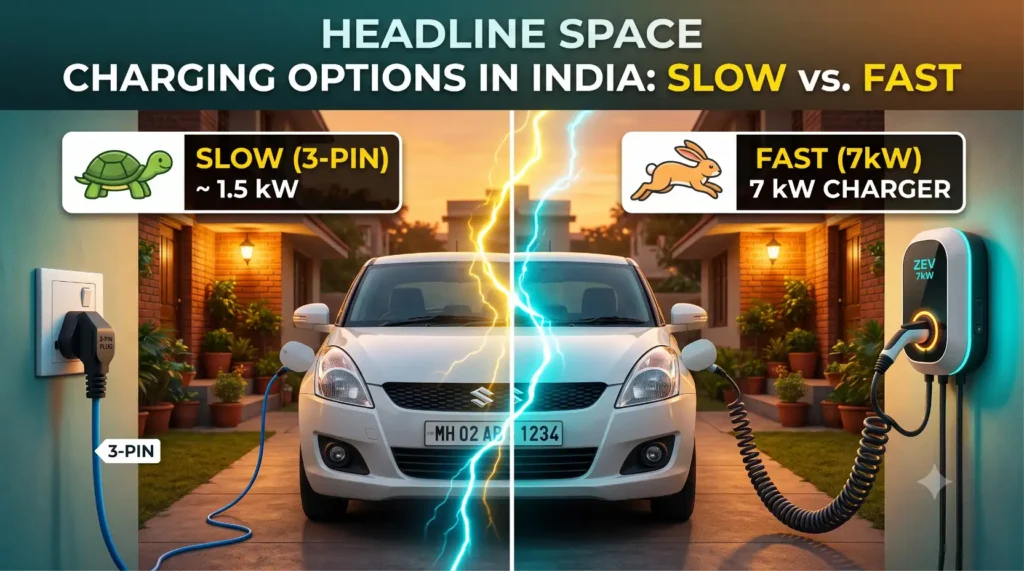
Every Indian EV owner eventually hits the same little fork in the road. You can keep using the humble 3-pin plug that came tucked in the boot, or you can spend a bit and put in a proper 7kW home charger India drivers keep recommending in every WhatsApp group and forum. 🤔
It feels like a tiny, almost boring decision. But it isn’t. It’s honestly the difference between waiting all night and still waking up to a half-full battery — versus plugging in after dinner and finding 100% by morning, every single day, without thinking about it.
And the wrong choice cuts both ways. Buy too much charger and you’ve burned ₹40,000 on speed your car can’t even use. Buy too little and you’ll spend two years quietly frustrated, planning your week around a slow trickle.
So let’s settle the 3-pin vs 7kW debate properly — with real numbers on speed, cost, safety, and the sneaky savings most people miss — and figure out exactly which setup belongs in your home. By the end you’ll know whether you need a 7kW home charger India. 👇
⚡ The Short Answer
- 3-pin (≈2.3–3 kW) 🐢 — slow, basically free, and genuinely fine for scooters and light city drivers.
- 7kW home charger (≈7.2 kW) 🐇 — 2–3× faster, fully charges most Indian EVs overnight, ideal for daily commuters.
- Speed gap: 3-pin adds ~10–15 km of range per hour; a 7kW unit adds ~30–50 km per hour.
- Full charge, 40 kWh EV: about 6 hours on 7kW vs a painful 13–17+ hours on 3-pin.
- The deciding factor isn’t budget — it’s how far you drive and how big your battery is.
If you drive a normal amount in a Nexon-class EV, a 7kW home charger India setup will quietly transform your daily life. If you barely drive and own a scooter or compact EV, 3-pin might genuinely be all you ever need. 😎
📊 3-Pin vs 7kW Home Charger — Side-by-Side
| Quick Insight | 🐢 3-Pin Socket | 🐇 7kW Home Charger |
|---|---|---|
| Power | ~2.3–3 kW | ~7.2 kW |
| Range added/hour | ~10–15 km | ~30–50 km |
| Full charge (40 kWh EV) | 13–17+ hrs | ~6 hrs |
| Setup cost | ₹0 (cable included) | ₹30,000–₹55,000 installed |
| Phase needed | Single-phase | Single-phase (7.2 kW max) |
| Smart features | None | App, scheduling, load balancing |
| Best for | Scooters, light drivers | Daily car commuters |
| Convenience | Plug in and wait | Plug in, wake up full |
Look hard at the “range added/hour” row. That one gap — 10–15 km versus 30–50 km — is the entire reason the 7kW home charger India market is exploding right now. ⚡
🐢 When 3-Pin Charging Is Genuinely Enough
Let’s start by giving 3-pin its fair due, because the internet loves to dunk on it and that’s not always honest.
The bundled 3-pin (or 3.3 kW portable) charger is perfectly adequate for a real slice of Indian EV owners. You don’t need to spend a rupee more if you fit this profile:
- ✅ You ride an electric scooter or drive a compact city EV
- ✅ Your daily distance is comfortably under ~40 km
- ✅ Your car can sit plugged in for many uninterrupted hours overnight
- ✅ You’re renting, or you simply don’t want to commit to a wall install yet
For these drivers, a 3-pin socket quietly tops up the battery overnight at zero setup cost. The trickle is slow, sure — but if you only drained 30–40 km of range today, even a slow trickle refills you before sunrise. 🙌
There’s also a comfort argument people forget. Slow charging runs cooler and is famously gentle on the battery. You’re never blasting heat into the pack. For a light-use owner, 3-pin can keep a battery happy for years with almost zero fuss.
The honest catch: the moment your daily driving or battery size grows, 3-pin stops keeping up. And that’s exactly where the 7kW conversation begins.
🐇 When a 7kW Home Charger Is Worth It
A 7kW home charger India setup earns its keep — and then some — the moment your driving gets serious. It’s the right call if:
- ✅ You drive a Nexon-class or bigger EV with a 35–50 kWh battery
- ✅ Your daily distance is 50+ km, or it swings unpredictably
- ✅ You sometimes forget to plug in (a 7kW unit catches up overnight where 3-pin can’t)
- ✅ You want to fully exploit cheap off-peak EV tariffs in the narrow night window
Here’s the thing people underrate. It’s not just about speed for its own sake — it’s about fitting a full charge into the cheap, convenient hours. A 7kW unit can refill a big battery entirely between, say, 11 PM and 6 AM, right inside the off-peak tariff slot. A 3-pin trickle simply can’t finish that job in time, so you either wake up short or pay daytime rates.
That combination — wake up full and charge at the cheapest tariff — is the real clincher. It’s why four-wheeler owners almost never regret the upgrade. 😍
A good 7kW wallbox also brings smart features 3-pin will never have: app scheduling, charge timers, energy tracking, load balancing so you don’t trip the main, and proper weatherproofing for an outdoor wall. You’re buying convenience and safety, not just watts.
💡 Curious about exact install pricing and what drives it up or down? Read our full breakdown: EV Charger Installation Cost in India
⏱️ Charging Time Examples for Popular Indian EVs
Numbers make the 3-pin vs 7kW home charger India difference impossible to ignore. Here’s roughly how long a full charge takes on each, for the EVs most Indians actually own. 👇
| EV (approx battery) | 🐢 3-Pin (~2.5 kW) | 🐇 7kW Home Charger |
|---|---|---|
| Tata Tiago EV (24 kWh) | ~10–11 hrs | ~3.5 hrs |
| Tata Punch EV (35 kWh) | ~14–15 hrs | ~5 hrs |
| Tata Nexon EV (40 kWh) | ~16–17 hrs | ~6 hrs |
| MG ZS EV (50 kWh) | ~20+ hrs | ~7 hrs |
| Mahindra XUV400 (39 kWh) | ~15–16 hrs | ~5.5 hrs |
See the story the table tells? On a 3-pin socket, a bigger EV like the ZS EV simply cannot fully recharge in a normal overnight window. You’d plug in at 11 PM and still wake up short — a genuinely frustrating way to start a workday.
A 7kW home charger India setup erases that problem completely, comfortably refilling even a 50 kWh battery by morning with hours to spare. ⚡
Notice the lower end too. A Tiago or Punch driver with light daily use can keep up just fine on 3-pin — the small battery and short commute work in your favour. But the second you step up to a Nexon-class or larger EV and drive a real commute, the 7kW upgrade stops being a luxury and becomes the thing that makes daily EV life genuinely stress-free.
That’s the entire decision compressed into one table: match the charger to your battery size and how far you actually drive. 🎯
🔌 Single-Phase Compatibility & Sanctioned Load
This is the part that trips up more buyers than any other, so let’s slow down and get it right.
Most Indian homes run on a single-phase connection, and the good news is a 7kW (7.2 kW) charger works beautifully on single-phase. In fact, 7.2 kW is the practical ceiling for single-phase homes — anything higher, like an 11 kW or 22 kW unit, needs a three-phase connection that most residences simply don’t have. So for the vast majority of Indian households, 7kW is the fastest home charging you can realistically install.
But there’s a catch, and it has a name: sanctioned load.
Your sanctioned load is the maximum power your discom has officially approved for your home, printed right on your electricity bill in kilowatts. A 7kW charger pulls about 7.2 kW on its own — roughly the same as running several air conditioners at once. If your sanctioned load is low (say 3–5 kW) and you fire up the charger while the AC, geyser, and kitchen are running, your main breaker will trip. Repeatedly. Annoyingly. 😤
Before you buy a 7kW unit, do two simple things:
- Check your bill for your current sanctioned load in kW.
- If it’s tight, apply to your discom for a load enhancement — usually a small, one-time process that’s well worth it.
A 3-pin charger sidesteps all of this. At 2.3–3 kW it slips comfortably under almost any home’s load, which is part of why it’s the no-hassle default for renters and budget setups. With a 7kW home charger India install, the smart move is to confirm your load first, enhance if needed, and let a licensed electrician size the wiring and breaker properly.
💸 The Dedicated EV Meter Savings Most People Miss
Here’s a money trick that quietly pays for your charger over time, and a shocking number of owners never set it up.
Many state discoms now offer a dedicated EV meter — a separate connection just for car charging — billed at a special, concessional EV tariff. We’re talking roughly ₹4.50–₹6 per kWh in several states, often with even cheaper off-peak night slabs, versus your regular domestic slab which climbs much higher as you use more.
Run the math and it’s eye-opening. A 40 kWh battery, charged on a cheap EV tariff, can cost dramatically less to fill than the same energy billed on your top domestic slab. Over a year of daily charging, that gap can run into thousands of rupees — easily enough to recover a chunk of your 7kW home charger India install cost.
Why does the 7kW unit pair so well with this? Because the cheap tariff often lives in a narrow off-peak window. A 7kW charger can pour a full charge into that window before the cheap rate ends. A slow 3-pin trickle frequently can’t finish in time, so part of your charge spills into pricier hours. Speed plus a dedicated meter equals real, repeatable savings. 💰
The setup does carry an upfront cost — a new meter, application paperwork, sometimes a deposit. But for any car owner charging daily, it usually pays back fast. If you’re installing a 7kW wallbox anyway, ask your electrician and discom about a dedicated EV meter in the same breath.
🔒 Safety: Please, No Extension Cords
Quick but important, because this one is about your home, not your wallet.
3-pin charging is safe — when you do it right. The single biggest mistake we see is people running their EV charger through a cheap extension cord or a multi-plug board. Don’t. Just don’t. 🔥
An EV pulls a steady, heavy current for many hours straight. Ordinary extension cords and strip boards aren’t built for that kind of sustained load. They heat up, the contacts degrade, and you’ve created a genuine fire risk overnight while everyone’s asleep. This is not a hypothetical — it’s the most common EV charging incident in Indian homes.
The rules are simple:
- ✅ Always plug directly into a sound, dedicated wall socket — never an extension cord or power strip.
- ✅ Use a 16A industrial-grade socket rated for continuous high current, not a standard 6A point.
- ✅ Get the wiring and earthing checked by a licensed electrician before you start.
- ✅ For 7kW, insist on a dedicated circuit with its own breaker (MCB/RCBO) and proper earthing.
A 7kW wallbox actually has a safety edge here. It’s hardwired or installed on a dedicated industrial socket with built-in protections — earth-leakage detection, surge handling, temperature cut-offs — that a bare 3-pin plug simply doesn’t offer. If safety and peace of mind rank high for you, that’s a real point in the 7kW home charger India column. ⚡
🚗 Three Real-World Scenarios
Let’s make the choice concrete with three everyday Indian situations. Find the one that sounds like your life. 👇
Scenario 1: The Scooter + Small EV Household 🛵
You own an electric scooter and a compact city EV, covering maybe ~30 km a day between them. A 3-pin socket tops both up overnight with room to spare. A 7kW unit here would be genuine overkill — your battery can’t even use the speed, and that ₹40,000 is better spent elsewhere. 3-pin wins, comfortably.
Scenario 2: The Daily Office Commuter 🏢
You drive a Nexon-class EV around 60 km a day, sometimes more. On 3-pin, you’d barely recover that overnight, leaving you anxious before any longer trip and forever doing range math. A 7kW home charger India setup refills you in roughly 3–4 hours, so you wake at 100% every single day with zero stress — and you fit the whole charge inside the cheap night tariff. 7kW wins, no contest.
Scenario 3: The Weekend Road-Tripper 🏔️
You drive lightly on weekdays but live for long Saturday-and-Sunday drives. A 7kW charger lets you fully recharge Friday night and Sunday evening without planning your weekend around a slow top-up. The speed literally buys you spontaneity — decide to drive, and the car’s ready. 7kW wins.
See the pattern? The more you drive — and the bigger your battery — the more a 7kW charger quietly transforms ownership from “managed” to “effortless.” 😎
⚠️ Common Mistakes When Choosing
Buyers weighing a 7kW home charger India purchase tend to slip up in the same predictable spots. Dodge these and you’ll be fine:
- 🚫 Buying 7kW for a car that only accepts 3.3 kW onboard — some EVs cap their AC charging rate, so you’d pay more for zero extra speed. Check your car’s max AC rating first.
- 🚫 Ignoring sanctioned load — a 7kW unit on an under-rated connection trips again and again until you fix it.
- 🚫 Skipping the dedicated EV meter — you quietly leave thousands of rupees of tariff savings on the table every year.
- 🚫 Choosing a “dumb” charger — no scheduling means no automated off-peak charging, so you lose the cheapest hours.
- 🚫 Using extension cords or multi-boards — a real, serious fire risk. Always plug direct. 🔥
- 🚫 Hiring an unlicensed installer — bad earthing and undersized wiring on a 7kW circuit is dangerous and voids warranties.
Avoid these six and whichever option you pick will serve you reliably for years. ✅
📈 How 2026 Trends Tilt the Decision
The 3-pin vs 7kW home charger India choice is shifting fast as the market matures, and almost every trend now points the same way for car owners.
EV batteries keep getting bigger. The Nexon EV, ZS EV, XUV400, and a wave of newer SUVs carry 40–50 kWh packs, and that makes 3-pin’s slow trickle feel painfully inadequate for anyone driving a real commute. A bigger battery and a slow charger is the worst possible pairing.
At the same time, the cost of entry to 7kW has dropped. Affordable, reliable domestic 7kW wallboxes from Indian and global brands are now widely available, install networks have matured, and more discoms are rolling out concessional EV tariffs and dedicated-meter schemes. The upgrade is cheaper to buy and more rewarding to run than it was even two years ago.
The net result for 2026: 7kW has become the default for four-wheeler owners, while 3-pin holds its ground as the sensible, no-hassle pick for scooters and genuinely light budget commuters. The market hasn’t picked one winner — it’s sorted owners into two clear lanes. 🇮🇳
✅ 5 Tips Before You Decide
- Track your real daily km for one full week. 📏 Almost everyone drives less than they assume — and the honest number decides everything.
- Match power to your car, not the hype. A small EV or one with a low onboard AC rating may not benefit from 7kW at all.
- Check your sanctioned load before you install a 7kW unit — and apply for a load enhancement if it’s tight.
- Set up a dedicated EV meter to unlock concessional ₹4.50–₹6/kWh tariffs and ride the cheap off-peak window.
- Pick a smart 7kW charger with app scheduling so off-peak charging happens automatically, every night, without you lifting a finger.
🛒 Shop This Post
Affiliate-friendly picks, sorted by what you actually need. 😍
1. 7.2 kW Smart Wallbox — The Upgrade ⚡
Fast overnight charging plus app scheduling, energy tracking, and proper outdoor weatherproofing. The default choice for four-wheeler owners.
👉 Shop 7.2 kW smart wallboxes
2. Quality 3.3 kW Portable Charger — The Budget Pick 💸
Light, affordable, and perfectly capable for scooters and small city EVs with light daily use.
👉 Shop 3.3 kW portable chargers
3. Surge Protector + Cable Organizer — The Smart Add-On 🧰
Shields your charger and car from voltage spikes and keeps your charging corner tidy and trip-free.
👉 Shop surge protectors & cable gear
🛍️ Disclosure: These are affiliate picks — buying through them costs you nothing extra and helps support EVs Mirror. 🙏
🎯 Quick Quiz: 3-Pin or 7kW?
- What do you drive? 🅐 Scooter / small EV 🅑 Nexon-class car or bigger
- Daily distance? 🅐 Under 40 km 🅑 Over 50 km
- Cheap night EV tariff available? 🅐 No / unsure 🅑 Yes
- Do you sometimes forget to plug in? 🅐 Rarely 🅑 Often enough to matter
Mostly 🅐: 🐢 3-pin is genuinely fine — save your money.
Mostly 🅑: 🐇 Invest in a 7kW home charger. You’ll wonder how you managed without it.
📋 Decision Checklist
- [ ] Measure your real daily km over a week
- [ ] Confirm your EV’s maximum onboard AC charging rate
- [ ] Check your home’s sanctioned load on your electricity bill
- [ ] Decide: 3-pin or 7kW
- [ ] Apply for a load enhancement if your 7kW choice needs it
- [ ] Apply for a dedicated EV meter (if eligible in your state)
- [ ] Choose a smart charger with app scheduling
- [ ] Confirm a 16A socket or dedicated circuit with proper earthing
- [ ] Book a licensed electrician — never DIY a 7kW install ⚡
🤔 People Also Ask
Q: Is a 7kW home charger worth it for an Indian EV?
A: For most four-wheeler owners, absolutely. A 7kW home charger India setup fully recharges a typical 40 kWh EV in about 6 hours overnight, versus a painful 13–17+ hours on a 3-pin socket. For scooters and genuinely light drivers, 3-pin still does the job.
Q: Can I run a 7kW home charger India on a single-phase connection?
A: Yes, in most cases. 7.2 kW is actually the practical ceiling for single-phase homes, so it’s the fastest you can install without three-phase power. Just confirm your sanctioned load supports it, and enhance the load if it’s tight.
Q: Is 3-pin charging safe for my EV?
A: Yes — if you plug directly into a sound, dedicated 16A socket with proper earthing and never use an extension cord or multi-board. It’s slow but gentle on the battery and runs cool.
Q: How much does a 7kW home charger cost to install in India?
A: Typically ₹30,000–₹55,000 all-in, sometimes less if your car came with a compatible charger. A dedicated EV meter adds a bit upfront but unlocks cheaper tariffs that often pay it back within a year or two.
Q: Will a 7kW charger spike my electricity bill?
A: No. It charges faster, not more expensively — the same kWh enters the battery either way. Pair it with an off-peak EV tariff and your per-charge cost can actually drop below what you’d pay on a regular domestic slab.
Q: My EV only accepts 3.3 kW — should I still buy a 7kW charger?
A: Probably not for speed alone, since the car caps the rate. But a 7kW unit future-proofs you for your next EV and adds smart scheduling and safety features. If you’ll keep this car for years, the matching 3.3 kW charger is the smarter spend.
🚀 The Bottom Line
The 3-pin vs 7kW home charger India decision was never really about which charger is “better” on paper — it’s about your driving and your battery. 🎯
Ride a scooter or do light city runs in a compact EV? 3-pin saves you money and hassle, and you’ll never feel the limit. Commute daily in a Nexon-class or bigger EV? A 7kW home charger is the upgrade you’ll quietly thank yourself for every single morning — full battery, lowest tariff, zero range anxiety. ⚡
Match the charger to how far you actually drive, check your sanctioned load, set up that dedicated EV meter, and you’ll get this decision right the first time.
💬 Which setup do you run? Drop your EV model and daily km in the comments — we love seeing the real-world spread.
📤 Know someone stuck on this exact choice? Share this guide and settle the debate for them. 🙏
🔖 Bookmark EVs Mirror for India-focused EV charging guides that actually cut through the noise.
👉 Still deciding which unit to buy? Read our hands-on roundup: Best Home EV Chargers in India (2026 Buyer’s Guide)