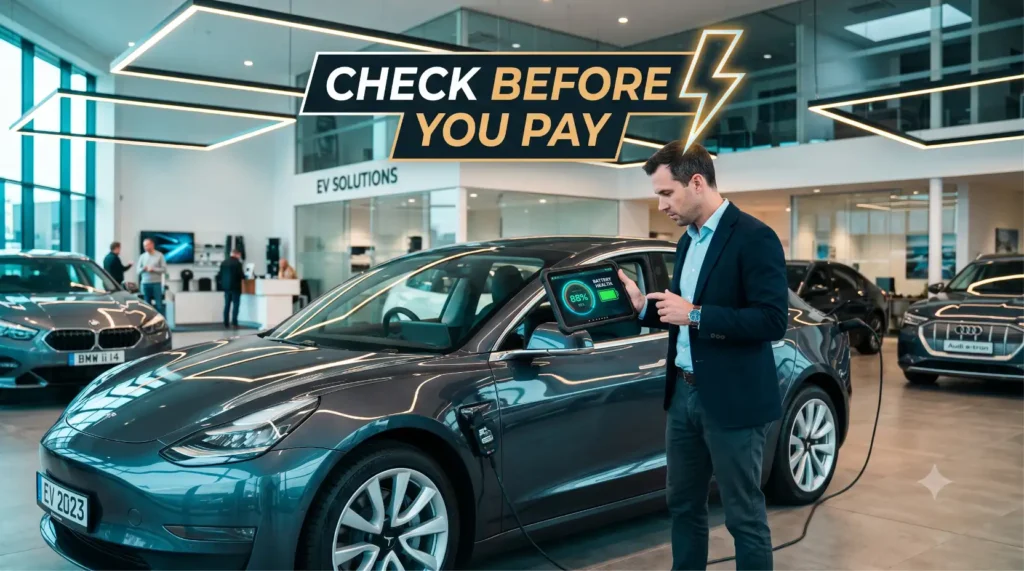
Here’s the thing nobody selling you a used EV wants to say out loud: the odometer is almost meaningless. 🤫
A petrol car lives or dies by mileage. An EV lives or dies by its battery — and two identical cars with identical miles can have wildly different batteries depending on how they were charged, where they lived, and how hard they were pushed. One might be near-new inside. The other might be quietly cooked.
So before you sign anything, hand over cash, or fall in love with a shiny dashboard, you need to check battery health used EV style — the smart way, with real numbers instead of hope. 👇
⚡ The Short Answer
To check battery health used EV buyers should run through these methods, fastest to most accurate:
- 🚗 Read the car’s own SoH/range data — free, instant, but limited.
- 🔋 Plug in an OBD2 dongle + app — the DIY gold standard for a real State of Health number.
- 📏 Do a full-charge real-range test — practical proof the battery delivers.
- 🔧 Get a dealer or service-center battery report — official, paper-backed.
- 📜 Ask for a third-party SoH certificate — best for high-value buys.
The sweet spot for most buyers: an OBD2 scanner + app to pull the State of Health (SoH) number, backed up by a quick range test. 🎯
📊 Battery-Health Check Methods — Compared
Different methods trade effort for accuracy. Here’s how they stack up before you spend a rupee or a dollar. 👇
| Method | Effort | Accuracy | Cost |
|---|---|---|---|
| 🚗 In-car SoH / range display | Easy | Medium | Free |
| 📏 Full-charge real-range test | Medium | Medium–High | Free |
| 🔋 OBD2 dongle + app | Easy | High | ~$20–$60 / ₹1,500–₹5,000 |
| 🔧 Dealer / service battery report | Appointment | High | ~$30–$150 / ₹500–₹3,000 |
| 📜 Third-party SoH certificate | Booking | Very High | ~$50–$200 / ₹2,000–₹6,000 |
Notice the pattern: the cheapest method (in-car display) is the least reliable, and the most accurate (certificate) costs the most. For most used buys, the OBD2 + app combo is the value pick. 😎
🔋 Why State of Health Matters More Than Mileage
Let’s settle this first, because it changes how you shop. When you check battery health used EV listings, the single most important number isn’t on the odometer — it’s the State of Health (SoH). 🔑
SoH is the percentage of the battery’s original usable capacity that still remains. A brand-new pack is 100%. After a few years it might be 92%. That number directly controls your real-world range, your resale value, and how soon you’ll be staring down a five-figure replacement bill.
Here’s why mileage lies. A car that did 60,000 gentle highway miles on slow home charging can have a healthier battery than one that did 30,000 miles on daily DC fast charging in a hot climate. Same odometer story, totally different battery reality.
That’s the whole game. ✅
💡 New to this whole topic? Start with our Used EV Buying Guide: What to Check Before You Pay so the battery check fits into the bigger inspection.
So when a seller leads with “low miles, one owner,” nod politely — then go straight for the SoH. The battery is 30–50% of the car’s value. Treat it that way. 💰
🚗 Reading the Car’s Own Battery & Range Data
The fastest free check is sitting right in front of you on the dashboard. Every EV shows something about its battery, and you can learn a lot in two minutes. 🚗
Start with the estimated range at full charge (or projected range). Compare it against the car’s original EPA / WLTP / ARAI rating. If a model rated for 250 miles (or 400 km) now shows 195 miles fully charged, that’s a meaningful gap worth investigating.
Some brands go further. Many newer EVs have a battery condition indicator or an energy/efficiency screen buried in settings. Tesla owners can read the displayed range at 100%; Hyundai, Kia, MG, and Tata models often surface useful battery info in service menus.
Two big cautions, though. ⚠️ First, range estimates are heavily skewed by recent driving — a car driven hard in cold weather will predict low range even with a healthy pack. Second, sellers can reset trip data to make things look rosy.
So treat the in-car display as a first glance, not a verdict. It tells you whether to keep digging — not whether to buy. 🔍
📏 The Full-Charge Real-Range Test
Want proof the battery actually delivers, not just what a screen claims? Run a full-charge range test. It’s old-school, it’s free, and it cuts through marketing. 📏
Here’s the simple version. Charge the car to 100%, note the indicated range and the odometer. Then drive a steady, real-world loop — mixed roads, normal speeds, climate control on as you’d actually use it — for a measured distance. Watch how many real miles or kilometers you burn versus how much range disappears.
If you drive 50 miles and the range drops by 50–60 miles, that’s healthy and normal. If you drive 50 miles and the range collapses by 90, the usable capacity is shrinking faster than the dashboard admits. 🚩
A few honesty rules so you don’t fool yourself:
- 🌡️ Weather skews everything. Cold and heat both eat range. Test in mild conditions if you can.
- 🛣️ Match real use. Don’t hypermile at 30 mph — drive how you’ll actually drive.
- 🔋 Note the start and end %. Capacity loss shows up as range dropping faster than distance covered.
It won’t give you a clean SoH percentage, but a full-charge range test is the most convincing “does this thing still go the distance” check you can do on a test drive. 😎
🔋 Using an OBD2 Dongle + App to Read SoH
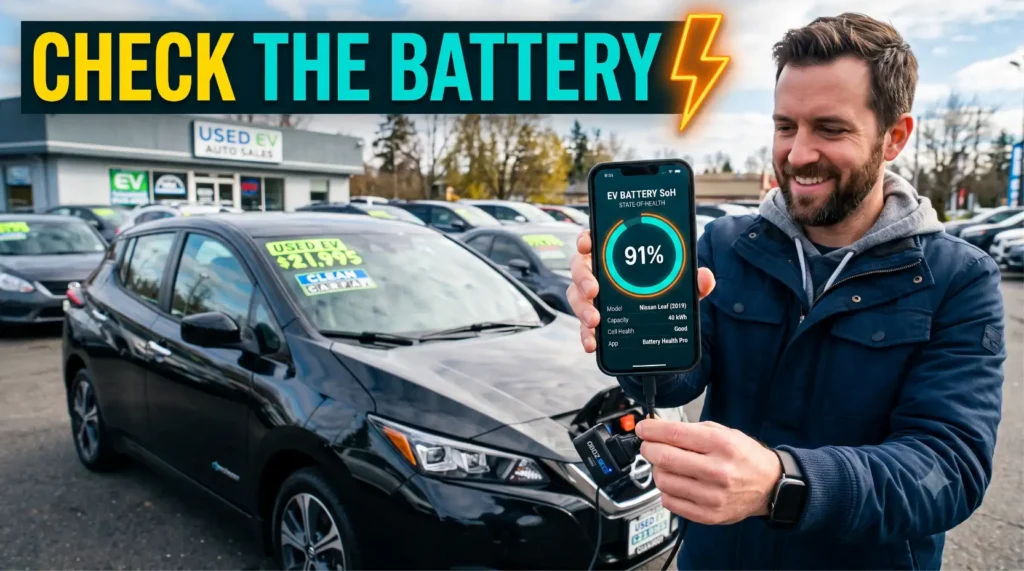
This is the method serious buyers swear by, and honestly it’s the one that turns a nervous gamble into an informed decision. To truly check battery health used EV condition, plug in an OBD2 dongle and read the SoH directly from the battery management system. 🔌
Here’s how it works. You buy a small Bluetooth OBD2 scanner (the EV-compatible kind matters — not every cheap dongle reads battery data). You plug it into the car’s OBD2 port, usually under the dashboard near the driver’s knee. Then you pair it with a battery-health app made for that brand.
Within a minute or two, the app pulls real data the dashboard hides: State of Health percentage, individual cell voltages, pack temperature, and degradation history. This is the actual truth from the battery’s own brain, not a marketing estimate.
Popular apps cover specific ecosystems — there are dedicated tools for Tesla, the Hyundai/Kia family, Nissan Leaf, MG, and others. A good app shows you not just how much capacity is left but whether the cells are balanced and aging evenly.
💡 Want app and dongle picks? See our deep-dive: Best OBD2 Scanner for EV Battery Health.
The beauty here is the cost-to-confidence ratio. A scanner runs roughly $20–$60 (₹1,500–₹5,000) — pocket change against a used EV’s price — and it pays for itself the moment it talks you out of one bad battery. 🛡️
One practical tip: ask the seller upfront if you can plug in a scanner. A confident seller says yes immediately. Hesitation is data too. 🪨
🔧 Getting a Service-Center Battery Report
If you want something official — paper you can wave at a seller or keep for resale — book a battery health report at a dealer or authorized service center. This is the step that takes you from “I think it’s fine” to “I have it in writing.” 🔧
Manufacturer service centers can run a deep battery diagnostic that reads the pack’s true capacity, checks for stored BMS fault codes, and confirms whether the car has any open recalls or software updates affecting the battery. Many brands now generate a formal battery health certificate as part of certified pre-owned programs.
In the US, certified pre-owned EVs from major brands often include a battery report, and independent EV specialists offer standalone inspections. In India, Tata, MG, and Mahindra service networks increasingly offer battery diagnostics, and platforms like Spinny, Cars24, and OEM-backed used programs are starting to bundle health checks.
Cost varies — roughly $30–$150 (₹500–₹3,000) depending on whether it’s a quick scan or a full bench diagnostic. For an expensive used EV, that’s cheap insurance. 💸
The bonus: a documented battery report also protects your resale value later. If you ever sell, you hand the next buyer proof — and command a better price. 📈
🔢 What SoH Number Is Actually Acceptable?
Okay, you’ve got a number. Now — is it good or bad? This is where most buyers panic unnecessarily, so let’s anchor it to reality. 🧭
Healthy EV batteries degrade slowly and predictably, typically around 1.5–2.5% capacity loss per year for the first several years, then the curve flattens. That means a well-cared-for 4-year-old EV often sits around 90–94% SoH, which is completely normal — not a defect.
Here’s a rough buyer’s scale to judge what you read:
- ✅ 95–100% SoH — excellent, basically near-new. Pay confidently.
- 👍 88–95% SoH — healthy, normal aging. The bulk of good used EVs live here.
- 🆗 80–88% SoH — still usable, expected on older/higher-mile cars. Negotiate on price.
- ⚠️ Below 80% SoH — significant loss. Check warranty terms and replacement cost hard.
The key mindset: don’t demand 100%. Demand normal for the age and miles. A 2020 EV at 89% is a healthy car. A 2024 EV at 89% has aged abnormally fast and deserves scrutiny. 🔍
💡 For the full curve and brand-by-brand context, read EV Battery Degradation: How Much Is Normal? — it explains exactly what “normal” looks like by age.
And remember the warranty backstop. Most EV battery warranties cover the pack to 8 years / 100,000 miles (or ~160,000 km) and guarantee roughly 70% capacity. A used EV still inside that window carries built-in protection — factor that into your decision. 🛡️
🚩 Red Flags That Should Make You Walk Away
Numbers are great, but some warning signs scream “don’t buy” regardless of the headline SoH. When you check battery health used EV condition, watch hard for these. 🚩
Sudden capacity drop. Healthy batteries decline in a smooth line. If the history (or your readings versus the car’s age) shows a sharp cliff in capacity, something failed — a bad cell, thermal damage, or a software-masked problem. Gradual is normal; sudden is a siren. 🚨
Mismatched or imbalanced cells. A good OBD2 app shows individual cell voltages. If they’re all tightly clustered, great. If one or two cells read noticeably lower than the rest, the pack is aging unevenly — that’s expensive to fix and only gets worse.
Active BMS errors or fault codes. Stored battery management system errors, persistent warning lights, or a “reduced power” message are major red flags. A seller who recently cleared codes right before your visit is hiding something. Re-scan after a drive.
Range that doesn’t match the SoH. If the app says 95% but the car can barely deliver half its rated range, the numbers don’t reconcile — and that contradiction is itself a warning. 🤔
Suspicious charging history. Heavy daily DC fast charging, frequent 100% storage, or a car from a brutal-heat region all accelerate wear. Ask. The answers (or the dodging) tell you a lot.
Any one of these in isolation might be negotiable. Two or more together? Walk. There are plenty of healthy used EVs out there. 🚶
🌏 India vs US: What’s Different
Where the car lived matters enormously, because the two biggest battery killers — heat and fast-charging habits — play out very differently in each market. 🌏
In India, heat is the headline. Sustained high ambient temperatures in much of the country stress batteries harder than temperate climates. A used EV that spent its life parked in 45°C summers without a robust thermal management system may show faster degradation than the same model abroad.
So in India, prioritize models with active liquid cooling, ask whether the car was garaged, and weight the SoH check even more heavily. Also confirm local service-network support for battery diagnostics — Tata, MG, and Mahindra coverage is growing but varies by city. 🇮🇳
In the US, fast-charging history is the wildcard. Many American EVs see heavy Supercharger or DC fast-charger use on road trips. Occasional fast charging is fine; relentless daily fast charging accelerates wear. Ask for the charging pattern, and use an OBD2 app to confirm the cells aged evenly. ❄️ Cold-climate cars also see range dip in winter — normal, not damage.
In both markets, the move is the same: don’t assume — measure. A US buyer should probe fast-charging history; an Indian buyer should probe heat exposure. Then let the SoH number settle the argument. ⚖️
📈 2026: Better Tools for Checking Used EV Batteries
The good news? Checking a used EV battery has never been easier or more transparent than it is in 2026. The whole process used to be a dealer-only mystery — now it’s in your pocket. 📱
Globally, OBD2 apps have gotten dramatically more accurate and model-specific, reading deeper into the BMS than ever. Independent battery-certification services (like third-party SoH testing platforms) have spread, giving buyers paper-backed confidence on private sales.
Marketplaces are adding SoH data too. A growing number of used-EV listings — from certified pre-owned programs to online platforms — now publish a battery health score upfront, making degradation a normal, visible part of the listing rather than a hidden gamble.
In India, OEM-backed used programs and platforms like Spinny and Cars24 are increasingly bundling battery diagnostics, and the certified pre-owned EV space is maturing fast. In the US, CPO battery reports and instant SoH apps are now buyer table stakes.
Bottom line: the information asymmetry that used to favor sellers is collapsing. You have more power to check battery health used EV deals than buyers did even two years ago. Use it. 🔋
✅ 5 Steps to Verify Battery Health
Here’s the clean, repeatable process — do these in order on any used EV. 👇
- Read the in-car range at 100% and compare to the original rating. 🚗
- Plug in an OBD2 scanner + app and record the SoH percentage. 🔋
- Check cell balance and fault codes in the app for hidden problems. 🔍
- Run a short real-range test to confirm the battery delivers. 📏
- Ask for an official battery report or certificate for high-value buys. 📜
Five steps, maybe thirty minutes total. That’s all that stands between you and a confident purchase. ✅
🛒 Shop This Post
The gear that turns a guess into a decision. 😍
1. A Bluetooth EV OBD2 Scanner 🔋
The core tool to read State of Health, cell voltages, and fault codes. EV-compatible only.
👉 Shop OBD2 battery scanners
2. A Battery-Health App (with your model’s support) 📊
Pairs with the dongle to translate raw data into a clean SoH number and history.
👉 Shop battery-health apps & subscriptions
3. A Smart Home Charger ⚡
Once you buy, gentle scheduled charging protects the battery you just verified.
👉 Shop smart Level 2 / 7kW chargers
🛒️ Shop This Post: (Affiliate picks — no extra cost to you, and they keep EVs Mirror running. 🙏)
🎯 Quick Quiz: How Should You Check It?
- How much is the used EV worth? 🅐 A lot 🅑 Budget buy
- Are you comfortable with a phone app + dongle? 🅐 Yes 🅑 Prefer no gadgets
- Is the car still under battery warranty? 🅐 No 🅑 Yes
Mostly 🅐: 📜 Go full — OBD2 scan plus an official battery report or certificate.
Mostly 🅑: 🔋 An OBD2 + app SoH reading and a range test will cover you.
📋 Used EV Battery Check Checklist
- [ ] Note the in-car range at 100% vs original rating
- [ ] Confirm the seller allows an OBD2 scan
- [ ] Read State of Health (SoH) percentage
- [ ] Check individual cell voltages for balance
- [ ] Scan for BMS fault codes / warning lights
- [ ] Run a short real-world range test
- [ ] Compare SoH against normal degradation for the age
- [ ] Confirm remaining battery warranty coverage
- [ ] Get an official battery report for expensive buys ⚡
🤔 People Also Ask
Q: How do I check battery health on a used EV before buying?
A: The most reliable way to check battery health used EV condition is to plug a Bluetooth OBD2 scanner into the car and read its State of Health (SoH) percentage with a model-specific app. Back it up with a full-charge range test and, for pricey cars, an official service-center battery report.
Q: What is a good State of Health (SoH) for a used EV?
A: It depends on age. A 3–4 year old EV at 88–95% SoH is healthy and normal. Above 95% is excellent. Below 80% signals significant degradation — check warranty and replacement cost before buying.
Q: Can I check a used EV’s battery without any tools?
A: Partly. You can read the in-car range at 100% versus the original rating and run a real-world range test for free. But to check battery health used EV condition accurately, you need an OBD2 scanner and app to read the real SoH number.
Q: How much does an EV battery health check cost?
A: A DIY OBD2 scanner costs about $20–$60 (₹1,500–₹5,000) and is reusable. A dealer or service-center battery report runs roughly $30–$150 (₹500–₹3,000), and a third-party SoH certificate can be $50–$200 (₹2,000–₹6,000).
Q: Is mileage or battery health more important on a used EV?
A: Battery health, easily. Two EVs with identical mileage can have very different batteries depending on charging habits, climate, and fast-charging history. The SoH number tells the real story; the odometer barely matters.
Q: What are the warning signs of a bad used EV battery?
A: Red flags include a sudden capacity drop, mismatched or imbalanced cell voltages, active BMS fault codes or warning lights, range that doesn’t match the claimed SoH, and a history of heavy daily fast charging or extreme heat exposure.
🚀 The Bottom Line
Buying a used EV doesn’t have to be a leap of faith. The odometer is theater — the battery is the truth. Learn to check battery health used EV style and you flip the power from seller to buyer. ⚡
Start with the in-car range, plug in an OBD2 scanner to read the real State of Health, run a quick range test, and for anything expensive, get an official battery report. Judge the SoH against what’s normal for the age, watch for the red flags, and remember the warranty backstop. Do that, and you’ll buy a great EV at a fair price instead of inheriting someone else’s cooked battery. 🔋
💬 Checked a used EV’s SoH recently? Drop the number and model in the comments to help other buyers benchmark!
📤 Know someone EV-shopping? Send them this guide before they pay. 🙏
🔖 Bookmark EVs Mirror for honest used-EV buying advice.
👉 Up next: Used EV Buying Guide: What to Check Before You Pay and EV Battery Degradation: How Much Is Normal?