Every few months, a headline promises that the battery breakthrough is finally here. ⚡ In 2026, those headlines are louder than ever — and, for once, there’s real substance behind some of them.
Toyota says it’s poured $15 billion-plus (₹1.25 lakh crore-plus) into the technology and holds more patents than anyone. In late May 2026, a top CATL scientist publicly said the manufacturing bottlenecks are getting solved. The hype machine is in full swing. 🔥
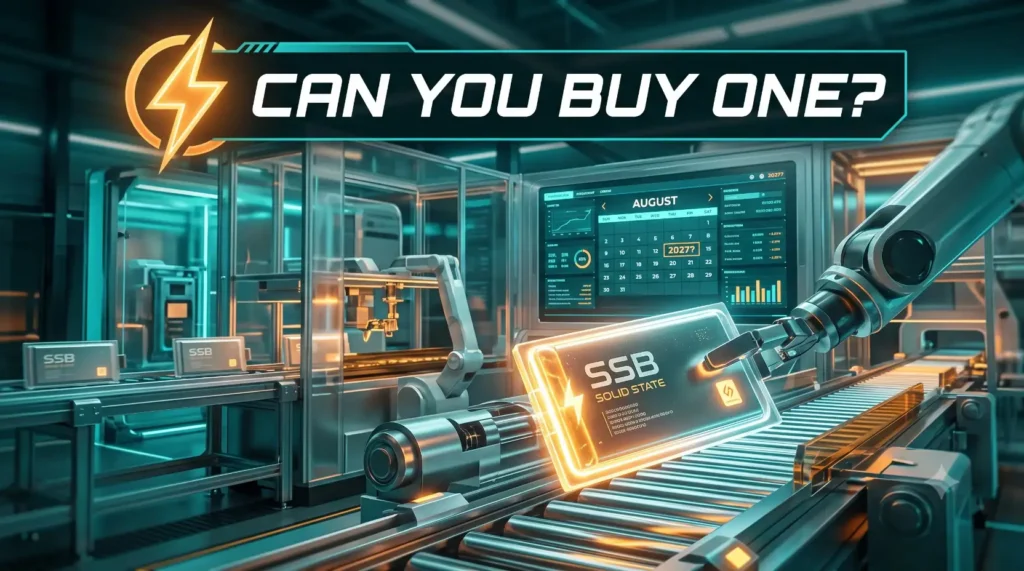
But here’s the question that actually matters to you, the person reading this on your phone: can you walk into a showroom and drive home a solid state battery EV in 2026? Let’s cut through the noise. 👇
⚡ The Short Answer
Where the solid state battery EV 2026 story really stands:
- 🔬 The breakthroughs are real — Toyota, CATL, Samsung, QuantumScape and others have made genuine lab and pilot progress.
- 🏭 But mass production hasn’t started. The hard part is scaling lab samples to gigawatt-hour factories.
- 📅 Realistic mass-market timeline: 2027–2028 at the earliest, with broad affordability later.
- 🛒 Bottom line: No, you can’t buy a mass-market solid-state EV in 2026. Don’t hold your breath — or your wallet. 😎
📊 Who’s Building Solid-State Batteries — and Where They Stand
Here’s a snapshot of the major players and their reported status. ⚠️ These figures are illustrative, based on public announcements and company claims — not guaranteed delivery dates. 👇
| Maker | Reported Status (Illustrative) | Expected Timeline (Illustrative) |
|---|---|---|
| Toyota | $15B+ invested, most patents, pilot lines | Mass production ~2027–2028 |
| CATL (China) | Manufacturing bottlenecks “being resolved” (May 2026) | Small-quantity output ~2027 |
| QuantumScape (w/ VW) | Multi-layer cell samples shipped | Commercial cells later this decade |
| Samsung SDI | Pilot line running, sampling automakers | Targeting ~2027 |
| BYD (China) | Roadmap announced, demo cells | Pilot ~2027, scale later |
| Factorial / Mercedes | Road-testing solid-state prototype cells | Limited fleet trials mid-decade |
The pattern is clear: lots of 2027 in that right column, and almost nothing in 2026 at any real volume. 🎯
🔋 What Solid-State Batteries Are (and Why Everyone’s Obsessed)
Before we judge the solid state battery EV 2026 hype, you need to know what’s actually different here. 🔬
Today’s EVs run on lithium-ion batteries with a liquid electrolyte — the goo that lets ions shuttle between the electrodes. A solid-state battery swaps that liquid for a solid electrolyte (ceramic, glass, or polymer). Sounds boring. It isn’t.
That one swap unlocks three big wins, in theory:
- 🔋 Higher energy density — more range in the same space, because you can pack cells tighter and use better electrode materials.
- ⚡ Faster charging — solid electrolytes can handle higher charge rates, fueling those “10-minute charge” claims.
- 🛡️ Better safety — no flammable liquid means a far lower risk of thermal runaway (the worst-case battery fire).
Add it up and the promise is an EV that goes 20–50% farther (illustrative figures, vary by chemistry), charges in roughly the time it takes to grab a coffee, and is harder to set on fire. That’s why the whole industry is sprinting toward it. 😎
🚀 The 2026 Breakthroughs (What Actually Happened)
This year wasn’t all marketing. A few things genuinely moved the needle in the solid state battery EV 2026 race. 📈
Toyota’s patent fortress. Toyota has reportedly invested $15 billion-plus (₹1.25 lakh crore-plus) and holds the largest pile of solid-state patents of any company. Its public targets: mass production around 2027–2028, with claims of roughly 10-minute charging and 20–50% more range versus its current packs. (Those numbers are company targets — flagged illustrative — not yet proven at scale.) 🔬
CATL’s manufacturing signal. On May 30, 2026, a chief scientist at CATL — the world’s biggest battery maker — publicly said the manufacturing bottlenecks are being resolved, with small-quantity production expected around 2027. That’s a big deal, because CATL’s problem was never the science; it was making the things at volume. ⚙️
The supporting cast. QuantumScape (backed by Volkswagen) shipped multi-layer cell samples. Samsung SDI has a pilot line and is sampling automakers. BYD laid out a roadmap. Factorial is road-testing cells with Mercedes-Benz. None of this is vaporware — it’s measurable, incremental progress. 🎯
So yes — the breakthroughs are real. But notice what every single one of them has in common: the word “2027” keeps showing up, and the word “samples” or “pilot” keeps showing up. That gap matters. 👇
🏭 Why You Still Can’t Buy One in 2026 (The Scaling Problem)
Here’s the part the hype headlines skip. Making one brilliant solid-state cell in a lab is not the same as making millions of identical ones in a factory. This is the entire solid state battery EV 2026 reality check. ⚠️
The killer is manufacturing tolerance. Solid electrolytes need to make near-perfect contact with the electrodes — we’re talking micron-level precision (a micron is one-thousandth of a millimeter). Tiny gaps or imperfections cause:
- 🔌 Resistance that kills fast-charging performance.
- 💥 Dendrites — microscopic metal spikes that can short the cell.
- 📉 Yield problems — too many rejected cells make the batteries wildly expensive.
Liquid electrolytes are forgiving; they flow into every gap. Solids don’t. So a process that works beautifully on a lab bench can fall apart when you try to run it at gigawatt-hour scale across thousands of cells per hour. 😅
This is exactly why CATL’s May 2026 comment focused on manufacturing — not chemistry. The science is increasingly solved. The factory is the boss battle. 🎮
Until those yields hit commercial levels, solid-state cells stay expensive and low-volume — fine for pilot fleets and luxury halo cars, not for the mass-market EV in your driveway. That’s the honest reason 2026 isn’t your year. 🎯
🔋 What They’ll Mean for Range and Charging
Let’s daydream responsibly. If the targets hold, what does a solid state battery EV actually feel like to live with? ⚡
Range. A 20–50% energy-density bump (illustrative) could turn a 300-mile (≈480 km) EV into a 375–450-mile (≈600–725 km) one — without making the car heavier. For India’s intercity driving and US road trips alike, that quietly erases most range anxiety. 🛣️
Charging. “Ten-minute charging” sounds magical, but it depends on more than the cell — you also need brutal-powerful chargers and a grid that can feed them. Still, solid-state’s tolerance for high charge rates is the missing piece that makes ultra-fast charging safe and repeatable. ⚡
Longevity. This is the underrated win. Solid electrolytes may handle more charge-discharge cycles before wearing out, which ties directly into how long your pack lasts.
💡 Curious how cycles affect battery life today? Read: How Many Charge Cycles Does Your EV Battery Have?
If solid-state delivers even half its promise on cycle life, the “how long will it last?” question gets a lot less scary. 😎
🚗 What It Means for Today’s Lithium-Ion EVs (Don’t Wait!)
Here’s the trap. Some people read “solid-state is coming” and decide to delay buying an EV until it arrives. That’s usually a mistake. 🙅
First, the timeline: even optimistically, affordable solid-state EVs are years away. Waiting from 2026 could mean driving a gas car (or no car) until 2028, 2029, or later. ⏳
Second, today’s lithium-ion batteries are genuinely good. Modern LFP and NMC packs already last well past their 8-year warranties and degrade slowly with normal care. The “my battery will die” fear is mostly outdated.
💡 Worried about your current pack aging? Read: EV Battery Degradation: What’s Normal?
Third — and this is the kicker — there will always be a better battery next year. If you wait for the perfect tech, you wait forever. The right EV for you is the one that fits your budget and life now. Buy it, enjoy the savings, and let solid-state mature for your next car. 🎯
📅 The Realistic Timeline (2027–2028 and Beyond)
Let’s put a sober calendar on the solid state battery EV 2026 question, based on what companies have actually said. 📅
- 2026 (now): Pilot lines, samples, demo cells, lab records. Zero mass-market cars. 🔬
- ~2027: First small-quantity production (CATL’s stated target). Likely premium, low-volume, or limited fleets. ⚙️
- ~2027–2028: Toyota’s targeted mass production window. Expect first cars to be expensive halo models. 🚗
- Late 2020s: Scaling ramps, costs slowly fall, more automakers join. 📈
- Early 2030s: Realistic window for affordable, mainstream solid-state EVs. 🌍
Notice the shape — much like battery degradation itself, this is a slow curve, not a cliff. The first solid-state cars will likely be luxury showpieces, not budget commuters. The mass-market version that matters to most readers is firmly a next-decade story. 🎯
🎭 Hype vs Reality (An Honest Scorecard)
Because the internet loves extremes, here’s the grown-up middle. 😌
The hype says: “Solid-state will make every EV charge in 10 minutes and go 600 miles by next year!” That’s overcooked. 🔥
The doomers say: “It’s all vaporware, it’ll never ship.” That’s wrong too — pilot lines and shipped samples are real, measurable progress. ❌
The reality: The chemistry is largely cracked. The remaining challenge is manufacturing at scale, which is hard but solvable — and being actively solved. So solid-state is coming, just slower and more expensively than headlines suggest. Real, but not 2026-real for buyers. 🎯
If a YouTube thumbnail tells you to “wait for solid-state before buying an EV in 2026,” close the tab. That’s clickbait, not advice. 😅
🇮🇳 What This Means for India
India’s solid state battery EV 2026 angle is a bit different from the US. 🌏
The Indian EV market today runs heavily on LFP lithium-ion — durable, heat-tolerant, and affordable, which matters in a price-sensitive, hot-climate market. Tata, Mahindra, MG and the two-wheeler giants (Ola, Ather) are scaling on existing chemistry, not waiting for solid-state. ⚡
When solid-state does arrive, India will almost certainly get it late and at a premium — first in luxury imports, then slowly trickling down. The high upfront cost of early solid-state cells clashes hard with India’s value-first buyers. 💰
The practical takeaway for Indian readers: today’s LFP EVs are an excellent buy right now. A ₹15–20 lakh ($18,000–24,000) EV with a solid LFP pack will serve you brilliantly for years — long before affordable solid-state lands in showrooms here. Don’t wait. 🎯
📈 2026: Battery Tech Trends (It’s Not Just Solid-State)
Solid-state grabs headlines, but it’s one lane in a busy highway of 2026 battery progress. 🛣️
- 🔋 LFP everywhere — cheap, safe, long-lasting lithium-iron-phosphate now powers a huge share of new EVs in both markets. The quiet workhorse.
- 🧂 Sodium-ion rising — CATL and others are commercializing sodium-ion: cheaper raw materials, great cold-weather performance, ideal for budget cars and grid storage.
- ⚡ Faster lithium-ion — even conventional packs are hitting better charge speeds and energy density each year.
- 🔄 Better recycling — closing the loop on battery materials is scaling up fast.
The big picture: batteries are improving on multiple fronts at once. Solid-state is the flashy long-term bet, but LFP and sodium-ion are delivering real value today. 😎
✅ 5 Things to Know Before You Wait for Solid-State
- It won’t be cheap first. Early solid-state cars will be premium halo models, not budget EVs. 💰
- 2027 means “small quantity,” not “in stock.” Production starting ≠ you can buy one. ⚙️
- Today’s batteries are already great. Modern lithium-ion lasts past its warranty with easy care. 🔋
- Waiting has a real cost — lost fuel savings, lost incentives, and there’s always a better battery next year. ⏳
- Manufacturing, not chemistry, is the gate. Watch yield and factory news, not lab records. 🏭
🛒 Shop This Post
Gear to get the most out of the EV you can actually buy today. 😍
1. An OBD2 Battery-Health Scanner 🔋
Track your current lithium-ion pack’s real capacity and degradation over time.
👉 Shop OBD2 scanners
2. A Smart Level 2 Home Charger ⚡
Gentle, scheduled charging keeps today’s battery healthy for years to come.
👉 Shop smart Level 2 chargers
3. A Quality Portable EV Charger 🔌
A reliable backup for any current EV — solid-state or not.
👉 Shop portable EV chargers
🛍️ Shop This Post: (Affiliate picks — no extra cost to you, and they support EVs Mirror. 🙏)
🎯 Quick Quiz: Should You Wait for Solid-State?
- Do you need a car in the next 1–2 years? 🅐 Yes 🅑 No, I can wait years
- Is your budget mass-market (not luxury)? 🅐 Yes 🅑 No, money’s no object
- Are you nervous about today’s battery life? 🅐 A little 🅑 Very
Mostly 🅐: 🟢 Buy a great lithium-ion EV now — solid-state isn’t your 2026 option.
Mostly 🅑: 🟡 You might enjoy an early premium solid-state car when it lands — but that’s still 2027+.
📋 Solid-State Reality Checklist
- [ ] Understand: no mass-market solid-state EV exists in 2026
- [ ] Note the real timeline: ~2027 pilot, mass-market early 2030s
- [ ] Remember early cells will be premium-priced
- [ ] Don’t delay an EV purchase waiting for “perfect” tech
- [ ] Know today’s lithium-ion already lasts past warranty
- [ ] Watch manufacturing/yield news, not lab records
- [ ] Care for your current battery (80% daily, slow charging) ⚡
🤔 People Also Ask
Q: Can I buy a solid state battery EV in 2026?
A: No. In 2026, solid-state batteries are still at the pilot-line and sample stage. No automaker sells a mass-market solid state battery EV this year. Realistic small-quantity production starts around 2027, with affordable, mainstream cars likely in the early 2030s.
Q: Which company is leading the solid state battery EV 2026 race?
A: Toyota is widely seen as the leader, reportedly investing $15 billion-plus (₹1.25 lakh crore-plus) and holding the most patents, targeting mass production around 2027–2028. CATL, Samsung SDI, QuantumScape (with VW), BYD and Factorial (with Mercedes) are all close behind.
Q: Why are solid-state batteries so hard to mass-produce?
A: The science is largely solved; the manufacturing isn’t. Solid electrolytes need micron-level precision contact with the electrodes. Tiny imperfections cause resistance, dendrites, and low factory yields — making cells expensive and hard to build at gigawatt-hour scale.
Q: How much better are solid-state batteries?
A: Claims include roughly 20–50% more range, around 10-minute charging, better safety (no flammable liquid), and potentially longer cycle life. These are largely company targets — flagged illustrative — and not yet proven in mass-market cars.
Q: Should I wait for solid-state before buying an EV?
A: Usually no. Affordable solid-state EVs are years away, today’s lithium-ion batteries already last well past their warranties, and there’s always a better battery coming next year. Buying now captures fuel savings and incentives sooner.
Q: What’s the difference between solid-state and lithium-ion batteries?
A: Lithium-ion uses a liquid electrolyte; solid-state replaces it with a solid one. That swap promises higher energy density, faster charging, and better safety — but it’s far harder to manufacture at scale.
🚀 The Bottom Line
The solid state battery EV 2026 story is genuinely exciting and genuinely overhyped at the same time. The breakthroughs from Toyota, CATL, Samsung, QuantumScape, BYD and Factorial are real — but every one of them lands on 2027 and beyond, in small quantities, at premium prices. The chemistry is nearly cracked; the gigawatt-hour factory is the boss fight that’s still being fought. ⚡
So the honest answer: you cannot buy a mass-market solid-state EV in 2026. And that’s fine — today’s lithium-ion EVs are excellent, long-lasting, and ready now. Don’t wait years for tech you can’t yet buy. 😎
💬 Would you wait for solid-state, or buy a great EV today? Tell us in the comments!
📤 Know someone “waiting for solid-state”? Send them this honest reality check. 🙏
🔖 Bookmark EVs Mirror for no-hype EV battery news.
👉 Up next: EV Battery Degradation: What’s Normal? and How Many Charge Cycles Does Your EV Battery Have?