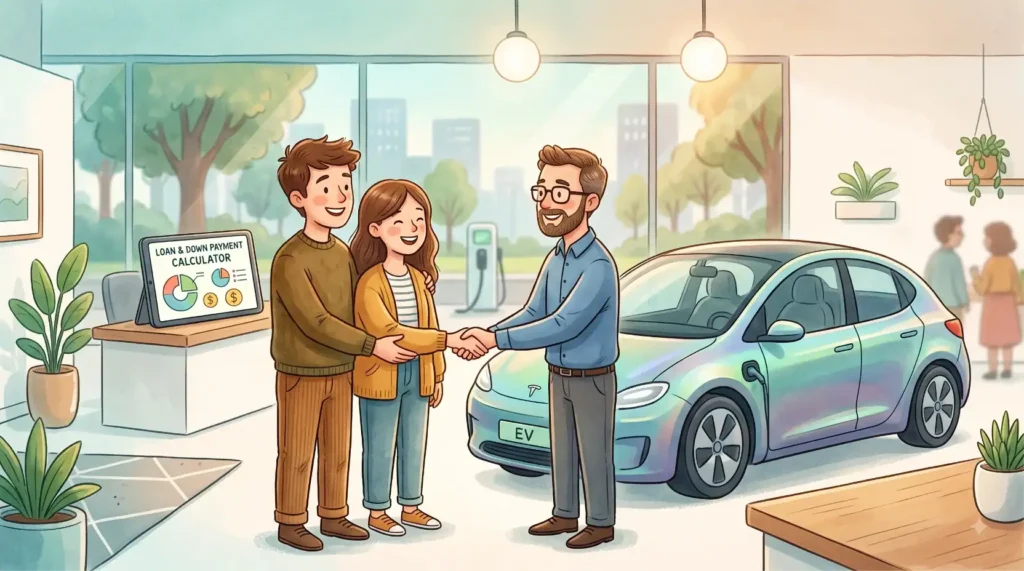
So you’ve fallen for an electric car. Maybe it’s the silent torque, maybe it’s the gas-station-free lifestyle, maybe it’s the climate guilt finally catching up with you. Whatever the reason, you’re sitting at the finance desk (or scrolling a lender’s app at midnight) and one number keeps blinking at you: the down payment. And the question that won’t go away is simple but slippery — EV down payment how much is actually the right amount to put down?
Short version: there’s a smart range, and there’s a trap on either side of it. Put down too little, and you risk owing more than your car is worth. Put down too much, and you drain the cash cushion you might genuinely need. The sweet spot is more interesting than “20% and done,” and EVs add a twist that gas cars don’t. Let’s get into it.
⚠️ Quick disclaimer (read this first)
This article is general educational information, not financial advice. Every number you see below is illustrative — made up to show how the math behaves, not a quote. Your actual rate, term, and ideal down payment depend on your credit score, income, the specific vehicle, your local incentives, and the lender across the desk. Before you sign anything, run your real numbers and talk to a qualified lender, financial advisor, or accountant. We’ll repeat this a few times because it genuinely matters. 🙏
⚡ The Short Answer
If you just want the headline before the deep dive, here it is:
- 🎯 Aim for ~20% down on an EV. It’s the classic rule of thumb and it works well for electric cars too.
- 📉 EVs can depreciate fast in their early years, so a bigger down payment protects you from going “upside-down” (owing more than the car is worth).
- 💸 Zero-down deals feel great today and cost you more tomorrow — higher interest, bigger risk of negative equity.
- 🧮 More down = lower monthly payment + less total interest. Simple, but powerful over a 4–6 year loan.
- 💰 Don’t drain your emergency fund to hit 20%. A flat tire on your finances is worse than a slightly bigger loan.
- 🇮🇳 In India, lenders often expect 10–20% down on EVs; some run special low-down EV schemes — read the fine print.
- 🪙 Stack your incentives smartly — sometimes it’s better to bank a rebate as cash than to throw every rupee or dollar at the down payment.
Want a number tailored to your budget? That’s literally the whole point of the rule we’ll cover next. Let’s look at the math first.
📊 What Different Down Payments Actually Do (Illustrative)
Numbers make this real. Let’s say you’re financing a $40,000 EV in the US (and we’ll mirror it with a ₹20,00,000 EV in India for our Indian readers). Assume a 7% APR over 60 months for the US example. Watch how the down payment changes everything.
| Down Payment | Amount Down | Loan Amount | Est. Monthly EMI | Est. Total Interest | Equity Position (Day 1) |
|---|---|---|---|---|---|
| 0% | $0 / ₹0 | $40,000 / ₹20,00,000 | ~$792 / ~₹39,600 | ~$7,520 / ~₹3,76,000 | 🔴 Likely negative — owe more than car’s value |
| 10% | $4,000 / ₹2,00,000 | $36,000 / ₹18,00,000 | ~$713 / ~₹35,640 | ~$6,770 / ~₹3,38,000 | 🟠 Thin cushion, still risky early |
| 20% | $8,000 / ₹4,00,000 | $32,000 / ₹16,00,000 | ~$634 / ~₹31,680 | ~$6,015 / ~₹3,01,000 | 🟢 Comfortable — usually right-side-up |
| 30% | $12,000 / ₹6,00,000 | $28,000 / ₹14,00,000 | ~$554 / ~₹27,720 | ~$5,265 / ~₹2,63,000 | 🟢 Strong equity, lowest payment |
Figures are illustrative and rounded for clarity. Real EMIs, interest, and rates vary by lender, term, credit profile, and region. Not financial advice — verify with your lender.
When buyers ask EV down payment how much changes the actual cost, this table is the answer. Notice the pattern? Each 10% you add shaves roughly $80 off the US monthly payment and hundreds off total interest, while pushing you further from the danger zone of owing more than the car’s worth. That’s the whole story in one table — now let’s unpack why it behaves this way.
🧭 The Rule of Thumb: Around 20% Down
When people ask EV down payment how much, the cleanest answer the finance world keeps coming back to is about 20%. It’s not magic; it’s just the point where the math starts working in your favor without being painful.
The 20% figure comes from the well-known 20/4/10 rule for car buying — put 20% down, finance for no more than 4 years, and keep your total transportation costs under 10% of your gross income. It’s a guardrail, not a law. But it exists because lenders and buyers learned the hard way what happens when you ignore all three.
We’ve got a full breakdown of how that rule applies to electric cars specifically over in How Much EV Can You Afford? (20/4/10 Rule) — worth a read if you want to size your whole budget, not just the down payment.
Why 20% and not 5% or 50%? At 20%, you usually clear the early depreciation cliff fast enough to stay “right-side-up,” your monthly payment stays manageable, and lenders treat you as a lower-risk borrower (which can mean a better rate). It’s the Goldilocks zone. Next, let’s see exactly how that bigger deposit pays you back.
💸 Why a Bigger Down Payment Saves You Money
A down payment isn’t just a hoop to jump through — it’s a lever that quietly changes the cost of the entire loan. Here’s the mechanism in plain language.
1. You borrow less, so you pay less interest. Interest is charged on the amount you finance. Knock $8,000 (₹4,00,000) off the loan and you’re not paying 7% on that chunk for five years. In our table above, going from 0% to 20% down saved roughly $1,500 in total interest on the US example. That’s real money you keep.
2. Your monthly payment drops. A smaller loan spread over the same term means a lighter EMI. That breathing room matters when electricity bills, insurance, and life happen.
3. You avoid negative equity sooner. This is the big one for EVs, and it gets its own section below. The faster you build equity, the safer you are.
4. You may unlock a better interest rate. Lenders see a larger down payment as “this person has skin in the game.” Lower perceived risk can translate to a lower APR — which compounds the savings. More on that shortly.
None of this is exotic. It’s just the boring magic of borrowing less. But with EVs there’s an extra wrinkle worth understanding — depreciation.
📉 The EV Depreciation Angle: Don’t Get Upside-Down
Here’s where electric cars play by slightly different rules. Some EVs have depreciated faster than comparable gas cars in their first couple of years — partly because the technology moves quickly (better batteries, longer range), partly because incentives and price cuts on new models drag down used values, and partly because battery health questions spook some used buyers.
What does that mean for your down payment? The faster a car loses value, the more cushion you need to avoid being “upside-down” (also called negative equity) — owing the lender more than the car would sell for.
Picture this. You put 0% down on a $40,000 EV. You drive off the lot, and the moment you do, the car might be worth $34,000–$36,000. You owe $40,000-plus. You are instantly underwater. If the car gets totaled or you need to sell early, you’re writing a check just to walk away.
Now picture 20% down. You financed $32,000 on a car worth ~$35,000 on day one. You’re already above water, and you stay there as you pay down the loan. That cushion is the entire point.
A healthy down payment is basically insurance against the EV depreciation curve. Speaking of curves heading the wrong way — let’s talk about the deals designed to look irresistible.
🎣 Zero-Down Deals: Tempting, But Costly
“$0 down! Drive home today!” It’s one of the most effective lines in car sales, and EVs are no exception. Sometimes it’s a legit promotion. More often, it’s a way to get you focused on the monthly payment while the real costs hide in plain sight.
Here’s what a zero down EV deal typically does to you:
- 📈 You borrow the full sticker price, so you pay maximum interest over the life of the loan.
- 🔴 You start in negative equity — underwater from minute one, especially given EV depreciation.
- ⏳ You’re vulnerable for longer. It can take a year or more of payments just to break even with the car’s value.
- 💔 Early exit hurts. Want to sell, trade, or upgrade in two years? You may owe more than you’ll get.
That doesn’t make zero-down always wrong. If a manufacturer is offering a genuinely low APR (think 0–2.9%) as part of a promotion, the math can shift. And if you’d otherwise drain every last rupee or dollar of savings, a smaller down payment that keeps you liquid might be the wiser personal call.
But “no money down” should set off a little alarm in your head — what am I paying for this convenience? Usually, the answer is “more than you think.” Which brings us to how your deposit and your interest rate are quietly linked.
📋 How Your Down Payment Affects Your Loan Rate
A lot of buyers assume the interest rate is fixed by their credit score alone. Credit is the biggest factor, yes — but your down payment plays a supporting role that’s easy to overlook.
From the lender’s chair, a bigger down payment means a smaller loan-to-value ratio (you’re borrowing a smaller slice of the car’s worth). Lower loan-to-value = lower risk for them = sometimes a lower APR for you. It’s not guaranteed, and the effect varies by lender, but it’s real often enough to matter.
There’s a compounding effect here that’s easy to miss:
- A larger down payment can fetch a slightly lower rate, and
- It shrinks the balance that rate applies to.
So you’re winning on two fronts at once. Even a half-percent rate improvement on a smaller principal adds up across a 5- or 6-year electric car financing term.
The flip side: don’t assume a huge down payment automatically buys you a great rate. Your credit profile, income, and the lender’s current promotions usually dominate. Always — always — ask the lender directly how your down payment changes the offered rate, and get it in writing. (Friendly reminder: this is general info, not financial advice. Your lender’s quote is the only number that counts.) Now, before you empty your bank account, let’s talk about the cost of going too far.
⚖️ Balancing Your Down Payment vs. Keeping Cash & Incentives
Here’s the part the “just put 20% down” crowd often skips: a down payment that’s too big can be its own mistake. Cash you hand the dealer is cash you no longer have for emergencies, opportunities, or that surprise medical or home repair bill.
Think of it as a balancing act between three priorities:
- 🛟 Liquidity. Keep a real emergency fund — ideally a few months of expenses — before you stretch for a bigger deposit. A car loan is survivable; a cash crisis with zero buffer is not.
- 🪙 Incentives & rebates. Many EVs qualify for tax credits, state or central subsidies, or manufacturer rebates. Sometimes it’s smarter to bank a rebate as cash than to pour every dollar into the down payment — especially if the rebate arrives after purchase, like a tax-time credit.
- 📈 Opportunity cost. If your savings are earning a solid return and your loan APR is low, throwing extra cash at the car may not be the highest use of that money. (And if your APR is high, the opposite is true — paying it down hard makes sense.)
The honest answer to EV down payment how much is: enough to stay above water and grab a good rate, but not so much that you’re car-rich and cash-poor. For a deeper look at whether financing even beats leasing for your situation, check out EV Loan vs Lease: Which Saves You More? — the down payment math looks very different depending on which path you choose.
Speaking of different paths, let’s cross the ocean and look at how this plays out for our Indian readers.
🇮🇳 India Down-Payment Norms (What to Expect)
If you’re buying an EV in India, the playbook is similar in spirit but different in the details. Indian lenders and EV financiers have their own conventions, and they’re worth knowing before you walk into a showroom.
Typical down payment: Most banks and NBFCs expect somewhere around 10% to 20% of the on-road price as a down payment for an EV loan, though this swings based on your credit (CIBIL) score, the vehicle, and the lender. Some will finance up to 85–90% of the on-road price for strong borrowers; others want more skin in the game.
Special EV schemes: Because the government has been pushing electric adoption, you’ll sometimes find low-down-payment EV schemes, reduced processing fees, or slightly softer interest rates on green vehicle loans. Great — but read the fine print. A tiny down payment plus a longer tenure can mean you pay a lot more interest overall and sit in negative equity for ages.
On-road vs ex-showroom: Remember that your down payment is usually calculated on the on-road price (which includes registration, road tax, and insurance), not just the ex-showroom sticker. That changes your real cash-needed-upfront number meaningfully.
The depreciation point still applies. Indian EV resale values are still maturing, and battery-warranty questions affect used demand here too. A healthy EV loan down payment of 15–20% gives you the same protective cushion it does in the US. The 20% rule of thumb travels surprisingly well across both markets.
As always — these are general norms, not a quote, and definitely not financial advice. Your bank’s offer is the real one. So how do you land on a final number? Let’s build it.
🧮 How to Decide Your Number
Enough theory. Here’s a simple way to arrive at your down payment, not a generic one.
Deciding EV down payment how much comes down to five quick steps.
Step 1 — Start at 20%. Take the total price (on-road in India, out-the-door in the US) and calculate 20%. That’s your default target.
Step 2 — Stress-test your cash. Subtract that down payment from your savings. Do you still have a healthy emergency fund left? If yes, great. If it leaves you dangerously thin, dial the down payment down, not your emergency fund.
Step 3 — Check the depreciation cushion. Roughly, will your loan balance stay below the car’s likely value? If you’re putting little down on a fast-depreciating model, nudge the deposit up.
Step 4 — Factor in incentives. Are you getting a rebate or tax credit? Decide whether to apply it at purchase or bank it. Don’t double-count money you don’t have yet.
Step 5 — Ask the lender about the rate. Get quotes at two different down-payment levels and compare the APR and total interest. Let the actual numbers — not a rule of thumb — make the final call.
Run that sequence and you’ll have a number you can defend, tuned to your life rather than a blog post. (Yes — still not financial advice. Use it as a framework, then verify with a pro.) Now let’s zoom out to where the market’s heading.
📈 2026: Down-Payment Trends
The financing landscape around EVs keeps shifting, and 2026 has its own flavor. A few patterns worth watching:
- 🔻 Falling sticker prices on many EVs mean the dollar amount of a 20% down payment is dropping even when the percentage stays the same. Cheaper cars, smaller deposits.
- 🏦 More green-loan products from banks and NBFCs (especially in India) are competing for EV buyers, occasionally with lower-down or lower-rate offers. Competition is your friend — shop around.
- 🪫 Battery-health transparency tools are slowly improving used-EV resale confidence, which may soften early depreciation over time — but don’t bet your down payment on it yet.
- 📉 Lingering depreciation caution means smart buyers in 2026 still lean toward larger down payments on EVs than they might on a gas car, just to stay safely right-side-up.
- 💳 Longer loan terms (72–84 months) are tempting buyers with low monthlies — but they massively increase total interest and keep you underwater longer. A bigger down payment is the antidote.
The throughline: 2026 gives you more tools and cheaper cars, but the core wisdom hasn’t changed. Put down enough to stay above water. Let’s turn all of this into action.
✅ 5 Tips for Your Down Payment
- 🎯 Anchor to 20%, adjust from there. Use it as your starting point, then tune up or down based on your cash cushion and the car’s depreciation.
- 🛟 Never sacrifice your emergency fund. A slightly bigger loan beats a financial emergency with no savings. Liquidity first.
- 🔍 Get rate quotes at two down-payment levels. Ask the lender how 10% vs 20% changes your APR and total interest — then decide with real numbers.
- 🪙 Be strategic with incentives. Decide consciously whether to apply a rebate to the down payment or bank it as cash. Don’t spend money you haven’t received yet.
- 🚩 Treat “zero down” with suspicion. It’s not always bad, but always ask what convenience is really costing you in interest and risk.
Stick these on a sticky note before you visit the showroom. Next, a quick gut-check quiz.
🛒 Shop This Post
Tools that make the down-payment decision (and the whole loan) easier to navigate:
- 🧮 Auto Loan & EMI Calculator App — Model different down payments, terms, and rates side by side so you can see the interest savings before you commit. Worth its weight in avoided regret.
- 📊 Credit Score Monitoring Service — Since your credit drives both your rate and how much down payment lenders expect, knowing (and improving) your score before you apply can save you real money.
- 📚 Personal Finance Budgeting Book/Planner — A solid budgeting resource helps you figure out how much you can responsibly put down without wrecking your emergency fund.
Disclosure: This section may contain affiliate links. If you buy through them, we may earn a small commission at no extra cost to you. It helps keep evsmirror.com running — thank you! 💚 As always, these are tools, not financial advice.
🎯 Quick Quiz
Test yourself — answers below. 👇
1. What’s the classic rule-of-thumb down payment for a car (EV included)?
– A) 5% B) 20% C) 50%
2. Why is a bigger down payment especially smart for EVs?
– A) EVs charge faster B) Some EVs depreciate quickly, so it avoids negative equity C) It’s legally required
3. What’s the main risk of a zero down EV deal?
– A) Starting underwater / negative equity B) Voiding the warranty C) Higher insurance
4. True or False: You should drain your emergency fund to hit a 20% down payment.
Answers: 1-B, 2-B, 3-A, 4-False (keep your cushion!).
How’d you do? Now grab the checklist before you sign anything.
📋 Down-Payment Checklist
Before you commit, run through these:
- ☐ Calculated 20% of the total price (on-road / out-the-door)
- ☐ Confirmed I’d still have a healthy emergency fund after paying
- ☐ Checked whether the loan balance stays below the car’s likely value
- ☐ Identified all eligible incentives/rebates and decided how to use them
- ☐ Got rate quotes at two different down-payment levels
- ☐ Read the fine print on any “zero down” or special EV scheme
- ☐ Confirmed whether figures are based on ex-showroom or on-road price (India)
- ☐ Talked to a qualified lender or advisor before signing ✅
Tick every box and you’re buying with your eyes open. A few common questions next.
🤔 People Also Ask
Q: EV down payment how much should I really put down in 2026?
Around 20% is the smart default for most buyers. It usually keeps you right-side-up against EV depreciation, lowers your interest and monthly payment, and can help your rate — without forcing you to drain your savings. Adjust based on your cash cushion and the specific car. (General info, not financial advice.)
Q: Is a zero down EV deal ever a good idea?
Occasionally — for example, when paired with a genuinely low promotional APR, or when keeping your cash liquid is more important than a bigger deposit. But you’ll pay more interest and start in negative equity, so go in with your eyes open and read every line.
Q: How much down payment do Indian banks want on an EV loan?
Typically 10–20% of the on-road price, depending on your CIBIL score, the lender, and the vehicle. Some green-loan schemes allow less, but a smaller deposit usually means more total interest and a longer stretch underwater.
Q: Does a bigger down payment lower my interest rate?
It can. A larger deposit means a lower loan-to-value ratio, which lenders sometimes reward with a slightly lower APR. Your credit score still matters most, so always ask the lender how your down payment changes the actual quote.
Q: What is negative equity (being “upside-down”) on an EV?
It means you owe the lender more than the car is currently worth. Because some EVs depreciate quickly early on, a small down payment can leave you underwater for a year or more — risky if you need to sell, trade, or if the car is totaled.
Q: Should I use my EV tax credit or rebate as the down payment?
Sometimes yes, sometimes no. If the incentive arrives at purchase, applying it can boost your deposit. If it comes later (like a tax credit) or you’d rather keep cash liquid, banking it may be smarter. Decide consciously — and don’t spend money you haven’t received yet.
🚀 The Bottom Line
If you remember one thing about EV down payment how much, make it this: aim for around 20%, stay above water, and never sacrifice your safety net to do it. That single sentence solves the puzzle for most buyers in both the US and India.
A healthy down payment is your cheapest insurance against fast EV depreciation, your ticket to a lower payment and less interest, and your shield against negative equity. But it’s a balance — keep enough cash to sleep at night, use your incentives wisely, and let the lender’s real numbers (not a rule of thumb) make the final call.
Do the homework, run the math, and you’ll drive off in your EV feeling smart instead of stretched. 🔋⚡
👉 Next step: size your whole budget with our How Much EV Can You Afford? (20/4/10 Rule) guide, then decide your financing path with EV Loan vs Lease: Which Saves You More?. Your future self — and your bank account — will thank you. 💚
One last time: this is general educational information, not financial advice. All figures are illustrative. Please verify your real numbers with a qualified lender or financial advisor before making any decision.