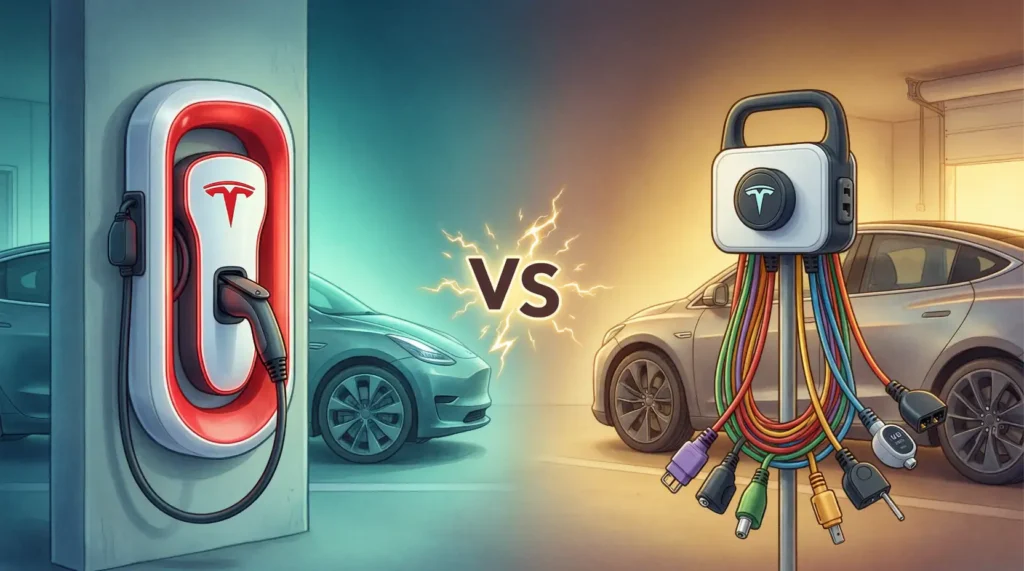
So you’ve got an EV in the driveway (congrats! 🎉) and now you’re staring at a question that looks tiny but really isn’t: do you bolt Tesla’s own Wall Connector to your garage wall, or go with a third-party “universal” charger that plays nice with literally any electric car on the road?
It feels like a $200 decision. It’s actually a 5-to-10-year decision. 😅
The charger you mount this weekend is going to outlive your current car. It might outlive your next car. And depending on which way the industry breaks, the “obvious” choice today could feel a little awkward in three years.
Here’s the thing nobody tells you in the showroom: both of these chargers are genuinely good. There’s no lemon in this fight. The real question isn’t “which one is better” — it’s “which one is better for your driveway, your panel, and the cars you’ll actually own.“
So let’s settle the Tesla Wall Connector vs universal charger debate honestly, with zero fanboy nonsense, so you spend your money once and never think about it again. 👇
⚡ The Short Answer
If you skim one block, skim this one. In the Tesla Wall Connector vs universal charger matchup:
- Tesla Wall Connector 🔴 — sleek, fast, well-priced, and ideal if every car you’ll own for the next decade is a Tesla or an NACS-native EV.
- Universal charger 🌍 — works with any EV out of the box (Tesla included, via a small adapter), and it’s the smart pick if your household runs mixed brands, you might switch carmakers, or you want zero adapter drama.
Both top out at roughly the same home charging speed — about 11.5 kW (48 amps) — so this isn’t a speed war. It’s a compatibility and future-proofing war.
The right answer comes down to one honest gut-check: what’s plugging in over the next 5–10 years? 🔮
📊 Tesla Wall Connector vs Universal Charger — Side-by-Side
| Feature | 🔴 Tesla Wall Connector | 🌍 Universal Charger |
|---|---|---|
| Works with non-Tesla EVs | ⚠️ Yes, with adapter | ✅ Yes, natively |
| Connector type | NACS | J1772 (US) / Type 2 (India) |
| Max home power | Up to ~11.5 kW (48A) | Up to ~11.5 kW (48A) |
| Smart app & scheduling | ✅ Tesla app | ✅ Brand app |
| Power sharing (2 cars) | ✅ Excellent with two Teslas | ✅ Available on many models |
| Design / aesthetics | 😍 Very sleek, minimal | Varies by brand |
| Typical price | Often the cheaper option | Similar to slightly more |
| Adapter needed long-term | For non-NACS cars | For Tesla today (NACS-native soon) |
| Best for | Tesla / NACS-only homes | Mixed-brand or future-proof homes |
That bottom row? That’s the whole ballgame in the Tesla Wall Connector vs universal charger decision. Everything else is close enough to call a tie. ⚡
🔴 When the Tesla Wall Connector Wins
Let’s give Tesla its due, because for a lot of households this is genuinely the smart-money pick.
Go with the Tesla Wall Connector if:
- ✅ You own a Tesla and plan to keep owning Teslas (or other NACS-native EVs) for the foreseeable future
- ✅ You love a clean, minimalist look and want the charger to basically disappear into the garage wall
- ✅ You want tight integration with the Tesla app — charge scheduling, energy stats, and start/stop right from your phone
- ✅ You have (or might have) two Teslas and want the brilliant power-sharing feature
That last one is underrated. If two Teslas plug into two networked Tesla Wall Connectors on a shared circuit, they intelligently split the available power instead of tripping your breaker. For a two-Tesla family, that alone can justify the choice. 😍
And here’s the kicker — the Tesla Wall Connector is often the cheaper unit on the shelf. Tesla isn’t trying to make margin on the hardware; they want you charged up and happy. So you frequently get premium build quality and a gorgeous design for less than a comparable universal charger.
For a committed Tesla household, the math is hard to argue with: lower price, better looks, native app, and no adapter ever needed. Done. 🏁
🌍 When a Universal Charger Wins
Now flip it around, because plenty of driveways tell a different story.
Go universal if:
- ✅ Your household has mixed-brand EVs — say a Tesla and a Ford, Hyundai, or Rivian
- ✅ You might switch brands at your next purchase (and let’s be honest, the EV market is moving fast)
- ✅ You want one charger any visiting friend or family member can use, no questions asked
- ✅ You’d rather not babysit an adapter every single time you plug in
A universal charger (sometimes called an “open” or J1772/Type 2 charger) speaks the language that most non-Tesla EVs were born speaking. No adapter, no fuss, no “where did I leave that dongle” moment in the rain. 🌧️
The industry is sliding toward NACS as the standard, sure — but there are millions of J1772 and Type 2 cars on the road right now, and they’ll be on the road for a decade. A universal charger is the flexible hedge that covers today’s reality and tomorrow’s direction at the same time.
In the Tesla Wall Connector vs universal charger call, flexibility is the universal charger’s superpower. It says “yes” to almost every car you could ever park in front of it. 🛡️
💡 Not sure how much power your setup actually needs before you commit? Read this first: How Many Amps Does Your EV Charger Need?
🔌 The NACS Transition & Adapters (the part everyone’s confused about)
Okay, this is the section that trips people up, so let’s slow down.
NACS stands for the North American Charging Standard — that’s the connector Tesla uses, now opened up and adopted by basically every major automaker. J1772 is the older standard most non-Tesla EVs used for Level 2 home charging in the US. In India and Europe, the equivalent is Type 2.
Here’s how the adapter situation actually shakes out in 2026:
- A non-Tesla EV charging from a Tesla Wall Connector needs a NACS-to-J1772 adapter today. It works fine — it’s just one more thing in the loop.
- A Tesla charging from a universal J1772 charger needs a J1772-to-NACS adapter (the small one Tesla ships with the car). Also works fine.
- Newer EVs are increasingly shipping with native NACS ports, which means they’ll plug straight into a Tesla Wall Connector with no adapter at all.
So the adapter question isn’t “do I need one forever?” It’s “how long until the cars in my driveway are NACS-native?” If that’s soon, the Tesla charger gets more attractive. If you’re driving J1772 cars you plan to keep for years, a universal charger spares you the daily dongle dance. 🔁
The honest takeaway: adapters work reliably, but they’re a minor friction tax. Whether that tax is worth paying depends entirely on which connector your cars actually have.
⚡ Power & Amperage — Spoiler, It’s a Tie
Let’s kill a myth right now: the Tesla Wall Connector is not faster than a good universal charger for home charging. 🙅
Both max out at around 11.5 kW, which is 48 amps on a 60-amp circuit. That’s the practical ceiling for Level 2 AC home charging, and both types hit it.
What actually controls your charging speed is a three-way handshake:
- Your car’s onboard charger — if your EV can only accept 7.7 kW (32A), that’s your real ceiling no matter what’s on the wall.
- Your circuit and breaker — a 48A charger needs a 60A circuit. Put it on a 40A circuit and it’ll throttle to 32A.
- Your home’s electrical panel — some older panels simply can’t spare 60 amps without an upgrade.
So when someone says “the universal charger is slower,” they’re almost always describing a circuit or car limitation, not the charger brand. ⚙️
Practical advice: don’t overbuy amperage. If both your cars cap out at 32A onboard, paying for a 48A charger and a 60A circuit is spending money you won’t use. Match the charger to the car, not to the spec sheet bragging rights.
💡 This is exactly why we always say: size the amps to your actual cars. The amps guide walks through the math in plain English.
📱 Smart Features — Closer Than You’d Think
Five years ago, Tesla’s app was miles ahead. In 2026? The gap has shrunk a lot.
Tesla Wall Connector gives you scheduling, energy monitoring, over-the-air firmware updates, and that buttery Tesla app integration. If your whole life already lives in the Tesla app, it’s seamless. The downside: the deepest features assume you’re driving a Tesla.
Universal smart chargers now offer genuinely strong apps too — scheduled charging to catch cheap off-peak rates, energy usage tracking, load management, Wi-Fi connectivity, and integrations with smart-home platforms and utility demand-response programs. Some support dynamic load balancing, throttling your charge when the dryer and oven are running so you don’t pop the main breaker.
For most people, the smart-feature difference won’t be the deciding factor. Both let you do the one thing that actually saves money: schedule charging for off-peak hours. That alone can shave real dollars off your monthly bill. 💸
If you’re an automation nerd who wants deep integrations across brands, universal chargers often win on flexibility. If you live and breathe the Tesla ecosystem, Tesla’s app feels more native. Pick your vibe.
🔧 Install Considerations (don’t skip this)
Whatever you choose, the install is where surprises (and costs) hide. Both charger types install almost identically — they’re both hardwired or plug-in Level 2 units — but a few things deserve attention.
- Hardwired vs plug-in (NEMA 14-50): Hardwiring at 48A gives you max speed and a tidy look. A plug-in setup caps you around 40A (32A continuous) but lets you unplug and move the unit. Both Tesla and universal chargers come in both flavors.
- Panel capacity: A 48A charger wants a dedicated 60A breaker. If your panel is maxed out, you may need a subpanel or a panel upgrade — that’s where budgets balloon. Get this checked before you buy.
- Cable length & placement: Measure from the charger location to where your car’s port sits. Tesla ports are rear-left; many other EVs differ. A too-short cable is a daily annoyance.
- Licensed electrician: Level 2 chargers are 240V appliances. Always use a licensed installer, and check whether your area requires a permit. Many utilities also offer rebates that require a permitted, professional install. 💰
The install cost is roughly the same regardless of which charger you pick — so let compatibility, not installation, drive the decision.
🔮 Future-Proofing & Home Resale
Here’s an angle most buyers forget: the charger is part of your house now.
If you ever sell, a hardwired EV charger is a selling point — but a universal charger that works with any EV appeals to a wider pool of buyers than a brand-specific one. A future buyer with a Hyundai or a Chevy doesn’t want to inherit a charger that needs an adapter dance for their car.
On the flip side, as NACS becomes the dominant connector across the industry, a Tesla-style NACS charger becomes more universal over time, not less. A few years from now, “the Tesla charger” and “the universal charger” may both just be “the NACS charger.” The lines are blurring fast.
So think about your time horizon:
- Selling in 2–3 years? A universal charger is the safer resale play right now, since today’s market still has tons of J1772 cars. 🏠
- Staying put for a decade? Either choice ages gracefully, because by then your driveway is probably NACS-native anyway.
Future-proofing isn’t about predicting the winner perfectly. It’s about not painting yourself into a corner. A universal charger is the lower-regret option for most uncertain situations; a Tesla Wall Connector is the lower-regret option for the committed-Tesla crowd.
🇮🇳 India & the Type 2 Reality
Quick but important detour for our India readers, because the calculus is different here. 🇮🇳
In India, Type 2 is the de facto connector standard for AC home charging across Tata, MG, Hyundai, Mahindra, BYD, and the rest. Tesla’s footprint, while growing, is still small compared to the US — and NACS isn’t the home-charging standard the way it’s becoming stateside.
So for the vast majority of Indian EV owners, the Tesla Wall Connector vs universal charger debate barely applies the same way. A universal Type 2 Level 2 charger is almost always the practical, sensible pick — it works with whatever you drive now and whatever you’re likely to buy next.
If you do own a Tesla in India, you’ll typically lean on a Type 2-compatible setup or the appropriate adapter anyway. Bottom line for India: think “Type 2 universal first,” and you’ll rarely go wrong. ✅
👨👩👧 Mixed-Brand Households — The Real Tiebreaker
If there’s one scenario that settles this instantly, it’s the mixed-brand garage.
Picture it: a Tesla Model Y for the commute, a Hyundai Ioniq 5 for the family hauls. One Tesla Wall Connector means the Hyundai needs an adapter every single time. That’s fine occasionally — but as a daily ritual for two drivers? It gets old fast, and adapters get lost, left at the office, or buried under a car seat. 🤦
A universal charger handles both cars natively (the Tesla via its included adapter, the Hyundai with nothing extra), or you simply keep one adapter dedicated to whichever car needs it. Cleaner, calmer, fewer arguments about whose turn it is to hunt for the dongle.
The pattern is simple: single-brand (Tesla) home → Tesla Wall Connector. Mixed-brand home → universal charger. If your household is mixed today, flexibility almost always beats sleekness over the long haul.
📈 How 2026 Trends Tilt the Decision
The Tesla Wall Connector vs universal charger choice is genuinely shifting under our feet, and it’s worth understanding the direction of travel.
In the US: NACS standardization is the headline. Most major automakers have committed to Tesla’s connector, and new EVs are increasingly shipping with native NACS ports. That does two things at once — it makes the Tesla Wall Connector more “universal” over time, and it pushes universal-charger makers to ship NACS-ready units or bundle adapters. The historical gap between the two camps is narrowing every quarter. 📊
In India: Type 2 remains king for home AC charging, and Tesla’s presence is still modest. So the trend that’s reshaping the US market hasn’t reshaped India’s the same way. Universal Type 2 chargers stay the practical default, full stop. 🇮🇳
The meta-trend? The connector wars are cooling. As NACS wins in North America, the choice increasingly becomes less about “which connector” and more about “which app, which price, which design, which install.” That’s a good thing for buyers — it means you can pick on value and looks instead of fearing you’ll back the wrong standard.
✅ 5 Tips Before You Choose
- Think 10 years ahead, not 10 minutes. 🔮 Will every car in your driveway be a Tesla/NACS car? If you’re even slightly unsure, lean universal.
- Audit the connectors you own. Write down each EV’s port type (NACS vs J1772/Type 2) and what adapter, if any, it needs.
- Match amperage to your cars and panel. Don’t pay for 48A if your cars cap at 32A — and confirm your panel can handle the circuit before you buy.
- Prioritize off-peak scheduling. Both options support it, and it’s the single biggest money-saver. Use it.
- Factor home resale. A universal charger appeals to a broader set of future buyers — worth it if you might sell within a few years. 🏠
🛒 Shop This Post
Whichever way you lean, here are our affiliate-friendly picks to get you charging fast. 😍
1. Tesla-Style NACS Wall Connector 🔴
Sleek, fast, and the value champ for Tesla/NACS households. Hardwire it at 48A and forget about it.
👉 Shop NACS wall connectors
2. Universal Smart Level 2 Charger 🌍
Works with any EV today, NACS-ready for tomorrow — the flexible, future-proof pick for mixed-brand or uncertain homes.
👉 Shop universal Level 2 chargers
3. NACS ↔ J1772 / Type 2 Adapter 🔌
The little bridge that lets either setup talk to any car. Keep one in the glovebox no matter what you choose.
👉 Shop charging adapters
🛒️ Affiliate disclosure: These are affiliate picks. They cost you nothing extra, and a small commission helps keep EVs Mirror running. 🙏
🎯 Quick Quiz: Tesla or Universal?
Answer fast, go with your gut:
- Will every EV you own for the next decade be a Tesla / NACS car? 🅐 Yes 🅑 No / unsure
- Is your household mixed-brand (or might it be)? 🅐 No 🅑 Yes
- Might you switch carmakers at your next purchase? 🅐 No way 🅑 Maybe
- Do you hate fumbling with adapters? 🅐 Don’t mind it 🅑 Yes, hate it
Mostly 🅐: 🔴 Tesla Wall Connector — sleek, cheaper, native app, zero regrets for a Tesla home.
Mostly 🅑: 🌍 Universal charger — flexible, future-proof, and friendly to every car in (and visiting) your driveway.
📋 Decision Checklist
Run through this before you click “buy”:
- [ ] List every EV you own and plan to own
- [ ] Note each car’s connector (NACS vs J1772 / Type 2)
- [ ] Decide honestly if you’ll stay Tesla-only long term
- [ ] Confirm your panel can handle the circuit (60A for 48A charging)
- [ ] Match charger amperage to your cars’ onboard limits
- [ ] Check the smart-app features you actually care about
- [ ] Measure cable length to your car’s charge port
- [ ] Budget for any adapter you’ll need
- [ ] Look up local utility rebates (often require a permit)
- [ ] Book a licensed electrician for install ⚡
🤔 People Also Ask
Q: Can a non-Tesla EV use a Tesla Wall Connector?
A: Yes — with a NACS-to-J1772 (or Type 2) adapter. It charges reliably. But if you regularly plug in a non-Tesla, a universal charger spares you the daily adapter routine. In the Tesla Wall Connector vs universal charger decision, this adapter friction is often the deciding factor for mixed-brand homes.
Q: Is the Tesla Wall Connector worth it?
A: For a Tesla-only household, absolutely — it’s sleek, fast, frequently the cheaper unit, and integrates beautifully with the Tesla app. For mixed-brand or uncertain homes, a universal charger is usually the smarter long-term buy.
Q: Are universal chargers slower than the Tesla one?
A: No. Both top out around 11.5 kW (48A) for Level 2 home charging. Your actual speed is set by your car’s onboard charger and your circuit, not by the charger’s brand.
Q: With NACS becoming standard, should I just buy Tesla’s charger?
A: It’s increasingly defensible in the US as automakers adopt NACS. But if you currently drive a J1772 or Type 2 car you’ll keep for years, a universal charger avoids adapters today while staying compatible tomorrow. The Tesla Wall Connector vs universal charger gap really does narrow as NACS spreads.
Q: Which charger is better for India?
A: A universal Type 2 charger, almost every time. Type 2 is the home-charging standard across Indian EV brands, and Tesla’s footprint is still small, so a universal unit is the practical default.
Q: Do I need different wiring for a Tesla vs a universal charger?
A: No — both are 240V Level 2 chargers and install on essentially the same circuit. A 48A unit needs a dedicated 60A breaker either way. The wiring depends on amperage, not brand, so install cost is roughly identical.
🚀 The Bottom Line
Strip away the noise and the Tesla Wall Connector vs universal charger decision comes down to one honest question: will everything in your driveway be a Tesla or NACS car for the next decade?
If yes — the Tesla Wall Connector is sleek, fast, often cheaper, and adapter-free. Buy it and never look back. 🔴
If there’s any doubt — a mixed-brand garage, a possible brand switch, guests to charge, or a home you might sell soon — the universal charger’s flexibility wins. It says yes to every car and ages gracefully as NACS takes over. 🌍
Either way, you can’t really lose. Both charge at the same speed, both have solid apps, both install for about the same cost. So pick based on your cars, your panel, and your time horizon — then go enjoy the magic of waking up to a full battery every morning. ⚡
💬 Which did you choose and why? Drop it in the comments and help the next person decide!
📤 Know a new EV owner stuck on this exact call? Share this breakdown with them. 🙏
🔖 Bookmark EVs Mirror for clear, no-nonsense EV gear comparisons.
👉 Up next: Best Portable EV Chargers You Can Keep in the Trunk