Somewhere in the noise of 2026 — between price wars, charging headlines, and the endless “are EVs dead?” takes — a genuinely big number quietly slid past us. 📊
For the first time, electric vehicles aren’t a niche line item on the global car market. They’re roughly a quarter of it, and climbing. Industry outlooks like BloombergNEF and the IEA peg 2025 at more than 20 million EVs sold — about 1 in 4 new cars worldwide.
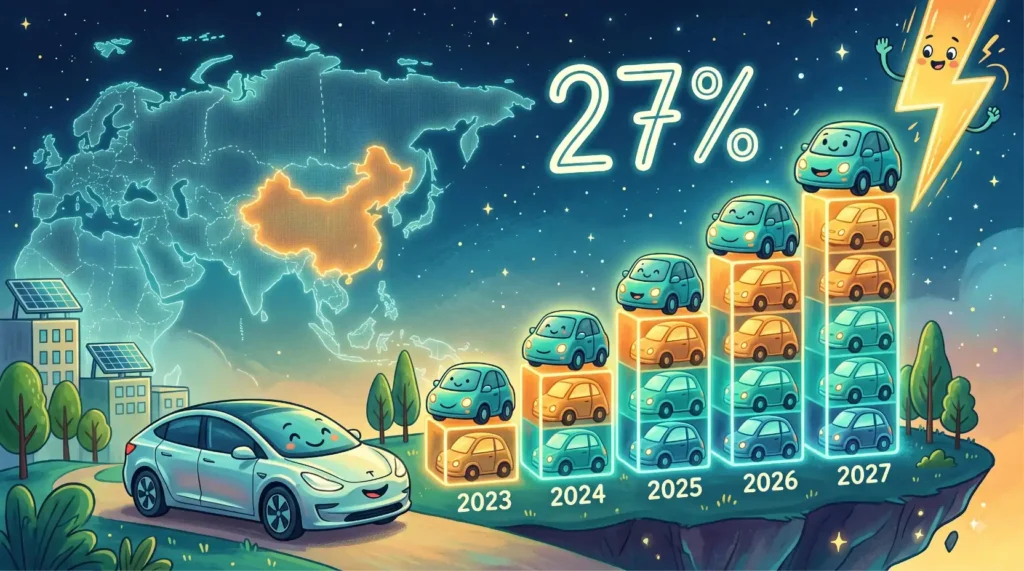
Now 2026 is tracking even higher, with projections pointing past 23 million units and an electric share creeping toward 27%. That’s not a rounding error. That’s a market tipping. ⚖️
If you want to actually understand global EV sales 2026 — the milestone, the momentum, and the very real places it’s slowing — this is the plain-English breakdown. 👇
⚠️ Quick honesty note (please read): Every figure in this article is illustrative and as-of-2026, drawn in broad strokes from public industry outlooks like BloombergNEF and the IEA. We’re rounding to clean numbers to tell the story clearly — not quoting any single report to the decimal. Sales data gets revised, definitions of “EV” differ (some include plug-in hybrids, some don’t), and forecasts shift. Treat the numbers here as the shape of the trend, not gospel. Always check the latest primary source before you cite a precise stat.
⚡ The Short Answer
Short on time? Here’s the whole story in a few bullets. ⏱️
- 🌍 EVs crossed ~20 million units in 2025 — roughly 25% of all new cars sold globally, per industry outlooks.
- 📈 2026 is projected past ~23 million units, an increase of around +11%, pushing the electric share toward ~27%.
- 🇨🇳 China dominates, accounting for roughly 63% of 2025 EV sales on its own — the single biggest force in the market.
- 🐢 Growth is cooling at the edges — US regulatory rollback and a maturing China market led BNEF to trim its long-term outlook slightly.
- 🚗 For everyday buyers, this means more models, sharper prices, and a faster charging buildout — adoption at scale tends to help shoppers.
- 🛵 In India the story is smaller but fast — low overall share, but two-wheelers (scooters) are leading the charge.
Bottom line: the milestone is real, the trajectory is up, and the nuance is where the smart reading lives. 😎
📊 The Climb at a Glance (Illustrative)
Numbers tell this one better than adjectives. Here’s the rough shape of how EV sales have scaled — flagged as illustrative and rounded, attributed broadly to industry outlooks. 👇
| Year | Approx. EVs Sold (Global) | Approx. Share of New Cars | Note |
|---|---|---|---|
| 2020 | ~3 million | ~4% | Early scaling phase |
| 2022 | ~10 million | ~13% | Momentum builds |
| 2024 | ~17 million | ~22% | Mainstreaming |
| 2025 | ~20 million+ | ~25% | 1-in-4 milestone |
| 2026 (projected) | ~23 million+ | ~27% | Tipping toward mainstream |
📌 These figures are illustrative and as-of-2026, rounded for clarity and attributed generally to BloombergNEF/IEA-style outlooks — not lifted precisely from any single report. Definitions vary on whether plug-in hybrids count. Always verify against the latest primary data before quoting.
Read the table top to bottom and the story writes itself: a market that was a curiosity at the start of the decade is now a structural force. The slope is the headline. 📈
🏁 The Milestone: ~27% of New Cars Going Electric in 2026
Let’s start with the number that’s grabbing attention. 🎯
For 2026, industry outlooks point to more than 23 million EVs sold worldwide, an increase of roughly 11% over 2025. That lifts the electric share of new-car sales to around 27% — meaning, very loosely, that better than one in four cars rolling off lots this year plugs in rather than fills up.
Pause on that. A quarter-plus of a global market measured in the tens of millions of vehicles is now electric. ⚡
Five years ago, EVs were a rounding error in most countries. Today they’re a default option on nearly every showroom floor, from compact hatchbacks to full-size pickups. That shift didn’t happen because of one breakthrough — it happened because price, range, charging, and choice all improved at once.
The global EV sales 2026 milestone matters less as a trophy and more as a signal: the market has crossed from “early adopters” into “everyday buyers.” Once a technology hits roughly a quarter of sales, it stops being a movement and starts being the baseline. 🔁
That’s the real meaning of 27%. Not that EVs won — but that they’re no longer optional to take seriously.
🚀 How Fast We Got Here: From Niche to 1-in-4
To appreciate 2026, rewind to 2025 — the year the market quietly crossed a psychological line. 🧠
Per industry outlooks, 2025 closed above 20 million EVs sold, roughly 25% of all new cars. One in four. That’s the kind of figure that, a decade ago, sat in optimistic forecasts that most analysts politely doubted.
The pace here is the wild part. The market went from around 3 million units in 2020 to north of 20 million in 2025 — a multiplication, not an increment. 📈
A few forces stacked up to make that happen. Battery costs fell dramatically over the decade, dragging sticker prices closer to gas equivalents. Model choice exploded, so buyers stopped having to compromise on body style or size. And charging — both home and public — went from “scary unknown” to “mostly fine” in a lot of markets.
Government policy lit the fuse in many countries, but by 2025 the fire was self-sustaining in the biggest markets. People weren’t buying EVs only for incentives; they were buying them because they’d become genuinely good cars. 🚗
That’s the difference between a subsidy bubble and a structural shift. The 2025-to-2026 jump suggests we’re firmly in the second category — even if the growth rate is starting to mature.
🇨🇳 Where the Growth Lives: China Leads, Decisively
You cannot understand global EV sales 2026 without understanding China. It’s not close. 🐉
By industry estimates, China accounted for roughly 63% of 2025 EV sales — well over half the entire planet’s electric cars in a single country. When the world’s EV market grows, it’s largely because China’s does.
The reasons are structural. China built an enormous domestic supply chain — batteries, components, and dozens of homegrown automakers competing ferociously on price and features. That competition produced affordable, well-equipped EVs at a scale no other market has matched.
Add aggressive policy support, dense urban charging, and buyer enthusiasm, and you get the engine of global electrification sitting in one country. 🏭
This concentration is why “the world’s EV market” and “China’s EV market” sometimes feel like the same sentence — and why a slowdown there ripples everywhere. It’s also reshaping who makes the world’s electric cars, not just who buys them.
We dig into that production side — who’s actually building these vehicles and what it means for prices everywhere — in our companion piece: China Now Makes Most of the World’s EVs. It’s the natural next read if this milestone has your attention. 🌏
The takeaway: the global story is real, but it’s heavily a China story. Keep that lens on as we look at where things are cooling.
🐢 Where It’s Slowing: The Nuance Behind the Milestone
Here’s where the honest, balanced read earns its keep — because “27% and rising” is only half the picture. 🪞
BloombergNEF, while still bullish on the long arc, trimmed its long-term outlook slightly in recent updates. Two reasons stand out, and they’re worth understanding clearly.
First, the US regulatory rollback. Shifts in federal policy — softer incentives and looser emissions pressure — reduce the tailwind that helped US EV adoption climb. When the policy support eases, near-term growth in that market tends to cool, and forecasters adjust accordingly. 🇺🇸
Second, a maturing China market. China is so far ahead that its blistering growth rate is naturally slowing — not because EVs are failing there, but because the easy gains are already banked. A market approaching saturation grows in smaller percentage jumps, even as the absolute numbers stay enormous. 📉
It’s the classic S-curve: explosive early growth, then a more measured climb as the market matures. That’s normal — and it’s why a slightly trimmed outlook isn’t a doom signal.
The key distinction: the trajectory is still firmly upward. What changed is the slope of the long-term curve, nudged down a notch by policy in one market and maturity in another. 🎚️
So when you see a headline shouting that “EV growth is stalling,” read closer. Slower growth on top of a record-high base is not the same as decline. The market is still expanding — it’s just expanding like a mature giant rather than a sprinting startup.
🛒 What 27% Means for Everyday Buyers
Macro numbers are fun, but here’s the part that actually touches your wallet. When EVs hit a quarter of the market, regular shoppers benefit in concrete ways. 💸
More models, more choice. At 27% share, automakers can’t treat EVs as a side project. You get electric versions across nearly every segment — small cars, SUVs, trucks, even budget options — instead of a thin handful of pricey flagships. 🚙
Sharper prices. Scale drives cost down. More volume, cheaper batteries, and fierce competition (especially from China’s market) push sticker prices closer to gas equivalents over time. Used EV prices have loosened up too, opening the door for budget buyers. 🏷️
A faster charging buildout. Networks expand where demand concentrates. As more EVs hit the road, public fast-charging and home-charging options grow denser and more reliable — chipping away at the range anxiety that scared off early skeptics. 🔌
Better resale clarity. A bigger, more mature market means more data on reliability, battery longevity, and depreciation — so buyers can shop with far more confidence than the guesswork era of a few years back. 📚
The honest caveat: these benefits land unevenly. They show up fastest in markets with high adoption and slower where EVs are still a small slice. But the direction of travel is buyer-friendly, and the 27% milestone is a big reason why. ✅
⚖️ EV vs Hybrid in This Shift
Here’s a question the 27% headline conveniently skips: in a maturing market, is a full EV even the right call for you — or does a hybrid still make more sense? 🤔
It’s a fair question, and the answer is genuinely “it depends.” As EV adoption scales, hybrids haven’t disappeared — in several markets they’re growing alongside EVs, serving buyers who want lower running costs without committing fully to plug-in life.
The math comes down to your situation: how much you drive, whether you can charge at home, your local electricity and fuel prices, and how long you’ll keep the car. 🧮
In high-adoption markets with good charging and cheap electricity, a full EV often pulls ahead on total cost of ownership. In places where charging is sparse or electricity is pricey relative to fuel, a hybrid can be the smarter near-term pick. Neither answer is universal.
This is exactly the kind of decision that rewards running your own numbers rather than following a headline. We built a full breakdown for that: EV vs Hybrid: Which Is Cheaper to Own Today?. 💡
The big-picture point: the 27% milestone doesn’t mean “everyone must buy an EV tomorrow.” It means EVs are now a mainstream, credible option — and worth comparing seriously against a hybrid before you decide. Both can be right answers depending on who’s asking. ✅
🇮🇳 The India Angle: Small Share, Fast Climb, Scooters Leading
Zoom into India and the global EV sales 2026 story shifts shape entirely — and it’s one of the most interesting subplots out there. 🌶️
By overall car-market share, India’s EV penetration is still small compared to China, Europe, or the US. Four-wheeler EVs remain a modest slice of new-car sales, held back by upfront prices, charging gaps, and buyer caution.
But “small” and “fast-growing” aren’t contradictions. India’s EV adoption is climbing quickly off a low base, and the energy is unmistakable on the ground. 📈
Here’s the twist most global coverage misses: in India, the EV revolution is happening on two and three wheels first. Electric scooters and motorcycles are leading adoption, not cars. For millions of daily commuters, an electric scooter is cheaper to run, easy to charge from a regular socket, and perfectly suited to crowded city traffic. 🛵
Three-wheelers — autos and cargo haulers — are electrifying fast too, often because the running-cost savings are simply too good for a working driver to ignore.
So India’s contribution to the global milestone looks different. It’s less about ₹20-lakh electric SUVs and more about affordable electric two-wheelers reaching the masses — a bottom-up electrification that suits the market’s realities. 💪
For Indian readers, the practical read is this: car-side EV share is rising but still early, while the scooter segment is already deep into the mainstream. Both are part of how India quietly adds to the global numbers — just on a different vehicle and a different timeline. 🇮🇳
🔮 What the Next Milestone Looks Like
If 2026 is the “1-in-4 going on 1-in-3” year, what’s the next flag on the road? 🗺️
The natural next milestone is a third of new cars going electric — the ~33% line. Based on the current trajectory in industry outlooks, that’s plausibly within a few years for the global market, though the exact timing depends heavily on China, US policy, and how fast emerging markets like India scale. ⏳
But here’s the more sophisticated way to watch it: don’t fixate on a single global percentage. The real action is in the spread between markets. 🌐
Some markets are already past 50% EV share. Others are barely starting. The next phase of global EV sales 2026 and beyond is as much about where growth shifts — from China and Europe toward Southeast Asia, Latin America, and India — as it is about the headline number ticking up.
Expect the growth rate to keep maturing in the leaders while accelerating in the latecomers. The torch passes; the total keeps climbing. 🔥
And expect the “EVs are dead” headlines to keep coming every time the growth rate dips, even as the absolute numbers set fresh records. Now you’ll know how to read past them. 📰
The next milestone isn’t a finish line. It’s just the next marker on a road the market is clearly still traveling — slower in some lanes, faster in others, but forward overall.
📈 2026: Adoption Trends to Watch
A few currents shaping the year, beyond the headline percentage. 🌊
Price competition intensifies. China’s hyper-competitive market keeps pushing affordable EVs, and that pressure ripples into other markets as automakers fight to stay relevant. Buyers tend to win this one. 🏷️
Policy diverges sharply. With the US easing support while other regions hold or expand theirs, 2026 is a year of uneven policy landscapes. Where you live increasingly shapes how attractive an EV purchase is. 🗺️
Hybrids stay in the mix. Rather than vanishing, hybrids are growing alongside EVs in several markets as a transitional choice — a reminder that electrification isn’t a single switch but a spectrum. 🔀
Charging catches up unevenly. Infrastructure expands fastest where adoption is densest, widening the gap between “easy to own an EV here” and “still tricky there.” 🔌
Two-wheelers electrify globally. India’s scooter-led story is echoing across parts of Asia, where affordable electric two- and three-wheelers are quietly racking up huge unit numbers. 🛵
The through-line: 2026 isn’t one EV story — it’s many regional stories adding up to a record global total. 📊
✅ 5 Takeaways From the Numbers
The whole article, distilled. 🧾
- The milestone is real. EVs topped ~20M in 2025 (~25% share) and 2026 is tracking past ~23M (~27% share), per industry outlooks. 📈
- China is the engine. At roughly 63% of 2025 sales, China drives the global trend more than any other market. 🇨🇳
- Slower growth ≠ decline. A slightly trimmed long-term outlook reflects US rollback and a maturing China market — not a market in reverse. ⚖️
- Buyers benefit at scale. More models, sharper prices, and a faster charging buildout follow naturally from mainstream adoption. 🛒
- The story is regional. India’s small-but-fast, scooter-led path shows the next growth won’t look like the last. 🛵
🛒 Shop This Post
A few practical companions for living the EV milestone, not just reading about it. 😍
1. A Home Level 2 EV Charger ⚡
If you’re joining the 27%, home charging is the single biggest quality-of-life upgrade. A solid Level 2 unit turns “range anxiety” into “wake up full” — and it’s the foundation of cheap, convenient ownership.
👉 Shop home EV chargers
2. An OBD2 Scanner / Battery-Health Tool 🔋
A mainstream market means a deep used-EV pool — and a good battery-health reader helps you shop that pool with confidence by checking what really matters before you buy.
👉 Shop EV battery scanners
3. A Portable EV Charger for Travel 🔌
Charging is still uneven across regions, so a reliable portable charger is cheap insurance — a way to top up from a standard outlet wherever you land.
👉 Shop portable EV chargers
🛒️ Affiliate disclosure: Some links above are affiliate links. If you buy through them, EVs Mirror may earn a small commission at no extra cost to you — it helps keep our news explainers free. 🙏 We only suggest things we’d genuinely point a friend toward.
🎯 Quick Quiz: How Well Do You Read the Milestone?
Test your new EV-data literacy. 👇
- EVs reached roughly what share of new cars in 2025? 🅐 ~10% 🅑 ~25% 🅒 ~50%
- Which country accounted for ~63% of 2025 EV sales? 🅐 USA 🅑 India 🅒 China
- A “trimmed long-term outlook” mainly means: 🅐 EV sales are falling 🅑 The growth rate is maturing while totals still rise 🅒 EVs are being banned
Answers: 1 → 🅑 (~25%) · 2 → 🅒 (China) · 3 → 🅑 (maturing growth, not decline).
Mostly right? 🟢 You’re reading the data like an analyst, not a headline.
Missed a couple? 🟡 Re-skim “Where It’s Slowing” — that’s where most people misread the trend.
📋 Your EV-Milestone Reading Checklist
Use this to cut through any EV-sales headline you meet. ✅
- [ ] Check whether the figure counts plug-in hybrids or only full EVs 🔍
- [ ] Separate growth rate from absolute volume (slower growth can still mean records) 📊
- [ ] Note which market is driving the number (usually China) 🇨🇳
- [ ] Ask whether a “slowdown” is decline or just maturing growth ⚖️
- [ ] Consider the regional spread, not just the global average 🌐
- [ ] Factor in policy shifts (like the US rollback) when reading forecasts 🏛️
- [ ] For your own purchase, run the EV vs hybrid math for your situation 🧮
- [ ] Treat any precise stat as illustrative until you check the primary source 📚
🤔 People Also Ask
Q: What are global EV sales 2026 expected to be?
A: Per industry outlooks like BloombergNEF and the IEA, global EV sales 2026 are projected to exceed roughly 23 million units — an increase of around 11% over 2025 — lifting the electric share of new-car sales toward about 27%. These figures are illustrative and rounded; definitions and revisions vary, so check the latest primary source before quoting a precise number.
Q: How many EVs were sold in 2025?
A: Industry estimates put 2025 above roughly 20 million EVs sold worldwide — about 25% of all new cars, or one in four. That made 2025 the year EVs crossed firmly out of niche territory and into mainstream-adoption status, setting up the higher 2026 projection.
Q: Why is the global EV sales 2026 growth rate slowing?
A: Two main reasons feature in industry outlooks: the US regulatory rollback (softer incentives and emissions pressure reducing near-term demand there) and a maturing China market, where blistering early growth naturally cools as the market approaches saturation. BNEF trimmed its long-term outlook slightly for these reasons — but that’s a smaller growth rate on top of record volumes, not an actual decline.
Q: Which country sells the most EVs?
A: China, by a wide margin. It accounted for roughly 63% of 2025 EV sales — more than every other market combined — thanks to a deep domestic supply chain, fierce price competition, strong policy support, and dense charging. When global EV sales move, China is usually the biggest reason.
Q: Does 27% mean everyone is switching to EVs?
A: Not quite. Roughly 27% of new cars sold in 2026 are projected to be electric — that’s a share of fresh sales, not of all cars on the road, which changes far more slowly. It signals that EVs are now a mainstream option, but plenty of buyers still choose gas or hybrids depending on their needs, charging access, and local prices.
Q: How big is India’s role in global EV sales?
A: India’s overall car-market EV share is still small compared with China, Europe, or the US, but it’s growing fast off a low base. The standout is two-wheelers — electric scooters and three-wheelers are leading India’s electrification, so the country’s contribution looks different from the car-led story elsewhere.
🚀 The Bottom Line
The headline is earned: somewhere in 2026, roughly 27% of new cars going electric became the working reality of the auto market. Global EV sales 2026 are tracking past 23 million units, building on 2025’s 20-million-plus milestone — and EVs have officially graduated from movement to mainstream. ⚡
But the smart read is the nuanced one. Growth is maturing at the edges — nudged by the US regulatory rollback and a China market that’s already so far ahead it can’t sprint forever. That’s why thoughtful outlooks like BNEF’s trimmed slightly, even as the absolute numbers keep setting records. Slower growth on a record base is still growth. 📈
For you, the buyer, the milestone cashes out as more choice, better prices, and a thickening charging network — while hybrids stay a legitimate option worth comparing for your specific situation. And in India, the revolution is rolling in on two wheels first. 🛵
Read the numbers like an analyst, not a headline, and 2026’s milestone stops being noise and starts being a map. 🗺️
💬 What’s the EV share where you live? Drop it in the comments — the regional spread is the most interesting part of this whole story.
📤 Know someone arguing “EVs are dead”? Forward them this explainer before the next debate. 🙏
🔖 Bookmark EVs Mirror for honest, no-hype EV news and data explainers.
👉 Go deeper on the engine of it all: China Now Makes Most of the World’s EVs — and if you’re shopping, run the numbers with EV vs Hybrid: Which Is Cheaper to Own Today?
This article is general, illustrative information based on public industry outlooks (BloombergNEF/IEA), not financial or purchase advice. EV sales figures are rounded, as-of-2026, and subject to revision; definitions of “EV” differ across sources. Always verify the latest primary data before relying on any precise statistic.