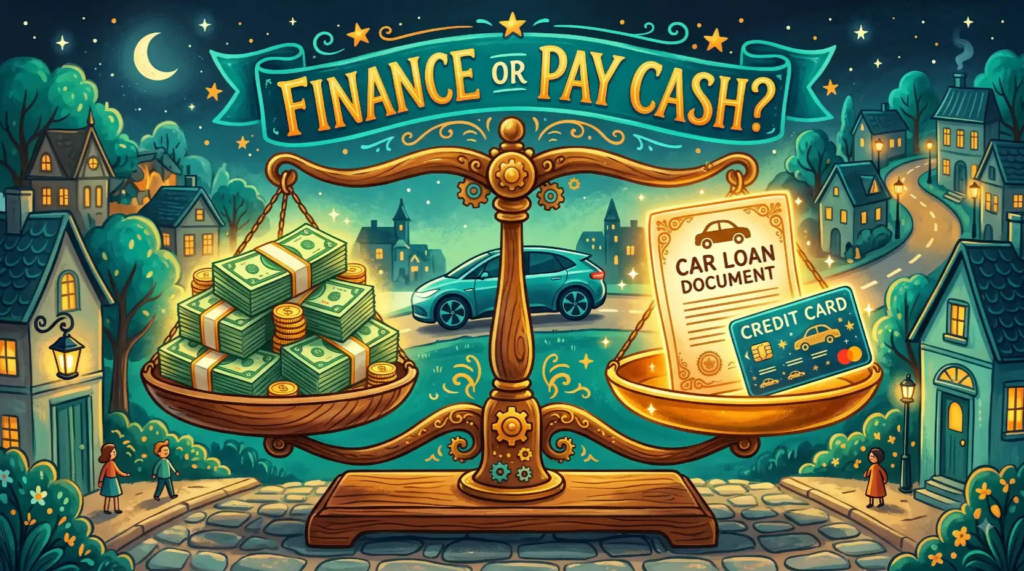
You’ve finally decided on the electric car. The color, the trim, the wheels — sorted. Then the finance manager slides a piece of paper across the desk and asks the question that quietly stresses out almost every buyer: do you want to finance, or are you paying in full? 😅
It feels like it should be simple. You’ve either got the money or you don’t, right? But it’s sneakier than that. Plenty of people who can write the full check still finance — and they’re not being reckless. Plenty of people who finance should have paid cash. The “right” answer flips depending on interest rates, what else you could do with the money, and how you sleep at night. 💸
So before you sign anything, let’s settle the finance vs cash EV debate properly — with real 2026 numbers for the US 🇺🇸 and India 🇮🇳, the opportunity-cost math nobody explains clearly, and a way to figure out which side you land on. 👇
⚠️ Quick heads-up (please read): This is general information, not financial advice. The right move depends on current interest rates, the returns you can realistically earn, your tax situation, and your personal circumstances — all of which change. Every figure below is illustrative, used to show the math, not to predict your actual numbers. Before you make a six-figure decision, talk to a qualified financial advisor who knows your full picture. 🙏
⚡ The Short Answer
If you want the headline before the homework, here it is. 👇
- 🟢 Finance if your loan rate is low (or 0% APR) and you can reliably earn more by keeping your cash invested. That gap is your profit.
- 💵 Pay cash if loan rates are high, you have no better use for the money, or debt genuinely stresses you out. Peace of mind has real value.
- 🛡️ Never drain your emergency fund either way. A paid-off car with zero savings is a financial trap waiting to spring.
- 📈 There’s no universal winner. The smart choice is whichever one leaves you richer and calmer — and that’s a math problem plus a temperament problem.
The rest of this guide is about working out which camp you’re in. ⚡
📊 Finance vs Cash EV — Head to Head
Before we dig in, here’s the whole debate on one screen. Notice that neither column is all green — each approach wins on some rows and loses on others. 👇
| Factor | 💳 Financing | 💵 Paying Cash |
|---|---|---|
| Interest cost | You pay interest (unless 0% APR) — a real, guaranteed cost | Zero. You owe nothing to anyone |
| Opportunity cost | Low — your cash stays free to invest or earn | High — money sunk into a depreciating car can’t grow |
| Ownership | Lender holds a lien until you finish paying | You own it outright from day one ✅ |
| Flexibility | Cash stays liquid for emergencies & opportunities | Cash is gone; harder to access if life happens |
| Credit-building | On-time payments build your credit score 📈 | No credit impact — neither helps nor hurts |
| Risk | Owing on a fast-depreciating asset; payment obligation | Tied-up capital; no debt risk at all 🛡️ |
See the tension? Financing keeps your money flexible and builds credit but costs interest. Cash kills interest and debt stress but locks up capital. The “best” answer is just whichever set of trade-offs fits your situation. Let’s unpack each one. 🎯
🎯 The Core Trade-Off: Pay Interest or Tie Up Cash
Strip away the noise and the entire finance vs cash EV decision is one swap. 🔁
Finance, and you pay interest — a known, guaranteed cost — but your cash stays free to do other things. Pay cash, and you pay opportunity cost — the invisible return your money could have earned — but you owe nobody anything.
That word “invisible” is why so many people get this wrong. The interest on a loan shows up on a statement in bold, so it feels expensive and scary. The opportunity cost of cash never sends you a bill, so it feels free. It isn’t. 😬
Here’s the honest way to frame it: when you pay cash, you’re effectively choosing to “earn” a return equal to your loan rate by avoiding it. If the loan was going to cost 8%, paying cash is like locking in a guaranteed 8% return. Not bad! But if you could’ve earned 11% investing that same money, you just left 3% on the table. 📉
So the real question isn’t “do I hate debt?” It’s: can my cash earn more elsewhere than the loan costs me? Everything downstream flows from that single comparison. (And yes — keep “talk to an advisor” in your back pocket, because your realistic return is the hard part to nail.) 🧮
💵 When Paying Cash Wins
Paying cash isn’t old-fashioned or unsophisticated. In several very common situations, it’s flat-out the smarter financial move. 💪
🔺 When loan rates are high. This is the big one for 2026. If you’re staring at an auto loan at 9%, 10%, or higher (and used-EV loans often run steeper), that’s an expensive, guaranteed cost. To beat it, your investments would need to reliably out-earn that rate after tax — a tall order without taking on real risk. When the loan rate is high, paying cash usually wins cleanly.
🤷 When you have no better use for the money. If your cash is sitting in a low-yield checking account doing nothing, financing to “keep it invested” is a fantasy — it’s not invested, it’s idle. In that case, killing the interest by paying cash is the obvious win. The opportunity cost is only real if you’d actually put the money to work.
😌 When debt genuinely stresses you out. This isn’t a soft factor — it’s a real one. If a car loan will keep you up at night, make you drive nervously, or stop you from changing jobs, the “math win” of financing isn’t worth it. A paid-off car you own free and clear is a kind of freedom that doesn’t show up in a spreadsheet. 🛡️
📉 On a fast-depreciating asset. Cars — EVs included — lose value quickly, especially in the first few years. Owing money on something that’s shrinking in value is uncomfortable, and being “underwater” (owing more than the car’s worth) is a real risk if you financed with little down. Paying cash sidesteps that entirely.
If two or three of these describe you, cash is probably your answer. But don’t close the tab yet — financing has its own strong case. 👇
💡 Wondering how much to put down if you do finance? Read: EV Down Payment: How Much Should You Put Down?
💳 When Financing Wins
Now the other side. Financing isn’t a trap or a sign you can’t afford the car. Used well, it can leave you genuinely better off. ⚡
🎉 When you get a low or 0% APR. EV makers and lenders love to dangle promotional financing — sometimes 0%, sometimes a couple of percent. When money is that cheap, financing is almost a no-brainer. Why hand over a lump of cash to avoid a near-zero interest cost? Keep the cash, make the payments, and let your money work elsewhere. A 0% loan is essentially free leverage. 🤑
📈 When your cash can earn more than the loan costs. This is the heart of the pro-financing argument. If your loan costs 4% but your money can reliably earn 8% in a diversified investment, financing keeps that 4% spread working for you instead of sinking it into a car. Over a multi-year loan, that gap can add up to real money. (Note the words “reliably” and “after tax” — we’ll stress-test them in the next section.)
💧 When liquidity matters more than a few hundred in interest. Cash in hand is optionality. It covers a job loss, a medical bill, a sudden opportunity. Tying up your entire savings in a car to dodge a modest interest cost can leave you cash-poor and exposed. Financing keeps you nimble. 🛡️
📊 When you’re deliberately building credit. A car loan, paid on time, is one of the cleaner ways to build or strengthen a credit history — useful if a mortgage or another big loan is on your horizon. More on that below.
The catch with all of these: the financing advantage is only real if the numbers actually work and you stay disciplined. Let’s make the math concrete. 🧮
🔍 Comparing financing to leasing instead of cash? See: EV Loan vs Lease: Which Saves You More?
🧮 The Opportunity-Cost Calculation (Illustrative)
This is the section everyone skims and shouldn’t. Let’s actually run it — slowly — so you can copy the steps for your own numbers. Remember, every figure here is illustrative to show the method, not a forecast. 📐
The simple rule: Compare your loan rate against the return you can realistically earn on the cash, after tax. If your expected return is comfortably higher than the loan rate, financing has the edge. If it’s lower (or too close to call), cash wins. 🎯
US example 🇺🇸. Say you’re buying a $40,000 EV.
- Scenario A — high loan rate: You’re offered 9% APR. To beat that, your investments must reliably out-earn 9% after tax — which usually means taking on meaningful risk. The smart, low-stress move here leans toward paying cash. You “earn” a guaranteed 9% by skipping the interest.
- Scenario B — promotional rate: You’re offered 2% APR. Keeping $40,000 invested at an expected, diversified ~7% after tax means roughly a 5% spread working in your favor each year. Over a multi-year loan that’s a meaningful sum. Here, financing looks attractive — if you’d genuinely invest the cash and leave it there.
India example 🇮🇳. Say you’re buying a ₹20 lakh EV.
- Scenario A: Your EV loan is quoted at 9.5%. A safe fixed deposit (FD) might return, illustratively, around 7% before tax — below your loan rate. Safe money can’t beat the loan, so paying cash (or a large down payment) is the cleaner win.
- Scenario B: You snag a subsidized 6% EV loan, and you’re comfortable with a diversified long-term investment expected to return more than that after tax. Then keeping the cash invested and financing the car can come out ahead — with the usual caveat that higher returns carry higher risk. ⚖️
Notice the pattern: low rate + reliable higher return = finance; high rate or safe-only money = cash. And the squishy variable is always that expected return — guaranteed nowhere, which is exactly why a financial advisor earns their fee here. 🤝
🛡️ Keep Your Emergency Fund — Don’t Drain Savings for a Car
Here’s a rule that overrides almost everything above: do not empty your emergency fund to pay cash for a car. 🚫
It’s tempting. You see the loan interest, you’ve got the balance sitting there, and writing one big check feels responsible. But a car that’s fully paid off while your savings account reads ₹0 / $0 is not financial freedom — it’s a trap with a steering wheel. 😬
The standard guidance is to keep roughly three to six months of living expenses in accessible savings before you sink money into a depreciating asset. If paying cash for the EV would wipe that buffer out, financing (even at a meh rate) is often the safer play — because the loan interest is cheaper than the credit-card debt you’d rack up the next time life throws a curveball. 💳
Think of it this way: liquidity is insurance. A job loss, a medical emergency, or a sudden repair doesn’t wait for your savings to recover. Keeping cash accessible — and financing the car instead — can be the more conservative choice, even though it involves debt. 🛡️
So the order of operations is: emergency fund first, then decide finance vs cash with whatever’s left over. Never the reverse. ✅
📊 Financing to Build Credit
One underrated perk of financing sits entirely outside the interest math: it can build your credit. 📈
If you’ve got a thin credit file, or you’re working toward a big future loan (a mortgage, a business loan, a bigger second car), a car loan that you pay on time, every time, is a clean, structured way to add positive history. Lenders like to see that you can handle installment debt responsibly. 💪
Two honest caveats, though. One: don’t take on a loan you don’t need purely to build credit — there are cheaper ways to build a score, and paying interest just for points is rarely worth it. Two: the credit boost only works if every payment lands on time. A single missed EMI or installment can do more damage than the loan ever did good. 😬
In India, a healthy CIBIL score smooths the path to better rates on future loans, so a well-managed EV loan can pay quiet dividends down the line. In the US, the same logic applies to your FICO score. Just treat credit-building as a bonus of financing — never the sole reason to do it. 🎯
⚡ The EV-Specific Angle: Incentives & Depreciation
Cars are cars, but EVs add two wrinkles that tilt the finance vs cash EV math in ways a petrol or gas car wouldn’t. Worth knowing before you choose. 🔋
💸 Incentives change your real cost. EV tax credits, point-of-sale rebates, road-tax exemptions, and state subsidies can knock a serious chunk off the price. In the US, a point-of-sale rebate may reduce what you actually finance or pay on the spot. The cleaner your incentive picture, the smaller the gap you’re financing or fronting — which can make paying cash less painful, or shrink the loan you need. Sort out which incentives you qualify for before you decide how to pay.
📉 Depreciation cuts both ways. EVs have historically depreciated quickly, especially early on. If you finance with very little down, you can end up “underwater” — owing more than the car is worth — which is risky if you need to sell or it gets totaled. Paying cash (or a healthy down payment) avoids that gap. On the flip side, sinking a big cash lump into a fast-depreciating asset means more of your money is exposed to that value drop, rather than the lender’s. ⚖️
The practical takeaway: factor incentives into your real out-the-door cost first, then weigh how depreciation risk sits with your stomach. For some buyers, a modest down payment plus financing is the sweet spot — skin in the game without draining the bank. (As always, a quick advisor check on the tax side is money well spent.) 🤝
📉 Want the depreciation deep-dive? It pairs naturally with the down-payment question here: EV Down Payment: How Much Should You Put Down?
🇮🇳 India Context: Loan Rates vs FD & Investment Returns
The finance vs cash EV call plays out a little differently in India, so let’s give it its own moment. 🇮🇳
Loan rates run higher. Indian car loan rates are typically meaningfully higher than the promotional 0–2% deals you’ll see advertised abroad. That raises the bar your investments must clear to make financing worthwhile. When the loan’s at 9–10%, safe options usually can’t keep up. ⚖️
The FD comparison is the gut-check. A common instinct is “I’ll keep the money in an FD and finance the car.” But if your fixed deposit returns, illustratively, around 7% before tax while your loan costs 9.5%, the math doesn’t work — you’d lose money on the spread. Safe, low-return parking simply can’t beat a higher-rate loan, so paying cash (or a large down payment) often wins for risk-averse buyers. 💵
Higher-return investments shift it. If you’re comfortable with longer-term, diversified investments expected to out-earn the loan after tax — and you can stomach the ups and downs — then keeping the cash invested and financing can come out ahead. But “expected” is doing heavy lifting there: those returns aren’t guaranteed, and the loan cost is. This is precisely where a SEBI-registered advisor earns their keep. 🤝
Don’t forget incentives and credit. Indian EV buyers can tap road-tax exemptions and state subsidies that lower the real cost, while a cleanly-paid EV loan strengthens your CIBIL score for future borrowing. Both nudge the decision — but neither overrides the core rate-vs-return comparison. 🎯
📈 2026: Financing vs Cash Dynamics
The finance vs cash EV landscape isn’t static — and the 2026 backdrop matters for your call. 📅
🇺🇸 In the US: Auto loan rates have stayed elevated compared to the cheap-money years, which strengthens the case for paying cash on standard loans — a high guaranteed cost is hard for safe investments to beat. But manufacturers, hungry to move EVs, keep dangling promotional 0–3% APR deals on select models. When you can grab one of those, financing flips to attractive again. The lesson: the headline rate you’re actually offered changes the answer, so shop the financing as hard as you shop the car.
🇮🇳 In India: EV loan rates remain higher than developed-market promos, keeping the bar high for financing to beat safe investments like FDs. At the same time, subsidized green-loan schemes and lender EV offers occasionally bring rates down, and generous state incentives shrink the amount you’re financing in the first place. Net effect: cash (or a big down payment) is the low-stress default for many Indian buyers, with financing winning mainly when a genuinely cheap loan appears. 💸
The through-line for 2026 in both markets: the answer follows the rate. Cheap money favors financing; expensive money favors cash. Always run the comparison against the specific offer in front of you — not last year’s assumptions. And revisit it, because rates move. 🎯
✅ 5 Tips to Decide
You don’t have to agonize. Run through these five and the answer usually reveals itself. 👇
- 🧮 Compare the loan rate to your realistic after-tax return. If your money can reliably out-earn the loan, lean finance. If not — or it’s close — lean cash. This single comparison does most of the work.
- 🛡️ Protect your emergency fund first. Keep 3–6 months of expenses accessible no matter what. If paying cash would drain it, finance instead. Liquidity beats a small interest saving.
- 😌 Be honest about your stress tolerance. If debt will genuinely weigh on you, that’s a real cost. Peace of mind is allowed to win the tie-breaker.
- 💸 Factor in EV incentives and depreciation. Nail your true out-the-door cost after credits, and weigh how comfortable you are owning (or owing on) a fast-depreciating asset.
- 🤝 Talk to a financial advisor before a big decision. A pro can pressure-test your expected returns, tax situation, and risk tolerance — the exact variables that decide this. Worth the hour.
Do these five and you’ll choose with confidence, not anxiety. ⚡
🛒 Tools to Run the Numbers (Shop This Post)
Want to actually crunch your finance vs cash decision instead of guessing? These three picks help you turn the abstract math into hard numbers. 😍
1. A Personal Finance & Loan Calculator App 📱
Model your loan EMI, total interest, and the opportunity cost of paying cash side by side — so you can see the spread before you sign.
👉 Shop finance & budgeting apps
2. An Investment & Robo-Advisor Platform 📈
If you’re leaning toward financing to keep your cash invested, a low-cost investing platform helps you actually put that money to work (instead of letting it sit idle and kill the whole argument).
👉 Shop investing platforms
3. A Personal Finance Book on Debt & Investing 📚
A solid read on opportunity cost, good vs bad debt, and emergency funds will pay for itself many times over in better money decisions.
👉 Shop personal-finance books
🛒️ Shop This Post: (These are affiliate picks — they cost you nothing extra, and a small commission supports EVs Mirror. They’re tools, not financial advice — your decision should still run through a qualified advisor. Thank you! 🙏)
🎯 Quick Quiz: Finance or Cash for You?
Three questions. Answer honestly. 👇
- What’s your loan rate? 🅐 Low / 0% APR 🅑 High (9%+)
- Can your cash reliably out-earn the loan after tax? 🅐 Yes 🅑 No / not sure
- Would paying cash drain your emergency fund? 🅐 No, plenty left 🅑 Yes, it’d wipe me out
Mostly 🅐: 💳 Financing likely wins — cheap money plus a healthy return means keeping your cash working makes sense. (Confirm with an advisor.)
Mostly 🅑: 💵 Cash likely wins — a high rate and safe-only money mean killing the interest is the cleaner play. (But never below your emergency-fund line.)
Mixed bag: 🟡 It’s genuinely close — run the opportunity-cost math on your real numbers, and consider a down payment as a middle path.
📋 Decision Checklist
Print this. Don’t sign the finance paperwork until every box is ticked. ✅
- [ ] Confirmed the actual loan rate (APR) you’re being offered
- [ ] Estimated the realistic, after-tax return you could earn on the cash
- [ ] Compared the two: does your return beat the loan rate?
- [ ] Confirmed paying cash won’t drain your 3–6 month emergency fund
- [ ] Factored in all EV incentives to find your true out-the-door cost
- [ ] Considered depreciation and whether you’d be “underwater” if financing
- [ ] Weighed your honest comfort level with carrying debt
- [ ] Booked (or planned) a chat with a financial advisor for the big call ⚡
🤔 People Also Ask
Q: Is it better to finance or pay cash for an EV?
A: It depends on the numbers. The finance vs cash EV decision favors financing when you get a low or 0% APR and can reliably earn more by keeping your cash invested. It favors cash when loan rates are high, your money has no better use, or debt stresses you out. There’s no universal winner — run your own rate-versus-return comparison and, ideally, check it with an advisor.
Q: Does paying cash for a car save money?
A: It saves you the interest, which is a guaranteed return equal to your loan rate. That’s a clear win when rates are high. But it has an opportunity cost — if your cash could reliably earn more invested than the loan costs, paying cash can actually leave you worse off. The smart move depends on that spread.
Q: When does financing an EV make more sense than paying cash?
A: When you land a low or promotional APR (especially 0%), when your cash can reliably out-earn the loan after tax, when keeping liquidity matters, or when you’re deliberately building credit. In those cases, financing keeps your money flexible and working while the loan costs little.
Q: Should I drain my savings to pay cash for an EV?
A: No. Never empty your emergency fund — keep roughly three to six months of expenses accessible first. A fully paid-off car with zero savings leaves you exposed to the next emergency, often forcing pricier debt later. Financing can be the safer choice when paying cash would wipe out your buffer.
Q: Does financing an EV help build credit?
A: Yes — a car loan paid on time, every time, adds positive installment history to your credit file (FICO in the US, CIBIL in India). It’s useful if a mortgage or other big loan is coming. Just don’t borrow only to build credit, and never miss a payment, since one slip can undo the benefit.
Q: How do I calculate the opportunity cost of paying cash for an EV?
A: Compare your loan rate against the return you could realistically earn on that cash, after tax. If your expected return is comfortably higher than the loan rate, financing has the edge and paying cash carries an opportunity cost. If your return is lower or too close to call, paying cash wins. Because expected returns aren’t guaranteed, it’s wise to confirm with a financial advisor.
🚀 The Bottom Line
So, finance vs cash EV — which wins? Neither, universally. The right answer is whichever one leaves you richer and calmer, and that comes down to one comparison: your loan rate versus the return your cash can reliably earn. 💸
If money is cheap (low or 0% APR) and your cash can genuinely out-earn the loan, financing keeps your capital working and your life flexible. If the rate is high, your money has no better home, or debt keeps you up at night, paying cash kills the interest and hands you outright ownership. Either way — protect your emergency fund first, factor in EV incentives and depreciation, and remember that peace of mind has real value. 🛡️
This is a six-figure decision, so don’t wing it. Run the opportunity-cost math on your numbers, then take it to a qualified financial advisor before you sign. The hour you spend will be the best-paid hour of the whole purchase. 🤝
💬 Did you finance or pay cash for your EV — and would you do it again? Tell us in the comments!
📤 Know someone stuck at the finance desk? Send them this guide before they sign. 🙏
🔖 Bookmark EVs Mirror for honest, no-spin EV money guides.
👉 Up next: EV Loan vs Lease: Which Saves You More? — and if you’re financing, don’t miss EV Down Payment: How Much Should You Put Down?