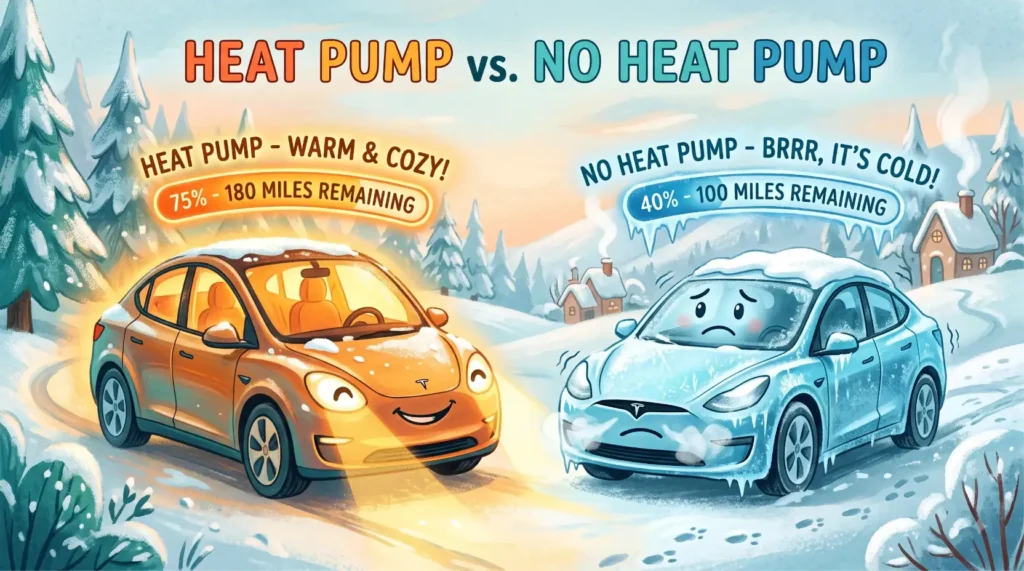
You’re comparing two EVs that look nearly identical on paper. Same battery, same rated range, same price-ish. One has a heat pump; the other doesn’t. The salesperson shrugs and says “eh, it’s a winter thing.” 🤔
Then January hits. One car cruises through a cold commute losing maybe 15% of its range. The other limps home having shed nearly a third — the cabin heater quietly draining the pack like a leaky tap. Same weather. Same drive. Very different outcome.
That little box of refrigerant and coils is one of the most misunderstood features on an EV spec sheet. Most buyers ignore it. The ones who live somewhere cold really shouldn’t. 🥶
In this guide we’ll settle it once and for all: what a heat pump actually does, how the alternatives compare, and exactly how big the real-world heat pump EV winter range difference is. Let’s warm up. 👇
⚡ The Short Answer
Short on time? Here’s the gist before we dig in:
- A heat pump moves heat instead of making it — pulling warmth from outside air and the car’s own parts, so it sips far less battery energy. 🔋
- In real winter driving, a heat pump typically saves around 10–20% of range versus an EV using a plain resistive heater in similar cold.
- Cabin heating is the biggest single winter drain, so attacking it with a heat pump hits your largest loss directly. 🔥
- A resistive heater is simple but thirsty, pulling 3–6 kW continuously — like running a space heater off your range.
- Heat pumps lose some of their edge in extreme cold (think well below 0°F / -18°C), where they lean on backup heat — but they still usually beat resistive setups.
- For cold-climate drivers, a heat pump is usually worth paying for; for mild-winter folks, it’s a nice-to-have.
- Either way, smart habits — preconditioning, heated seats — multiply the benefit. 🌡️
Now let’s unpack how this little gadget pulls off such a big trick. 🎯
📊 Resistive Heater vs Heat Pump: The Quick Comparison
Before the deep dive, here’s the head-to-head. These are illustrative real-world figures — your exact numbers shift with car, climate, and driving — but they show the shape of the gap clearly. 📌
| Factor | Resistive Heater | Heat Pump |
|---|---|---|
| ⚙️ How it works | Burns electricity directly into heat (like a space heater) | Moves existing heat from outside air + components |
| 🔋 Efficiency | ~1 unit heat per 1 unit energy (COP ~1.0) | ~2–3 units heat per 1 unit energy (COP ~2–3) |
| ❄️ Winter range impact | Bigger loss — heating alone can cost 15–25%+ | Smaller loss — often 10–20% less total range hit |
| 💵 Cost to you | Standard / cheaper to build | Often a paid option or higher trim ($500–$1,500 / ₹40k–₹1.2L equivalent) |
| 🌡️ Cold-temp limit | Works at any temperature (always 100% effort) | Most efficient in mild cold; backup heat kicks in deep below ~0°F / -18°C |
(Read it like this: the heat pump wins big in the temperatures most people actually drive in, and ties or slightly trails only in brutal extreme cold.) ⚡
🔬 What a Heat Pump Actually Does
Let’s clear up the central confusion first, because it’s the whole ballgame. ⚡
Most heaters make heat. You run electricity through a coil, the coil fights the current, and that resistance throws off warmth — exactly how a toaster, a hair dryer, or an electric space heater works. It’s effective, but there’s a hard ceiling: one unit of electricity becomes, at best, one unit of heat. You can’t beat 100%.
A heat pump cheats that ceiling. Instead of making heat, it moves heat that already exists — even out of cold-looking air. 🤯
Here’s the trick. There’s usable warmth in the outside air right down to surprisingly low temperatures (air at 30°F / -1°C still holds plenty of heat energy). A heat pump uses a refrigerant and a compressor to grab that ambient warmth, concentrate it, and pump it into your cabin. It also scavenges waste heat from the motor, battery, and electronics — heat that would otherwise be wasted.
Because it’s relocating heat rather than generating it from scratch, a heat pump can deliver two to three units of heat for every one unit of electricity it consumes. That ratio is called the coefficient of performance (COP), and a COP of 2–3 is exactly why the heat pump EV winter range advantage exists. Same comfort, a fraction of the battery drain. ❄️
🆚 Resistive Heater vs Heat Pump, Explained Simply
If the science feels slippery, here’s a kitchen analogy that nails it. 🍳
Imagine you want to warm a cold room. Option one: plug in an electric space heater and let it blaze. It works, but it gulps power the entire time it’s on. That’s your resistive (PTC) heater — simple, reliable, present in basically every EV as either the main system or a backup. It never struggles in any temperature, but it’s permanently thirsty. 🌡️
Option two: instead of generating heat, you run a device that gathers warmth from somewhere else and concentrates it into the room. That’s your heat pump. Same cozy room, far less electricity, because you’re moving heat rather than brute-forcing it into existence.
Now here’s the nuance people miss: it’s the exact same machine as your air conditioner, just run in reverse. Your EV’s AC already moves heat out of the cabin in summer. A heat pump simply flips that cycle to move heat in during winter. Clever, efficient, and mostly invisible to you as the driver.
The practical upshot? A resistive heater turns your range into heat at a fixed, expensive exchange rate. A heat pump gives you a far better exchange rate most of the year. You don’t operate it differently — you just lose fewer miles staying warm. 🔥
❄️ The Winter Range Difference: Why Heating Dominates
To understand why this one component matters so much, you have to know where your winter miles actually go. 🥶
A gas car heats your cabin for free — it scavenges waste heat from an engine that’s burning fuel anyway. An EV has no roaring furnace under the hood. Every bit of cabin warmth has to come from the same battery that powers the wheels. So heating isn’t a side cost; it’s a direct subtraction from your range.
And it’s the biggest subtraction. On a genuinely cold drive, cabin heating is usually the single largest range-loss factor — bigger than slowed battery chemistry, bigger than reduced regen, bigger than tyre and air drag. If you want the full breakdown of every winter loss, we cover it in How Cold Weather Reduces EV Range.
Here’s why that matters for the heat pump question: if you’re going to fix one thing, fix the biggest thing. A heat pump targets the single largest winter drain head-on. ⚡
A resistive heater pulling 3–6 kW on a short, cold commute can quietly eat 20%+ of your range by itself. Swap in a heat pump delivering the same warmth at a third to half the energy, and that 20% drain shrinks toward 7–12%. That recovered slice — roughly 10–20% of total range in real cold-weather driving — is the headline number people mean when they talk about the heat pump advantage. 🔋
📉 How Much Range a Heat Pump Actually Saves
Let’s put rough numbers on it, because percentages are useless when you’re staring at a range gauge before a trip. ❄️
These are illustrative figures for two otherwise-identical EVs that nominally do 280 miles (450 km) in mild weather — one resistive, one heat-pump. Your mileage will literally vary, but this shows the pattern:
- Mild cold, ~40°F / 4°C, light heat: Resistive ~250 mi (400 km); heat pump ~262 mi (420 km). A modest ~12 mi (20 km) edge.
- Cold, ~25°F / -4°C, heater working: Resistive ~210 mi (340 km); heat pump ~238 mi (380 km). Now it’s ~28 mi (40 km) — you’d feel that.
- Hard freeze, ~10°F / -12°C, heat blasting, short trips: Resistive ~180 mi (290 km); heat pump ~205 mi (330 km). Still a meaningful ~25 mi (40 km) saved.
- Extreme, ~-10°F / -23°C, highway: The gap narrows. Resistive ~165 mi (265 km); heat pump ~175 mi (280 km). The heat pump leans on backup heat here, so its edge shrinks. 🧊
A few patterns worth noting. The heat pump’s biggest percentage win lands in the moderate-cold zone — roughly 14–40°F (-10 to 4°C) — which, conveniently, is where most people do most of their winter driving. In extreme cold the advantage shrinks but rarely disappears. And short trips amplify the difference, because heating dominates a bigger share of a short drive’s energy budget.
Across a whole winter of mixed driving, a heat pump owner typically banks a steady 10–20% range advantage over an identical resistive-only car. Over thousands of cold miles, that adds up to a lot of saved charging stops. 👇
🌡️ The Cold-Temperature Limit: Where Heat Pumps Struggle
Heat pumps aren’t magic, and it’s worth being honest about their weak spot. 🧊
Remember the trick: a heat pump works by harvesting heat from outside air. The colder that air gets, the less heat there is to harvest, and the harder the system has to work to extract it. As temperatures plunge toward and below 0°F (-18°C), the heat pump’s efficiency advantage (its COP) drops — sometimes toward 1.0, where it’s no better than a resistive heater.
That’s why most heat-pump EVs include a resistive backup heater. When it gets brutally cold, the car blends in or switches to resistive heat to keep you comfortable and to defrost the glass fast. In those moments, a heat-pump car and a resistive car burn power at similar rates — the heat pump’s edge temporarily fades. ❄️
There’s also a cold-start quirk. On a deeply frozen morning, a heat pump can be sluggish to deliver warmth right away, so some cars fire the resistive element first for instant heat, then hand back to the pump once things stabilize.
The honest takeaway: a heat pump is a fantastic most-of-the-winter tool, not an all-conditions miracle. If you live somewhere that routinely hits -20°F (-29°C), the advantage is real but smaller. If your winters mostly sit between 15°F and 45°F (-9 to 7°C) — which describes the vast majority of populated cold regions — the heat pump shines almost every single day. 🌡️
💰 Is a Heat Pump Worth Paying For?
Here’s the question that actually matters when you’re configuring a car or comparing trims. 💵
Sometimes a heat pump is standard. Sometimes it’s a paid option or locked behind a higher trim, adding roughly $500–$1,500 (₹40,000–₹1.2 lakh equivalent) to the price. So is it worth it? The answer hinges almost entirely on your climate. 🌍
If you live somewhere with real winters — the US Northeast, Midwest, Mountain states, Canada, or any place that spends months below freezing — yes, get the heat pump. It directly shrinks your biggest seasonal range loss, every cold day, for the life of the car. The comfort-and-range payoff over years of ownership easily justifies the upfront cost. ✅
If you live somewhere mild — coastal California, the US South, most of lowland India — the math is softer. You’ll see the benefit only on the handful of genuinely cold mornings each year. It’s a nice-to-have, not a must-have, and you might spend that money elsewhere.
The resale angle matters too. A heat pump is increasingly an expected feature, and a used EV without one can be a tougher sell in cold markets. Buyers shopping in winter climates specifically look for it.
Bottom line: in cold country, the heat pump EV winter range savings (plus comfort and resale) make it one of the smartest boxes you can tick. In warm country, your wallet won’t miss it much. If you’re cross-shopping cold-weather cars, our guide to the Best Electric Cars for Cold Climates flags which ones include one. 🔋
🔍 Does Your EV Already Have One?
Maybe you’re not shopping — you already own an EV and you’re wondering which camp you’re in. Here’s how to find out. 🕵️
Check the spec sheet or window sticker. It’s the most reliable source. Look for “heat pump,” “heat-pump heating,” or sometimes “high-efficiency heating system.” If it explicitly lists a “PTC heater” with no mention of a heat pump, you’re likely resistive-only.
Model year is a strong hint. Older EVs (roughly pre-2020) very often used resistive heating only. From about 2021 onward, heat pumps spread quickly, and by 2024–2026 they’re standard or widely available on most new EVs. The newer your car, the better your odds. 📅
Trim level can decide it. On some models the heat pump came only on higher trims, with later or specific battery packs, or in cold-weather-package bundles. Two cars of the same model and year don’t always match — check your build. 🤔
When in doubt, ask the manufacturer or a forum. Owner communities for your exact model usually have a definitive list of which years and trims got the heat pump. It’s a common question, so the answer is rarely hard to find.
Knowing the answer changes your winter strategy. Heat pump? Lean on it and relax a little. Resistive-only? You’ll want to work the smart-heating habits below harder to make up the difference. 🌡️
🧤 Maximizing Efficiency — With or Without a Heat Pump
Whichever heater you’ve got, how you use it hugely affects your winter range. The single best habit applies to everyone. ⚡
Precondition while plugged in. This is the closest thing to a cheat code. Warm the cabin and battery before you unplug, using your home charger, so the heating energy comes from the grid instead of your range. You step into a toasty, ready car with full usable miles — and even a thirsty resistive heater costs you nothing if it runs on shore power. 🔌
Heat the person, not the whole cabin. Heated seats and a heated steering wheel are radiant contact heaters — they warm you on 50–100 watts, versus the thousands of watts a cabin air heater pulls. Crank those, then dial the cabin air down a few degrees. This trick saves range whether you have a heat pump or not, and it’s especially powerful for resistive-only cars trying to close the gap. 🔥
If you have a heat pump, let it do its job. Avoid blasting max heat the instant you start; give it a moment to find its efficient rhythm. Use the auto climate setting, which lets the car balance pump and backup intelligently.
If you’re resistive-only, lean hardest on the free wins — preconditioning, seat/wheel heat, lower cabin temp, batched trips. A savvy resistive driver can match a careless heat-pump driver. The hardware sets the ceiling; your habits decide where you land under it. 🧊
🇮🇳 A Quick Note for India’s Hill Drivers
Most of India never gets cold enough for a heat pump to earn its keep — but the hills are a different story. 🏔️
If you drive in Himachal, Uttarakhand, Ladakh, Kashmir, Sikkim, or the higher Northeast, winter mornings dip near or below freezing, and the heat pump advantage becomes very real — exactly the moderate-cold zone where it shines. Add altitude climbs (which already strain range) and every saved kilowatt-hour counts double on a mountain road. 🥶
For hill buyers, prioritising an EV with a heat pump is genuinely smart money. Pair it with preconditioning off a home wallbox on a cheap night tariff, so you bank ₹ savings and range savings before you climb. And lean on heated seats over cabin heat — the comfort-per-watt is unbeatable on a chilly Manali morning.
For most lowland Indian cities, though, a heat pump is a minor luxury you’ll rarely notice. Spend that budget on range or features that matter more in your climate. Know your terrain, then choose. 🇮🇳
📈 2026: Heat Pumps Keep Getting Better
Here’s the encouraging part: the heat pump itself is improving fast, and 2026 systems are noticeably better than the early ones. 📈
Cold-weather performance is climbing. Newer heat-pump designs use smarter refrigerants, multi-source heat harvesting (pulling warmth from the battery, motor, and air at once), and better controls — pushing usable efficiency further down the temperature scale than older systems managed. The “it stops working when it’s cold” weakness is shrinking. ❄️
Integration is tighter. Modern EVs blend the heat pump, battery thermal management, and cabin climate into one coordinated system, so the car automatically picks the most efficient heat source moment to moment. You just set a temperature and it optimises behind the scenes. 🌡️
Availability is exploding. What used to be a premium option is now standard on most new EVs, which means the heat pump EV winter range advantage is reaching millions of mainstream buyers who’d never have ticked the box manually.
The result: a 2026 heat-pump EV holds onto winter range better than a 2020 one did, struggles less in the cold, and increasingly comes as standard kit. The technology is actively engineering winter range loss into a smaller and smaller problem. 🔋
✅ 5 Tips for Winter Heating Efficiency
The whole guide, distilled into five moves you can use this winter: ⚡
- Precondition while plugged in. Warm the cabin and battery on grid power before you leave — the single biggest range-saver, heat pump or not.
- Heat yourself, not the air. Crank heated seats and the steering wheel; drop cabin temp a few degrees. Touch heat sips watts; air heat guzzles them.
- Let your heat pump settle. Use auto climate and avoid instant max-blast so the pump runs in its efficient zone instead of triggering backup resistive heat.
- Batch your trips. One warm drive beats three cold starts — heating dominates short trips, so fewer cold starts means fewer expensive warm-ups.
- Know your hardware. Confirm whether you have a heat pump, then tune your habits to it — resistive-only cars gain the most from the free tricks. 🧊
🛒 Shop This Post
A few cheap accessories punch way above their price for winter EV comfort and range — especially if your car is resistive-only. Here’s what’s worth a look: 🛍️
1. Stay-Warm — Heated Seat Cushion 🔥
If your EV lacks great built-in seat heaters, a quality 12V heated cushion warms you directly so you can run the cabin heater cooler — clawing back real winter miles whether or not you have a heat pump.
👉 Shop heated seat cushions
2. Toasty Grip — Heated Steering Wheel Cover 🧤
Cold hands make you crank the cabin heat. A heated wheel cover keeps your grip warm on a few watts, letting you keep the thirsty air heater turned down.
👉 Shop heated steering wheel covers
3. Smart Departure — Wi-Fi Charging Scheduler / Smart Plug 🔌
Makes plugged-in preconditioning effortless by scheduling your charge and warm-up to cheap off-peak hours, so the grid heats your car instead of your battery.
👉 Shop smart charging accessories
🛒️ Disclosure: These are affiliate picks. They cost you nothing extra, and a small commission helps keep EVs Mirror free and running. 🙏
🎯 Quick Quiz: Do You Need a Heat Pump?
- How cold are your typical winters? 🅐 Months below freezing 🅑 A few cold mornings a year
- Do most of your winter drives include the heater running hard? 🅐 Yes, a lot 🅑 Rarely
- Are you shopping new, with the option to choose? 🅐 Yes, choosing now 🅑 Already own my EV
Mostly 🅐: A heat pump is worth it for you. You’ll see the heat pump EV winter range benefit nearly every cold day, plus better comfort and resale. Tick the box (or shop a model that includes one).
Mostly 🅑: A heat pump is a nice-to-have, not essential. You’ll rarely feel its absence — focus your budget elsewhere and lean on the free heating habits when it does get cold.
📋 Winter Heating Checklist
- [ ] Confirm whether your EV has a heat pump or resistive-only heating
- [ ] Set up scheduled departure preconditioning in the app
- [ ] Precondition only while plugged in (use grid, not range)
- [ ] Use heated seats + steering wheel before cabin air heat
- [ ] Lower cabin temp a few degrees once you’re warm
- [ ] Use auto climate to let the heat pump optimise itself
- [ ] Batch short trips into fewer warm drives
- [ ] If buying for a cold climate, prioritise a heat pump
- [ ] Add a heated cushion / wheel cover if your car is resistive-only
- [ ] Precondition the battery before winter fast-charging ❄️
🤔 People Also Ask
Q: How much does a heat pump improve EV winter range?
A: In real-world cold driving, a heat pump typically improves heat pump EV winter range by around 10–20% compared with an identical EV using a plain resistive heater. The exact gain depends on temperature and trip length — it’s largest in moderate cold and on short trips, and smallest in extreme sub-zero conditions where the heat pump leans on backup heat.
Q: What’s the difference between a heat pump and a resistive heater in an EV?
A: A resistive (PTC) heater makes heat by running electricity through a coil, capped at one unit of heat per unit of energy. A heat pump moves existing heat from the outside air and the car’s components, delivering two to three units of heat per unit of energy. That higher efficiency is why a heat pump cuts winter range loss.
Q: Do heat pumps work in extreme cold?
A: They work, but their efficiency advantage shrinks as it gets very cold — below about 0°F (-18°C) there’s less heat in the air to harvest, so the system leans on a resistive backup heater. In brutal cold a heat-pump car burns power at rates closer to a resistive one. In moderate cold, though, the heat pump’s advantage is large and consistent.
Q: Is a heat pump worth paying extra for?
A: For cold-climate drivers, almost always yes — it directly shrinks your biggest winter range loss every cold day and helps resale. For mild-climate drivers, it’s a minor nice-to-have you’ll rarely notice. The decision hinges on how cold and how long your winters actually are.
Q: How do I know if my EV has a heat pump?
A: Check the spec sheet or window sticker for “heat pump” or “high-efficiency heating”; a listing of only a “PTC heater” usually means resistive-only. Model year helps too — pre-2020 EVs are often resistive, while 2024–2026 cars commonly include a heat pump. Trim level can also decide it, so verify your exact build.
Q: Can I get heat-pump-like savings without a heat pump?
A: You can’t change the hardware, but you can close much of the gap. Precondition while plugged in so heating runs on grid power, lean hard on heated seats and steering wheel, lower the cabin temperature a few degrees, and batch short trips. A savvy resistive-only driver can rival a careless heat-pump driver.
🚀 The Bottom Line
Here’s the honest verdict: a heat pump is one of the most valuable winter features on an EV — but only if you actually get winters. ❄️
It works by moving heat instead of making it, delivering the same warm cabin for a fraction of the battery drain. In real cold-weather driving that’s worth roughly 10–20% more range than an identical resistive-only car — a daily advantage that adds up to a lot of saved charging stops over a cold season. The edge narrows in extreme cold, where backup heat takes over, but for the moderate winters most people actually drive in, the heat pump shines nearly every day.
So if you live somewhere genuinely cold — Minnesota, the mountains, or a Himachal hill town — tick the box and don’t look back. If your winters are mild, save the money and lean on smart heating habits the few times it matters. Either way, precondition while plugged in and heat yourself instead of the cabin, and you’ll stretch every winter mile further. 🔋
💬 Heat pump or resistive — which does your EV have, and how’s it doing this winter? Drop a comment and tell us your climate.
📤 Got a friend cross-shopping cold-weather EVs? Share this and save them the spec-sheet headache. 🙏
🔖 Bookmark EVs Mirror for honest EV guides — and dig deeper with How Cold Weather Reduces EV Range and the Best Electric Cars for Cold Climates.