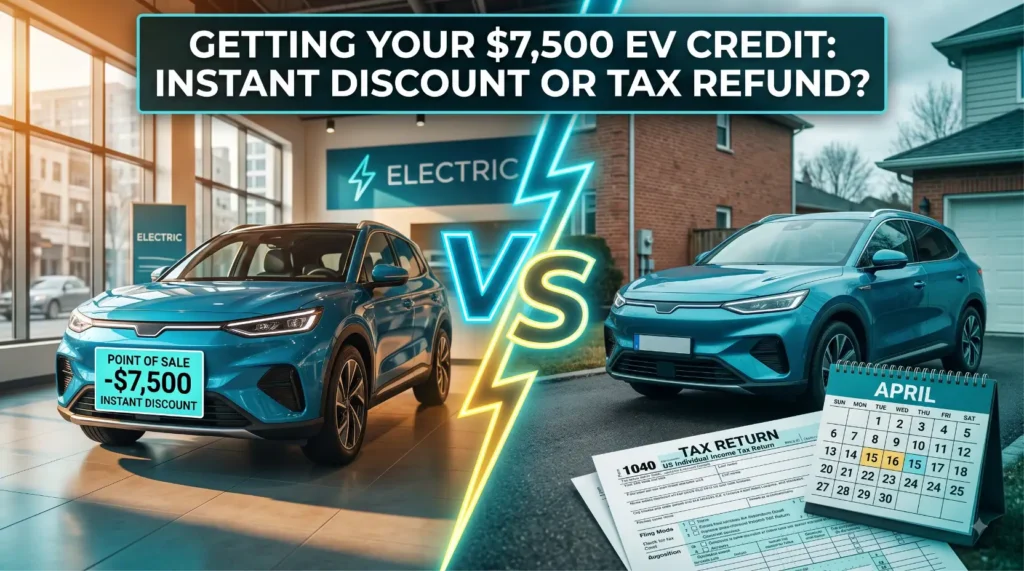
Imagine walking into a dealership, picking out your electric car, and watching $7,500 vanish from the sticker price right there at the desk — no waiting, no spreadsheet, no April refund. 🤯
For years, the federal EV tax credit was a “claim it later” deal. You bought the car, you wrote a check for the full price, and then — months down the road — you hoped your tax return would hand some of that money back. Plenty of buyers never got the full benefit at all.
Then the rules changed. Buyers got a new option: turn the credit into an instant discount at the dealer instead of waiting on the IRS. 💸
That instant-discount option is what people mean when they say the point of sale EV rebate. And while it sounds like a no-brainer, it isn’t automatically the right move for everyone — the timing, the eligibility math, and the repayment risk all differ from the old-school route in ways that can cost you. 🤔
⚠️ Important — please read this first: This article covers a tax topic, and tax rules change. Programs like the federal clean vehicle credit can be modified, paused, or repealed by legislation, and the details below reflect general information, not personalized tax advice. Always confirm the current rules with the IRS (irs.gov) and a qualified tax professional before you make a buying decision. We’ll repeat this caveat throughout — because it genuinely matters here. 🙏
⚡ The Short Answer
Short on time? Here’s the point of sale EV rebate vs claim-on-your-return decision in plain English. 👇
- 🛒 Point of sale = instant discount. You transfer the credit to a registered dealer and they knock it off the price (or hand you cash) the day you buy. Great for cash flow.
- 🧾 Claim on return = the traditional route. You pay full price, then claim the credit when you file your taxes — and wait for the benefit.
- 💪 The biggest perk of point of sale: you can usually get the full value even if you owe little or no tax, because it’s advanced to you upfront.
- ⚠️ The biggest catch: you attest to your eligibility at the dealer. If you turn out to be over the income cap, you may have to repay the amount at tax time.
- 🏪 You need a registered dealer. Not every dealership is set up to process the transfer.
Bottom line: if you’re clearly eligible and want the money now, the point of sale rebate usually wins. If your income is borderline or the dealer isn’t registered, claiming on your return is the safer play. Always verify with the IRS first. 😎
📊 Point-of-Sale Rebate vs Claim-on-Return — At a Glance
Here’s the head-to-head comparison so you can see the trade-offs fast. 👇
| Factor | 🛒 Point-of-Sale Rebate (transfer to dealer) | 🧾 Claim on Your Tax Return |
|---|---|---|
| When you get the money | Instantly, at purchase | When you file (months later) |
| How it arrives | Price discount or cash down | Reduces your tax bill / boosts refund |
| Needs tax liability? | No — it’s advanced to you | Historically yes (depends on rules) |
| Cash flow impact | Lower price now, smaller loan | Pay full price now, wait |
| Eligibility checked | You attest at the dealer | Verified when you file |
| Repayment risk | Yes, if you exceed income caps | No surprise clawback |
| Dealer must be registered? | Yes | No (you just need the report) |
| Convenience | High | Moderate |
| Best for | Clearly eligible, cash-flow focused | Borderline income, cautious buyers |
Point of sale wins on speed and accessibility. The return route is the cautious default when there’s any doubt about your numbers. 🎯
💡 Not sure whether you even qualify? Start here: EV Tax Credit 2026: Who Qualifies and How Much?
🛒 What the Point-of-Sale EV Rebate Actually Is
Let’s clear up the language first, because “rebate,” “credit,” and “discount” get thrown around like they’re the same thing. They’re not — and the difference is the whole point. 🤓
The federal clean vehicle credit is a tax credit. Traditionally, a tax credit only does something when you file your return — it lowers what you owe. So even if you bought a qualifying EV in March, you didn’t see a dime of that benefit until you filed the following year.
The point of sale EV rebate flips that. 🔄
Under the credit-transfer mechanism, you’re allowed to transfer your eligible clean vehicle credit to a registered dealer at the time of purchase. In exchange, the dealer gives you the value of the credit upfront — either as a straight reduction in the price or as cash toward your down payment.
So technically it’s still the same tax credit. But because you receive it instantly as a discount, everyone calls it a “point-of-sale rebate” or “instant rebate.” Same money, totally different timing. 💸
The headline number people care about is the same one tied to the credit itself — up to $7,500 for many new qualifying EVs, and a smaller amount for qualifying used EVs. The transfer option just changes when and how you get it.
⚠️ Verify-with-IRS reminder: Credit amounts, vehicle eligibility, and the transfer mechanism itself are all governed by rules that can change. Confirm the current figures and process at irs.gov before you count on any specific dollar amount.
🏪 How the Point-of-Sale Rebate Works at the Dealership
Okay, so what does this actually look like when you’re standing at the dealer’s desk? Here’s the play-by-play. 🎬
Step 1 — You pick a qualifying vehicle. ✅
Not every EV qualifies, and the rules around assembly location, battery sourcing, and price caps shift over time. The vehicle has to be on the eligible list for the credit you’re claiming.
Step 2 — You choose to transfer the credit. 🔁
You tell the dealer you want to apply the point of sale EV rebate rather than claim it later. This is your decision to make at the time of sale.
Step 3 — You attest to your eligibility. ✍️
This is the big one. You confirm — in writing — that you expect to meet the requirements, including the income cap. More on that risk below, because it’s where buyers get burned.
Step 4 — The dealer registers the sale. 🖥️
The dealer submits the sale through the IRS portal (often called IRS Energy Credits Online) and provides you a time-of-sale report. Keep this document. Seriously — keep it somewhere you won’t lose it. 🗂️
Step 5 — You get the discount. 💰
The credit value comes off the price or goes toward your down payment, lowering both your out-the-door cost and, often, the size of your loan.
The whole thing is meant to feel seamless — like any other discount applied at checkout. But behind the scenes, you’ve made a tax decision, not just a shopping decision. That distinction matters when April rolls around. 🧾
💡 Want the full paperwork walkthrough for both routes? Read: How to Claim the Federal EV Tax Credit Step by Step
💪 The Big Advantage: Instant Cash, No Tax Liability Needed
Here’s where the point of sale EV rebate genuinely shines, and why it changed the game for so many buyers. 🌟
Advantage #1 — You get the money now. ⚡
Instead of waiting months for a tax refund, you see the benefit the day you drive off the lot. For a big-ticket purchase, having thousands knocked off upfront is a real, tangible thing — not an IOU.
Advantage #2 — A smaller loan. 📉
Because the discount lowers your purchase price upfront, you finance less. That can mean a smaller monthly payment and less interest paid over the life of the loan. On a five- or six-year auto loan, that interest savings adds up. 💸
Advantage #3 — You don’t need a big tax bill. 🙌
This is the quiet superpower of the transfer option. Traditionally, a nonrefundable credit only helps if you actually owe taxes — if your tax liability was small, you couldn’t capture the full credit. With the point-of-sale transfer, the credit is advanced to you regardless of your tax liability (subject to current rules). That opened the benefit to a much wider group of buyers, including folks who never had enough liability to use the old credit fully.
Advantage #4 — Simplicity at the moment that counts. 😌
For a confident, clearly-eligible buyer, it’s just easier. The discount happens at the desk, and you walk away with a better deal and one less thing to chase down next spring.
For most buyers who comfortably meet the requirements, this combination — instant savings, smaller loan, no liability hurdle — makes point of sale the obvious pick. 😎
⚠️ “Subject to current rules” is doing real work in that section. The interaction between the transfer option and your tax liability is exactly the kind of detail legislation can tweak. Confirm it with the IRS and your tax pro.
⚠️ The Catch: Eligibility Attestation and the Repayment Trap
Now the part nobody wants to talk about but everybody needs to understand. The instant rebate isn’t free of strings — it’s built on a promise you make. 🤝
When you take the point of sale EV rebate, you attest that you expect to qualify. The headline qualifier is the income cap, measured by your modified adjusted gross income (MAGI).
Here’s the trap. 🪀
The income limits for the clean vehicle credit are typically checked against your MAGI for either the year you take delivery or the prior year — whichever is lower (under the rules as they’ve existed). The dealer advances you the credit based on your good-faith belief that you’ll be under the cap.
But what if you guess wrong? 😬
Say you take the $7,500 rebate at the dealer in good faith. Then you have a great income year — a bonus, a side hustle that pops, a partner’s raise, capital gains — and your MAGI ends up over the cap. In that case, you may have to repay the credit when you file your tax return. The instant discount you enjoyed at the dealer becomes a bill at tax time. 💥
That’s the whole risk in one sentence: the rebate is advanced on your word, and if your word turns out wrong, you pay it back.
So who should be cautious?
– 🟡 Anyone whose income is near the cap in both the current and prior year.
– 🟡 Anyone expecting a big income jump this year (new job, equity vesting, large gains).
– 🟡 Anyone unsure how MAGI is even calculated for their situation.
If that’s you, this is exactly when a tax professional earns their fee — running your numbers before you sign anything at the dealer. 🧮
⚠️ Verify-with-IRS reminder (again, on purpose): Income caps, MAGI rules, and the repayment mechanics are all set by tax law and can change. Do not rely on a friend’s experience from a prior year. Check the current thresholds at irs.gov and confirm your specific situation with a tax pro.
🏪 The Dealer Must Be Registered (No Way Around It)
Here’s a practical wall a lot of buyers hit without warning: not every dealership can do this. 🚧
To process the point of sale EV rebate, the dealer must be registered with the IRS to participate in the credit-transfer program (through the IRS Energy Credits Online system). A registered dealer can submit the sale, generate your time-of-sale report, and advance you the credit.
An unregistered dealer? They simply can’t offer the instant discount. 🙅
This means a couple of things for you as a shopper:
Ask early. 📞
Before you fall in love with a specific car at a specific dealer, ask the simple question: “Are you registered to process the federal clean vehicle credit transfer at point of sale?” If the answer is no — or a confused stare — you’ll be claiming on your return instead.
Registration doesn’t equal eligibility. ⚠️
Even at a registered dealer, you still have to qualify (income cap), and the vehicle still has to qualify. The dealer being registered just unlocks the option — it doesn’t guarantee the outcome.
Get the time-of-sale report no matter what. 🗂️
Whether you take the rebate or plan to claim on your return, you want that report. It’s your proof the sale was reported to the IRS and documents the credit tied to your vehicle.
If your preferred dealer isn’t registered, you’ve got a choice: shop a dealer that is, or simply plan to claim the credit on your return. Neither is wrong — it just changes your route. 🛣️
⚠️ Dealer requirements and the registration system are administrative details that can evolve. Confirm the current process and which dealers participate at irs.gov.
🧾 When Claiming on Your Return Is the Better Move
The instant rebate gets all the hype, but claiming the credit on your tax return is still the smarter call in several real situations. Don’t sleep on it. 🧠
1. Your income is borderline. 🟡
This is the big one. If there’s any real chance your MAGI lands over the cap, claiming on your return means the IRS verifies your eligibility at filing — when your actual income is known. No advance, no attestation gamble, no repayment surprise. You only get the credit if you actually qualify.
2. The dealer isn’t registered. 🏪
If your dealer can’t process the transfer, the return route is your only path to the credit. You’ll use the time-of-sale report and the required IRS form when you file.
3. You prefer certainty over speed. 😌
Some people just sleep better knowing the credit is locked in based on real, filed numbers rather than a projection. If the idea of a clawback stresses you out, claim it on your return.
4. Your tax situation is complicated. 🧮
Multiple income streams, big swings year to year, recent life changes — when your MAGI is genuinely hard to predict, the return route removes the guesswork from the dealership and puts the decision where the real numbers live.
The honest framing: the point of sale EV rebate is about cash flow and convenience. Claiming on your return is about certainty. Most clearly-eligible buyers value the cash flow. Borderline and complicated cases should value the certainty. 🎯
💡 Either way, you’ll want the step-by-step: How to Claim the Federal EV Tax Credit Step by Step
🚧 Common Pitfalls to Avoid
Even savvy buyers trip over the same handful of mistakes. Here’s what to watch for so the point of sale EV rebate doesn’t bite you. 👇
Pitfall #1 — Treating it like a “free discount.” 🆓❌
It’s not a coupon. It’s an advance on a tax credit, attached to an attestation about your income. Treat it with the seriousness of a tax decision, because that’s what it is.
Pitfall #2 — Ignoring the income cap until it’s too late. 📈
Buyers often forget that a strong income year can push them over the line. Check your expected MAGI for the relevant years before you sign — not in April when it’s a done deal.
Pitfall #3 — Losing the time-of-sale report. 🗂️
This document is your paper trail. Lose it and you create headaches at filing — even if you took the rebate at the dealer. Scan it, back it up, file it.
Pitfall #4 — Assuming every EV (or every dealer) qualifies. 🚫
Vehicle eligibility shifts with sourcing and assembly rules. Dealer eligibility depends on registration. Verify both — don’t assume.
Pitfall #5 — Skipping the tax pro on a borderline case. 🧮
If your income is anywhere near the cap, a quick consult is cheap insurance against a four-figure repayment. This is the single most common expensive mistake.
Pitfall #6 — Forgetting that the rules can change mid-year. 📅
Tax programs get amended. What’s true at the start of the year may not hold by the time you buy. Re-confirm before you commit. ⚠️
Avoid these six and you’ve sidestepped the vast majority of point-of-sale rebate horror stories. 😎
📈 How 2026 Changes Could Affect the Point-of-Sale Rebate
This is the section to read slowly, because 2026 is a moving target. 🎯
The federal EV incentive landscape has been unusually volatile. The credit-transfer mechanism that makes the point of sale EV rebate possible exists because of specific legislation — and legislation can be amended, sunset, or repealed. There’s been ongoing political debate about the future of federal EV credits, and the program’s status can shift with new laws or administrative guidance. 🏛️
What could realistically change?
– 📉 The credit amount or its very existence — the dollar figure isn’t carved in stone.
– 🚗 Which vehicles qualify — sourcing, assembly, and price-cap rules get updated.
– 💵 Income caps and MAGI rules — thresholds can move.
– 🔁 The transfer mechanism itself — the ability to take the rebate at point of sale depends on the program continuing as structured.
– 🏪 Dealer registration and reporting — administrative processes evolve.
Here’s the practical takeaway: never assume last year’s rules still apply. A deal your neighbor got in a prior year might not be available — or might come with different strings — by the time you’re at the desk in 2026. 🤷
Before you buy, do three things: check the current rules at irs.gov, ask the dealer to confirm the live process, and — if there’s any money at stake worth worrying about — talk to a tax professional. ⚡
⚠️ We mean it: this program changes and could be repealed or restructured. Treat everything in this article as general background, and verify the current status with the IRS and a tax pro before acting.
✅ 5 Steps to Use the Point-of-Sale Rebate Safely
Want the instant discount without the regret? Follow these five steps. 👇
-
Confirm the program is live and the rules are current. 🌐
Check irs.gov for the current credit, vehicle list, and transfer process before you shop. Rules change — verify the present-day version. -
Run your income numbers honestly. 🧮
Estimate your MAGI for the relevant years. If you’re anywhere near the cap, loop in a tax professional before committing. This is the step that prevents repayment surprises. -
Verify the dealer is registered. 🏪
Ask directly whether they can process the credit transfer at point of sale. No registration, no instant rebate. -
Confirm the vehicle qualifies. 🚗
Don’t assume. Match the specific model to the current eligibility list for the credit you’re claiming. -
Get and keep the time-of-sale report. 🗂️
Collect your documentation at purchase and store it safely. You’ll want it at filing — rebate or not. ⚡
Do these five and you capture the upside of the point of sale EV rebate while dodging the traps. 😎
🛒 Shop This Post
A few tools that make either route smoother. 😍
1. Tax Software With EV Credit Support 🧾
Whether you take the instant rebate or claim on your return, good tax software walks you through the right forms and flags repayment situations.
👉 Shop tax software
2. A Home EV Charger 🔌
You just got a great deal on the car — now charge it cheaply overnight at home. A Level 2 charger pays for itself fast versus public charging.
👉 Shop home EV chargers
3. An EV Savings & Planning Tool 📊
Compare upfront-rebate savings vs filing-time savings, and model your true cost of ownership before you buy.
👉 Shop EV planning tools
🛍️ Affiliate disclosure: These are affiliate picks. If you buy through our links, we may earn a small commission at no extra cost to you — and it helps support EVs Mirror. 🙏
🎯 Quick Quiz: Point of Sale or Claim on Return?
Answer these three and see which route fits. 🧐
- Is your income comfortably under the cap in both relevant years? 🅐 Yes 🅑 It’s borderline
- Do you want the savings now (and a smaller loan)? 🅐 Yes 🅑 I don’t mind waiting
- Is your dealer registered to process the transfer? 🅐 Yes 🅑 No / not sure
Mostly 🅐: 🛒 The point of sale rebate is your best bet — take the instant discount.
Mostly 🅑: 🧾 Claim on your return for certainty and zero repayment risk.
(Still unsure? That’s your cue to call a tax professional. 😉)
📋 Decision Checklist
Run through this before you sign anything. ✅
- [ ] Confirmed the credit program is currently live (irs.gov) ⚡
- [ ] Confirmed the specific vehicle qualifies
- [ ] Estimated my MAGI for the relevant years
- [ ] Checked whether I’m comfortably under the income cap
- [ ] Asked the dealer if they’re registered for credit transfer
- [ ] Decided: point of sale rebate vs claim on return
- [ ] Collected and saved the time-of-sale report 🗂️
- [ ] Consulted a tax professional (especially if borderline) 🧮
🤔 People Also Ask
Q: Is the point of sale EV rebate better than claiming the tax credit on my return?
A: For buyers who are clearly under the income cap and want lower upfront cost, the point of sale EV rebate is usually better — you get the discount instantly and finance less. If your income is borderline or your dealer isn’t registered, claiming on your return is safer because eligibility is verified at filing. Always confirm the current rules with the IRS. ⚡
Q: How does the point of sale EV rebate actually work?
A: You transfer your eligible clean vehicle credit to an IRS-registered dealer at the time of purchase. The dealer advances you the credit’s value as a price discount or cash toward your down payment, gives you a time-of-sale report, and reports the sale to the IRS — so you don’t wait until tax season to benefit.
Q: Do I have to repay the rebate if I take it at the dealer?
A: Possibly. You attest to your eligibility (mainly the income cap) when you take the instant rebate. If your modified adjusted gross income ends up over the cap, you may have to repay the credit when you file. Only take it upfront if you’re confident you’ll qualify, and check current rules with the IRS. ⚠️
Q: Can I get the EV credit at point of sale even if I owe little or no tax?
A: Generally yes — that’s a key advantage. Because the credit is advanced to you at purchase, you may receive the full value even with low tax liability, unlike the traditional return route. Confirm the current rules, since this interaction can change.
Q: What if my dealer isn’t registered for the transfer?
A: Then you can’t take the instant rebate there. You’d either shop a registered dealer or claim the credit on your tax return using the dealer’s time-of-sale report and the required IRS form. Get that report either way.
Q: Could the point of sale EV rebate go away in 2026?
A: It’s possible — the program depends on legislation that can be amended or repealed, and federal EV incentives have been politically contested. Don’t assume the rules are static; verify the current status at irs.gov and with a tax professional before you buy. 🏛️
🚀 The Bottom Line
The choice between the point of sale EV rebate and claiming the credit on your return really comes down to two things: confidence and cash flow. 🎯
If you’re clearly under the income cap, your dealer is registered, and you’d rather have the savings now (with a smaller loan), the instant rebate is the better deal — and you don’t even need a big tax bill to benefit. 💸
If your income is borderline, your situation is complicated, or you simply prefer certainty over speed, claiming on your return protects you from a repayment surprise. There’s no shame in the cautious route — for the right buyer, it’s the smart one. 😌
Whatever you choose: confirm the vehicle qualifies, verify the dealer’s registration, run your income numbers, keep your time-of-sale report, and — because this is a tax topic that genuinely changes — double-check the current rules with the IRS and a tax professional before you sign. ⚡
💬 Did you take the instant rebate or wait for your refund? Tell us how it went in the comments!
📤 Know someone car-shopping at the dealership this week? Send them this before they sign. 🙏
🔖 Bookmark EVs Mirror for honest, no-spin EV money guides.
👉 Up next: EV Tax Credit 2026: Who Qualifies and How Much? and How to Claim the Federal EV Tax Credit Step by Step
This article is general information, not tax advice. EV credit programs can change or be repealed — always verify the current rules with the IRS (irs.gov) and a qualified tax professional before making a purchase decision.