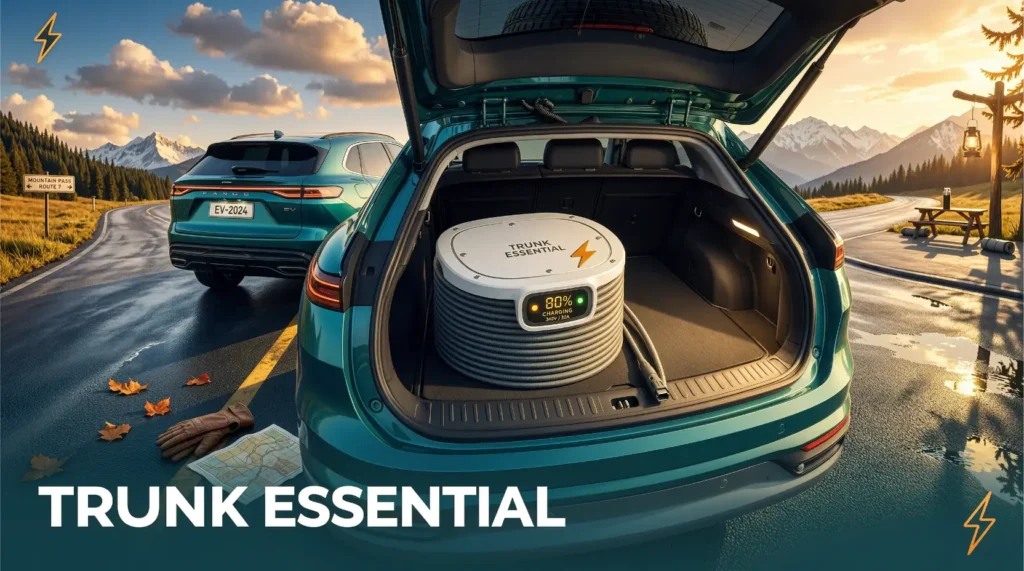
Here’s a little secret every seasoned EV owner figures out eventually: the most valuable thing in your trunk isn’t the spare tire. It’s a good portable charger. 🎒⚡
Think about it for a second. Public chargers break. They get occupied by the one guy who left his car plugged in three hours ago. Sometimes the nearest working one is a 20-minute detour you didn’t budget for. But a regular wall socket? Those things are everywhere. Hotels, your cousin’s garage, the back of a rural diner, an apartment parking spot — outlets are the most abundant infrastructure on the planet.
A portable charger quietly turns all of that into your personal backup fuel station. You don’t think about it most days. Then one day it saves your trip, and you never drive without one again.
So let’s actually find the right one. Whether you’re driving a long-range EV across two US states or zipping around an Indian city on a compact electric, this guide will help you choose the best portable EV charger to stash in your trunk for 2026. 👇
⚡ Why You Need a Portable Charger (Even With a Home Wallbox)
“I already have a home charger, so why bother?” Fair question. But a fixed wallbox only helps when you’re parked in your own driveway. The best portable EV charger earns its keep the moment you leave it:
- 🏨 Hotels and Airbnbs — most still only offer a standard outlet, not a dedicated EV point.
- 🔌 Broken or occupied public chargers — you roll up, it’s down, and you have a Plan B in the trunk.
- 🏠 Visiting family or staying in a rental — plug into any socket and wake up with range.
- 🆘 Range misjudgments — you cut it too close, and now any outlet becomes a lifeline.
- 🛠️ Wallbox downtime — if your home unit acts up, you’re not stranded waiting on a technician.
- 🏢 Apartment living — if your building has no fixed charger, a portable plus a willing outlet is your whole setup.
It’s cheap peace of mind that lives in your trunk and asks for nothing in return. 😎
📊 Best Portable EV Chargers 2026 — At a Glance
Here are the five archetypes worth knowing. Match each to current listings via the links further down — these are types, not invented brands.
| Rank | Archetype | Best For | Power | Plugs | Vibe |
|---|---|---|---|---|---|
| 🥇 | Adjustable Level 1/2 Portable | Most drivers, US + India | Up to ~7.2 kW | Swappable NEMA / 3-pin / 16A | The do-it-all all-rounder |
| 🥈 | Compact 16A Travel Charger | Light & travel use | ~3.7 kW | Standard socket / 16A | The featherweight |
| 🥉 | Rugged Weatherproof Charger | Road trips & outdoors | ~7.2 kW | Multiple, IP65+ | The tough one |
| 🏅 | Budget 3.3 kW Charger (India) | Scooters & small EVs | 3.3 kW | 3-pin / 16A | The value pick |
| 🏅 | Smart Portable w/ App | Tech lovers & data nerds | Up to ~7.2 kW | Multiple + Wi-Fi | The clever one |
Five different jobs, five different price points. The trick is matching the archetype to how you actually drive — which is exactly what the rest of this guide walks you through. 🎯
🔍 How to Pick the Best Portable EV Charger
Before you click “buy,” run through these. Getting the right charger for you comes down to roughly five decisions, and none of them are complicated once you see them laid out.
1. Adjustable amperage. 🔧 This is the single most useful feature. A charger that lets you dial the current down (say to 6A or 10A) on an old, sketchy circuit — and crank it back up on a strong one — is safer and more versatile. It’s the difference between “charges anywhere” and “trips the breaker at grandma’s house.”
2. Interchangeable plugs and adapters. 🔌 In the US, that means NEMA options (5-15 for a normal outlet, 14-50 for a dryer-style high-power socket). In India, it means a 3-pin domestic plug and a 16A industrial plug. One body, several tips, maximum coverage.
3. Safety certifications. 🛡️ Non-negotiable. Look for over-current, over-voltage, over-temperature, and ground-fault (leakage) protection. We’ll go deeper on this below, but skipping it is how cheap cables turn into melted plugs.
4. Cable length. A 5–7.5 m cable covers most awkward parking spots. Too short and you’ll be playing inch-by-inch Tetris with your parking position every single time.
5. Build quality and weather rating. If you’ll ever charge outdoors — and on a road trip you will — an IP65 or better rating keeps rain and dust out of the connections.
Nail those five and you’ve got a charger that works almost anywhere you can find a plug. Everything else is a bonus.
🔋 Level 1 vs Level 2 Portables — What’s the Real Difference?
This is where most first-time buyers get confused, so let’s make it dead simple. Portable chargers come in two flavors, and the best portable EV charger for you depends on which speed you actually need.
Level 1 portables (≈1.4–2.4 kW in the US, ~3.3 kW in India on 230V): These plug into a normal household socket — the same one your phone charger uses. They’re light, cheap, and foolproof. The trade-off is speed: in the US you’re adding maybe 3–5 miles of range per hour. India’s 230V supply is kinder here, pushing a basic portable to genuinely useful overnight speeds.
Level 2 portables (up to ~7.2 kW): These need a higher-power outlet — a NEMA 14-50 in the US or a 16A point in India — but they charge dramatically faster. We’re talking 25–30 miles (40–50 km) per hour. That’s a full top-up overnight, easily.
The honest answer for most people? Get an adjustable unit that does both. Dial it down to Level 1 speeds for a normal socket, snap on a higher-power adapter when one’s available, and you’ve covered every scenario with one device.
💡 Want the full breakdown on charging speeds and which level fits your life? Read Level 1 vs Level 2 Charging: Which Do You Actually Need? — it pairs perfectly with this guide.
⚙️ Why Adjustable Amperage Matters More Than You Think
Let me make the case for adjustable amperage with a real-world scene. 🎬
You pull into a charming old farmhouse rental. The wiring is older than you are. You plug in a fixed-16A charger, it draws full current, and ten minutes later the breaker trips — or worse, the outlet starts to warm up uncomfortably. Not great.
Now replay that with an adjustable charger. You dial it down to 8A, the old circuit handles it comfortably, and you charge slowly but safely all night. In the morning you’ve got range and the house still has working lights. 😅
That’s the magic. Adjustable amperage lets one charger adapt to wildly different electrical realities — a robust modern garage, a tired apartment socket, a campsite hookup. It’s also gentler on unknown wiring, which is exactly the kind of wiring you’ll meet when traveling.
This is why nearly every portable-charger shortlist puts adjustable units at the top. The flexibility isn’t a luxury feature — it’s the whole point of going portable in the first place.
🔌 Interchangeable Plugs — NEMA (US) and 3-Pin / 16A (India)
A portable charger is only as useful as the outlets it can reach. This is where interchangeable plugs turn a good charger into a great one.
In the US 🇺🇸: The two adapters that matter most are the NEMA 5-15 (your standard wall outlet, Level 1 speeds) and the NEMA 14-50 (a 240V outlet like the one behind your dryer or in many garages, Level 2 speeds). A few units add 6-20, 10-30, and TT-30 (RV) adapters for campgrounds and older homes. The more tips in the box, the fewer outlets you’ll walk past helplessly.
In India 🇮🇳: Here it’s about the 3-pin domestic plug (the everyday wall socket) and the 16A industrial plug (the heavier-duty point you’ll find in newer parking setups and many homes). A portable that ships with both — or accepts both via adapters — covers the vast majority of real charging situations across cities and highways alike.
The takeaway is the same in both markets: buy the most versatile charger you can that bundles the adapter set, or buy the adapters alongside it. A bare charger with one fixed plug is a charger that’ll leave you stuck the day the only outlet around doesn’t match it.
🛡️ Safety Certifications — Don’t Skip This Part
Here’s the unglamorous section that actually protects your car and your life, so stick with me. ⚠️
A portable charger is pushing serious current through a plug for hours at a time, often into wiring you didn’t install and can’t inspect. That’s exactly the situation where cheap, uncertified gear fails — melted plugs, tripped breakers, fire risk. Not worth saving twenty bucks.
What to look for:
- Over-current protection — cuts off if the draw spikes dangerously.
- Over-voltage and under-voltage protection — guards against unstable supply (very relevant in some Indian grids).
- Over-temperature protection — many quality units have a temperature sensor in the plug head that throttles or stops charging if it gets too hot. This is gold.
- Ground-fault / leakage protection (RCD) — trips instantly if it detects current leaking to ground. This is the one that protects you.
On the certification label, US buyers should look for UL or ETL listing; India buyers should look for BIS compliance and, ideally, IEC-based testing. A reputable, certified unit with these protections is genuinely safe when plugged directly into a sound outlet. A no-name eBay special with vague claims is not. Choose accordingly. 🛡️
🌧️ Weatherproofing — Because Road Trips Happen in the Rain
You will, at some point, charge outdoors. A driveway, a parking lot, a campsite, a hotel side-entrance with one lonely outdoor outlet. And weather doesn’t check your schedule.
That’s what IP ratings are for. The number you want is IP65 or higher — the “6” means fully dust-tight, the “5” (or “7”) means protected against water jets or immersion. A charger rated this way shrugs off rain, splashes, and grime without you sweating over a short circuit.
A few practical habits help too: keep the outlet connection itself sheltered and dry (the charger may be weatherproof, but a soaked wall socket is its own problem), avoid leaving connectors lying in puddles, and give everything a quick wipe before you coil it back up.
For anyone who road-trips, camps, or just lives somewhere with real weather, a rugged weatherproof unit is the category to shortlist. The peace of mind is worth the small premium. ☔
🧭 Real Use Cases — Where a Portable Actually Shines
Theory is nice, but here’s where these chargers earn their place in your trunk, with concrete scenarios. 🚗
Travel & road trips. ✈️ You arrive somewhere new, range is low, and the fancy fast charger is either occupied or imaginary. You plug your portable into the property’s outlet overnight and leave fully topped up. No app, no queue, no stress.
Hotels & rentals. 🏨 The vast majority of accommodations have outlets, not EV points. A portable means you treat every hotel as a charging hotel. Ask the front desk, find the nearest outdoor socket, and you’re set.
Apartments & no-home-charging life. 🏢 Millions of EV owners can’t install a wallbox because they rent or share a building. A portable plus a reachable outlet (and permission) can genuinely be a complete charging solution for low-to-moderate daily mileage.
Emergencies. 🆘 The classic “I cut it too close” moment. With a portable in the trunk, any wall socket — a gas station, a shop, a friend’s house — becomes enough juice to limp you to the next proper charger. It’s roadside insurance you control.
Visiting family. 👨👩👧 No more apologizing for needing to “go find a charger.” Plug in at their place, contribute a few rupees or dollars to the electricity bill, and you’re the easy houseguest.
In every one of these, the portable isn’t the fastest option. It’s the available one. And available beats fast when fast isn’t there.
🤔 Can a Portable Be Your Only Charger?
Short answer: for a lot of people, yes — and that surprises buyers who assume they “need” a wallbox.
Where a portable-only setup works well:
- 🛵 Scooters and small EVs in India, where battery sizes are modest and a 3.3 kW portable refills overnight easily.
- 🔋 PHEVs and short-range EVs with small batteries.
- 🚶 Low-mileage drivers (under ~30 miles / 50 km a day) who can replenish slowly overnight.
- 🏢 Apartment dwellers with outlet access but no wallbox option.
Where you’ll want a fixed home charger too:
- 🫣 High-mileage drivers who routinely deplete a big battery and need fast overnight refills.
- 🅿️ Anyone whose only outlet is too far, too weak, or shared.
- ⚡ Drivers who simply value the speed and “set it and forget it” convenience of a wallbox.
The honest framing: an adjustable portable can absolutely be your primary charger if your daily distance is low and your outlet situation is decent. For everyone else, it’s the best backup money can buy — and even wallbox owners should keep one in the trunk. Either way, a good portable rarely goes to waste.
💡 Curious exactly how much range a normal socket can deliver — and where the limits are? Read Can You Charge an EV From a Normal Wall Socket? before you commit to a portable-only setup.
📈 How 2026 Trends Affect Portable Chargers
The market for the best portable EV charger has matured a lot, and a couple of 2026 shifts are worth knowing before you buy.
In the US 🇺🇸 — the NACS transition. With the connector landscape standardizing around NACS, portable chargers are increasingly shipping NACS-ready or with NACS adapters in the box. If you drive (or are buying) a vehicle moving to NACS, check that your portable either speaks NACS natively or includes the right adapter. Meanwhile, swappable-NEMA adjustable units have become the default travel companion, and prices keep falling as competition heats up. Bundled adapter kits that used to cost extra are now often included.
In India 🇮🇳 — 230V works in your favor. India’s single-phase 230V supply means even a basic portable charges respectably faster than a US Level 1 unit on 120V. Combine that with the explosion of electric scooters and compact EVs, and affordable 3.3 kW portables have become a near-default purchase. 16A travel units serve car owners well, and BIS-certified options are far easier to find now than a couple of years ago. The result: a genuinely capable portable is more affordable here than it’s ever been.
Both markets are trending the same direction — more adapters, better certifications, lower prices. Good news for your trunk. 🎉
✅ 5 Safety Tips for Using a Portable Charger
- Match the adapter to the outlet — never force a plug. ⚡ If it doesn’t seat cleanly, it’s the wrong tip. Forcing it is how connections arc and overheat.
- Dial down amperage on old or unknown wiring. 🔧 When in doubt, start low. You can always step up once you’ve confirmed the circuit is happy.
- Plug directly into the wall — never an extension cord or power strip. 🚫 Extension cords are the number-one cause of portable-charger overheating. Direct connection only.
- Check the plug temperature during charging. 🔥 Warm is fine. Hot to the touch is a stop sign — unplug, let it cool, and reduce amperage or find a better outlet.
- Store it dry and padded, and inspect the cable periodically. 🧳 A cracked cable or corroded pin is a hazard. Give it a glance now and then so it’s always trip-ready.
🛒 Shop This Post
Trunk-ready picks, sorted by need. 😍
1. Best Overall — Adjustable Level 1/2 Portable ⚡
Swappable plugs plus adjustable amps means you can charge almost anywhere, on almost any outlet. This is the archetype most drivers should buy first.
👉 Shop adjustable Level 1/2 portable chargers
2. Best Value — Compact 16A / 3.3 kW Travel Charger 💸
Light, affordable, and perfect as a backup for scooters and small EVs — especially for India buyers who want capable charging without overspending.
👉 Shop compact travel chargers
3. Must-Have Add-On — Carry Bag + Adapter Set 🧳
Keeps your charger, NEMA/16A adapters, and cable organized and protected in the trunk. The accessory that makes everything else easier to live with.
👉 Shop charger bags & adapter sets
🛓 Affiliate disclosure: These are affiliate picks. If you buy through our links, we may earn a small commission at no extra cost to you — and it helps keep EVs Mirror running. 🙏
🎯 Quick Quiz: Which Portable Suits You?
Answer three quick questions:
- What do you drive? 🅐 Scooter / small EV / PHEV — 🅑 Long-range EV
- How often do you travel or road-trip? 🅐 Rarely — 🅑 Often
- Will you charge outdoors? 🅐 No — 🅑 Yes
Mostly 🅐: A compact 16A or 3.3 kW portable is plenty. Light, cheap, and exactly enough.
Mostly 🅑: Go for an adjustable Level 1/2 unit with a weatherproof build and a full adapter set. You’ll want the flexibility and the speed.
A mix? Default to the adjustable all-rounder — it covers both worlds and you won’t outgrow it. 😎
📋 Portable Charger Checklist
Before you buy, tick these off:
- [ ] Confirm your EV’s connector type and max AC charge rate
- [ ] Choose adjustable amperage if at all possible
- [ ] Get the right plug adapters (NEMA 5-15 / 14-50 in the US; 3-pin / 16A in India)
- [ ] Verify safety certifications (UL/ETL in US, BIS in India) and RCD protection
- [ ] Pick an adequate cable length (5–7.5 m)
- [ ] Add an IP65+ weather rating if you’ll use it outdoors
- [ ] Confirm NACS readiness (US) if your vehicle is moving to that connector
- [ ] Grab a carry bag so it stores neatly in the trunk
- [ ] Store it dry, padded, and always ready ⚡
🤔 People Also Ask
Q: What is the best portable EV charger to keep in the car?
A: The best portable EV charger for most people is an adjustable Level 1/2 unit with swappable plug adapters and solid safety certifications. It lets you charge from a normal socket or a higher-power outlet, which makes it the most versatile backup you can stash in a trunk.
Q: Can a portable charger be my only charger?
A: For light-mileage drivers, scooters, and PHEVs, often yes — a portable plus a decent outlet can be a complete setup. For high-mileage drivers or anyone with weak or distant outlets, it’s better treated as a backup to a fixed home wallbox.
Q: Are portable EV chargers safe?
A: Reputable, certified units with over-current, over-temperature, and ground-fault (RCD) protection are safe when plugged directly into a sound outlet. Avoid no-name cables and never run them through an extension cord or power strip.
Q: How fast does a portable EV charger actually charge?
A: A Level 1 portable adds roughly 3–5 miles (or ~10–15 km on India’s 230V supply) of range per hour. A Level 2 portable on a high-power outlet can add about 25–30 miles (40–50 km) per hour — enough for a full overnight top-up.
Q: Do portable chargers work in the rain?
A: Yes, if you use an IP65-rated or higher unit designed for outdoor use. Keep the wall-outlet connection itself sheltered and dry, avoid puddles, and wipe everything down before coiling it up.
Q: What plug adapters do I need for the US and India?
A: In the US, prioritize NEMA 5-15 (standard outlet) and NEMA 14-50 (high-power outlet), adding RV and 6-20 tips if you travel. In India, you’ll want a 3-pin domestic plug and a 16A industrial plug to cover homes, highways, and newer parking setups.
🚀 The Bottom Line
The best portable EV charger is the cheapest insurance policy an EV owner can buy. It turns every wall socket into a backup fuel station, rescues you from broken public chargers, and travels everywhere you do without complaint. ⚡
Get an adjustable, certified unit with the right adapters for your market, add a weatherproof rating if you road-trip, and toss it in the trunk. You’ll forget it’s there for months — right up until the day it quietly saves your trip. That’s the whole pitch, and it’s a good one.
💬 Ever been rescued by a portable charger? Tell us your story in the comments — we love a good “almost stranded” tale.
📤 Know an EV owner road-tripping soon? Share this before they go. 🙏
🔖 Bookmark EVs Mirror for honest, trunk-ready EV gear guides for the US and India.