Here’s a sentence that gives new-car buyers nightmares and makes smart used buyers grin: most electric cars lose a brutal chunk of their value in the first couple of years. 😬
New owners watch it happen in real time. They drive a shiny EV off the lot, and within 36 months a third (sometimes more) of the price has quietly evaporated. Painful if you bought new. ⚡
But flip the camera around. That “loss” doesn’t vanish into thin air — it transfers. Straight into the pocket of whoever buys the car next. The first owner ate the depreciation; the second owner eats the savings.
That’s the whole secret, and it’s exactly why being an EV depreciation used buyer in 2026 might be one of the savviest money moves on four wheels. Let’s break down how to turn someone else’s loss into your win. 👇
⚡ The Short Answer
No fluff. Here’s why depreciation works for you when you buy used:
- 📉 EVs depreciate faster than petrol cars — tech moves quickly, and new-car incentives drag prices down.
- 🎁 That depreciation is a gift to the second owner — you get a near-new car for a deeply discounted price.
- 🎯 The sweet spot is roughly 2–4 years old — the steepest drop is done, but the car still feels modern.
- 🔋 A falling price doesn’t mean a failing battery — depreciation and battery health are two different stories.
- 💰 Some models tank harder than others — and those are often your best deals.
- 🤝 Use the depreciation curve as your negotiating weapon — numbers beat charm.
Get those right and you can land a 3-year-old EV for half its original sticker, with most of its life still ahead. 😎
📊 The Depreciation Curve & Your Buyer’s Sweet Spot
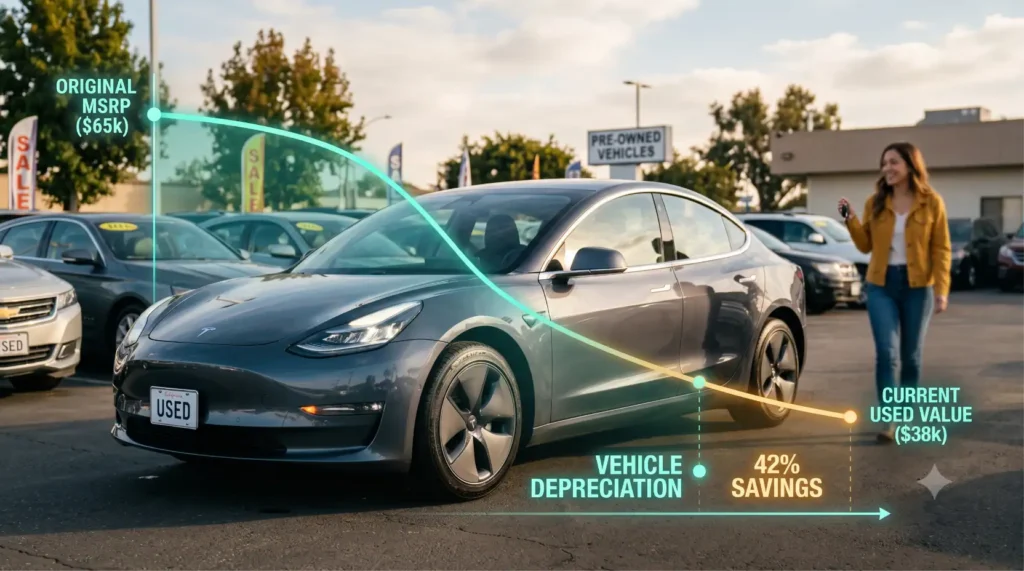
Numbers make this real. Below is an illustrative curve for a typical mainstream EV — figures are rounded and for example only, not a quote on any specific model. 👇
| Age | US Value (≈$45,000 new) | India Value (≈₹20,00,000 new) | What’s Happening |
|---|---|---|---|
| Brand new | $45,000 | ₹20,00,000 | Full price, full incentive baked into rivals |
| 1 year | $33,000 (~-27%) | ₹15,00,000 (~-25%) | The first cliff — steepest single-year drop |
| 3 years | $24,000 (~-47%) | ₹11,00,000 (~-45%) | 🎯 Buyer’s sweet spot — near-new, half price |
| 5 years | $19,000 (~-58%) | ₹8,50,000 (~-57%) | Curve flattens; great value if SoH is healthy |
See that 3-year row? That’s the magic zone. ✨ The first owner has already absorbed the worst of the fall, the car still has modern range and software, and you’re paying roughly half of what they did. The line gets flatter after this, so you’re no longer “catching a falling knife.”
That sweet spot is the heart of being a clever EV depreciation used buyer — and the rest of this guide explains exactly how to exploit it. 💡
🏎️ Why EVs Have Depreciated Faster Than Petrol Cars
Let’s be honest about the elephant in the garage: for years, EVs lost value quicker than comparable petrol cars. Understanding why is what lets you profit from it.
Reason one: tech moves at phone-speed. 📱 An EV from 2021 and one from 2026 can feel a generation apart — bigger batteries, faster charging, slicker software. When the new model leaps forward, the older one looks dated overnight, and the market prices that in. Petrol engines, by contrast, barely changed for decades.
Reason two: incentives on new cars. 🏷️ In the US, the federal tax credit and state rebates knock thousands off a new EV. In India, FAME-era subsidies, state perks and road-tax waivers did the same. A buyer comparing a used EV with no incentive against a new one with a big discount needs the used price to fall — a lot — to stay tempting.
Reason three: battery anxiety. 🔋 Plenty of buyers still fear a degraded pack and an eye-watering replacement bill. That fear, fair or not, suppresses used demand and drags prices down further than the cars actually deserve.
Stack those three together and you get a faster fall than a petrol equivalent — roughly 40–50% gone by year three in many cases. Brutal for sellers. A buffet for buyers. 🍽️
🎁 How That Fall Becomes a Gift to the Second Owner
Here’s the reframe that changes everything. Depreciation isn’t money that gets destroyed — it’s value that gets handed over.
Think about it. The first owner paid $45,000 (₹20 lakh) and used the car for three years. You come along and pay $24,000 (₹11 lakh) for that same car — and it still has 80–90% of its battery, the same cabin, the same comfort, often years of warranty left. 🛡️
You didn’t lose $21,000. You saved it. The first owner basically subsidised your motoring. 🤝
And the kicker: the car barely changed. Unlike a petrol car where three years means a worn clutch, tired suspension and a tank’s worth of carbon, an EV’s drivetrain is laughably simple. No oil, no belts, no gearbox grinding away. The most expensive part — the battery — degrades slowly, often just 1–2% a year. 🔋
So as an EV depreciation used buyer, you’re collecting nearly all the value while paying half the price. That’s not a consolation prize. That’s the best seat in the house. 🎟️
🎯 The Sweet Spot: Why 2–4 Years Old Wins
If you only remember one rule, make it this: target the 2-to-4-year-old window. Here’s the logic. ⏳
Younger than 2 years? You’re still riding the steepest part of the curve. You’ll pay a premium that’s only slightly below new, and you’ll watch a big chunk of value keep dropping under you. You catch the falling knife. 🔪
Older than 5 years? The price is lovely, but now battery state of health (SoH) becomes a real question, warranty coverage may be gone, and older tech (slower charging, smaller range) starts to bite. Great value if you check carefully — riskier if you don’t.
The 2–4 year zone is the Goldilocks band. 🐻 The brutal first cliff is behind you, the curve is flattening, the battery is still strong, the software still gets updates, and there’s frequently factory warranty left. You get “almost new” at “well used” money.
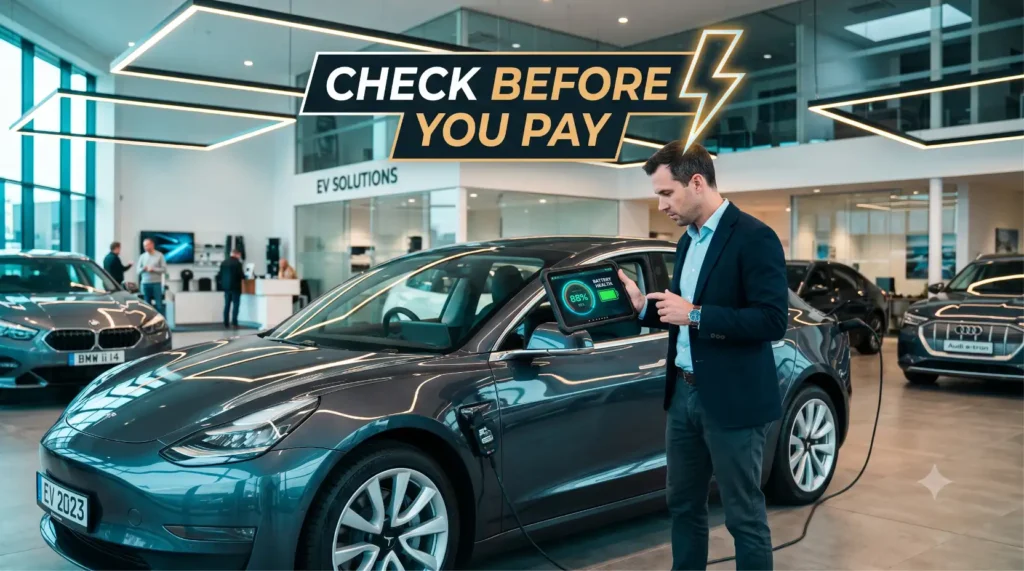
A quick gut check before you commit: pair the age with the battery number. A 3-year-old EV at 90% SoH is a trophy; a 3-year-old EV at 78% SoH that lived on DC fast chargers in extreme heat is a negotiation — or a walk-away. Our used EV buying guide walks through exactly how to test that battery before you pay a single dollar or rupee. 🔍
🔋 The Battery Reality Check: Depreciation ≠ A Bad Battery
This is the single most important mindset shift, so read it twice. A low price does not mean a sick battery. 🧠
The market drops EV prices for market reasons — newer models launched, incentives shifted, the badge fell out of fashion, fear of the unknown. None of those have anything to do with the actual health of the pack sitting under the car you’re looking at.
A well-treated 4-year-old battery that charged mostly at home and rarely sat at 100% in the heat can still be at 88–92% SoH — barely distinguishable from new in everyday driving. Yet its car may have lost half its value on paper. That gap between paper value and real condition is precisely where smart buyers feast. 🍴
So separate the two questions in your head:
– 📉 Why is the price low? (Usually market forces — good for you.)
– 🔋 Is the battery actually healthy? (Test it — SoH, charging behaviour, history.)
When the answer is “price low for market reasons, battery genuinely strong,” you’ve found gold. ✨ Grabbing a cheap OBD2 scanner or asking for a battery health report turns that guesswork into a number. Never confuse a falling price with a falling pack. They’re separate stories that happen to share a car.
📉 Models That Depreciate Hardest (Best Deals) vs Those That Hold Value
Not every EV falls at the same speed — and that’s a treasure map for buyers. 🗺️
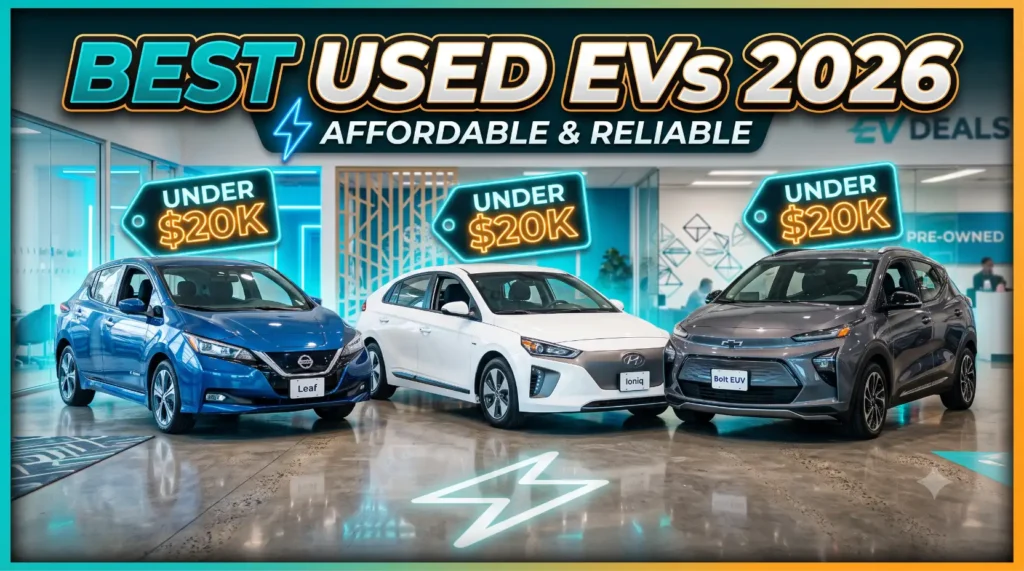
Cars that depreciate HARD = your best bargains. Mainstream EVs from brands without cult followings, models that were superseded quickly, and cars tied to big launch incentives often shed value fast. In the US, plenty of early Nissan Leafs, Chevy Bolts and various Hyundai/Kia EVs hit deep discounts used. In India, early Tata Nexon EV and MG ZS EV examples can be surprisingly affordable second-hand. Fast depreciation = a steeper discount you get to pocket. 💰
Cars that HOLD value = comfort, but a smaller win. Tesla (especially Model 3 and Model Y) historically held value better than most, thanks to brand pull, the Supercharger network and strong demand. They’re a safer resale bet — but you’ll pay closer to new, so the depreciation gift is thinner. 🔒
Here’s the strategic point for an EV depreciation used buyer: if your goal is maximum savings today, hunt the hardest-depreciating models and just verify the battery hard. If your goal is protecting your own future resale, lean toward value-holders. You can’t fully optimise both — pick your priority.
For a deeper head-to-head on whether a value-holder bought new beats a fast-depreciator bought used, see our used EV vs new EV breakdown. 📊
🏷️ How Incentives on New Cars Push Down Used Prices
This one’s sneaky, and it’s pure upside for you. Incentives on new EVs quietly drag used prices down too. 🦄
Picture the math. A new EV lists at $45,000 (₹20 lakh), but a $7,500 US tax credit (or India’s state subsidies and road-tax waivers) effectively makes it a $37,500 car. Now a used buyer eyeing a 2-year-old version has to weigh it against that discounted new price — not the full sticker. To stay attractive, the used car must drop below the post-incentive number. 📉
So every fat incentive on the new side reaches over and shoves the used price lower. It’s a knock-on discount you never had to qualify for. 🎯
It gets better. When governments sweeten new-car incentives — bigger credits, new state rebates — the used market often softens further within months. And when a manufacturer slashes new-car prices (it’s happened more than once), every used example of that model instantly re-rates downward too. Watching new-car incentive and pricing news is basically watching a sale on used EVs. 🛒
The lesson: as a used buyer, you benefit from incentives you can’t even claim, simply because they reset the whole pricing ladder beneath them.
⚠️ The Risk Side: Remember You’ll Sell One Day Too
Time for the honest counterweight, because this isn’t all sunshine. ☁️ The same depreciation that hands you a bargain today will nibble at your car when you sell.
If you buy a 3-year-old EV and keep it five years, you’ll sell a 8-year-old car — older tech, more battery questions, a smaller buyer pool. The curve is flatter down there, so you won’t lose as dramatically as the first owner did. But don’t picture zero loss. 📉
Three ways to protect yourself:
– 🔋 Buy battery health, not just a cheap price. Strong SoH resells far better than a bargain with a tired pack.
– 🏆 Lean toward value-holding models if you plan to sell again soon — the resale floor is higher.
– 🛡️ Mind the warranty runway. A car still under battery warranty when you sell is dramatically easier to move.
There’s also a real-world risk worth naming: if a much better, cheaper EV launches while you own yours, your resale can dip faster than expected. That’s the tech-pace double-edge — it gifted you a discount going in, and it can trim your exit. Buy with that in mind and you won’t be surprised. 😌
🤝 How to Use Depreciation as Your Negotiating Weapon
Here’s where knowledge becomes cash in your pocket. The depreciation curve isn’t just trivia — it’s leverage. 💪
Anchor to the curve, not the seller’s hope. Sellers price on emotion and what they paid. You price on where the car should sit on the depreciation line. Show up knowing that a 3-year-old version of this model typically trades around X, and the seller’s $4,000 (₹3 lakh) “optimism premium” suddenly has nowhere to hide. 📊
Use a valuation tool, out loud. Pull up a used-car valuation estimate on your phone at the viewing. “The book value here is $23,000 — you’re asking $27,000. Help me understand the gap.” Numbers are calm, hard to argue with, and they do the confrontation for you. 📱
Turn the battery number into dollars. If SoH is 82% instead of a healthy 90%, that’s lost range and lost value — and a legitimate reason to push the price down. Quantify it: “8% less battery, so 8% off.” 🔋
Let new-car incentives do the talking. “A new one is effectively $37,500 after the credit — this used one needs to make real sense against that.” Watch the price soften. 🏷️
The seller wants to forget depreciation exists. Your entire job as an EV depreciation used buyer is to keep it politely, factually on the table. The curve is your co-negotiator. 🧊
📈 2026: Is the Depreciation Gap Narrowing?
Fair question — because the EV market in 2026 isn’t the wild-west of a few years back. Some of the brutal early depreciation is softening, and it’s worth knowing which way the wind blows. 🌬️
Three reasons the gap is narrowing:
– 🔋 Battery confidence is rising. Years of real-world data show packs lasting longer than feared. Less fear = less price crash = used EVs holding a bit better.
– 🌍 Used demand is climbing. As more drivers go electric, the pool of buyers hunting affordable used EVs is growing, which props prices up.
– 🏭 New-car price wars are stabilising. Fewer panic price cuts on the new side means fewer sudden used re-ratings.
But the gap hasn’t closed. EVs still generally depreciate faster than petrol cars, tech still moves quickly, and incentive-driven new pricing still drags the used market. The window for a great deal is still wide open in 2026 — it’s just maturing, not disappearing. ✅
The takeaway: don’t wait forever hoping for a steeper crash. The smartest 2–4 year-old buys are available right now, and the case for being an EV depreciation used buyer is as strong as ever. ⏳
✅ 5 Tips to Exploit Depreciation as a Buyer
Let’s make it practical. Here’s how to turn theory into a parked-in-your-driveway bargain. 🚗
- 🎯 Hunt the 2–4 year window. Let the first owner eat the cliff. You arrive after the steepest fall, while the car’s still modern.
- 🔋 Always price against battery health. A low sticker means nothing without SoH. Test it, get a report, and tie the number to the price.
- 📉 Chase the hardest-depreciating models for savings. Non-cult mainstream EVs give you the deepest discount — just verify the pack carefully.
- 🏷️ Watch new-car incentives and price cuts. Every sweetener on new EVs quietly lowers the used floor. Time your hunt after big incentive news.
- 🤝 Negotiate with the curve, not your charm. Bring a valuation estimate, anchor to where the car should sit, and let the data do the haggling.
Do these five and you’re not just buying a used EV — you’re systematically harvesting someone else’s depreciation. 🌾
🛒 Shop This Post
A few tools that make exploiting depreciation easier (and safer). 👇
- 🔍 Used-Car Valuation Tool — Know what a model should cost at its age before you negotiate. Anchoring to a real number is your single strongest haggling move.
- 🔧 OBD2 Scanner — Plug in and read battery state of health yourself. Separates a genuinely healthy pack from a “cheap for a reason” one in minutes.
- 🔌 Home EV Charger (Level 2 / 7.4kW) — Gentle home charging is the kindest thing for a used battery’s long life — and protects your own future resale value.
💬 Disclosure: Some links above are affiliate links. If you buy through them, evsmirror.com may earn a small commission — at no extra cost to you. We only suggest gear we’d genuinely use ourselves. 🙏
🎯 Quick Quiz
Test your depreciation IQ. Answers below. 🧠
-
A used EV’s price has dropped 45%. What does that tell you about its battery?
(a) It’s badly degraded · (b) Almost nothing — price and battery health are separate · (c) It’s fine -
Which age range is usually the buyer’s sweet spot?
(a) Under 1 year · (b) 2–4 years · (c) 8+ years -
Why do new-car incentives help used buyers?
(a) They don’t · (b) They drag the whole used price ladder down · (c) They raise used prices
Answers: 1 → (b) · 2 → (b) · 3 → (b). Three out of three? You’re ready to go deal-hunting. 🏆
📋 The Depreciation-Smart Buyer’s Checklist
Screenshot this and take it to the viewing. 📸
- ☑️ Is the car in the 2–4 year sweet spot? (Steep drop already absorbed.)
- ☑️ Have I checked battery SoH — not just admired the low price?
- ☑️ Did I pull a valuation estimate to anchor my offer?
- ☑️ Is this a hard-depreciating model (bigger discount) or a value-holder (better resale)?
- ☑️ Have I checked current new-car incentives to push the price lower?
- ☑️ Is there warranty left — for both my use and my future resale?
- ☑️ Did I separate “price low for market reasons” from “battery actually weak“?
- ☑️ Have I planned for my own resale down the line?
Tick all eight and you’re buying with your head, not your heart. 💪
🤔 People Also Ask
Why does EV depreciation help a used buyer so much?
Because the value a car loses doesn’t disappear — it transfers to whoever buys next. An EV depreciation used buyer pays roughly half the original price for a car that still has most of its battery, range and comfort intact. The first owner absorbs the steepest fall; the second owner pockets the savings. 🎁
Do EVs really depreciate faster than petrol cars?
Historically, yes — often losing 40–50% of value by year three versus a slower fall for petrol cars. Fast-moving battery tech, hefty incentives on new EVs, and lingering battery anxiety all push used prices down quicker. In 2026 that gap is narrowing, but it hasn’t closed. 📉
What’s the best age to buy a used EV for value?
Roughly 2 to 4 years old. By then the steepest depreciation cliff is over, the curve flattens, the battery is typically still strong (90%+ SoH), and there’s often warranty remaining. You get near-new quality at well-used pricing. 🎯
Does a big price drop mean the battery is bad?
No — this is the key myth to bust. Prices fall for market reasons (newer models, incentives, brand demand), which have nothing to do with the actual pack. A cheap used EV can have an excellent battery. Always test SoH separately from judging the price. 🔋
Which used EVs are the best depreciation bargains?
Mainstream, non-cult models tend to depreciate hardest — early Nissan Leaf, Chevy Bolt, and various Hyundai/Kia EVs in the US, or early Tata Nexon EV and MG ZS EV in India. They shed value fast, which means a deeper discount for you — just verify the battery thoroughly. 💰
How do I use depreciation to negotiate a lower price?
Anchor to the depreciation curve, not the seller’s asking price. Bring a used-car valuation estimate, show where the model should sit at its age, quantify any battery shortfall into a price cut, and point to discounted new-car pricing after incentives. Let the numbers, not your charm, do the haggling. 🤝
🚀 The Bottom Line
EV depreciation looks like a horror story — until you realise you can stand on the receiving end of it. ⚡
That steep first-few-years fall isn’t destroyed value; it’s a transfer of wealth from the first owner straight to you. Target the 2–4 year sweet spot, separate the falling price from the (usually healthy) battery, chase the hardest-depreciating models for the deepest discounts, and negotiate with the curve as your co-pilot. Do that, and you’ll drive away in a near-new EV for a deeply used price. 😎
The first owner paid for the privilege of being first. As a smart EV depreciation used buyer, you get to be the one who actually wins. 🏆
👉 Ready to hunt? Start with our used EV buying guide to test that battery before you pay, then read used EV vs new EV to lock in whether used is truly the smarter buy for you. Happy bargain-hunting. 🚗💨