You’ve decided. An electric car is in your future, and buying used is the smart play — let someone else eat that brutal first-year depreciation while you scoop up the savings. 😎
But then the next question hits, and it’s a surprisingly big one: where do you actually find the thing? An online retailer that delivers to your door? A franchise dealer’s certified lot? That suspiciously cheap private listing? Each channel comes with its own mix of price, peace of mind, and risk — and picking the wrong one can turn a great deal into a headache fast. So let’s settle, once and for all, exactly where to buy used EV confidence and a clear head. 🔋
⚡ The Short Answer
- 🛒 Online used-EV retailers = the easiest experience. Fixed prices, return windows, home delivery. You pay a small convenience premium for the comfort.
- 🏢 Franchise dealer CPO = the safest middle ground. Inspections, warranties, and financing under one roof — but expect the highest sticker.
- 🏷️ Manufacturer certified programs = brand-backed reassurance, factory warranty extensions, and EV-trained techs. Limited selection.
- 🤝 Private party / peer-to-peer = the cheapest path, hands down — and the riskiest. No warranty, no safety net, all on you.
- 📰 Classified marketplaces = the widest selection at every price point, but quality is a coin flip. You’re the inspector.
- 🇮🇳 In India, organized used-car chains now rival local dealers on trust, while local dealers still win on price flexibility.
- 🛡️ On any channel, a vehicle history report, a battery-health check, and a pre-purchase inspection are your real protection.
Below is the bird’s-eye view. Each channel trades price against safety in its own way, and the right answer depends entirely on what kind of buyer you are. Keep this table handy while you read — every row gets unpacked in detail further down.
| Channel | Typical Price | Trust Level | Inspection | Warranty | Returns |
|---|---|---|---|---|---|
| 🛒 Online used-EV retailer | 💲💲 Mid–high | 🟢 High | ✅ Reconditioned + reported | ✅ Limited warranty common | ✅ 7–10 day window typical |
| 🏢 Franchise dealer / CPO | 💲💲💲 Highest | 🟢 High | ✅ Multi-point inspection | ✅ CPO warranty | 🟡 Sometimes / negotiable |
| 🏷️ Brand certified program | 💲💲💲 High | 🟢🟢 Highest | ✅ Factory standard | ✅ Extended factory warranty | 🟡 Varies by brand |
| 🤝 Private / peer-to-peer | 💲 Lowest | 🔴 Buyer-beware | ❌ You arrange it | ❌ None (as-is) | ❌ No returns |
| 📰 Classified marketplace | 💲–💲💲💲 All over | 🟡 Mixed | ❌ You arrange it | ❌ Usually none | ❌ Rare |
🛒 Online used-EV retailers: convenience first
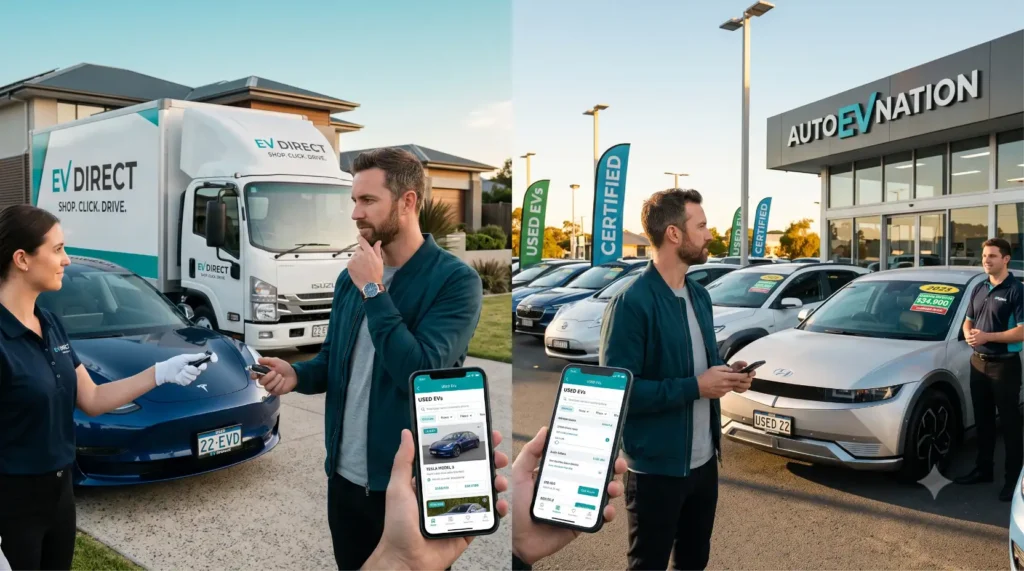
Over the last few years, a whole category of online-first used-car retailers has reshaped how people shop. You browse a big inventory from your couch, filter by range and price, see fixed no-haggle numbers, and in many cases get the car delivered to your driveway. For a lot of EV buyers, this is the path of least resistance. 🛋️
The appeal is real. These platforms typically recondition vehicles before listing, publish a vehicle history report up front, and — crucially for EVs — increasingly surface battery-health information. Most offer a return window, often around 7 to 10 days, which is a genuine safety net you simply don’t get from a private seller. If the car feels wrong in your driveway, you send it back.
The trade-off is price. That convenience, reconditioning, and return policy all cost money, so online retailers usually sit a notch above the cheapest private listings. In the US you’re often looking at a modest premium over rock-bottom; in India, organized online platforms price similarly above what a hard-bargaining local deal might land.
The other catch: the car shows up after you commit, so the return window does a lot of heavy lifting. Use it. On day one, charge to 100%, check the projected range against the model’s rated figure, and read the battery state of health if you can. Treat the return window as your inspection period, not a formality.
🏢 Franchise dealer & CPO: warranty and markup
A franchise dealer — the brand-name showroom that also sells new cars — is the traditional answer to where to buy used EV stock with a real safety net behind it. Their used inventory often includes Certified Pre-Owned (CPO) vehicles, and that “certified” label is the headline feature here. 🏅
CPO generally means the car passed a multi-point inspection, met an age and mileage cap, and comes with a dealer-backed warranty. For an EV, that inspection ideally covers the high-voltage system and battery, not just tires and brakes — so ask specifically what the EV checklist included. A genuine CPO program can include a warranty extension that outlasts the original coverage.
The downside is predictable: markup. Dealers carry overhead, reconditioning costs, and a warranty to honor, so their sticker is usually the highest of any channel. In the US that can mean a few thousand dollars over a comparable private sale; in India, expect a similar premium versus a local independent dealer.
Two things to verify before you sign. First, confirm the battery warranty status and whether it transfers to you — that 8-year/100,000-mile (160,000 km) coverage is worth real money. Second, get the multi-point inspection report in writing. A “certified” sticker without a documented EV-specific inspection is just marketing. 📋
🏷️ Manufacturer certified programs: brand-backed reassurance
A step beyond a regular dealer CPO is the manufacturer’s own certified used program. Several automakers run brand-specific schemes where their dealers recondition and certify used cars to a factory standard, often bundling an extended factory warranty and roadside assistance. For EVs specifically, this is appealing because the techs are brand-trained and the diagnostic tools are the real deal. 🔧
Why does this matter more for electric cars than gas ones? Because reading an EV’s true battery state of health, checking for stored battery-management-system errors, and confirming software and recall status all need manufacturer-grade equipment. A brand certified program is the channel most likely to have done that properly — and to stand behind the result.
The reassurance comes at two costs. One is price: brand-certified cars usually sit near the top of the range, similar to or above standard CPO. The other is selection. You’re limited to that brand’s models, and certified EV inventory can be thin depending on the marque and your region.
If your heart is set on a particular brand, this is often the lowest-stress way to buy that car used. You’re paying for the manufacturer’s name on the warranty — and for an expensive, hard-to-inspect component like a battery, that name can be worth the premium. Just confirm exactly what the certified warranty covers and for how long.
🤝 Private-party / peer-to-peer: cheapest, riskiest
Now the channel that saves you the most money and exposes you to the most risk: buying directly from the current owner, whether through a peer-to-peer platform or a straight private sale. There’s no dealer overhead, no reconditioning markup, no warranty to fund — so the price is the lowest you’ll find anywhere. 💰
That’s the whole pitch, and it’s a strong one. A well-kept EV from a careful owner who charged at home and has every service record is often a fantastic buy at a private price. You can also learn a lot talking to the actual person who drove the car daily — something no dealer interaction gives you.
But here’s the hard truth: it’s as-is. No warranty. No return window. No recourse if the battery turns out to be quietly degraded. Every risk that a dealer or online retailer absorbs now sits squarely on your shoulders. This is exactly the channel where the used EV warning signs that should make you walk away matter most — there’s no one to call if you miss one.
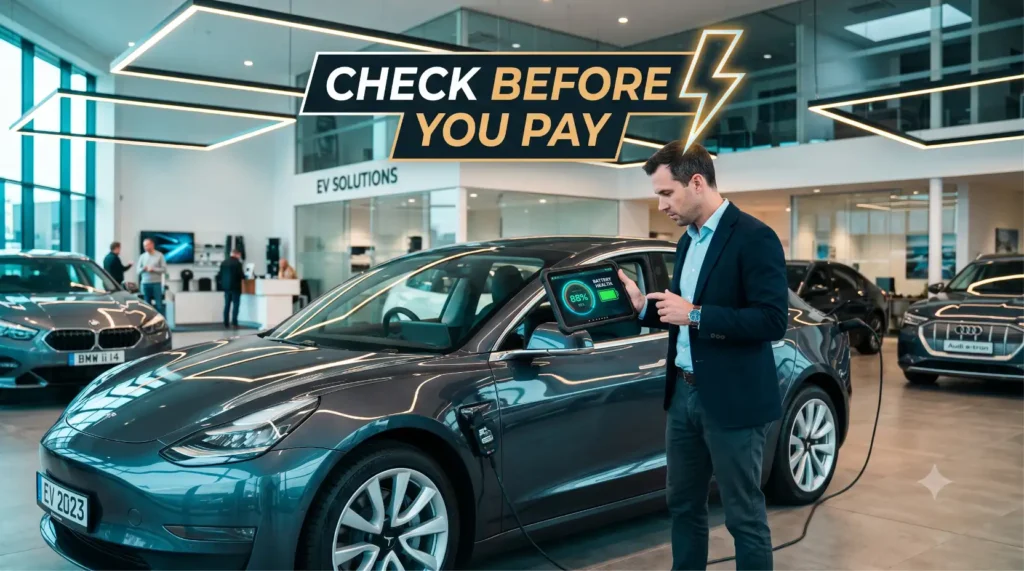
So if you go private, you become the quality-control department. Insist on a battery state-of-health reading, run a vehicle history report yourself, and pay for an independent pre-purchase inspection before any money changes hands. The savings are real, but only if you do the homework a dealer would otherwise have done for you. Walk through our used EV buying guide on what to check before you pay before you meet a single private seller. 🕵️
📰 Classified marketplaces: widest net, mixed quality
Classified marketplaces — the big general listing sites where dealers and private sellers post side by side — are where most people start their search, and for good reason. The selection is enormous and spans every price point, from immaculate certified cars to questionable bargains. If you want to see what’s out there, this is your panoramic view. 🔭
The strength is also the weakness. Because anyone can list, quality is wildly inconsistent. A single search might surface a reputable dealer’s CPO car right above a private seller’s as-is gamble right above an outright scam. The platform itself rarely vouches for the car — it’s mostly a bulletin board, not a guarantor.
That puts the entire burden of verification on you. Classifieds offer no inspection, no standardized history report, and almost never a return. You’re essentially using the platform to find cars, then applying private-party rules to whichever one you pursue.
Use classifieds for discovery and price benchmarking — they’re brilliant for understanding what a given model actually sells for in your area. Then, once you find a contender, treat it exactly like a private sale: history report, battery check, independent inspection. And stay alert for classic scam patterns — a price that’s too good, a seller who “can’t meet in person,” or a request to wire a deposit on a car you haven’t seen. 🚩
🇮🇳 India: organized used-car channels vs local dealers
In India, the used-car landscape has shifted fast, and it changes the “where to buy used EV” calculus in a specific way. On one side you have organized used-car chains — the branded, multi-city platforms that inspect, recondition, and certify cars, publish standardized reports, and often bundle a limited warranty and a short return window. On the other side sit the traditional local independent dealers and direct private sales. 🛵
The organized chains brought something Indian used-car buyers historically struggled to find: trust and standardization. A documented inspection, a clearer history, and warranty-backed reassurance go a long way when you’re spending lakhs on a car whose battery you can’t see. For a used EV specifically — still a relatively new category in India — that structured confidence is genuinely valuable.
Local dealers and private sellers, meanwhile, still win on price flexibility. There’s room to negotiate that the fixed-price organized platforms don’t offer, and a sharp buyer who knows what to inspect can land a better number. The risk profile, though, looks a lot like the private-party channel above — you carry the inspection burden yourself.
A practical note for India: EV resale data and battery-health tooling are still maturing, so documentation matters even more. Confirm the RC transfer is clean and in the seller’s name, check the battery warranty status and transferability, and get an EV-aware mechanic to verify pack health. Whether you go organized or local, the protection steps are the same — only the price and the hand-holding differ. 🇮🇳⚡
🛡️ How to protect yourself on any channel
Here’s the liberating part: no matter where you buy, the same three safeguards turn a risky purchase into a confident one. Master these and the channel becomes a preference, not a gamble. 💪
1. Pull a vehicle history report. Before you fall in love, run the VIN (or check the RC and service records in India) through a history report. You’re looking for accident history, title or lien issues, odometer mismatches, flood records, and completed recalls. This is non-negotiable on classifieds and private sales, and a smart double-check even at a dealer.
2. Verify battery health. The battery is a third to half of an EV’s value, so its state of health is the single most important number you’ll check. A $30–$60 (₹2,500–₹5,000) OBD2 scanner paired with the right app reads true SoH, cell balance, and stored fault codes — turning “looks fine” into hard data. Always charge to 100% and compare projected range to the model’s rated figure.
3. Get a pre-purchase inspection. A $150–$250 (₹4,000–₹15,000) inspection by an EV-savvy mechanic checks the high-voltage system, charging hardware, brakes, and underbody — the things you can’t assess from the driver’s seat. Against an $8,000–$20,000 (₹6–18 lakh) battery replacement, it’s the cheapest insurance you’ll ever buy.
And for the money itself: never wire a deposit on a car you haven’t seen, use traceable payment, and on high-value private deals consider an escrow service or completing the transfer at a bank or RTO office. If a seller pressures you to skip these steps, that pressure is your answer. 🔒
🎯 Matching the channel to your buyer type
There’s no single best place to buy — there’s the best place for you. Match yourself to a profile and the choice gets easy. 🧩
The convenience seeker (busy, values their time, hates haggling): go with an online used-EV retailer. Fixed prices, home delivery, and a return window do the worrying for you.
The peace-of-mind buyer (first EV, nervous about the battery, wants a safety net): go CPO or manufacturer certified. Yes, you’ll pay the most, but the inspection and warranty buy real sleep.
The bargain hunter (knows cars, willing to do the legwork, wants the lowest price): go private party / peer-to-peer — but only if you commit to the history report, battery check, and inspection. The savings are conditional on the homework.
The wide-net shopper (open-minded, comparison-driven, patient): start on classifieds to survey the market, then funnel your top pick through private-sale due diligence or toward a dealer’s certified version. When you know your buyer type, the question of where to buy used EV stock practically answers itself.
The India buyer torn between options: if you value documentation and warranty, lean organized chain; if you value price and can inspect, a local dealer or private sale can save you money. Either way, verify RC, battery warranty, and pack health.
📈 2026: how used EV buying channels are evolving
The used EV market in 2026 looks noticeably different from a few years ago, and the changes mostly favor buyers. 🚀
First, battery-health transparency is becoming a competitive feature, not an afterthought. More sellers across channels — especially online retailers and certified programs — now surface state-of-health data up front, because buyers learned to ask. Expect SoH to show up next to mileage in listings the way it always should have.
Second, selection is finally deep. The wave of EVs sold new a few years ago is now hitting the used market in volume, which means more inventory at every price point and harder competition between channels. That competition is gentle pressure on prices and a push toward better return policies and warranties.
Third, the lines between channels are blurring. Dealers run online storefronts with delivery; online retailers add physical hubs; classifieds bolt on inspection and history-report add-ons. The practical upshot: you can increasingly mix-and-match — discover on a classified, verify with a third-party inspection, buy with a return window. In India specifically, organized chains keep expanding into more cities and EV-specific certification, narrowing the trust gap with local dealers.
✅ 5 Tips for choosing where to buy
- Decide what you’re optimizing for first. Lowest price points you to private sales; lowest stress points you to certified. Know your priority before you browse. 🎯
- Never skip the battery check, wherever you buy. SoH is the number that protects your wallet. A scanner reading beats any salesperson’s reassurance. 🔋
- Treat a return window like an inspection period. If your channel offers one, use it hard — charge, drive, and verify range on day one. ⏱️
- Run the history report yourself. Don’t rely on the seller’s summary. Pull your own VIN/RC report on every serious candidate. 🧾
- Use traceable payments and escrow on private deals. If a seller resists, walk. Legitimate sellers welcome a clean, documented transaction. 🔒
🛒 Tools That Make This Easier (Shop This Post)
A few affiliate-friendly picks that genuinely help you buy a used EV safely, no matter which channel you choose. 😍
1. OBD2 Bluetooth Battery Scanner 📱
Plugs into any used EV and reads true State of Health, cell balance, and fault codes — your single best defense on private sales and classifieds. The best $30–$60 (₹2,500–₹5,000) you’ll spend before buying.
👉 Shop OBD2 EV battery scanners
2. Pre-Purchase Inspection Service 🔧
An EV-savvy mechanic checks the high-voltage system, charging hardware, and underbody before you commit. A small fee now versus a five-figure surprise later — essential off-warranty.
👉 Book a pre-purchase EV inspection
3. Vehicle History Report 🧾
Pull accident, title, lien, odometer, and recall history from the VIN before you fall in love. The fastest way to spot a car’s hidden past on any marketplace.
👉 Get a vehicle history report
🛍️ Shop This Post: (These are affiliate picks. They cost you nothing extra and help keep EVs Mirror running. 🙏)
🎯 Quick Quiz: Which Channel Fits You?
- Do you hate haggling and want it delivered? 🅐 Yes 🅑 No
- Is this your first EV and the battery scares you? 🅐 Yes 🅑 No
- Are you confident inspecting a car (or paying someone who is)? 🅐 Yes 🅑 No
- Is rock-bottom price your top priority? 🅐 Yes 🅑 No
Mostly 🅐 on 1–2: 🟢 Online retailer or certified program — comfort and safety net are your friends.
Mostly 🅐 on 3–4: 💰 Private party or classifieds — you’ll get the best price if you do the due diligence.
📋 Where-to-Buy Decision Checklist
- [ ] 🎯 Decided what I’m optimizing for (price vs. peace of mind)
- [ ] 🛒 Compared at least two channels for the same model
- [ ] 🔋 Confirmed I can read or verify battery State of Health
- [ ] 🧾 Plan to pull my own vehicle history report
- [ ] 🔧 Budgeted for a pre-purchase inspection (if off-warranty)
- [ ] 🏅 Checked warranty transfer and return policy for the channel
- [ ] 🔒 Arranged traceable payment / escrow for any private deal
- [ ] 📄 Verified clean title/RC in the seller’s name, no lien
🤔 People Also Ask
Where is the best place to buy a used EV?
There’s no single best place — it depends on your priority. If you want convenience and a safety net, an online used-EV retailer or certified program is best. If you want the lowest price and don’t mind doing the inspection legwork, a private/peer-to-peer sale wins. The right answer to where to buy used EV stock is whichever channel matches how much hand-holding you want versus how much you want to save.
Is it cheaper to buy a used EV from a private seller or a dealer?
A private seller is almost always cheaper because there’s no dealer overhead, reconditioning markup, or warranty cost baked in. But that price comes with zero warranty and no returns, so you absorb all the risk. A dealer or CPO car costs more but bundles inspection, warranty, and recourse if something goes wrong.
How do I safely buy a used EV online?
Buy from a retailer that publishes a vehicle history report and battery-health data, and that offers a return window. Treat that return window as your inspection period: on day one, charge to 100%, compare projected range to the rated figure, read the state of health if you can, and send the car back if anything feels off.
Should I buy a certified pre-owned EV?
If it’s your first EV or the battery makes you nervous, often yes. CPO and manufacturer-certified EVs come with a multi-point inspection and a warranty extension, and certified programs usually use brand-grade tools to verify the battery and software. You’ll pay the highest sticker, but you’re buying genuine peace of mind on the most expensive component.
Where can I buy a used EV in India?
You’ve got two main routes: organized used-car chains that inspect, certify, and warranty their cars, or local independent dealers and private sellers who offer more price flexibility but less hand-holding. Whichever you choose, confirm a clean RC transfer, check battery warranty status, and get an EV-aware mechanic to verify pack health before you pay.
What should I check before buying a used EV from any marketplace?
Three things, every time: a vehicle history report (accidents, title, recalls), a battery state-of-health reading via an OBD2 scanner, and a pre-purchase inspection by an EV-savvy mechanic. These three safeguards work on any channel and protect you against the expensive surprises a listing won’t show.
🚀 The Bottom Line
Buying a used EV is one of the smartest moves in motoring right now — you skip the steepest depreciation and step into electric driving for far less than new. The only real decision left is where, and as you’ve seen, every channel trades price against peace of mind in its own way. 🔋
If you value comfort, lean toward online retailers and certified programs and accept the small premium. If you value savings and trust your own diligence, private sales and classifieds will reward you — as long as you bring the history report, battery check, and inspection that a dealer would otherwise do for you. In India, the choice between an organized chain and a local dealer comes down to that same trade: documentation versus negotiation. Wherever you land, the protection steps don’t change. 💪
Ready to buy smart? Arm yourself with our used EV buying guide on what to check before you pay, then memorize the used EV warning signs that should make you walk away so no channel can catch you off guard. Then go find the electric car that’s actually worth it. 🚗⚡