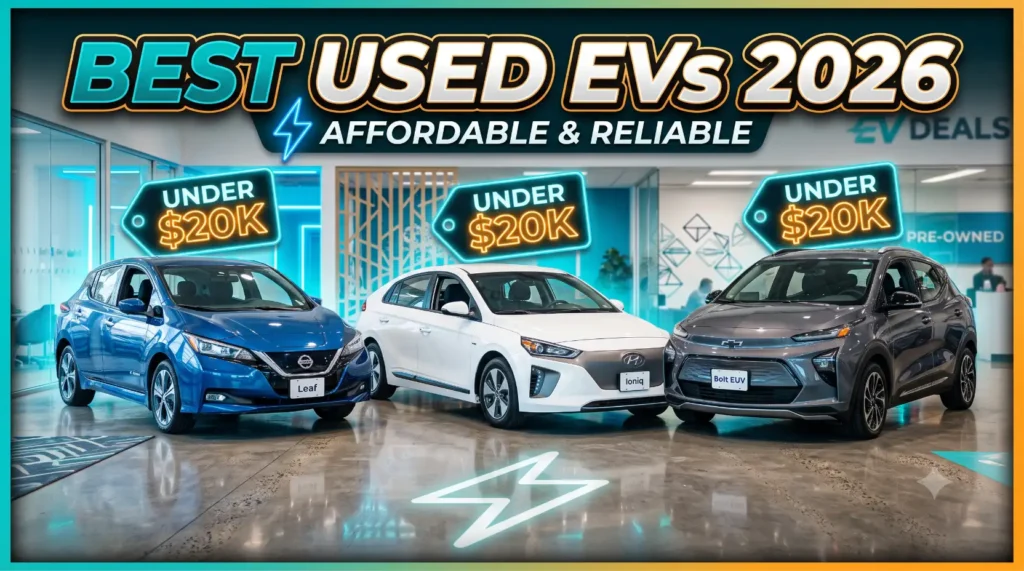
Standing in a dealership (or scrolling a listing at 11pm), you hit the fork in the road every EV shopper eventually faces. 🛣️
Door number one: a brand-new electric car, glossy and unscratched, with the latest range, the newest software, and a full warranty clock ticking from zero. Door number two: a two-or-three-year-old version of almost the same car for thousands less, because someone else already swallowed the ugly first-year depreciation.
Both are tempting. Both can be the right call. And both can quietly cost you money you didn’t need to spend. 💸
The honest truth is that there’s no universal winner here — only the winner for you, based on your budget, your mileage, your appetite for tech, and how long you plan to keep the thing. So let’s lay it all out, no hype, no dealership spin, and settle this used vs new EV debate with actual numbers. 👇
⚡ The Short Answer
No fluff. Here’s how it usually shakes out:
- 💰 Buy used if you want maximum value, lower monthly cost, and you don’t need the absolute latest range — someone else already ate the depreciation.
- ✨ Buy new if you want the longest warranty, newest tech, the cheapest financing, and (in many cases) the bigger upfront incentive.
- 📉 Depreciation is the whole game. A new EV can lose 30–50% of its value in 3 years. A used buyer skips that crater entirely.
- 🛡️ New wins on peace of mind (full warranty, full battery cover). Used wins on price — if the battery is healthy.
- 🇺🇸🇮🇳 Incentives differ by market. The US has both a new ($7,500) and used ($4,000) credit. India’s subsidies mostly favor new.
For most everyday buyers in 2026, a healthy 2–4 year-old EV is the smarter buy. But if you’re a high-mileage driver who keeps cars a decade, new can win on the long math. 🎯
📊 Used vs New EV: The Head-to-Head
Here’s the whole comparison on one screen. Screenshot it. 👇
| Factor | 🔋 New EV | ♻️ Used EV |
|---|---|---|
| 💰 Upfront price | Highest — full MSRP | 25–50% less for a 2–4 yr-old car |
| 📉 Depreciation hit | You eat the steep first-year drop | Already absorbed by owner #1 |
| 🛡️ Warranty | Full bumper-to-bumper + 8-yr battery | Whatever’s left (often years remain) |
| 🔋 Battery life left | 100% — factory fresh | ~85–95% typical (verify SoH) |
| 🎁 Tax credit / subsidy | Up to $7,500 (US) · FAME/state (India) | Up to $4,000 (US) · limited (India) |
| ✨ Latest tech & range | Newest software, longest range | Proven, slightly older spec |
| 🏦 Financing rates | Lowest (often 0–5% APR offers) | Higher (used-car rates, 1–3% more) |
Notice the pattern: new wins on protection and tech, used wins on price. The rest of this article is about which of those matters more for your situation. 💡
💵 The Upfront Price Gap (It’s Bigger Than You Think)
Let’s start with the number that grabs you first — the sticker. 🏷️
A new mainstream EV in the US typically lands somewhere between $35,000 and $55,000 before incentives. The same model, two or three years old with reasonable miles, often sells for $22,000 to $35,000. That’s frequently a $10,000–$15,000 gap for what is, mechanically, nearly the same car. 😮
In India, the math is just as dramatic. A new popular electric car might sticker at ₹15–20 lakh, while a clean two-year-old example trades closer to ₹9–13 lakh. On premium models the rupee gap can be even wider, because the steepest depreciation falls on the most expensive cars.
Why such a chasm? Because EVs depreciate harder and faster than petrol cars did, especially in their early years. Rapid tech improvement, falling new-car prices, and a flood of off-lease vehicles have all pushed used values down. 📉
For the buyer, that’s not bad news — it’s the opportunity. The used buyer essentially lets the first owner pre-pay the worst of the loss. That single dynamic is the beating heart of the used vs new EV decision, and it’s worth understanding deeply.
💡 Read: How EV Depreciation Helps Used Buyers Win — the full breakdown of why early depreciation is the used buyer’s best friend.
🎁 Who Gets the Incentives? (US + India)
Here’s where the “which is cheaper” question gets genuinely tricky, because incentives can flip the math. 🔄
In the United States 🇺🇸, the federal picture rewards both sides — but differently:
- New EVs can qualify for the Clean Vehicle Credit of up to $7,500, subject to price caps, income limits, and battery-sourcing rules. Not every model qualifies, so always check the current eligibility list.
- Used EVs have their own Used Clean Vehicle Credit of up to $4,000 (or 30% of the sale price, whichever is lower). The car must be at least two model years old, sold by a dealer, priced under $25,000, and bought by an income-qualified buyer.
So a new buyer can claim more on paper — but only if the model and their income qualify. A used buyer claiming the $4,000 credit on a $24,000 car is effectively paying $20,000 for it, which narrows the gap fast. 🧮
In India 🇮🇳, incentives lean heavily toward new. Central schemes (the FAME-style and successor programs) plus various state subsidies and road-tax/registration waivers apply almost entirely to new EV purchases. Used EVs rarely get fresh subsidies — but they also already reflect a lower price, so you’re capturing value a different way.
Bottom line: always price the car after incentives, not before. A new EV with a full $7,500 credit can occasionally land near a used one. Run both numbers for your exact situation. 💡
📉 Depreciation: New Buyer Eats It, Used Buyer Skips It
If there’s one section to tattoo on your brain, it’s this one. Depreciation is the single largest cost of owning a new EV — bigger than charging, bigger than insurance, bigger than maintenance. 😳
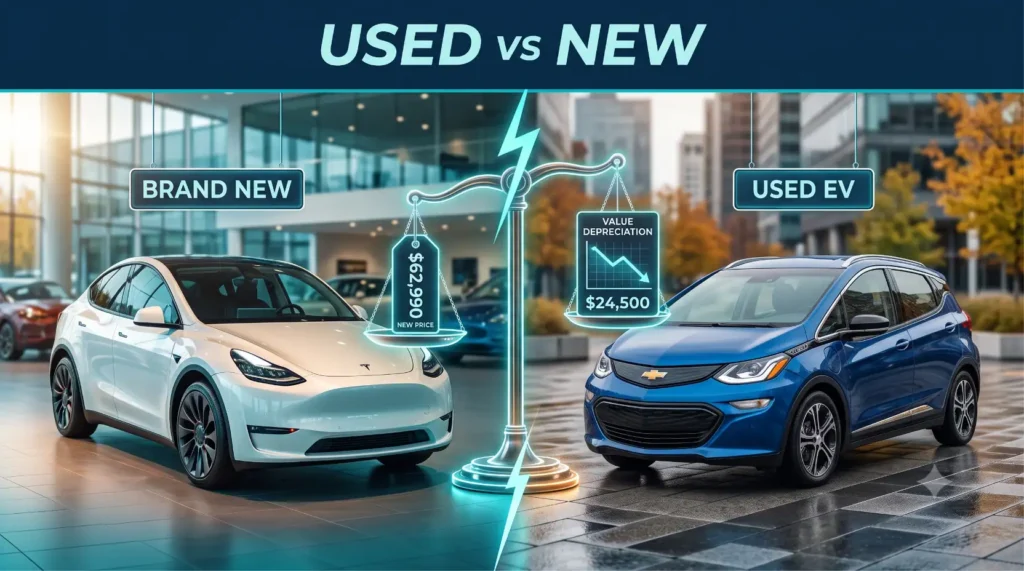
Here’s the brutal pattern. A new EV can lose 20–30% of its value in year one and 40–50% over three years. So a $45,000 car can be worth around $24,000–$27,000 after three years — meaning the first owner quietly “spent” roughly $18,000–$21,000 just on value lost. That’s not a repair bill. That’s evaporation. 💨
In rupees, a ₹18 lakh EV depreciating 45% over three years leaves you near ₹10 lakh — a ₹8 lakh drop the new buyer absorbed.
Now flip it. The used buyer steps in after that cliff. They buy at the bottom of the steepest part of the curve, where depreciation flattens out. From years three to six, the same car loses value much more slowly. So the used owner enjoys far gentler value loss for their entire ownership period. 🟢
That’s the whole secret. New buyers fund the depreciation; used buyers harvest it. In the used vs new EV calculation, this factor alone often decides the smarter financial choice — unless other variables (incentives, financing, how long you keep it) tip it back.
🛡️ Warranty & Battery Coverage Left
Peace of mind has a price, and this is where new earns its premium. 😌
A new EV comes with the full warranty clock at zero: typically a 3–5 year / bumper-to-bumper warranty plus an 8-year / 100,000-mile (≈160,000 km) battery warranty in most markets. If anything goes wrong with the most expensive component — the battery — you’re covered for nearly a decade.
A used EV comes with whatever’s left. The good news: because battery warranties run 8 years, a three-year-old EV still has roughly 5 years of battery cover remaining. That’s substantial protection, often overlooked by nervous buyers. 🔋
But two cautions for the used side:
- ⚠️ Confirm the battery warranty actually transfers to you — some are owner-bound or need a formal transfer.
- 📄 Check exactly how much time and mileage remain, and whether any bumper-to-bumper cover is still active.
So new gives you maximum, no-questions coverage. Used gives you partial — but often still-meaningful — coverage at a much lower price. For a healthy battery with years of cover left, that trade can be very smart. 🎯
✨ Latest Range & Tech vs Proven Reliability
This is the emotional tug-of-war, and it’s real. New EVs are genuinely better than they were three years ago. 🚀
A new EV typically offers more range (battery and efficiency gains add up fast), faster charging, the newest infotainment and driver-assist software, and ongoing over-the-air updates that keep improving the car. If you want the longest road-trip range and the slickest tech, new delivers.
A used EV gives you proven reliability instead. The early software bugs are patched, any factory teething issues are known and often fixed, and you can read real-world reliability reviews before you buy. You trade 10–15% less range and slightly older screens for a known quantity. 🟢
Ask yourself honestly: do you need 350 miles of range, or does your daily life rarely exceed 60? Most drivers vastly overestimate the range they actually use. If your commute and weekend trips fit comfortably inside a used EV’s real-world range, the “newest” tech is a want, not a need. 💡
And here’s a quiet point in used’s favor: a 2–3 year-old EV has already proven it doesn’t have a fatal flaw. That’s reliability information a brand-new model literally cannot give you yet.
🏦 Financing Cost Differences (Used Loans Cost More)
Here’s the factor most people forget — and it can erase part of used’s price advantage. 💳
Lenders generally charge higher interest rates on used-car loans than new ones. New EVs often come with manufacturer-subsidized financing — sometimes 0% to 5% APR promotional deals. Used EVs typically carry rates 1–3 percentage points higher, because used cars are seen as higher risk and loan terms are shorter. 📈
In India, the gap shows up too: new EV loans (sometimes with green-financing perks) tend to undercut used-car loan rates, which can run noticeably higher with shorter tenures.
What does that mean in real money? On a $25,000 loan, a 3-point higher rate over 5 years adds roughly $2,000 in interest. That doesn’t flip the decision — used is still usually cheaper overall — but it narrows the gap and deserves a spot in your spreadsheet. 🧮
Two smart moves: get pre-approved financing from a bank or credit union before you shop (often cheaper than dealer financing on used cars), and always compare the total cost including interest, not just the sticker. The monthly payment is what you actually live with. 💡
🧮 Total Cost of Ownership: The Real Comparison
Sticker price is one number. Total cost of ownership (TCO) is the number that actually matters — it bundles purchase, depreciation, financing, insurance, charging, and maintenance over the years you own the car. 📊
Let’s stack them honestly over a typical 5-year hold:
| Cost Bucket | 🔋 New EV | ♻️ Used EV |
|---|---|---|
| Purchase (after incentives) | Higher | Lower |
| Depreciation over hold | Larger (steeper curve) | Smaller (flatter curve) |
| Financing interest | Lower rate | Higher rate |
| Insurance | Higher (pricier car) | Lower (cheaper car) |
| Charging | Same per mile | Same per mile |
| Maintenance | Minimal (full warranty) | Low (some warranty left) |
For most buyers, the used EV wins on TCO because the two biggest costs — purchase price and depreciation — both favor it, and lower insurance helps too. The higher financing rate chips away at the lead but rarely eliminates it. 🟢
The exception? If you’re a very high-mileage driver who keeps the car 8–10 years, the new EV’s longer warranty, newer battery, and (sometimes) bigger incentive can pull ahead on the long math — because you’ll use up more of the car’s life and benefit from full coverage the whole way. 🎯
So TCO isn’t one-size-fits-all. It bends to your mileage and your holding period. Which leads neatly to the real question. 👇
🤷 So Who Should Buy New, and Who Should Buy Used?
Let’s make this personal. Here’s the honest split. ✂️
Buy NEW if you:
- ✨ Want the longest warranty and total peace of mind.
- 🛣️ Drive high annual mileage and keep cars 8–10 years.
- 🎁 Qualify for the full new-car incentive that closes the price gap.
- 🔋 Genuinely need the newest range, charging speed, or tech.
- 🏦 Can grab a 0–5% financing deal that used can’t match.
Buy USED if you:
- 💰 Want the best value and lowest upfront cost.
- 📉 Want to skip the steep first-years depreciation entirely.
- 🚗 Have typical mileage and a daily range well inside the car’s real range.
- 🛡️ Are happy with a healthy battery and the warranty time that’s left.
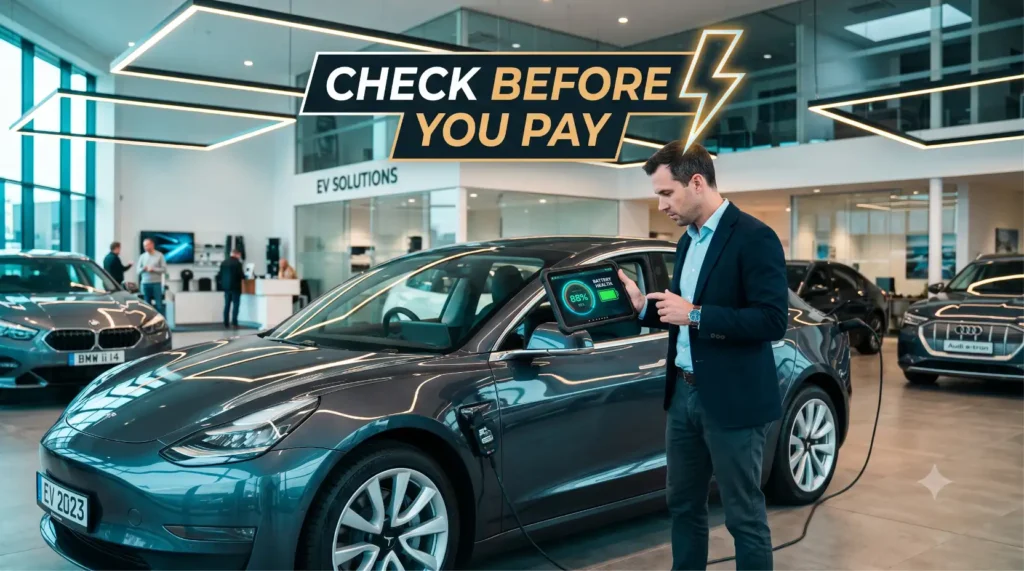
- 🧰 Don’t mind doing a proper pre-purchase battery check before paying.
Most everyday drivers fall into the used camp — and that’s exactly why the second-hand EV market is booming. But there’s no shame in buying new if the warranty, tech, or incentive genuinely fits your life. The used vs new EV answer is personal, not universal. 🤝
💡 Read: Used EV Buying Guide: What to Check Before You Pay — the exact battery, charging, and warranty checks that make a used EV a safe bet.
📈 2026: The Math Is Shifting Toward Used
Here’s the macro trend that’s quietly rewriting this whole debate. 📊
Three forces are colliding in 2026 to make used EVs unusually attractive:
- 🌊 A flood of off-lease cars. The big EV lease wave of 2022–2023 is hitting the used market now, dumping clean, low-mileage cars into supply and pushing prices down.
- 💸 New-car price cuts. Aggressive new-EV discounting drags used values down with it — great for buyers, painful for sellers.
- 🔋 Maturing battery data. We now have years of real-world degradation data showing most EV batteries hold up far better than feared, which de-risks buying used.
Add it up and the price gap between used and new has widened, while the risk of buying used has shrunk. That’s a rare, buyer-friendly combination. 🟢
In India 🇮🇳, the used EV market is younger but accelerating fast, with more organized dealers, certified pre-owned programs, and battery-health reporting making second-hand buying safer than ever. The trust gap is closing.
The takeaway: 2026 is one of the best years yet to buy used — provided you do your homework on battery health. The savings are bigger and the safety net is stronger than they were even two years ago. ⚡
✅ 5 Tips to Decide (New vs Used)
Cut through the noise with these five moves. 👇
- 🧮 Price it after incentives, both ways. Get the real out-the-door cost of a new car with its credit and a used car with its credit. Compare those, not the stickers.
- 📉 Estimate depreciation for your hold. Short hold (3–4 years)? Used almost always wins. Long hold (8–10 years)? New gets competitive.
- 🔋 Demand a battery State of Health number on any used car. Above ~85% is healthy. Use an OBD2 scanner — don’t trust the dashboard guess.
- 🏦 Compare total cost with interest. Get pre-approved financing and add interest to both options. The cheaper monthly number is what you live with.
- 🛣️ Match the car to your real mileage. If your range needs are modest, the newest spec is a luxury, not a necessity — and used pockets the difference.
Do these five and the right answer usually reveals itself. 💡
🛒 Shop This Post
Whether you go new or used, these tools make you a smarter EV owner from day one. 🔌
- 🔋 Level 2 Home EV Charger — New or used, charging at home overnight is cheaper and kinder to your battery than constant fast-charging. The single best EV accessory you can own. 👉 Shop home EV chargers
- 📱 OBD2 Bluetooth Scanner — Non-negotiable for used buyers. Read the real battery State of Health before you pay, so you never overpay for a tired pack. 👉 Shop OBD2 scanners
- 🧮 EV Trip & Cost Planning Tool — Plan routes, compare charging costs, and sanity-check whether a used EV’s range fits your life before you buy. 👉 Shop EV planning tools
🛍️ Shop This Post: (These are affiliate picks. They cost you nothing extra and help keep EVs Mirror running. 🙏)
🎯 Quick Quiz: New or Used for You?
- Do you keep cars longer than 8 years? 🅐 Yes 🅑 No
- Do you qualify for the full new-car incentive? 🅐 Yes 🅑 No
- Is the latest range and tech a genuine need (not a want)? 🅐 Yes 🅑 No
- Are you comfortable doing a battery health check on a used car? 🅑 Yes 🅐 No
Mostly 🅐: ✨ Lean new — your long hold, incentive, and tech needs justify the premium.
Mostly 🅑: ♻️ Lean used — you’ll capture maximum value and skip the depreciation crater.
📋 New vs Used Decision Checklist
- [ ] Priced both options after incentives 🎁
- [ ] Estimated depreciation for my actual holding period 📉
- [ ] Got pre-approved financing and compared interest 🏦
- [ ] Confirmed battery State of Health on any used car (85%+) 🔋
- [ ] Checked warranty time/mileage left on the used option 🛡️
- [ ] Verified incentive eligibility (income + model) for new 🇺🇸
- [ ] Matched the car’s real range to my daily mileage 🛣️
- [ ] Compared insurance quotes for both cars 💳
- [ ] Calculated full 5-year total cost of ownership 🧮
- [ ] Decided based on my numbers, not the salesperson’s 🤝
🤔 People Also Ask
Q: In the used vs new EV debate, which is actually cheaper?
A: Usually used, because the first owner absorbed the steep early depreciation and the purchase price is far lower. New can occasionally close the gap with a full $7,500 incentive (US) and cheaper financing, but for most buyers a healthy 2–4 year-old EV wins on total cost.
Q: Do used EVs qualify for any tax credit or subsidy?
A: In the US 🇺🇸, yes — a Used Clean Vehicle Credit of up to $4,000 for qualifying cars under $25,000 bought from a dealer, subject to income limits. In India 🇮🇳, fresh subsidies mostly apply to new EVs, though used prices already reflect lower value.
Q: How much does a new EV depreciate in the first three years?
A: Typically 40–50% of its value. A $45,000 new EV can be worth around $24,000–$27,000 after three years — which is exactly why buying used after that drop is so financially appealing.
Q: Is the warranty still good when buying a used EV?
A: Often yes. Battery warranties run 8 years / ~100,000 miles, so a three-year-old EV usually has about 5 years of battery cover left. Always confirm the warranty transfers to you and check the remaining time and mileage.
Q: Are used EV loans more expensive than new EV loans?
A: Generally yes. Used-car loans carry 1–3 percentage points higher interest, and new EVs often get 0–5% promotional financing. This narrows used’s price advantage, so always compare the total cost including interest, not just the sticker.
Q: Should a first-time EV buyer go new or used?
A: It depends on budget and mileage. New offers full warranty and the newest tech for peace of mind; used offers the best value and skips depreciation. For most first-time buyers with typical mileage, a healthy used EV is the smarter, lower-risk entry — just verify battery health first.
🚀 The Bottom Line
So, used vs new EV — which is the smarter buy in 2026? For the majority of everyday drivers, it’s used: the first owner already paid for the steepest depreciation, the price gap is wide, battery data has de-risked the purchase, and a healthy 2–4 year-old EV still carries years of warranty. You capture the value; you skip the crater. ⚡
But new isn’t wrong — it’s right for high-mileage drivers who keep cars a decade, for buyers who land the full incentive, and for anyone who genuinely needs the newest range and tech with cheaper financing. The smart move isn’t picking a side blindly; it’s running both numbers, after incentives, for your life. 🎯
⚠️ A quick honest note: Prices, incentives, depreciation rates, financing offers, and warranties vary by model, region, income, and individual car. Treat everything here as a friendly starting point — always confirm current credits, rates, and battery health before you commit. 🙏
💬 Torn between a specific new and used model? Drop both prices in the comments and let’s run the math together!
📤 Know someone stuck at this exact fork? Forward them this breakdown before they sign anything.
🔖 Bookmark EVs Mirror for honest, no-nonsense EV ownership guides.