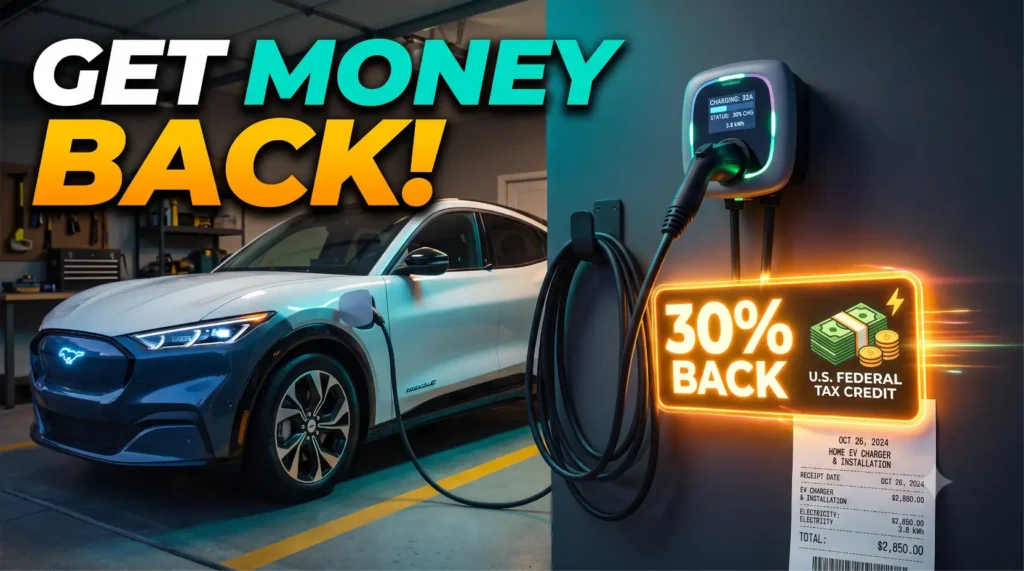
Everyone obsesses over the tax credit on the car. Almost nobody talks about the second credit quietly sitting in the garage. 🔌
That second one pays you back for the charger — the wall box, the wiring, the electrician’s labor. And a shocking number of EV owners install a charger, pay the bill, and never claim a dime of it back.
It’s not because they don’t qualify. It’s because they never heard of it. This is the EV charger tax credit explained in plain English for 2026 — what it covers, the caps, the location catch nobody warns you about, and how to actually claim it. 👇
⚠️ Important — read this first: This is a Your-Money-Your-Life tax topic, so let’s be straight. This article is general information, not tax advice. The credit (formally the Alternative Fuel Vehicle Refueling Property Credit, claimed on IRS Form 8911) can be changed, capped, restricted, or expired by Congress at any time. The 30% rate, the $1,000 residential cap, and the eligible-census-tract rules described here are framed as general guidance — always verify the current rules on IRS.gov and confirm your situation with a qualified tax professional before filing. 🧾
⚡ The Short Answer
If you only read one section, read this one:
- 💵 The credit returns 30% of your home charger’s hardware + installation cost.
- 🧢 For homes, it’s capped at $1,000 per charging unit.
- 📍 Your home must sit in an eligible census tract (a big catch — more below).
- 🧾 You claim it on IRS Form 8911 with your federal return.
- 🏢 The business/commercial version has a far bigger cap (up to $100,000 per item).
- ⏳ It can change or expire — verify the current rules with the IRS.
Meet the conditions, and a meaningful slice of your install cost comes back as a credit against your tax bill. 😎
📊 What the Charger Credit Covers — At a Glance
Here’s the framework in one table. Treat these as the categories and general figures — confirm the exact current numbers on IRS.gov. 👇
| What’s covered | Residential rule | Business / commercial rule |
|---|---|---|
| ⚡ Charger hardware (the wall box / EVSE) | ✅ Counts toward 30% | ✅ Counts toward 30% |
| 🔧 Installation labor (electrician) | ✅ Counts toward 30% | ✅ Counts toward 30% |
| 🧰 Electrical panel work / wiring / permits | ✅ Generally counts | ✅ Generally counts |
| 💵 Credit rate | 30% of cost | 30% (with prevailing-wage rules) |
| 🧢 Maximum cap | $1,000 per unit | Up to $100,000 per item |
| 📍 Location requirement | Eligible census tract | Eligible census tract |
| 🧾 Form to file | Form 8911 | Form 8911 |
The headline takeaway: installation and panel upgrades count, not just the box. That’s where a lot of the value lives. 🎯
🔌 What the EV Charger Tax Credit Actually Is
Let’s name it properly. The thing people call the “EV charger tax credit” is officially the Alternative Fuel Vehicle Refueling Property Credit. 📜
It’s a federal income-tax credit for installing equipment that “refuels” alternative-fuel vehicles — and yes, electricity counts, so your home EV charger qualifies as refueling property.
A credit is not a deduction. A deduction shaves your taxable income; a credit cuts your actual tax bill dollar-for-dollar. That makes it worth far more than the same number as a write-off. 💪
The catch with this particular credit is that it’s nonrefundable. That means it can reduce your tax owed down to zero, but it won’t generate a refund check beyond what you already paid in. No tax liability that year? No benefit — so timing matters.
💡 New to all of this? Start with our companion guide: EV Tax Credit 2026: Who Qualifies and How Much? — it covers the vehicle credit, which is a separate animal from the charger credit.
Again — verify the current rules on IRS.gov. This credit has been extended, modified, and reshaped multiple times, and Congress can do it again. 🎯
🏠 What It Covers: Equipment + Installation
Here’s the part that surprises people. This charger credit doesn’t just cover the shiny wall box. 🔌
It has generally applied to both the charging equipment and the cost of installing it. That bundle typically includes:
- ⚡ The charger itself (the EVSE / Level 2 unit).
- 🔧 The electrician’s labor to mount and wire it.
- 🧰 Associated electrical work — new circuits, conduit, a dedicated breaker.
- 🔌 In many cases, the panel upgrade if your home needed more capacity.
- 📋 Permits and certain materials tied to the install.
Why does this matter so much? Because installation is frequently the bigger line item. A Level 2 charger might run a few hundred dollars, but if your panel is maxed out and the run to the garage is long, the install can dwarf the hardware. 😅
Since the credit is 30% of the combined cost, those install dollars pull real weight. Keep every single receipt and invoice — itemized, dated, and clearly tied to the charger project. That paper trail is what makes or breaks your claim. 📄
💵 The 30% Rate and the $1,000 Residential Cap
Now the math. For a home install, the EV charger tax credit is 30% of the eligible cost, capped at $1,000 per charging unit. 💵
Let’s make that concrete with general examples (numbers illustrative, not a promise):
- Spend $1,500 total on hardware + install → 30% = $450 credit. Under the cap, so you’d claim the full $450.
- Spend $3,000 total → 30% = $900 credit. Still under the $1,000 cap.
- Spend $5,000 total → 30% = $1,500, but the cap clips it to $1,000.
So the practical sweet spot is roughly $3,300 of eligible spend — beyond that, you’ve maxed the residential cap and extra spending doesn’t grow the credit. 🧢
A couple of nuances worth flagging:
- The $1,000 is generally per charging port/unit, so a multi-port setup may stack — verify the current treatment.
- Because the credit is nonrefundable, you need enough tax liability to actually absorb it.
These figures are the general rule, but rates and caps are exactly the kind of thing legislation changes. Confirm the current percentage and cap on IRS.gov before you file. 🎯
📍 The Eligible-Location / Census-Tract Catch
This is the section most “30% back!” headlines conveniently skip — and it’s the one that disqualifies a lot of people. 📍
Under the rules in recent years, the charger credit only applies if your installation address sits in an eligible census tract. Broadly, those are tracts that qualify as low-income communities or non-urban (rural) areas. 🗺️
In plain terms: the program was deliberately targeted to push charging infrastructure into underserved and rural areas — not every suburban driveway in the country automatically qualifies. So even if you do everything else right, your address can be the deciding factor.
How do you check? The IRS and the Department of Energy have pointed taxpayers to mapping tools that let you punch in an address (or its census-tract ID) and see whether it falls in an eligible tract. Your tax software or tax pro can also run this check.
⚠️ Don’t skip this step. Buying the charger and saving receipts means nothing if your tract isn’t eligible. Confirm eligibility before you assume you’ll get the credit — and verify the current map and definitions on IRS.gov, because the eligible-tract rules can shift. 🎯
Bottom line: the census-tract requirement genuinely limits who qualifies. It’s the single biggest reason an otherwise-perfect claim gets denied. ⚠️
🧾 IRS Form 8911: The Document You’ll Actually File
The form that turns all of this into a real claim is IRS Form 8911, “Alternative Fuel Vehicle Refueling Property Credit.” 🧾
At a high level, Form 8911 walks you through:
- 📍 Confirming the property is in an eligible census tract.
- 💵 Reporting the total cost of the charger plus installation.
- 🔢 Calculating 30% of that cost.
- 🧢 Applying the $1,000 residential cap (or the larger business cap).
- ⚖️ Reconciling against your tax liability, since the credit is nonrefundable.
You’ll attach it to your federal return (Form 1040 for individuals), and the result flows through to reduce your tax owed. 🧮
A few practical pointers:
- 🗂️ Have your itemized invoices ready before you start — hardware and labor split out cleanly.
- 🏠 Note the install address and census-tract status.
- 💻 Good tax software with energy-credit support will usually handle Form 8911 for you and run the tract check.
💡 Want the click-by-click walkthrough? See our companion piece: How to Claim the Federal EV Tax Credit Step by Step — the same record-keeping discipline applies to the charger credit.
As always — the exact form, lines, and worksheets can change year to year. Pull the current Form 8911 and instructions from IRS.gov. 🎯
🔋 How It Stacks With Utility Rebates and the Vehicle Credit
Good news: the federal charger credit usually doesn’t exist in a vacuum. You can often stack incentives. 🧱
Utility and state rebates. Many electric utilities and states offer their own rebates for installing a Level 2 charger — sometimes a flat dollar amount, sometimes covering part of the panel work. These are typically separate from the federal credit, so you may be able to claim both. ⚡
One wrinkle to watch: if a utility rebate reduces what you actually paid for the charger, your eligible cost for the federal 30% may need to be calculated on the net amount. Your tax pro can sort out the ordering. 🧾
The vehicle credit is separate. The credit on the car (the Clean Vehicle Credit) and the credit on the charger are two distinct credits, filed on different forms. Qualifying for one doesn’t automatically qualify you for the other — and the charger credit’s census-tract rule has nothing to do with the vehicle credit’s price and income caps.
💡 To keep the two straight, read EV Tax Credit 2026: Who Qualifies and How Much? alongside this guide. Same wallet, different rulebooks. 💼
Stack smartly, document everything, and verify how each program interacts with the others — because combining incentives is where filing mistakes creep in. 🎯
🏢 The Business / Commercial Version (Bigger Cap)
If you’re installing chargers for a business — a workplace lot, a fleet depot, a retail location — the EV charger tax credit gets a lot more generous. 🏢
The same Alternative Fuel Vehicle Refueling Property Credit applies, but the cap jumps dramatically: up to $100,000 per item of refueling property, versus the $1,000 residential cap. That’s a 100x difference, and it reflects how much commercial charging hardware and installation can cost. 💰
A few things make the business side more complex:
- 🛠️ To claim the full 30%, projects generally must meet prevailing wage and apprenticeship requirements. Miss those, and the base rate can drop sharply (think 6% instead of 30%).
- 📍 The eligible census-tract requirement still applies — same map, same catch.
- 🧾 It’s still filed on Form 8911, but it interacts with depreciation and the broader business-credit rules.
For any commercial install of real size, this is firmly talk-to-your-CPA territory. The dollars are large enough that getting the wage rules and tract eligibility right genuinely matters — and the penalties for getting it wrong aren’t fun. 🧮
Verify the current business cap, wage rules, and percentages on IRS.gov before you budget around them. 🎯
✅ How to Claim It (The Process)
Here’s the end-to-end flow for claiming the home charger credit, start to finish. 🧾
- Confirm the credit currently exists and what its rate and cap are for the tax year you’re filing.
- Check your census tract using an IRS/DOE-recommended mapping tool — this is the make-or-break step. 📍
- Gather itemized documentation — charger invoice, electrician’s labor, panel work, permits.
- Complete Form 8911, applying 30% and the relevant cap. 🧾
- Attach it to your federal return and apply the credit against your tax liability.
- Keep records for years, in case of an IRS inquiry. 🗂️
Clean records and an eligible address are 90% of the battle. The arithmetic is the easy part. 📄
📈 How 2026 Changes Could Affect the Charger Credit
Here’s the honest part: this credit lives and dies by legislation, and 2026 is no exception. 📅
Several moving pieces could reshape the federal charger credit:
- ⏳ Expiration risk. The credit has a statutory window, and Congress has let similar incentives lapse before. The whole thing could sunset.
- 🧢 Cap and rate changes. The 30% rate and the $1,000 residential cap are numbers in a law — both can be adjusted.
- 📍 Census-tract redefinition. Which tracts count as “eligible” can be updated as new census data and rules roll out, quietly moving addresses in or out.
- 🏢 Business-rule tweaks. Prevailing-wage thresholds and the $100,000 commercial cap are frequent targets for revision.
The practical move: don’t rely on this article — or any older guidance — for the exact figures. Pull the current-year Form 8911 instructions straight from IRS.gov, and if your install is a meaningful expense, loop in a tax professional before you file. The rules you read last year may not be the rules that apply this year. 🎯
✅ 5 Steps to Claim the Charger Credit
- Verify the current credit — rate, cap, and that it still exists. 💵
- Confirm your home is in an eligible census tract. 📍
- Save every hardware + installation receipt, itemized. 🧾
- Complete IRS Form 8911 with your federal return. 📄
- Consult a tax professional to claim it correctly. 🧮
🛒 Shop This Post
Gear and tools that make claiming the charger credit easier. 😍
1. A Smart Level 2 Home Charger ⚡
The hardware cost is the first thing that counts toward your 30%. A quality Level 2 unit charges far faster than a wall outlet and keeps your install future-proof.
👉 Shop smart Level 2 home chargers
2. A Licensed Electrician / Installer Finder 🔧
Installation labor and panel work count toward the credit too — but only if it’s done right and documented. Use a finder tool to book a vetted, licensed pro who gives you an itemized invoice.
👉 Find a licensed EV charger installer
3. Tax Software With Energy-Credit Support 🧾
The right software handles Form 8911, runs the census-tract check, and helps you avoid leaving the credit on the table.
👉 Shop tax software with energy-credit support
🛍️ Affiliate disclosure: Some links above are affiliate links. If you buy through them, EVs Mirror may earn a small commission at no extra cost to you — it helps keep our money guides free. 🙏
🎯 Quick Quiz: Can You Claim the Charger Credit?
- Installing (or did you install) a home EV charger? 🅐 Yes 🅑 No
- Have you confirmed your address is in an eligible census tract? 🅐 Yes 🅑 No
- Are you keeping itemized receipts for hardware + installation? 🅐 Yes 🅑 No
- Will you have enough tax liability to absorb a nonrefundable credit? 🅐 Yes 🅑 No
Mostly 🅐: 🟢 You’re in great shape — file Form 8911 and claim it.
Mostly 🅑: 🟡 Start with the census-tract check and your receipts before you assume anything.
📋 Charger-Credit Checklist
- [ ] Confirmed the current credit rate (30%) and cap ($1,000 residential)
- [ ] Checked my address against an eligible census-tract map
- [ ] Saved the itemized charger hardware receipt
- [ ] Saved the electrician’s installation + panel-work invoice
- [ ] Saved permit and materials documentation
- [ ] Completed IRS Form 8911
- [ ] Confirmed I have enough tax liability (nonrefundable credit)
- [ ] Applied it on my federal return
- [ ] Consulted a tax professional ⚡
🤔 People Also Ask
Q: What is the EV charger tax credit and how much is it?
A: The EV charger tax credit — officially the Alternative Fuel Vehicle Refueling Property Credit — returns 30% of the cost of installing a home EV charger, including hardware and installation, capped at $1,000 per unit for homes. Eligibility depends on your census tract. Always verify the current terms with the IRS.
Q: Does the charger tax credit cover installation and panel upgrades?
A: Yes — it has generally covered the charger hardware plus installation labor, wiring, and often the panel upgrade. Since the 30% applies to the combined cost, those install dollars matter, which is why keeping itemized receipts is essential.
Q: What is the $1,000 cap on the home charger credit?
A: For residential installs, the credit is 30% of eligible cost but capped at $1,000 per charging unit. So once your eligible spend hits roughly $3,300, you’ve maxed the residential cap. The business version caps much higher — up to $100,000 per item.
Q: Does my home’s location really affect eligibility?
A: Yes, significantly. The credit applies only if your install address sits in an eligible census tract — generally low-income or non-urban areas. This genuinely limits who qualifies, so check your address on an IRS/DOE mapping tool before assuming you’ll get it.
Q: What IRS form do I use to claim the charger credit?
A: You claim it on IRS Form 8911, “Alternative Fuel Vehicle Refueling Property Credit,” attached to your federal return. You’ll report total cost, calculate 30%, apply the cap, and confirm the census-tract requirement. Pull the current form from IRS.gov.
Q: Can I claim the charger credit and the vehicle credit together?
A: Generally yes — the charger credit and the Clean Vehicle (car) credit are separate credits on separate forms with separate rules. Qualifying for one doesn’t qualify you for the other, but you may be able to claim both, plus utility rebates. Confirm with a tax professional.
🚀 The Bottom Line
The EV charger tax credit is the second credit most EV owners completely forget — and it’s real money. Done right, it returns 30% of your home charger’s hardware and installation cost, up to $1,000 for homes (and up to $100,000 per item for businesses). 💵
But the catches are real: your address has to sit in an eligible census tract, you need enough tax liability to use a nonrefundable credit, and you have to file Form 8911 with clean, itemized receipts. The census-tract rule alone disqualifies a lot of would-be claimants — so check it first.
Confirm the current-year rules on IRS.gov, keep your documentation, and consult a tax professional. Then claim the slice of your charging setup that’s rightfully yours. ⚡
💬 Did you claim the charger credit? Tell us how it went in the comments!
📤 Know someone installing a home charger? Send them this before they file. 🙏
🔖 Bookmark EVs Mirror for honest, no-hype EV money guides.
👉 Up next: How to Claim the Federal EV Tax Credit Step by Step
This article is general information, not tax advice. The Alternative Fuel Vehicle Refueling Property Credit can change or expire — verify current rules with the IRS and a qualified tax professional.