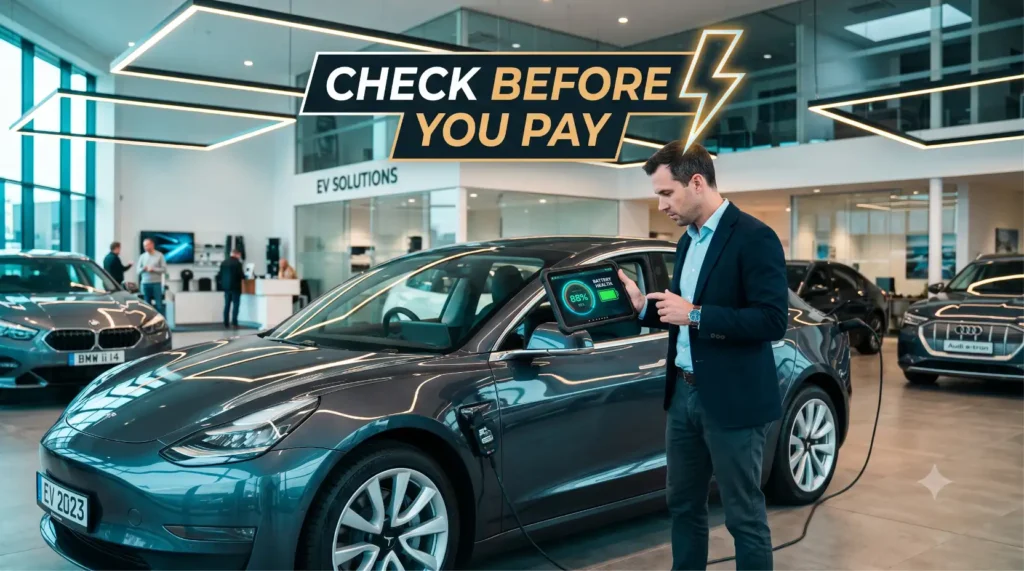
Picture this: you find a clean used EV, the price feels fair, the test drive is smooth, and the seller swears “the battery warranty is still good for years.” 🤝
So you pay. Months later the pack throws a fault, you call the manufacturer, and they tell you the warranty either lapsed, didn’t transfer, or got voided by something the previous owner did. Now that “good deal” is a five-figure problem sitting in your driveway. 😬
That nightmare is completely avoidable. It just takes a proper used EV warranty transfer check before any money changes hands. 👇
⚠️ One important note up front: Every warranty in this guide is described in typical or illustrative terms. Coverage years, mileage caps, transfer rules, and voiding factors vary by brand, model year, and country — and they change. Always confirm the exact terms in writing with the manufacturer (or an authorized dealer) for the specific VIN before you buy. Treat this article as a roadmap, not the final word on your particular car. ✅
⚡ The Short Answer
A solid used EV warranty transfer check comes down to confirming five things before you pay:
- 📅 The original in-service date — that’s when the warranty clock actually started, not the model year.
- 🔋 Battery warranty years and miles remaining — measured from that in-service date.
- 🔁 Whether the coverage transfers to you — most do automatically, but some have limits or paperwork.
- 🚫 Anything that could void it — salvage title, non-OEM repairs, commercial use, modifications.
- 📝 Proof in writing from the manufacturer — a VIN-based coverage statement, not the seller’s word.
The single most valuable thing you’re buying on a used EV often isn’t the car — it’s the remaining battery warranty. Verify it like your wallet depends on it, because it does. 🎯
📋 What to Verify Before You Pay
Here’s the at-a-glance table. Print it, screenshot it, or keep it open while you inspect. Every row is something a proper used EV warranty transfer check should confirm. 👇
| What to Verify | Why It Matters | How to Confirm |
|---|---|---|
| 📅 Original in-service date | Starts the warranty clock — older than you think? | VIN lookup, original sale invoice |
| 🔋 Battery warranty years/miles remaining | Tells you real coverage left (e.g., 8 yr/100k mi typical) | Manufacturer VIN report |
| 🔁 Transferability | Most transfer; some limit to first owner or one transfer | Brand warranty policy + dealer confirmation |
| 🚫 Voiding factors | Salvage title, non-OEM repairs, commercial/fleet use | Vehicle history report + service records |
| 🩺 Battery state of health (SoH) | A warranty is only useful if the pack is borderline | OBD2 scan / battery report |
| 📝 Paperwork needed | What the manufacturer requires to honor the transfer | Service records, ownership transfer docs |
Notice the theme: almost nothing here relies on trusting the seller. It all comes from the manufacturer, the VIN, or the paper trail. 🔍
🏆 Why the Battery Warranty Is the Most Valuable Thing That Transfers
Let’s be blunt about money for a second. When you buy a used petrol car, the engine warranty is usually long gone and replacing an engine costs a few thousand. On an EV, the battery is the single most expensive component — and replacing one out of warranty can run $10,000–$20,000 in the US or ₹6–₹12 lakh in India, sometimes more. 💸
That’s why a remaining battery warranty isn’t a nice bonus. It’s frequently worth more than every other feature on the car combined. A used EV with four years of battery coverage left is a fundamentally different (and safer) purchase than the identical car with the warranty expired.
So the heart of the whole exercise is simple: figure out exactly how much of that priceless battery protection actually comes with the car — and confirm it’s genuinely yours.
💡 New to used-EV shopping? Pair this with our Used EV Buying Guide: What to Check Before You Pay so the warranty check slots into your full inspection.
Think of it this way. You’re not just buying a car. You’re buying a car plus an insurance policy on its most expensive part — and you need to make sure that policy is still in force and still has your name on it. 🛡️
🔋 Typical EV Battery Warranty Terms (and Why “Typical” Matters)
Most EV battery warranties cluster around a familiar benchmark, but the details vary a lot, so treat these as illustrative. ⚠️
In the US, the common figure is 8 years / 100,000 miles of battery and powertrain coverage — partly because federal rules push automakers toward that floor. Many brands also guarantee the battery won’t drop below a certain capacity (often around 70%) during that window.
In India, EV battery warranties commonly land around 8 years / 160,000 km, though some brands offer shorter or longer terms, and a few separate the battery warranty from the general vehicle warranty entirely.
Here’s the catch that trips up buyers. ⏳
The battery warranty and the basic (bumper-to-bumper) warranty are usually two different clocks. The basic warranty might be 3–4 years and already expired, while the battery warranty still has years left. Don’t let an expired basic warranty fool you into thinking the battery coverage is gone too — that’s exactly the kind of thing a used EV warranty transfer check clarifies.
And again: these numbers are typical, not guaranteed. Some older or budget EVs carried shorter battery terms; some premium models carry longer ones. Confirm the actual figures for your specific VIN with the manufacturer. ✅
📅 How to Find the Original In-Service Date (the Start of the Clock)
This is the step buyers skip most often — and it’s the one that quietly costs them the most. 🕒
The warranty clock does not start on the model year printed on the listing. It starts on the in-service date — the day the car was first sold or first registered/put into service by the original owner. A “2022” EV could have an in-service date in late 2021 or well into 2023 depending on when it actually left the lot.
Why this matters: if a car has an 8-year battery warranty and was put in service in January 2020, then in mid-2026 you’ve got roughly 1.5 years of coverage left, not the “several years” the seller implied. 📉
Here’s how to nail down the real in-service date:
- 🔎 Run a VIN-based warranty/history lookup — many manufacturers and history reports show the in-service date directly.
- 🧾 Ask for the original purchase invoice — the first retail sale date is gold.
- 📞 Call an authorized dealer with the VIN — they can pull the warranty start date from the manufacturer system.
- 📋 Check the registration documents — first registration date is a strong proxy in many markets.
Get this date confirmed before you do anything else. Everything in your used EV warranty transfer check — years left, miles left, transfer eligibility — hangs off it. 🔑
🔁 Confirming Transferability (Most Transfer — Some Have Limits)
Good news first: for the vast majority of EVs, the battery and powertrain warranty transfers automatically to the next owner for the remainder of its term. You usually don’t have to do anything special. ✅
But “usually” is doing a lot of work in that sentence, so verify, don’t assume. Watch for these wrinkles:
- 👤 First-owner-only perks. Some extra benefits (extended coverage, certain top-up programs, or specific battery guarantees) are tied to the original buyer and don’t transfer, even if the core warranty does.
- 🔁 Transfer limits. A few programs allow the warranty to transfer only once, or require a transfer to be formally registered within a set window.
- 💵 Transfer fees or paperwork. Occasionally there’s a small administrative fee or a form the manufacturer wants filed to keep coverage active for the new owner.
- 🌍 Region locking. A warranty valid in one country may not follow the car across borders — relevant for imported used EVs.
The clean move: ask the manufacturer (or authorized dealer) one direct question with the VIN in hand — “Does the remaining battery warranty transfer to a second owner, and is there anything I must do to keep it valid?” Their written answer is the backbone of your used EV warranty transfer check. 📝
🚫 What Can Void the Warranty (Even If It “Transfers”)
A warranty that technically transfers is worthless if the car’s history already voided it. This is where the vehicle history report earns its cost. 🕵️
Common voiding or coverage-limiting factors include:
- 🏷️ Salvage, rebuilt, or branded title. A salvage title (or India’s equivalent total-loss/insurance write-off history) frequently voids the manufacturer battery warranty entirely. This is a hard stop for many buyers.
- 🔧 Non-OEM battery work or repairs. If the pack was opened, repaired, or serviced by an unauthorized shop — or fitted with non-genuine parts — coverage on the battery can be void.
- 🚕 Commercial or fleet use. Some warranties exclude or shorten coverage for cars used as taxis, ride-share, or delivery vehicles. Worth checking if the history hints at fleet life.
- 🛠️ Modifications. Aftermarket tuning, towing beyond rated limits, or hardware mods can compromise battery/powertrain coverage.
- 📵 Skipped required maintenance or software updates. A few brands require certain service intervals or BMS updates; ignoring them can weaken a claim.
- 💥 Severe accident damage near the pack. Structural damage around the battery can complicate or void coverage.
Run a vehicle history report and request the full service records. If anything on this list shows up, factor it into your used EV warranty transfer check — and your offer price. A salvage title alone can flip a “great deal” into a “walk away.” 🚶
🔍 How to Verify With the Manufacturer / VIN
Here’s the part that turns guesswork into proof. The seller is not your source of truth — the manufacturer is. 🏛️
Run through this verification sequence:
- Get the full 17-character VIN (or chassis number in India) from the car and the documents — make sure they match. 🔢
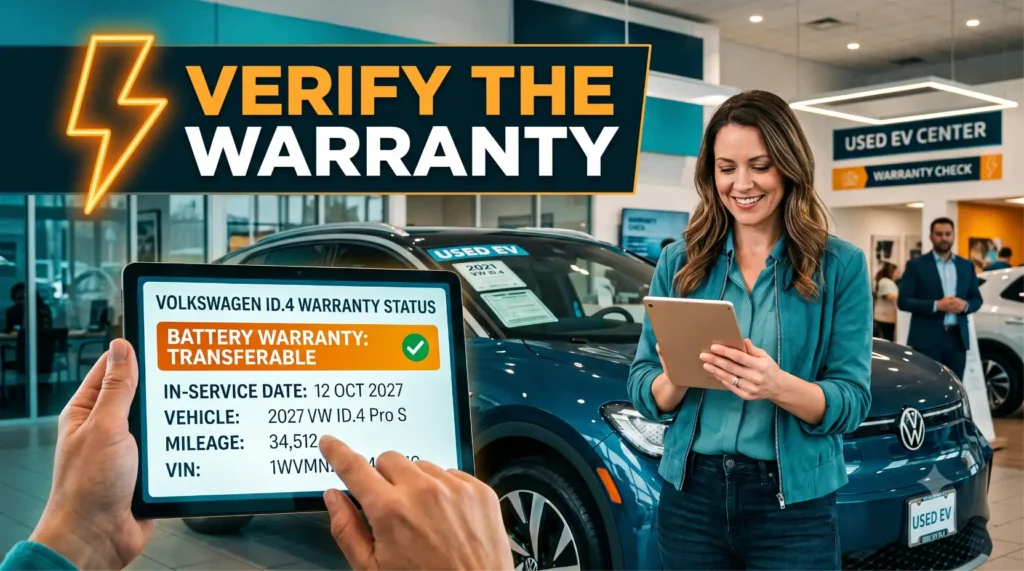
- Use the brand’s online warranty checker if one exists. Many manufacturers let you punch in a VIN and see remaining coverage. 💻
- Call or visit an authorized dealer/service center with the VIN and ask them to pull the warranty status, in-service date, and transfer terms from the manufacturer system. 📞
- Cross-check with a VIN-based vehicle history report for title status, accident/flood history, and ownership chain. 📑
- Run an OBD2 battery scan to confirm the pack’s state of health — a warranty matters most when the battery is borderline. 🔋
💡 Want the deeper context on how these warranties actually work? Read our EV Battery Warranty Explained guide before you make the calls — it’ll make every dealer conversation sharper.
The combination is what makes it bulletproof: the manufacturer confirms the coverage, the history report confirms it wasn’t voided, and the OBD2 scan confirms the battery is actually worth covering. That trio is the core of a real used EV warranty transfer check. 🎯
📝 Get It in Writing Before You Pay
This is the rule that protects you when memories get fuzzy and sellers get vague: if it’s not in writing, it doesn’t exist. ✍️
Verbal promises evaporate the moment there’s a problem. So before any money moves, collect:
- 📄 A manufacturer or dealer warranty statement showing the VIN, in-service date, and remaining battery coverage.
- 🔁 Written confirmation that the warranty transfers to you as the new owner, plus any steps required.
- 🧾 The vehicle history report showing a clean title and no voiding events.
- 🛠️ Service records proving required maintenance and authorized repairs.
For private sales especially, ask the seller to put their warranty claims in the bill of sale or a simple signed note. It won’t create coverage the manufacturer doesn’t recognize, but it documents what was represented to you — useful if you ever dispute the sale. 🛡️
If a seller resists every attempt to get things in writing, that resistance is your answer. A clean car with real coverage has nothing to hide. Slow down and protect yourself. 🐢
🇮🇳 India-Specific Warranty Transfer Notes
The Indian used-EV market has its own quirks, and a few of them directly affect your used EV warranty transfer check. 🛵
- 📅 Battery warranty terms vary widely. Many EVs carry around 8 years / 1,60,000 km on the battery, but budget two- and three-wheelers, and some older four-wheelers, may have shorter terms. Confirm the exact figure for the model and year.
- 🔁 Transfer is usually allowed but often paperwork-driven. Indian OEMs frequently honor transfer to the second owner, but doing the RC (Registration Certificate) ownership transfer cleanly — and informing the dealer — helps keep service and warranty records aligned.
- 🏷️ Insurance write-off history is the big red flag. A car that was declared a total loss / settled as an insurance claim can have voided coverage. Check this carefully via history and insurance records.
- 🔧 Stick to authorized service centers. Battery or BMS work done at unauthorized garages can compromise the warranty, just as in the US.
- 📞 Local dealer confirmation is essential. Brand warranty policies and transfer rules can differ between models and even between dealers’ interpretations — get the specific VIN/chassis status confirmed in writing.
Bottom line for Indian buyers: the principles are identical to the US — confirm the in-service date, the remaining coverage, transferability, and any voiding events — but lean extra hard on the RC transfer and insurance history. ⚖️
📈 2026: Warranty Transfer Is Getting Easier to Verify
The good news? In 2026, doing a used EV warranty transfer check is far less of a black box than it was even a couple of years ago. The information asymmetry that used to favor sellers is shrinking fast. 📱
Globally, more manufacturers now offer VIN-based online warranty checkers that show remaining coverage and in-service dates instantly — no dealer visit required. Certified pre-owned (CPO) EV programs increasingly bundle a verified warranty status right into the listing.
Vehicle history reports have gotten EV-smarter too. Many now flag battery-relevant events — flood damage, salvage titles, and major accidents near the pack — making voiding factors easier to spot before you ever call a dealer.
In India, organized used-EV platforms and OEM-backed pre-owned programs are standardizing warranty documentation and battery health reports, so transferable coverage is becoming a normal, visible part of listings rather than a hidden gamble.
The takeaway: you have more tools to verify coverage than buyers did even two years ago. The only mistake is not using them. 🔋
✅ 5 Steps to Verify the Transfer
Here’s the clean, repeatable process — run these in order on any used EV. 👇
- Confirm the original in-service date via VIN lookup or the original invoice. 📅
- Pull the remaining battery warranty (years and miles/km) from the manufacturer for that VIN. 🔋
- Confirm it transfers to you and note any required paperwork or fees. 🔁
- Run a vehicle history report to rule out salvage titles and other voiding events. 🚫
- Get all of it in writing before you hand over a single dollar or rupee. 📝
Five steps, maybe an afternoon of calls and clicks. That’s all that stands between you and an expensive surprise. ✅
🛒 Shop This Post
The tools that turn “the seller said” into “the manufacturer confirmed.” 😍
1. A Vehicle History Report 📑
Reveals salvage/rebuilt titles, accident and flood history, and ownership chain — the fastest way to catch a voided warranty.
👉 Shop vehicle history reports
2. A Bluetooth EV OBD2 Scanner 🔋
Confirms the battery’s state of health, so you know the warranty you’re verifying is actually protecting a pack worth protecting.
👉 Shop EV-compatible OBD2 scanners
3. An Extended EV Warranty / Coverage Plan 🛡️
If the factory battery warranty is short or expired, a reputable extended plan can bridge the gap — read the battery terms closely.
👉 Shop extended EV warranty plans
🛍️ Shop This Post: (Affiliate picks — no extra cost to you, and they keep EVs Mirror running. 🙏)
🎯 Quick Quiz: How Thorough Should Your Check Be?
- How expensive is the used EV? 🅐 Pricey 🅑 Budget
- Is the title clean and the history clear? 🅐 Not sure 🅑 Verified clean
- Did the seller put warranty claims in writing? 🅐 No 🅑 Yes
Mostly 🅐: 🔬 Go full — VIN warranty report, dealer confirmation, history report, and an OBD2 battery scan before paying.
Mostly 🅑: ✅ A VIN warranty check plus a clean history report should cover you — still get it in writing.
📋 Used EV Warranty Transfer Checklist
- [ ] Confirm the original in-service date (start of the clock)
- [ ] Pull remaining battery warranty years + miles/km from the manufacturer
- [ ] Verify the warranty transfers to a second owner
- [ ] Note any transfer paperwork, fees, or deadlines
- [ ] Run a vehicle history report for salvage/flood/accident events
- [ ] Confirm no non-OEM battery repairs in the records
- [ ] Check for commercial/fleet use exclusions
- [ ] Run an OBD2 battery state-of-health scan
- [ ] Get a written warranty statement tied to the VIN
- [ ] Confirm exact terms directly with the manufacturer ⚡
🤔 People Also Ask
Q: How do I do a used EV warranty transfer check before buying?
A: A proper used EV warranty transfer check means confirming the original in-service date, pulling the remaining battery warranty from the manufacturer for that specific VIN, verifying the coverage transfers to a second owner, running a vehicle history report to rule out voiding events like a salvage title, and getting it all in writing before you pay.
Q: Does an EV battery warranty transfer to the second owner?
A: In most cases, yes — the battery and powertrain warranty typically transfers automatically for the remainder of its term. But some programs have transfer limits, fees, or first-owner-only perks, so confirm the exact rules with the manufacturer for your VIN.
Q: How long do EV battery warranties last?
A: Typically around 8 years / 100,000 miles in the US and roughly 8 years / 160,000 km in India, often with a minimum capacity guarantee. These figures are illustrative and vary by brand and model year — always verify the actual terms.
Q: What voids an EV battery warranty on a used car?
A: Common voiding factors include a salvage or rebuilt title, non-OEM battery repairs, commercial or fleet use, certain modifications, and skipped required maintenance or software updates. A vehicle history report and service records help you catch these during your warranty transfer check.
Q: How do I find an EV’s original in-service date?
A: Use a VIN-based warranty or history lookup, the original retail purchase invoice, the first registration date, or call an authorized dealer with the VIN. The in-service date — not the model year — is when the warranty clock actually started.
Q: Can I verify a used EV’s warranty with just the VIN?
A: Largely, yes. Many manufacturers offer VIN-based online warranty checkers, and an authorized dealer can pull remaining coverage, the in-service date, and transfer terms from the VIN. Pair that with a VIN history report for the full picture.
🚀 The Bottom Line
A used EV is really two purchases in one: the car, and the insurance policy on its most expensive part. Skip the used EV warranty transfer check and you might be buying only the first one — with a five-figure liability hiding inside. ⚡
So do the work. Confirm the in-service date, pull the remaining battery coverage from the manufacturer, verify it transfers to you, run a history report to rule out salvage titles and other voiding events, scan the battery’s health, and get every bit of it in writing before you pay. And remember the golden rule: the exact terms always come from the manufacturer, not the seller. Do that, and you’ll buy with confidence instead of crossing your fingers. 🔋
💬 Verified a warranty transfer recently? Share what your manufacturer told you in the comments to help other buyers benchmark!
📤 Know someone EV-shopping? Send them this guide before they pay. 🙏
🔖 Bookmark EVs Mirror for honest used-EV buying advice.
👉 Up next: Used EV Buying Guide: What to Check Before You Pay and EV Battery Warranty Explained