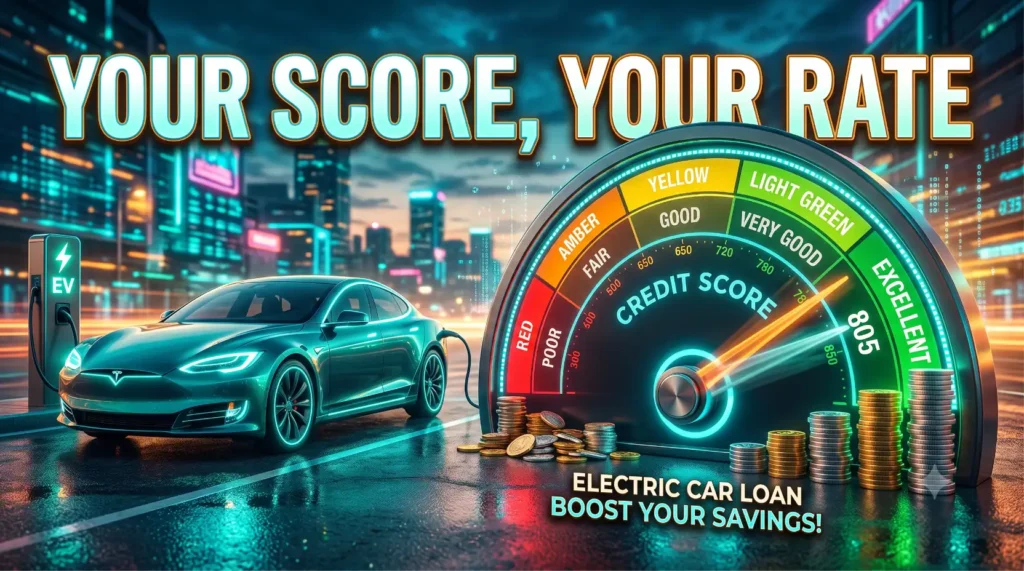
You found the EV. You did the test drive, you fell a little in love, and you’ve basically already named it. 🚗 Then comes the part nobody romanticizes: the financing.
The dealer or bank pulls a number you didn’t pick, didn’t see coming, and can’t argue with — your three-digit credit score. And in the space of about four seconds, that single number decides whether your monthly payment feels comfortable or makes you wince. 😬
Here’s what most buyers never realize: two people can buy the exact same electric car, on the same day, at the same dealership — and walk out paying thousands of dollars apart over the life of the loan. The car didn’t change. The price didn’t change. Their credit scores did. 💸
That’s the quiet power of your credit score on an EV loan, and this credit score EV loan guide breaks down exactly how it works — for both the US 🇺🇸 and India 🇮🇳 — so the number works for you instead of against you. 👇
⚠️ Quick but important disclaimer: This is general educational info, not financial advice. Every APR range, score tier, and monthly figure below is illustrative — your actual rate depends on your lender, your full credit profile, the car, the term, and the day you apply. Rates vary widely by lender and score. Always check your own credit, compare real quotes, and ideally run the numbers past a qualified financial advisor before signing. We’ll repeat this a few times, because money decisions deserve it. 🙏
⚡ The Short Answer
If you want the verdict before the homework, here it is. 👇
- 🟢 Higher score = lower rate. Your credit score EV loan rate is set by risk: a strong score signals “low risk,” which earns you the cheapest APR a lender offers.
- 💸 The gap is huge over time. A poor score versus an excellent one can mean thousands of dollars extra in interest on the same EV.
- 📊 It’s tiered, not a slider. Crossing into the next score band can drop your rate noticeably — even a few points can matter at the edges.
- 🇺🇸 In the US, it’s your FICO score (roughly 300–850) that does the heavy lifting.
- 🇮🇳 In India, it’s your CIBIL score (300–900) — same idea, different scale.
- 🛠️ You can move the needle. Small, fast fixes before you apply can bump you into a better tier and a cheaper rate.
That’s the spread. The rest of this article shows you the why, the how much, and the what to do about it. 😎
📊 Credit Score Tiers vs Illustrative EV Loan Rates
Here’s the whole story on one screen — how score tiers map to rates and what that does to your wallet. (All numbers illustrative; verify your own. 📋)
| Tier | 🇺🇸 FICO | 🇮🇳 CIBIL | Illustrative APR | Monthly cost impact (on a typical EV loan) |
|---|---|---|---|---|
| 🟢 Excellent | 750–850 | 800–900 | ~5–7% | Lowest payment — the rate everyone wishes they had |
| 🔵 Good | 700–749 | 750–799 | ~7–9% | Slightly higher — still a comfortable deal |
| 🟡 Fair | 640–699 | 680–749 | ~10–14% | Noticeably pricier — adds up fast over the term |
| 🟠 Poor | 580–639 | 600–679 | ~15–20%+ | Steep payments; total interest can balloon |
| 🔴 Deep subprime | <580 | <600 | 20%+ or declined | May need a co-signer, bigger down payment, or more time |
Notice the pattern: every tier you climb shaves real money off your rate. The jump from Fair to Good, or Good to Excellent, isn’t cosmetic — it’s the difference between a payment that fits your budget and one that strains it. Let’s unpack why. 👇
🎯 Why Your Credit Score Drives Your EV Loan Rate
At its core, a loan is a bet. The lender hands you a large pile of money up front and hopes you’ll pay it back, on time, for years. Your credit score is how they size up that bet. 🎲
Think of it as a risk-pricing engine. A high score whispers, “This person pays their bills, manages debt, doesn’t miss payments.” A low score whispers, “This one’s missed payments before — proceed carefully.” The lender can’t read your heart, so it reads your history. 📖
And here’s the key move: lenders don’t refuse risky borrowers outright (usually). Instead, they price the risk. Riskier borrower? Higher interest rate — to cover the chance you might default. Safer borrower? Lower rate — they’re confident they’ll get paid. ⚖️
This is why your credit score EV loan rate is joined at the hip with your number. You’re not being judged morally; you’re being priced statistically. The number is a shorthand for “how likely is this loan to go smoothly,” and the rate is simply the price tag attached to that probability. 🏷️
EVs add a small wrinkle, too. Because electric cars are newer and their resale values have been less predictable, some lenders eye the collateral a touch more cautiously. A strong score reassures them on both fronts — you and the asset. 🔋
The takeaway: your rate isn’t random or unfair. It’s a mirror of the trust you’ve built (or haven’t) with the financial system. The good news? Mirrors can be cleaned up. ✨
🟢🟡🟠 The Score Tiers and What They Actually Mean
Lenders mentally sort every applicant into bands, and your credit score EV loan offer is decided by which band you land in. Knowing which one you’re in — and how close you are to the next — is half the battle. Let’s walk the ladder. 🪩
🟢 Excellent (FICO 750–850 / CIBIL 800–900). This is the promised land. You get the lender’s best advertised rates, fast approvals, and real negotiating power. You’re the borrower banks compete for. If you’re here, your job is simply not to mess it up before signing. 👑
🔵 Good (FICO 700–749 / CIBIL 750–799). Still very strong. You’ll qualify easily and snag competitive rates — just a hair above the elite tier. Most well-organized buyers live here, and it’s a perfectly comfortable place to finance an EV. 💪
🟡 Fair (FICO 640–699 / CIBIL 680–749). The middle ground. You’ll likely get approved, but the rate climbs noticeably, and “noticeably” compounds over a multi-year loan. This is the tier where doing a little prep work before applying pays off the most. ⚙️
🟠 Poor (FICO 580–639 / CIBIL 600–679). Approval gets harder and rates get steep. Lenders may ask for a bigger down payment or a co-signer. It’s not hopeless — but it’s expensive, and worth improving first if you possibly can. ⏳
🔴 Deep subprime (FICO <580 / CIBIL <600). Here you may face very high rates, strict terms, or outright declines. The smartest move is often to pause, rebuild for a few months, and come back stronger. A short delay can save you a fortune. 🛑
The crucial insight: these bands have edges, and you’re often closer to the next one than you think. A handful of points can flip you from Fair to Good — and that flip is worth real money. 🎯
💸 How Much a Low Credit Score Actually Costs You
Let’s stop talking in percentages and start talking in cash, because that’s where this gets vivid. 🤑
Imagine two friends financing the same EV — say, a loan of around $35,000 / ₹15,00,000 over a 60-month (5-year) term. (Numbers illustrative — your real terms will differ.) 📋
Friend A has an excellent score and lands a ~6% APR. Friend B has a poor score and gets stuck at ~18% APR. Same car, same day, same dealership. Here’s roughly what happens:
- 🟢 Friend A (~6%): pays a lower monthly amount and shells out a few thousand in total interest over five years.
- 🟠 Friend B (~18%): pays a much higher monthly amount and can end up paying roughly double or more in total interest over the same five years.
The difference in total interest between those two scenarios can easily run into the thousands of dollars (₹ several lakhs in the India example). That’s a vacation. That’s a year of charging. That’s a chunk of the down payment on their next car — gone, simply because of a three-digit number. 😮
And it compounds in sneaky ways. A higher rate means more of each payment goes to interest instead of principal, so you build equity in the car more slowly, too. You owe more, for longer, on something that’s depreciating. 📉
This is the part that should motivate you: improving your credit score EV loan position before you apply isn’t a feel-good exercise — it’s one of the highest-return financial moves available to a car buyer. A few months of prep can outearn almost anything else you’ll do that year. 💰
(Illustrative figures — your actual savings depend on your lender, term, and full profile. Always run your own numbers. 🙏)
🇺🇸 vs 🇮🇳 FICO vs CIBIL — Both Matter, Same Logic
The score has a different name and scale depending on where you’re buying, but the philosophy is identical: prove you’re reliable, pay less. Let’s translate. 🌍
🇺🇸 In the US, it’s the FICO score (and sometimes VantageScore) that rules. It runs roughly 300 to 850, and most auto lenders treat the 700s and up as prime territory. Your score is built from payment history, amounts owed, length of credit history, new credit, and credit mix. Payment history and how much of your available credit you’re using carry the most weight. 📊
🇮🇳 In India, it’s the CIBIL score (from TransUnion CIBIL, with similar bureaus like Experian and Equifax) that lenders check. It runs 300 to 900, and most banks like to see 750+ for the best EV loan rates. The ingredients are familiar: repayment history, credit utilization, the mix of loans and cards, and how often you’ve applied for new credit. 🇮🇳
The scales differ — 850 versus 900 at the top — but the behaviors that build a great score are the same on both sides of the planet: pay on time, don’t max out your credit, and don’t chase loans you don’t need. 🌱
One practical note for Indian buyers: many banks offer EV-specific loan products and competitive rates, and a strong CIBIL score is your ticket to the lowest of them. (For a deeper dive on Indian numbers, see our guide to the best EV loan interest rates in India.) 🏦
And a note for everyone: whichever country you’re in, the score is a snapshot, not a sentence. It updates as your behavior does. Treat it as a dashboard light you can fix, not a permanent verdict. 🔧
🛠️ How to Improve Your Credit Score Before Financing
Here’s the empowering part: you can often nudge your score up meaningfully in just a few weeks or months — sometimes enough to jump a whole tier and unlock a better rate. Let’s get tactical. 💪
✅ Pay every bill on time, religiously. Payment history is the single biggest factor in both FICO and CIBIL. Even one late payment stings. Set up autopay so nothing slips through the cracks. ⏰
✅ Knock down your credit utilization. This is how much of your available credit you’re using. Lenders love to see it low — ideally well under 30%. Paying down card balances before you apply for an EV loan can give your score a quick, real lift. 📉
✅ Don’t open new credit right before applying. Each fresh application can ding your score and signal “this person’s hungry for credit.” Keep things calm in the months before you finance. 🧘
✅ Check your report for errors — and dispute them. A surprising number of credit reports contain mistakes: a paid debt marked unpaid, an account that isn’t yours. Fixing an error can bump your score for free. Pull your report and read it line by line. 🔍
✅ Keep old accounts open. Length of credit history helps. That ancient card you never use? It might be quietly boosting your average account age. Don’t close it on a whim. 🗂️
✅ Don’t apply for the car loan five minutes after deciding to buy. Give yourself a runway — even 30 to 90 days of clean, on-time, low-utilization behavior can show up in your score and your rate. 🛩️
The theme: small, boring, consistent habits move the needle more than any clever hack. And because the payoff is a lower rate on a big loan, that boring work is some of the best-paid effort you’ll ever do. 🤓
(General guidance, not financial advice — verify with your lender and a financial professional. 🙏)
🔍 Checking Your Score (For Free) Before You Shop
You wouldn’t walk into a negotiation blindfolded — so don’t walk into the finance desk not knowing your own number. The wild part? You can usually check it free. 🆓
🇺🇸 In the US: you’re entitled to free credit reports from the major bureaus (Equifax, Experian, TransUnion), and many banks, credit cards, and free apps now show your FICO or VantageScore at no cost. Check well before you shop so you have time to fix anything. 📲
🇮🇳 In India: you can get a free CIBIL score check annually, and various banking apps and financial platforms display it free, too. Same advice — look early, not at the showroom. 📱
Two things to know so you don’t accidentally hurt yourself:
- 🟢 Checking your own score is a “soft pull” — it does not lower your score. Check it as often as you like.
- 🟡 A lender checking it for a loan is a “hard pull” — that can nick your score a little. To minimize the damage, do your rate-shopping for the same car within a short window (often a couple of weeks); scoring models usually treat clustered auto-loan inquiries as a single shopping event. 🛒
Knowing your number ahead of time also gives you leverage. If you walk in already knowing you’re a prime borrower, you can confidently push back on a rate that doesn’t match your tier. Information is negotiating power. 💼
📋 What Else Lenders Look At (It’s Not Just the Score)
Your credit score is the headliner — but it’s not the whole band. Lenders weigh a few other factors that can soften or sharpen your rate. Know them, and you can shore up your case. 🎸
💵 Income and employment stability. Lenders want confidence you can comfortably afford the payments. Steady income and a stable job history reassure them — and can sometimes offset a slightly weaker score. 🏢
⚖️ Debt-to-income ratio (DTI). This compares your monthly debt payments to your monthly income. A low DTI says you’ve got breathing room for a new car payment; a high one raises eyebrows even with a decent score. Paying down other debts before applying helps here, too. 📐
💰 Down payment. Putting more money down shrinks the loan, reduces the lender’s risk, and can earn you a better rate — or rescue an approval that was on the fence. It’s the most direct lever you control on the day. (More on this in our guide to how much down payment you need for an EV.) 🏦
📆 Loan term and the car itself. Shorter terms often carry lower rates. And because EVs are newer with evolving resale values, the specific model and its expected value can influence the offer, too. 🔋
🤝 Co-signer or co-applicant. If your score is shaky, a creditworthy co-signer can pull your rate down — though they’re on the hook if you don’t pay, so it’s a serious favor to ask. 👥
The big-picture lesson: a great score is your strongest card, but it’s not your only card. Stack a healthy DTI, a solid down payment, and steady income on top of it, and you walk in holding a winning hand. 🃏
🟠 Getting Approved With a Lower Credit Score
What if your score isn’t where you’d like it, but you genuinely need the car now? Don’t despair — you have moves. They just cost a bit more, so play them smartly. 🧠
🏦 Shop around aggressively. Different lenders have different appetites for risk. Credit unions and EV-friendly banks sometimes approve and price more kindly than a dealer’s default option. Get multiple quotes — within a tight window to protect your score. 🛓
💰 Put more money down. A bigger down payment lowers the lender’s risk and can both unlock approval and trim your rate. It’s the most reliable lever when your score is the weak link. 📉
🤝 Bring a co-signer. A creditworthy co-signer can dramatically improve your terms. Just be crystal-clear about the responsibility you’re both taking on. 👥
⏳ Consider waiting a few months. Sometimes the cheapest “loan” is the one you delay. Even 60–90 days of on-time payments and lower card balances can lift you a tier and save you far more than the wait costs. ⌛
📑 Read the fine print on subprime offers. Higher-rate loans sometimes hide steep fees, prepayment penalties, or back-loaded terms. Know exactly what you’re signing, and avoid anything predatory. 🔎
A lower credit score EV loan scenario doesn’t lock you out — it just means you should be more deliberate, more patient, and a tougher shopper. Approached carefully, you can still drive home electric without overpaying for years. 🚗
(Not financial advice — verify all terms with your lender and, ideally, a financial advisor. 🙏)
📈 2026: Credit and EV Lending
The credit-and-EV landscape isn’t standing still. Here’s what’s shifting in 2026 — and why it matters for your rate. 👇
🔋 EV prices have eased. Falling battery costs have pushed many sticker prices down, which means smaller loans — and smaller loans are a touch more forgiving of a middling score. Cheaper cars soften the rate sting. 💪
🏦 Lenders are getting EV-savvy. As electric resale data matures, more banks treat EVs as mainstream collateral rather than question marks. That’s gradually translating into more competitive, EV-specific loan products on both sides of the world. 📊
📲 Score visibility is everywhere. Free score tracking is now baked into most banking and finance apps, so buyers walk in better-informed than ever. Use that — knowing your number before you shop is your single biggest advantage in 2026. 🎯
🇮🇳 India keeps incentivizing. Banks continue rolling out EV loan products, and many states maintain road-tax and registration perks that lower the on-road price regardless of your score — though a strong CIBIL still wins you the best rate. 🇮🇳
The headline for 2026: the informed buyer wins. With free score checks, easier prices, and more competition among lenders, the gap between a prepared borrower and an unprepared one has never been wider. Be the prepared one. ✅
✅ 5 Tips to Get a Better Rate
Five concrete moves to walk away with a cheaper EV loan. 👇
- 🔍 Check your score early — for free. Know your tier weeks before you shop, so you have runway to fix issues and leverage to negotiate.
- 📉 Slash your credit utilization. Pay down card balances before applying. It’s the fastest, most reliable score booster you control.
- ⏰ Never miss a payment in the run-up. Payment history is king. Autopay everything for the 90 days before you finance.
- 🛒 Shop multiple lenders in a tight window. Credit unions, banks, and EV-specific products vary a lot — and clustered inquiries protect your score.
- 💰 Put more down (if you can). A bigger down payment lowers risk, improves your rate, and shrinks the total interest you’ll ever pay. (Verify everything with your lender. 📋)
Do all five and you tilt the odds firmly in your favor. 🚀
🛒 Tools to Boost Your Score and Score a Better Rate (Shop This Post)
Want to walk into the finance desk holding the strongest hand possible? These help you prep your credit and run the numbers before you sign anything. 😍
1. A Credit Monitoring & Score-Tracking Service 📊
See your FICO/CIBIL movement in real time, get alerts on changes, and catch errors before a lender does — so you fix your score before it costs you.
👉 Shop credit monitoring services
2. An Auto Loan & EMI Calculator Tool 🧮
Plug in price, rate, and term to see exactly how your score’s APR translates to a monthly payment and total interest — no showroom surprises.
👉 Shop loan calculators
3. A Personal Finance & Budgeting App 💰
Track your debt-to-income, pay down balances strategically, and make sure the EV payment actually fits your life, not just the dealer’s pitch.
👉 Shop budgeting apps
🛍️ Shop This Post: (These are affiliate picks — they cost you nothing extra, and a small commission supports EVs Mirror. Thank you! 🙏)
🎯 Quick Quiz: How Ready Is Your Credit?
Three questions. Answer honestly. 👇
- Do you know your current score? 🅐 Yes, checked it recently 🅑 No idea
- Your credit card balances? 🅐 Low / paid off 🅑 Maxed or close
- Any missed payments in the last year? 🅐 None 🅑 One or more
Mostly 🅐: 🟢 You’re in great shape — likely a prime borrower. Shop confidently and push for the best rate.
Mostly 🅑: 🟠 Pump the brakes for a few weeks. A little prep — pay down balances, set autopay, check your report — could jump you a tier and save you real money.
Mixed bag: 🟡 You’re close. Knock out a couple of quick fixes before you apply and you’ll likely land a better rate.
📋 Pre-Loan Credit Checklist
Run through this before you sit at the finance desk. Don’t sign until every box is ticked. ✅
- [ ] Check your credit score (free) — FICO 🇺🇸 or CIBIL 🇮🇳
- [ ] Pull your full credit report and dispute any errors
- [ ] Pay down credit card balances to lower your utilization
- [ ] Confirm no missed payments in the recent months (set up autopay)
- [ ] Avoid opening new credit lines right before applying
- [ ] Estimate your debt-to-income ratio and trim other debt if high
- [ ] Decide on a down payment that lowers your loan and rate
- [ ] Get multiple loan quotes within a short shopping window
- [ ] Compare total interest, not just the monthly payment
- [ ] Run the final numbers past a financial advisor before signing ⚡
🤔 People Also Ask
Q: How does my credit score affect my EV loan rate?
A: Lenders use your credit score to price the risk of lending to you. A higher score (FICO 750+ / CIBIL 750+) earns the lowest APRs, while a lower score means a higher rate to offset perceived risk. On the same EV, the gap between an excellent and a poor score can mean thousands of dollars in extra interest over the loan. (Illustrative — verify your own numbers.)
Q: What credit score do I need for the best EV loan rate?
A: Generally, the higher the better. In the US, a FICO score in the 700s and above (ideally 750+) unlocks prime rates; in India, lenders typically want a CIBIL score of 750+ for their best EV loan offers. Below those bands, you’ll still likely qualify, but at a higher rate. Rates vary by lender — always compare.
Q: Can I get an EV loan with a low credit score?
A: Often, yes — just at a higher rate or with conditions. A bigger down payment, a creditworthy co-signer, or shopping multiple lenders can help. Credit unions and EV-specific products sometimes price more kindly. If your score is very low, waiting a few months to improve it can save you far more than it costs.
Q: Does checking my own credit score lower it?
A: No. Checking your own score is a “soft pull” and doesn’t affect it — you can check as often as you like. Only a “hard pull” by a lender during an application can nick your score slightly, so cluster your rate-shopping into a short window to minimize the impact.
Q: How much can a bad credit score cost me on an EV loan?
A: Potentially a lot. On an illustrative $35,000 / ₹15,00,000 loan over five years, the difference between a ~6% rate (excellent credit) and a ~18% rate (poor credit) can mean paying roughly double the total interest — thousands of dollars (₹ several lakhs) over the term. That’s the cost of a few credit points. (Figures illustrative.)
Q: How fast can I improve my credit score before financing?
A: Some moves work quickly — paying down credit card balances and disputing report errors can show up in weeks. Building a longer track record of on-time payments takes more time, but even 30 to 90 days of clean behavior before applying can lift you a tier and earn a better rate.
🚀 The Bottom Line
So, how much does your credit score EV loan rate really move based on your number? Enormously — and quietly. It’s the invisible hand setting your monthly payment before you’ve even sat down. ⚡
The encouraging truth is that this number is yours to shape. Unlike the car’s price or the lender’s policies, your score responds to a handful of boring, repeatable habits: pay on time, keep balances low, check your report, and don’t apply for the loan five minutes after deciding to buy. 🌱
Walk in knowing your number, with your utilization trimmed and your report clean, and you transform from someone the finance desk prices into someone who negotiates. That shift — from passenger to driver — is worth thousands over the life of the loan. 💰
Whether you’re comparing US FICO bands or chasing a higher CIBIL score in India, the playbook is the same: prep first, shop hard, and compare total cost, not just the monthly number. Do that, and your EV becomes a smart financial move instead of an expensive one. 🎯
(One more time, because money matters: this is general info, not financial advice. Rates vary by lender and score, all figures are illustrative, and you should check your own credit and run the numbers past a financial advisor before signing. 🙏)
💬 What’s your experience — did your score get you the rate you expected? Tell us in the comments!
📤 Know someone about to finance an EV? Send them this before they sign. 🙏
🔖 Bookmark EVs Mirror for honest, no-spin EV money guides.
👉 Up next: Best EV Loan Interest Rates in India and EV Loan vs Lease: Which Saves You More?