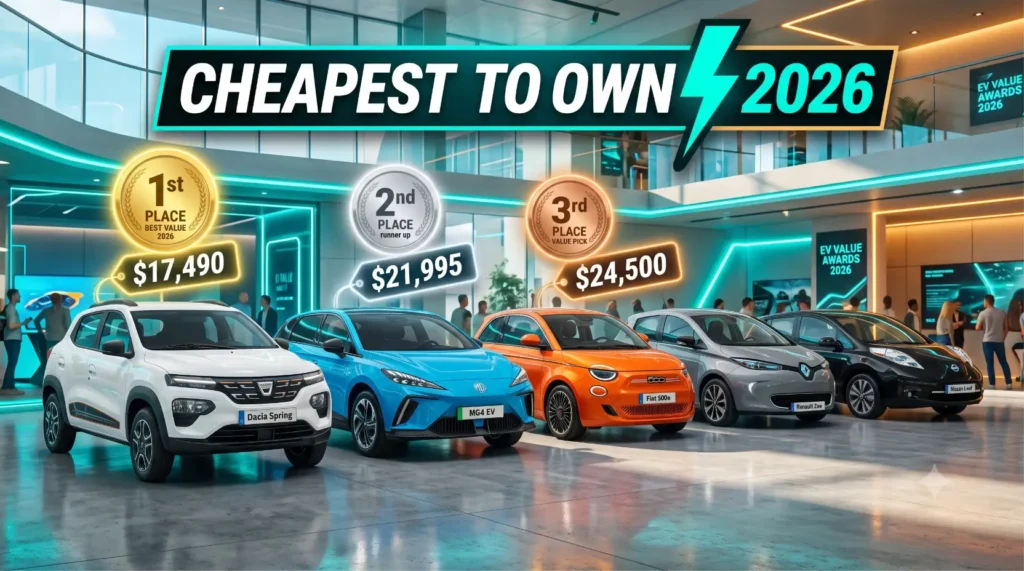
Here’s the trap almost every first-time buyer walks into: they open a browser tab, sort EVs by price, lowest first, and assume the cheapest number on the screen is the cheapest car to live with. 🏷️
It feels logical. It’s also wrong, and it’s wrong in a way that can cost you thousands of dollars across four or five years of ownership.
Because a car isn’t a one-time purchase. It’s a long, slow relationship. ☕ You pay for it every single month — in charging, in insurance, in the value quietly bleeding out of it while it sits in your driveway, and in the occasional tire or wiper that nobody warns you about.
Two electric cars can wear the exact same window sticker and still be wildly different to own. One sips electricity, holds its value, and costs peanuts to insure. The other guzzles kilowatt-hours, sheds value like a wet dog, and somehow triggers a scary insurance quote.
So the real question isn’t “what’s the cheapest electric car to buy.” It’s a sharper, more useful question — what’s actually the cheapest EV to own? 👇
- ⚡ The Short Answer
- 📊 What to Weigh — The Total-Cost Scorecard
- 🥇 Cheap to Buy vs. Cheap to Own — They're Not the Same Thing
- ⚡ Why Efficiency Is the Quiet Superpower
- 🛒 The Used EV Route — Often the Real Winner
- 📉 Insurance and Depreciation — The Two Costs Nobody Test-Drives
- 💰 Running Cost — The Drip That Adds Up
- 🧮 Total Cost vs. Sticker Price — How to Actually Rank Them
- 🇮🇳 A Quick Note for India Readers
- 📈 2026 Trends Affecting the Cheapest-to-Own Pick
- ✅ 5 Ways to Make Any EV Cheaper to Own
- 🛒 Shop This Post
- 🎯 Quick Quiz: Are You Optimizing for True Cheapest-to-Own?
- 📋 Cheapest-to-Own Checklist
- 🤔 People Also Ask
- 🚀 The Bottom Line
⚡ The Short Answer
The cheapest EV to own is rarely the one with the smallest price tag. It’s the one with the lowest total cost once you stack everything up.
- 🥇 Efficient, mainstream compact EVs usually win. They charge cheap, insure cheap, and sell easily later.
- 🥈 A lightly-used EV (1–3 years old) often beats a brand-new budget model, because someone else already ate the worst depreciation.
- 🥉 Value-holding models quietly win the long game — depreciation is almost always the single biggest cost of ownership, bigger than fuel.
- 💸 Incentives reshuffle the whole board. A car that’s mid-priced before the federal tax credit can become the cheapest one after it.
- 🛡️ Insurance is the wildcard. Two similar EVs can differ by hundreds of dollars a year — get quotes before you fall in love.
Sticker price is just the deposit on the real question. 😎 Let’s break down how to answer it properly.
📊 What to Weigh — The Total-Cost Scorecard
When you’re hunting for the lowest-total-cost EV, no single number tells the story. You have to weigh five cost factors together. Here’s the scorecard. 👇
| Cost Factor | What It Covers | Why It Matters |
|---|---|---|
| 🏷️ Price after incentives | Sticker minus tax credit/rebates | The real entry price — can swing by thousands |
| ⚡ Efficiency (mi/kWh) | Miles you get per unit of electricity | Drives your charging cost for every mile, forever |
| 🛡️ Insurance | Annual premium for that model | Varies hugely by repair cost and theft data |
| 📉 Depreciation | Value lost per year | Usually the largest single cost of ownership |
| 🛠️ Maintenance | Service, tires, brakes, fluids | Low for all EVs, but tires can surprise you |
The trick? The cheapest EV to own scores well across all five rows — not brilliantly on one and badly on the rest. A car that’s cheap to buy but expensive to insure and quick to depreciate isn’t cheap. It’s a trap wearing a discount sticker. 🎯
🥇 Cheap to Buy vs. Cheap to Own — They’re Not the Same Thing
This is the whole ballgame, so let’s slow down here.
“Cheap to buy” is a single moment. It’s the price you negotiate, sign for, and drive away on. It feels like the decision — but it’s really just the first of about sixty monthly decisions you’ve quietly committed to.
“Cheap to own” is the entire timeline. 📅 It’s that purchase price plus every dollar the car asks for over the years you keep it.
Think of two archetypes. The first is the bargain-bin EV — lowest sticker in its class, but it’s heavy, inefficient, unpopular on the used market, and pricey to insure. The second is the sensible efficient compact — costs a little more upfront, but it’s frugal with electricity, beloved by used buyers, and cheap to cover.
Run those two over five years and the “expensive” one often comes out thousands ahead. The bargain-bin car’s low price gets erased by everything that happens after you sign.
That’s the mental flip this whole guide is built on. Stop sorting by price. Start estimating total cost. The cheapest EV to own lives at the bottom of that second list, and it’s almost never the same car at the top of the first. 💡
⚡ Why Efficiency Is the Quiet Superpower
If there’s one spec that separates the genuinely cheap EVs from the merely cheap-looking ones, it’s efficiency — measured in miles per kilowatt-hour (mi/kWh).
Here’s the intuition. Two EVs both need to cover the same 12,000 miles a year. One does 4.0+ mi/kWh. The other, a heavier crossover, does maybe 2.5 mi/kWh. The frugal one uses roughly 3,000 kWh a year. The thirsty one burns closer to 4,800 kWh for the exact same driving. ⚡
That difference doesn’t happen once. It happens every year, on every mile, for as long as you own the car. Multiply it across electricity rates and several years and the gap can quietly rival a meaningful chunk of the purchase-price difference.
Efficiency is shaped by a few honest things — vehicle weight, aerodynamics, tire choice, and how you drive. 🍃 Lighter, slipperier, smaller cars almost always win. Big boxy SUVs almost always lose, no matter how clever their battery is.
So when you’re comparing “affordable” EVs and the prices look similar, let efficiency be your tiebreaker. The more efficient car is the one quietly handing money back to you at every charge. It’s the running-cost engine of cheap ownership, and most shoppers ignore it completely. 🎯
🛒 The Used EV Route — Often the Real Winner
Here’s the move that the sticker-price crowd almost never considers, and it’s frequently the single fastest path to the cheapest EV to own: don’t buy new. 🛓
New cars take their hardest depreciation hit in the first couple of years. It’s brutal and it’s front-loaded — a chunk of value evaporates the moment the car leaves the lot, and more melts away over the next 24 months.
A lightly-used EV lets someone else absorb that punch. You step in at year two or three and get a car that’s still mechanically near-new — EVs have very few wearing parts — for a meaningfully lower price. Same quiet cabin, same cheap-per-mile charging, same low maintenance. Just without the worst of the depreciation cliff. 📉
The used-EV market in 2026 is also far healthier than it was a few years ago. There are simply more EVs out there, which means more choice, more competitive pricing, and better data on which models hold up.
A few sanity checks before you sign on a used one:
- 🔋 Battery health — ask for a state-of-health reading; a healthy pack is the whole point.
- 🔌 Charging history and software — confirm it still gets updates and fast-charges normally.
- 🧾 Remaining warranty — many EV batteries carry long warranties that transfer to you.
- ⚡ Real-world efficiency — check owner reports, not just the original spec.
For pure total-cost value, a clean used value-holder is the model to beat. Always pit it against a new budget car before you decide. 🎯
💡 Read: Worried the car you pick will tank in value? Here’s the full breakdown — EV Depreciation: How Much Value Will You Lose?
📉 Insurance and Depreciation — The Two Costs Nobody Test-Drives
You can test-drive acceleration. You can’t test-drive an insurance premium or a resale value. Which is exactly why these two costs ambush so many buyers — and why they decide the cheapest EV to own more than almost anything else.
Depreciation first, because it’s usually the biggest number of all. 📉 Over a typical ownership period, the value a car loses often dwarfs what you’ll ever spend on electricity. A model that holds 60% of its value beats one that holds 40% — even if the second one was a little cheaper to buy. The difference is real money you get back when you sell.
What protects resale value? A few honest signals: a desirable, well-known nameplate; strong real-world range; a reputation for reliable batteries; and steady demand on the used market. Quirky, obscure, or range-anxious models tend to fall faster. 🫂
Insurance second, because it’s the sneaky one. 🛡️ Premiums swing widely between EVs based on how expensive they are to repair, how often they’re stolen, and how the model scores on safety. A “cheap” EV with pricey-to-fix body panels or a magnet for thieves can cost hundreds more a year to insure than a mundane, common compact.
The fix is simple and almost nobody does it: get a real insurance quote on your specific shortlist before you commit. 📞 Two minutes per car. It can flip your ranking entirely — and it’s free.
Stack those two together and you’ve covered the costs that don’t show up on any spec sheet but quietly run the math.
💰 Running Cost — The Drip That Adds Up
Purchase price is a wave. Running cost is the tide. 🌊 It’s small every day and enormous over time.
Running cost is mostly two things: what you pay to charge and what you pay to keep the car healthy. The good news is that EVs win big on the second part for everyone — no oil changes, no spark plugs, no exhaust, regenerative braking that spares the brake pads. Maintenance is genuinely low across the board. 🛠️
So the variable that actually moves the needle is charging — and that loops right back to two levers you control.
The first lever is efficiency, which we covered. The more mi/kWh, the less every mile costs.
The second lever is where and when you charge. 🏠 Charging at home on an off-peak overnight rate is dramatically cheaper than leaning on public fast chargers. A home Level 2 setup plus a smart schedule can cut your per-mile fuel cost to a fraction of what gas drivers pay — and a fraction of what convenience-charging EV owners pay, too.
Tires are the one running cost that surprises people. 🛸 EVs are heavy and torquey, so they can wear tires faster than expected. Choosing proper EV-rated tires and keeping them correctly inflated protects both your efficiency and your wallet. It’s a small habit with a real payoff.
Add it up and the cheapest cars to run are efficient ones, charged at home, on the right tires. None of that requires a bigger budget — just better choices. 💸
🧮 Total Cost vs. Sticker Price — How to Actually Rank Them
Let’s make this concrete, because “think about total cost” is useless advice without a method.
Here’s the simple framework. For each car on your shortlist, estimate four numbers over the years you plan to keep it: 📝
- Price after incentives — sticker minus any tax credit or rebate you qualify for.
- Charging cost — your annual miles ÷ efficiency × your electricity rate, across all the years.
- Insurance — your real quote × the number of years.
- Depreciation — price after incentives minus what you’d realistically sell it for later.
Maintenance is low and similar for most EVs, so it rarely changes the ranking — but add a modest line for tires and service to be honest.
Now add those up per car. The lowest total wins. That’s your cheapest EV to own, full stop — and it routinely isn’t the one with the lowest sticker. 🥇
The magic of this exercise is what it exposes. A cheap-to-buy car with bad efficiency and fast depreciation climbs the list once you total it. A slightly pricier efficient value-holder sinks to the bottom, where you want it. The sticker lied; the spreadsheet told the truth.
You don’t need fancy software. A napkin and five minutes of honest numbers will out-think 90% of car shoppers. ✍️
👉 Up next: Want the cleanest apples-to-apples math on fuel? Here’s the real number — EV vs Gas Car: Real Cost Per Mile
🇮🇳 A Quick Note for India Readers
The total-cost logic travels perfectly — but the levers look a little different in India. 🇮🇳
On price, the entry point keeps dropping as more affordable compact EVs and electric scooters arrive, and state incentives plus road-tax exemptions can shave the effective cost further. The cheapest-to-own winner is still usually the efficient, popular model with strong resale, not the rock-bottom sticker.
On running cost, the home-charging advantage is even more dramatic relative to petrol, especially on concessional or off-peak tariffs. Efficiency (here you’ll often see it framed per km) is still your biggest fuel lever.
The one factor to watch closely is resale and battery confidence, since the used-EV market is younger and demand varies by city. Pick a known nameplate with a transferable battery warranty and you protect the biggest cost of all. The principle never changes: total cost beats sticker price. ⚡
📈 2026 Trends Affecting the Cheapest-to-Own Pick
The landscape is shifting in buyers’ favor — but it’s shifting, so here’s what’s actually moving the needle this year. 🔭
Incentives are doing heavy lifting. 💸 In the US, federal tax credits and point-of-sale rebates on eligible models can dramatically cut the effective price, which reshuffles which car is genuinely cheapest after the math. A model that looks mid-pack on sticker can leapfrog to the front once the credit lands at the dealership instead of next April.
New-EV prices keep softening. As more models compete and battery costs trend down, entry prices have generally eased — pulling more cars into “genuinely affordable” territory.
The used market matured. 🛒 More EVs have aged into the used pool, giving buyers real choice, better pricing, and far more reliability data than even two years ago. This is the single biggest win for total-cost shoppers.
Efficiency is improving quietly. Newer platforms squeeze more miles from each kilowatt-hour, which lowers running cost across the board — even on cheaper trims.
Insurance is still the wildcard. 🛡️ Repair costs and parts availability keep premiums uneven between models, so quoting your shortlist matters more than ever. Don’t assume “EV” means “cheap to insure.”
The throughline: ownership is getting cheaper almost everywhere — but the ranking of which EV is cheapest changes year to year. Run your own numbers on today’s incentives, not last year’s headlines. 🎯
✅ 5 Ways to Make Any EV Cheaper to Own
Even after you’ve picked a car, you’ve got levers. Pull these and almost any EV gets cheaper to live with. 💪
- Claim every incentive you qualify for. 💸 Federal, state, and utility programs can stack — and a point-of-sale credit beats waiting until tax season. This single move can change which car is cheapest.
- Charge at home on off-peak rates. 🏠 An overnight schedule plus a smart Level 2 charger is the heart of low running cost. It’s the difference between fuel being an afterthought and a monthly sting.
- Pick (and keep) high efficiency. ⚡ Choose the more efficient model, then protect it — proper tires, correct pressure, easy acceleration. More mi/kWh means less spend per mile, every mile.
- Choose a value-holder. 📉 Depreciation is the biggest cost, so a desirable, well-known model with strong resale quietly saves you the most — you get more back when you sell.
- Shop insurance hard, every renewal. 🛡️ Premiums vary a lot between insurers and models. Quote before you buy, then re-shop annually. It’s the easiest free money in car ownership.
None of these require a bigger budget. They just require doing the boring stuff most buyers skip. 😎
🛒 Shop This Post
A genuinely cheap EV to own is mostly about charging smart and protecting efficiency. These three picks do exactly that. 🛍️
1. A Smart Level 2 Home Charger ⚡
Off-peak home charging is the single biggest running-cost saver there is. A scheduled Level 2 charger lets you fill up overnight at your cheapest rate while you sleep.
👉 Shop smart Level 2 chargers
2. A Smart Energy Monitor 📊
You can’t cut a cost you can’t see. An energy monitor shows your real charging spend so you can shift more of it to off-peak and keep ownership genuinely cheap.
👉 Shop energy monitors
3. EV-Rated Tires + a Portable Inflator 🛸
Heavy, torquey EVs chew through the wrong tires. EV-rated rubber plus a quick inflator protects your efficiency, your range, and your wallet from avoidable wear.
👉 Shop EV tires & inflators
🛒️ Disclosure: These are affiliate picks. If you buy through them it costs you nothing extra, and it helps support EVs Mirror. 🙏 We only suggest gear that actually lowers ownership cost.
🎯 Quick Quiz: Are You Optimizing for True Cheapest-to-Own?
Answer honestly. 👀
- Did you compare total cost — not just sticker price? 🅐 Yes 🅑 No
- Is your pick efficient (roughly 4+ mi/kWh)? 🅐 Yes 🅑 No
- Did you actually price a lightly-used value-holder against it? 🅐 Yes 🅑 No
- Did you get a real insurance quote on the specific model? 🅐 Yes 🅑 No
Mostly 🅐: 🟢 You’re optimizing for true cheapest-to-own. Sign with confidence.
Mostly 🅑: 🟡 Pause. Re-check efficiency, resale, used options, and insurance before you commit — the cheapest car on paper may not be cheapest to live with.
📋 Cheapest-to-Own Checklist
Print this. Tick every box before you sign. ✅
- [ ] Compared prices after incentives, not before
- [ ] Checked efficiency in mi/kWh for each model
- [ ] Got a real insurance quote per shortlisted model
- [ ] Researched resale value and depreciation history
- [ ] Compared a new budget model vs. a lightly-used value-holder
- [ ] Estimated annual home-charging cost on your real rate
- [ ] Confirmed battery health/warranty (especially if buying used)
- [ ] Added all of it into one total-cost ranking ⚡
🤔 People Also Ask
Q: What is the cheapest EV to own in 2026?
A: The cheapest EV to own is whichever model has the lowest total cost — price after incentives, plus charging, insurance, and depreciation over the years you keep it. In practice, efficient mainstream compacts and clean lightly-used value-holders usually win, not the car with the lowest sticker price.
Q: Is the cheapest EV to buy also the cheapest to own?
A: Often not. A low sticker price can be quietly erased by poor efficiency, high insurance, or fast depreciation. What matters is the total bill over several years, and the lowest-priced car frequently isn’t the cheapest EV to own once you add it all up.
Q: Are used EVs cheaper to own than new ones?
A: Frequently, yes. Buying a 1–3 year-old EV lets the first owner absorb the steepest depreciation while you keep the same low charging and maintenance costs. Just verify battery health and remaining warranty before you commit.
Q: Does efficiency really change ownership cost that much?
A: Yes — more than people expect. A 4+ mi/kWh car costs noticeably less to charge per mile than a heavy 2.5 mi/kWh model, and that gap repeats on every mile for years. Over tens of thousands of miles it adds up to serious money.
Q: How do incentives change which EV is cheapest?
A: Significantly. Federal, state, and utility incentives can cut the effective price by thousands, which reshuffles the ranking entirely. A point-of-sale credit at the dealer is better than waiting for tax season because it lowers what you finance.
Q: Does insurance really differ that much between EVs?
A: It can differ by hundreds of dollars a year, driven by repair costs, theft rates, and safety scores. That’s why you should quote your specific shortlist before buying — insurance alone can flip which model is cheapest to own.
🚀 The Bottom Line
The cheapest EV to own isn’t the one with the smallest number in the listing. It’s the one with the lowest total cost: affordable after incentives, efficient at the plug, sensible to insure, and slow to lose its value. ⚡
Sort by sticker price and you’re optimizing for a single moment. Sort by total cost and you’re optimizing for the entire relationship — which is the only number that ever actually leaves your bank account.
So do the five-minute math. Compare a used value-holder against the new budget pick. Charge at home, choose efficiency, quote your insurance, and claim every incentive. Do that, and you’ll drive home a car that’s genuinely cheap to live with for years — not just cheap to sign for on day one. 😎
💬 What’s the cheapest EV you’ve actually found to own? Drop your pick in the comments — real-world numbers help everyone.
📤 Know someone shopping on sticker price alone? Send them this before they sign. 🙏
🔖 Bookmark EVs Mirror for total-cost, value-first EV guides.