You’re scrolling used EV listings and you spot two nearly identical cars. Same model, same year, similar mileage. One is a private-party sale priced to move. The other wears a shiny “Certified Pre-Owned” badge — and costs noticeably more. 🤔
Your gut says the badge must mean something. But your wallet is asking the obvious question: is that extra money buying real protection, or just a sticker and a slightly cleaner dashboard? 💸
That’s the whole debate in one sentence. And for EVs specifically — where the battery can make or break the deal — the answer is more nuanced than it is for petrol cars. So let’s settle it honestly and figure out whether a certified pre-owned EV worth it for your situation. 👇
⚠️ A quick note on prices and terms: Every dollar figure, rupee figure, warranty length, and premium percentage in this guide is illustrative. CPO programs, coverage, and pricing vary wildly by brand, model year, region, and dealer — and they change constantly. Treat this as a decision framework, not a quote. Always confirm the exact certification terms in writing for the specific car before you buy. ✅
- ⚡ The Short Answer
- 📊 CPO vs Regular Used EV: The Honest Comparison
- 🏷️ What "Certified Pre-Owned" Actually Means for an EV
- 🔍 What the Inspection and Refurb Actually Cover (Including Battery SoH)
- 🛡️ The Warranty Angle: Often the Real Value
- 💰 The Price Premium Reality
- 🧠 When CPO Is Genuinely Worth It
- 🔧 When Regular Used + Your Own Checks Wins
- ⚡ CPO for EVs vs Petrol Cars: Why the Battery Changes the Math
- 🇮🇳 The India CPO Landscape (Organized Chains Are Rising)
- 📈 2026: CPO EV Programs Are Expanding
- ✅ 5 Tips for CPO Shoppers
- 🛒 Shop This Post
- 🎯 Quick Quiz: Should You Pay the CPO Premium?
- 📋 CPO EV Decision Checklist
- 🤔 People Also Ask
- 🚀 The Bottom Line
⚡ The Short Answer
Is a certified pre-owned EV worth it? Here’s the honest, no-fluff version:
- 💰 You’ll pay a premium — typically around $1,000–$3,000 in the US or ₹50,000–₹1,50,000 in India over a comparable private-sale EV.
- 🔋 The premium is most justified for EVs because certification usually includes a battery state-of-health check — the single most expensive thing that can go wrong.
- 🛡️ You’re really buying peace of mind and a warranty, not just a clean car — extended coverage is often the biggest part of the value.
- 🧠 It’s worth it if you’re risk-averse, financing the car, can’t inspect it yourself, or want the simplest path to a reliable EV.
- 🔧 It’s not worth it if you’re a confident buyer who can run your own checks, OBD2 scan included, and snag a clean private-sale car for less.
Bottom line: CPO trades money for risk reduction. Whether that trade is smart depends entirely on how much risk you can personally absorb. 🎯
📊 CPO vs Regular Used EV: The Honest Comparison
Before we dig in, here’s the at-a-glance breakdown. This single table answers most of “what am I actually paying for?” 👇
| Factor | Certified Pre-Owned (CPO) | Regular Used |
|---|---|---|
| 💰 Price premium | ~$1,000–$3,000 / ₹50k–₹1.5L higher | Lowest price, you negotiate |
| 🛡️ Warranty | Extended coverage added on top of factory warranty | Only remaining factory warranty (if any) |
| 🔍 Inspection | Multi-point inspection (often 100–200+ points) | None — you arrange your own |
| 💳 Financing | Often lower CPO interest rates, easier approval | Standard used rates, may be higher |
| 🔋 Battery cert | Battery SoH usually tested + documented | Unknown unless you scan it yourself |
| 📜 Reconditioning | Refurbished to a standard before sale | As-is — buyer beware |
| 🔄 Return policy | Some offer a short return/exchange window | Rarely any recourse after sale |
Notice the pattern: almost every CPO advantage is something you could arrange yourself on a regular used car — for a regular used car’s price. The question is whether you want to. ⚖️
🏷️ What “Certified Pre-Owned” Actually Means for an EV
Let’s clear up the biggest misconception first: “certified” is not a magic government stamp. It’s a program — and the quality varies enormously. 🧐
The gold standard is manufacturer-backed CPO (Tesla, Hyundai, Kia, BMW, Tata, Mahindra, MG, and others run these). The carmaker sets the rules: the car must be under a certain age and mileage, pass a defined inspection, and get reconditioned to a standard. In return, you get an extended factory-backed warranty. That’s the real deal. ✅
Then there’s dealer “certified” — where an independent dealer slaps a certified label on a car based on their checklist, not the manufacturer’s. This can still be fine, but the warranty is often a third-party plan rather than factory coverage, and the inspection rigor is whatever the dealer decides. 🚩
So before you even ask whether a certified pre-owned EV worth it, ask: certified by whom? A manufacturer CPO and a corner-lot “certified” sticker are not remotely the same product, even if the badge looks similar. 🔍
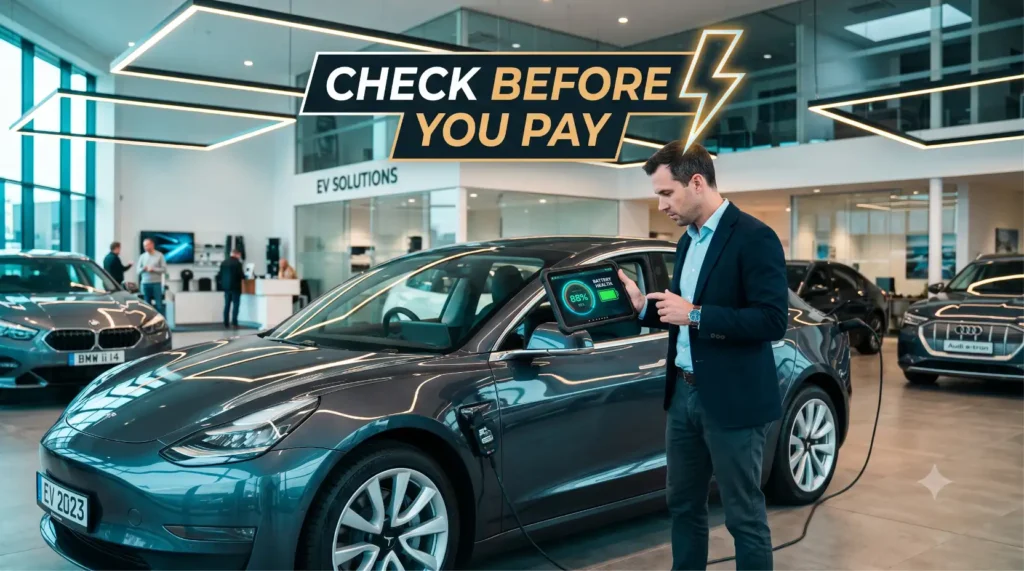
💡 New to used-EV shopping? Start with our Used EV Buying Guide: What to Check Before You Pay so you understand what any used EV — certified or not — should be checked for.
🔍 What the Inspection and Refurb Actually Cover (Including Battery SoH)
This is where CPO earns — or fails to earn — its keep. A real manufacturer CPO inspection runs through a long checklist, often 100 to 200+ points, covering the mechanical, electrical, cosmetic, and safety systems. 📋
For a petrol car, that list is about the engine, transmission, brakes, fluids, and so on. For an EV, the priorities shift dramatically. The things that matter most are: 🔋
- Battery state of health (SoH) — how much of the original capacity remains. This is the headline metric.
- High-voltage system integrity — connectors, coolant, the battery management system (BMS).
- Charging hardware — onboard charger, charge port, DC fast-charge capability.
- Motor and inverter — the drivetrain that replaces the engine.
- 12V battery, brakes, tyres, suspension — the normal car stuff that still matters.
The crucial EV-specific win is the battery state-of-health certification. A good CPO program tests the pack and documents the result — sometimes as a percentage, sometimes as a pass/fail against a minimum threshold (often around 70–80%). 📈
That documented SoH is genuinely valuable. On a regular used EV, you’re guessing at battery health unless you scan it yourself. On a solid CPO, it’s been measured and disclosed. But here’s the catch: not every CPO program publishes a real SoH number. Some just confirm “no battery fault codes,” which is far weaker. Ask exactly what the battery certification includes — and get the number in writing. ✍️
Reconditioning matters too: CPO cars typically get worn items replaced (tyres, brakes, wipers), a deep clean, and any open recalls handled — so you’re not inheriting a stack of deferred maintenance. 🔧
🛡️ The Warranty Angle: Often the Real Value
Ask people why they paid the CPO premium and most won’t say “the inspection.” They’ll say “the warranty.” And they’re usually right — the extended coverage is frequently the single most valuable thing in the package. 🛡️
Here’s the math that makes it matter. On an EV, the battery is the most expensive component, and an out-of-warranty replacement can run $10,000–$20,000 in the US or ₹6–₹12 lakh in India. The drivetrain and high-voltage electronics aren’t cheap either. A warranty that covers those is real financial insurance, not a throwaway perk. 💸
Manufacturer CPO programs typically add coverage in two ways: 📅
- Extending the bumper-to-bumper warranty by an extra year or two / set mileage beyond the factory term.
- Honoring the remaining factory battery and powertrain warranty (usually around 8 years / 100,000 miles in the US, ~8 years / 160,000 km in India) — which a regular used car keeps too, if it transfers cleanly.
That second point is critical. The battery warranty often transfers on a regular used EV as well — so don’t pay a CPO premium purely for coverage you’d get anyway. The genuine CPO bonus is the extra coverage layered on top, plus the guarantee it’s all been verified. 🔍
💡 Want to confirm what transfers on any used EV? Read How to Verify a Used EV’s Battery Warranty Transfer before you decide a CPO premium is the only way to get coverage.
💰 The Price Premium Reality
Let’s talk numbers honestly, because this is where the “worth it” question lives or dies. 💵
A CPO EV typically costs $1,000–$3,000 more in the US, or roughly ₹50,000–₹1,50,000 more in India, than an equivalent private-party used EV. Premium and luxury models can carry bigger gaps; mainstream models, smaller ones. These are illustrative — your real number depends on brand, demand, and how hot the model is. 📊
So the real question isn’t “is the premium big?” It’s “what would it cost me to recreate the CPO benefits myself?” Let’s price that out:
- 🔍 Independent inspection + OBD2 battery scan: a fraction of the premium.
- 🛡️ A separate extended warranty plan: can cost as much as — or more than — the CPO gap.
- 📜 Reconditioning (tyres, brakes, detail): variable, sometimes significant.
When you add up the warranty value especially, the CPO premium often looks reasonable rather than outrageous — particularly on a car where battery anxiety is real. The premium feels like overpaying only when you ignore what you’d otherwise spend (or risk) replicating it. ⚖️
The trap to avoid: paying a CPO premium for a dealer-certified car whose “warranty” is a thin third-party plan and whose inspection was a quick once-over. That’s premium pricing for non-premium protection. 🚩
🧠 When CPO Is Genuinely Worth It
CPO isn’t a scam and it isn’t a slam dunk — it’s the right call for specific buyers. You should lean toward CPO if: ✅
- 🛡️ You’re risk-averse. A surprise repair would genuinely hurt your finances, and you sleep better with a warranty.
- 🔧 You can’t (or won’t) inspect the car yourself. No OBD2 scanner, no trusted mechanic, no time — CPO outsources the diligence to the manufacturer.
- 💳 You’re financing. CPO programs often unlock lower interest rates and easier approval, which can offset part of the premium over the loan.
- 🔋 Battery health worries you. A documented SoH certification removes the single biggest used-EV unknown.
- 🆕 You’re new to EVs. First EV, unsure what to check? CPO is training wheels worth paying for.
- 🔄 You value recourse. Some programs include a return window or exchange policy — rare in private sales.
If three or more of those describe you, a certified pre-owned EV worth it is probably a “yes.” You’re not overpaying — you’re buying down risk you’d otherwise carry yourself. 🎯
🔧 When Regular Used + Your Own Checks Wins
Now the other side, because plenty of smart buyers skip CPO on purpose — and save real money doing it. 💪
Go regular used if:
- 🧰 You’re a confident, hands-on buyer. You own (or will buy) an OBD2 scanner, you can run a battery SoH check, and you know what warning signs to look for.
- 💵 You want the lowest price. Private-party sales are almost always cheaper, and the savings can fund your own warranty and inspection with money left over.
- 🔁 The factory warranty still transfers. If the car still has years of battery and powertrain coverage that carries to you, the CPO warranty premium loses much of its punch.
- 🕵️ You can verify the history. A clean vehicle history report and service records let you confirm what CPO would have confirmed — for free or near-free.
- 🛠️ You don’t mind minor reconditioning. Replacing a set of tyres or wipers yourself doesn’t faze you.
The winning move for this buyer: buy a clean private-sale EV, run your own OBD2 battery scan, pull a history report, confirm the warranty transfers, and optionally add a standalone extended warranty if you want coverage. Done right, you get most of the CPO protection for meaningfully less money. 🔋
The catch is the word right. This path only beats CPO if you actually do the work. Half-done diligence on a private sale is riskier than CPO — so be honest about whether you’ll follow through. ⚖️
⚡ CPO for EVs vs Petrol Cars: Why the Battery Changes the Math
Here’s something most CPO articles miss: the certified-pre-owned calculation is different for EVs than for petrol cars — and the difference favors CPO more for EVs. 🔋
On a used petrol car, the scariest failures are an engine or transmission — expensive, yes, but well-understood, and a used petrol market full of mechanics can assess them cheaply. The CPO premium buys convenience more than it buys mystery-solving.
On a used EV, the scariest failure is the battery, and it’s harder for the average buyer to assess without specialized tools. You can’t pop the hood and listen to a battery. Its degradation is invisible until it’s measured. That information gap is exactly what a battery state-of-health certification closes. ⚡
So the value of CPO leans heavier on EVs for two reasons:
- 🔋 The worst-case repair is more expensive and more opaque than on petrol cars.
- 📈 The key health metric (SoH) is invisible without testing — so a documented certification is worth more.
This is why a certified pre-owned EV worth it debate often tilts more positive than the same debate for a petrol car. The battery raises both the stakes and the value of having it professionally verified. That said — this advantage only holds if the CPO program actually publishes a real SoH number. A certification that skips the battery detail throws away the EV’s biggest CPO edge. 🎯
🇮🇳 The India CPO Landscape (Organized Chains Are Rising)
India’s used-EV market is younger and messier than the US’s — which makes certification both more valuable and more uneven. 🛹
For years, used EVs in India meant private sales and small dealers with little standardization. That’s changing fast. Organized pre-owned chains (manufacturer programs from brands like Tata and Mahindra, plus multi-brand organized platforms) are bringing structure: defined inspections, refurbishment standards, documented battery checks, and warranties on used EVs. 📈
What Indian CPO buyers should watch for:
- 🔋 A real battery health report. This is the most important document. Demand a documented SoH figure, not just “battery OK.”
- 🛡️ What the warranty actually covers — and whether it’s OEM-backed or a third-party plan. Confirm the battery is included.
- 📜 RC transfer handled cleanly. A good organized seller manages the Registration Certificate transfer and keeps service records aligned.
- 🏷️ Insurance write-off / flood history checked. A total-loss history can void coverage — organized chains should screen for this.
- 💳 Financing options. Organized chains increasingly offer used-EV loans, which can be hard to get on a private sale.
The premium in India typically runs ₹50,000–₹1,50,000 over a private sale, varying by model and city. For many Indian buyers — especially first-time EV owners nervous about battery life — that premium buys real confidence in a market that historically offered very little. ✅
📈 2026: CPO EV Programs Are Expanding
Here’s the encouraging trend: in 2026, certified pre-owned EV programs are growing fast in both markets — and getting better. 📱
In the US, as the first big waves of EVs come off lease and out of first ownership, manufacturers are scaling up CPO EV inventory and refining battery certification. More programs now publish a real SoH figure, and VIN-based warranty status is increasingly baked into listings — so verifying coverage is no longer a black box. 🔋
In India, organized used-EV platforms and OEM-backed pre-owned programs are expanding rapidly, standardizing battery health reports and warranty documentation. The shift from “buyer beware” private sales to certified, warranted, inspected cars is one of the most important developments in the Indian used-EV space. 🇮🇳
Across both markets, the trend is the same: more CPO EV inventory, better battery transparency, and warranties that actually mean something. That doesn’t automatically make every CPO car a good deal — but it does mean the good CPO programs are getting genuinely more compelling. The key in 2026 is still to separate real manufacturer certification from sticker-only “certified.” 🎯
✅ 5 Tips for CPO Shoppers
If you’re leaning CPO, do it the smart way. 👇
- Confirm it’s manufacturer-backed, not just dealer-certified. Ask who stands behind the warranty and the inspection. 🏛️
- Demand the battery SoH number in writing. “Battery OK” isn’t certification — a documented state-of-health figure is. 🔋
- Read exactly what the extended warranty covers. Confirm the battery and high-voltage system are included, and note the deductible. 🛡️
- Compare against a private sale + your own checks. Price out what it would cost to replicate the CPO benefits — sometimes you’ll still pay for CPO, sometimes you’ll save. ⚖️
- Verify the factory warranty transfers anyway. Don’t pay a premium purely for coverage you’d inherit for free. 📅
Five checks, and you’ll know whether that CPO badge is worth its premium for your car. ✅
🛒 Shop This Post
Whether you go CPO or build your own protection, these turn guesswork into certainty. 😍
1. An Extended EV Warranty / Coverage Plan 🛡️
The DIY version of a CPO warranty. If you buy private and want battery + drivetrain coverage, a reputable extended plan can match much of what certification offers — read the battery terms closely.
👉 Shop extended EV warranty plans
2. A Bluetooth EV OBD2 Scanner 🔋
The single tool that lets you check battery state of health yourself — exactly what a CPO inspection certifies. Pays for itself on the first car you screen.
👉 Shop EV-compatible OBD2 scanners
3. A Level 2 Home EV Charger ⚡
Certified or not, your used EV charges best at home. A Level 2 charger turns overnight charging into a non-issue from day one.
👉 Shop Level 2 home chargers
🛍️ Shop This Post: (Affiliate picks — no extra cost to you, and they keep EVs Mirror running. 🙏)
🎯 Quick Quiz: Should You Pay the CPO Premium?
- Can you run your own OBD2 battery scan and inspection? 🅐 No 🅑 Yes
- Would a surprise repair seriously hurt your finances? 🅐 Yes 🅑 No
- Are you financing the car? 🅐 Yes 🅑 Paying cash
Mostly 🅐: ✅ Lean CPO. The warranty, battery certification, and financing perks likely justify the premium for you.
Mostly 🅑: 🔧 Consider regular used + your own checks. You can probably recreate the CPO protection for less.
📋 CPO EV Decision Checklist
- [ ] Confirm certification is manufacturer-backed (not just dealer “certified”)
- [ ] Get the battery state-of-health (SoH) figure in writing
- [ ] Read exactly what the extended warranty covers (battery included?)
- [ ] Note the warranty length, mileage cap, and deductible
- [ ] Confirm the factory battery/powertrain warranty also transfers
- [ ] Check the multi-point inspection report for completeness
- [ ] Verify recalls have been addressed and reconditioning is done
- [ ] Compare the total CPO price against a private sale + your own checks
- [ ] Ask about any return or exchange window
- [ ] Confirm financing rate if you’re borrowing ⚡
🤔 People Also Ask
Q: Is a certified pre-owned EV worth it in 2026?
A: For many buyers, yes — a certified pre-owned EV worth it if you value the documented battery state-of-health check, the extended warranty, and the convenience of outsourced inspection. It’s most justified for risk-averse buyers, those financing the car, or anyone who can’t run their own checks. Confident hands-on buyers who can scan the battery themselves often save by buying private instead.
Q: How much more does a CPO EV cost than a regular used one?
A: Typically around $1,000–$3,000 more in the US, or ₹50,000–₹1,50,000 more in India, though premium models can carry bigger gaps. These figures are illustrative — the real premium depends on brand, demand, and region.
Q: Does CPO certification include a battery health check?
A: Good manufacturer CPO programs do — they test and document the battery’s state of health (often as a percentage or a pass against a minimum threshold). Weaker “certified” programs may only confirm no fault codes, so always ask for the documented SoH number in writing.
Q: Is the CPO warranty different from the factory battery warranty?
A: Yes. The factory battery and powertrain warranty (often around 8 years) typically transfers to any used buyer, CPO or not. The CPO program adds extra coverage on top — usually an extended bumper-to-bumper term. Don’t pay a premium purely for coverage you’d inherit anyway.
Q: Is manufacturer CPO better than dealer certified?
A: Generally, yes. Manufacturer-backed CPO uses the carmaker’s inspection standards and factory-backed warranty. “Dealer certified” uses the dealer’s own checklist and often a third-party warranty plan — which can be fine, but isn’t the same product, even if the badge looks similar.
Q: Should I buy CPO or do my own checks on a used EV?
A: If you can run an OBD2 battery scan, pull a history report, and confirm the warranty transfers, buying private plus your own checks usually saves money. If you can’t or won’t do that diligence, CPO outsources it to the manufacturer and is often worth the premium.
🚀 The Bottom Line
A certified pre-owned EV is really a trade: you pay a premium, and in return you hand off the risk and diligence to the manufacturer. Whether that trade is smart comes down to one honest question — how much of that risk can you personally absorb? ⚡
If you’re risk-averse, financing, new to EVs, or simply can’t inspect the car yourself, the premium buys genuine value: a documented battery state-of-health certification, an extended warranty, and a reconditioned car with recourse if something’s wrong. That’s a certified pre-owned EV worth it for you. If you’re a confident, hands-on buyer who’ll actually run an OBD2 scan, pull a history report, and confirm the warranty transfers, you can likely recreate that protection on a cheaper private-sale car — and pocket the difference. 🎯
Either way, the EV-specific rule holds: the battery is the most expensive thing that can go wrong, so make sure its health is verified — by a real CPO certification or by your own scan — before you pay. Do that, and you’ll buy with confidence instead of crossing your fingers. 🔋
💬 Bought a CPO EV — or skipped it on purpose? Share what tipped your decision in the comments to help other buyers!
📤 Know someone EV-shopping? Send them this guide before they pay the premium. 🙏
🔖 Bookmark EVs Mirror for honest used-EV buying advice.
👉 Up next: Used EV Buying Guide: What to Check Before You Pay and How to Verify a Used EV’s Battery Warranty Transfer