Here’s something most car-buying advice forgets: a used EV is not a used gas car wearing a quieter engine. 🤫
The biggest chunk of its value lives inside the battery pack — a part you can actually measure. And measurement is leverage. While the seller talks about “low mileage” and “one careful owner,” you can quietly pull a State of Health number, check the warranty clock, and notice that the original charging cable is mysteriously missing. Every one of those is a price chip.
That’s the whole game. If you know what to look at, you don’t have to be a smooth talker to win — you just have to be the person in the driveway holding the facts. So let’s break down exactly how to negotiate used EV price like someone who’s done their homework, in both the US ($) and India (₹). 👇
- ⚡ The Short Answer
- 📊 EV-Specific Negotiation Levers (and How to Use Each)
- 🔍 Do Your Homework First (Comps, SoH, History)
- 🔋 EV-Specific Leverage Points That Cut the Price
- 🗣️ How to Open the Negotiation (Without Killing the Deal)
- 🛠️ Using Inspection Findings to Negotiate
- ⏱️ Timing & Walk-Away Power
- 🤝 Private Seller vs Dealer Tactics
- 💰 Financing & Trade-In Negotiation
- 🤐 Closing the Deal & Paperwork
- 📈 2026: Buyer's-Market Dynamics for Negotiation
- ✅ 5 Tips to Negotiate Like a Pro
- 🛒 Shop This Post
- 🎯 Quick Quiz
- 📋 Negotiation Checklist
- 🤔 People Also Ask
- 🚀 The Bottom Line
⚡ The Short Answer
If you just want the playbook to negotiate used EV price without reading every word, here it is:
- 🔋 Battery State of Health is your #1 lever — a degraded pack means real, defensible money off.
- 📜 Warranty time left matters hugely — less coverage remaining equals less value remaining.
- 🔌 Missing charging cable or home charger? That’s $200–$1,500 (₹15,000–₹1,20,000) you can claim back.
- 📉 Use market depreciation — show comps proving EVs drop fast, so the asking price is negotiable by design.
- 🧾 Inspection + history findings convert vague worries into specific, dollar-amount deductions.
- 🚶 Walk-away power is the strongest tool of all — the buyer who can leave always wins.
Lead with data, anchor low but reasonable, and let the numbers — not emotion — set the price. 🎯
📊 EV-Specific Negotiation Levers (and How to Use Each)
Regular used-car haggling leans on mileage and dents. EVs hand you a richer toolkit, because so much of the value is quantifiable. Here are the levers unique to electric cars and how to actually pull them. 👇
| 🎯 Lever | Why It Matters | How to Use It in Negotiation |
|---|---|---|
| 🔋 Battery State of Health (SoH) | The pack is ~30–50% of the car’s value | “SoH reads 84%, not 100%. That’s lost range — I’m adjusting my offer down accordingly.” |
| 📜 Warranty time left | Battery warranties are the safety net | “Only 14 months of battery warranty remain vs 8 years from new — that’s risk I’m pricing in.” |
| 🔌 Charging equipment included | Cables & home chargers cost real money | “No original cable or home charger? That’s $400 (₹30,000) I have to spend — knock it off the price.” |
| 💻 Software features | Some features are subscription or locked | “Fast-charging or driver-assist is locked/expired — I’m not paying for what I can’t use.” |
| 📉 Market depreciation | EVs depreciate faster than ICE cars | “Comparable models have dropped 12% this quarter. Your asking price is above market.” |
| ⏱️ Charge history | Heavy DC fast-charging ages packs | “Charge logs show mostly DC fast-charging — that accelerates wear, and I’m factoring it in.” |
Notice the pattern: every lever turns a feeling (“it seems pricey”) into a number (“here’s why, and here’s the deduction”). Numbers win negotiations. 😎
🔍 Do Your Homework First (Comps, SoH, History)
You don’t win a negotiation in the driveway — you win it the night before, on your couch, with a few browser tabs open. 🛋️
Start with comps. Pull up at least five to ten listings of the same make, model, year, and trim in your region. Note the spread between asking prices and what cars actually sell for. This gives you a defensible “fair market” range — the anchor for everything that follows.
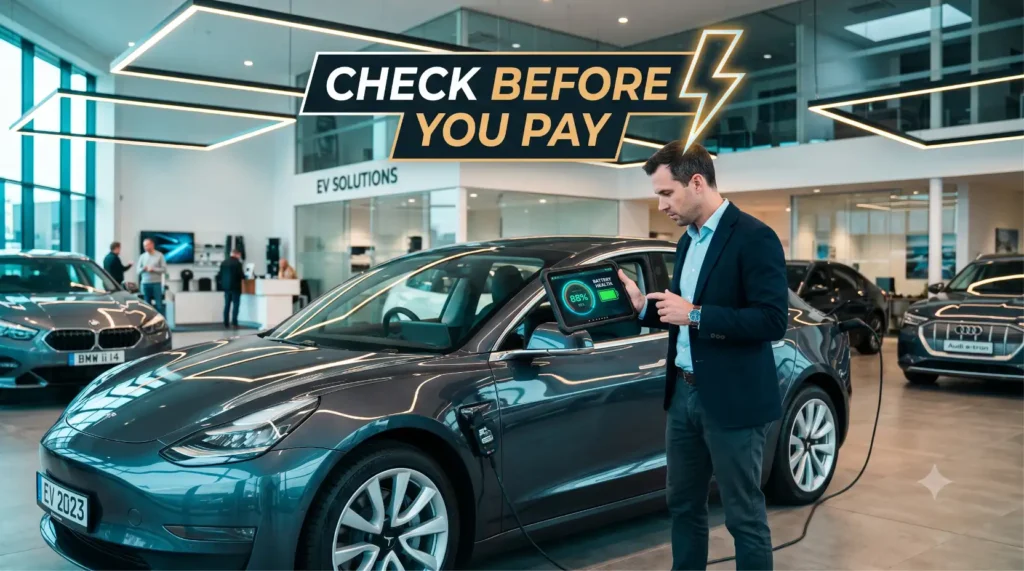
Next, learn the car’s battery State of Health if you possibly can. SoH is the single most important number in a used EV, because it directly maps to remaining range and lifespan. Ask the seller for it, or plan to read it yourself with an OBD tool at the viewing.
Finally, dig into the history. A vehicle history report surfaces accidents, title issues, and ownership count, while service records reveal how the car was cared for. The more you know before you speak, the calmer and more credible you’ll be when you negotiate used EV price face to face. 🧠
💡 New to this? Pair this with our Used EV Buying Guide: What to Check Before You Pay so your homework covers every inspection point, not just price.
🔋 EV-Specific Leverage Points That Cut the Price
This is where used EVs differ wildly from gas cars — and where smart buyers quietly save thousands. Let’s walk the big three. 💪
A degraded battery = a real price cut. If a car launched with a 250-mile (400 km) range and SoH has slipped to 85%, you’re buying roughly 212 miles (340 km) of usable range — not what the listing implies. Lost range is lost value, full stop. A 10–15% SoH drop justifiably supports a meaningful reduction, and you say so plainly.
A missing charge cable or home charger is money. EVs ship with a portable charging cable, and many owners add a home wall charger. If either is gone, you have to buy a replacement — $200 to $1,500 (₹15,000 to ₹1,20,000) depending on the unit. That cost belongs in the price conversation. 🔌
An expiring warranty shifts risk to you. A battery still under its 8-year/100,000-mile warranty is far safer than one with months left. When the safety net is nearly gone, the financial risk of a future pack repair lands on the buyer — and that risk has a price. ⚠️
Each of these is concrete, fair, and hard to argue with. You’re not lowballing; you’re pricing reality.
🗣️ How to Open the Negotiation (Without Killing the Deal)
The opening move sets the tone. Get it right and the seller respects you; get it wrong and they dig in or walk. 🎭
First, build a little rapport before talking money. Compliment something genuine, show you understand the car, and signal that you’re a serious, prepared buyer — not a tire-kicker. Sellers give better prices to people they don’t dread dealing with.
Then anchor low, but reasonable. Your first number should sit below your target yet stay defensible — backed by comps and SoH, never plucked from thin air. “Based on similar models selling around $X and the battery reading 86%, I’d be comfortable at $Y.” That’s an anchor with a spine.
Crucially, let the numbers do the talking. When you negotiate used EV price, frame every ask around evidence: the SoH reading, the missing cable, the market comps. This shifts the conversation from “haggling” to “fair pricing,” which is far harder for a seller to resist. 🎯
And then — pause. Silence after an offer is uncomfortable, and that discomfort works in your favor. Don’t rush to fill it.
🛠️ Using Inspection Findings to Negotiate
A pre-purchase inspection isn’t just protection — it’s a negotiating goldmine. Every finding is a fact you can convert into dollars or rupees. 🧧
Before you commit, get the car checked — either with your own OBD scan or, ideally, a professional pre-purchase inspection. The report turns vague concerns into a line-item list: worn tires, a flagged BMS code, a sagging cell, uneven brake wear, a software fault.
Now you negotiate with specifics. Instead of “it feels a bit pricey,” you say: “The inspection flagged tires at 30% and a cell-balance warning — replacing the tires is $600 (₹45,000), so let’s reflect that.” Specifics are almost impossible to dismiss. 🔧
The psychology matters too. A seller can wave away a feeling, but a written finding with a repair estimate attached forces a real response. This is exactly why paying for an inspection often pays for itself — it hands you the receipts you need to negotiate used EV price with authority. 📋
🔋 Want the deeper battery angle? See How EV Depreciation Helps Used Buyers Win for why time is genuinely on your side as a buyer.
⏱️ Timing & Walk-Away Power
Two of the most underrated negotiation tools cost nothing: when you buy and your willingness to leave. ⏰
Timing. Sellers get more flexible at certain moments — end of month, end of quarter, when a new model is about to launch and make theirs feel dated, or when a private listing has been sitting unsold for weeks. A car that’s lingered 45 days online has a motivated, slightly anxious owner. That anxiety is your friend.
Walk-away power. This is the single strongest card in any negotiation. The buyer who genuinely can — and will — walk away holds all the leverage, because their “no” is real. Never fall so in love with one car that you lose this. There’s always another listing. 🚶
How do you show it without being rude? Be warm but unhurried. Make your evidence-based offer, then say something like, “I think that’s fair given the battery and the comps — but I completely understand if it doesn’t work for you.” Then mean it. The ability to walk is what makes every other lever credible. ✅
🤝 Private Seller vs Dealer Tactics
Who you’re buying from changes the whole approach. The same offer that delights a private seller can bounce off a dealer’s desk — so adapt. 🎭
Private sellers are emotional and individual. They often have a number in their head tied to what they “need” to get, and they’re motivated by convenience — a quick, clean, drama-free sale. With them, rapport matters more, cash-readiness is persuasive, and pointing out genuine flaws (politely) lands directly. There’s no manager to consult; the person in front of you can say yes.
Dealers are systematic and margin-driven. They expect negotiation, build in room for it, and won’t be shaken by emotion. With a dealer, focus on the out-the-door price, not the monthly payment, and watch for add-ons (fees, “protection packages,” accessories) padding the total. Dealers also have more levers to trade — a warranty, a fresh service, a charging cable thrown in. 🏢
In both cases the data is your anchor. But with a private seller you lean on rapport and decisiveness; with a dealer you lean on persistence and total-cost clarity. Knowing which game you’re in is half the battle when you negotiate used EV price. 🎯
💰 Financing & Trade-In Negotiation
Here’s a trap that quietly costs buyers thousands: letting financing and trade-in muddy the price of the car itself. Keep them separate. 🧮
Negotiate the car price first — and only the car price. Dealers love to pivot to “What monthly payment works for you?” because a low monthly can hide a high total via a longer loan. Always pin down the vehicle’s out-the-door price before any talk of payments, rates, or terms. 📉
Then handle financing as its own deal. Get pre-approved at a bank or credit union before you shop so you have a benchmark rate. If the dealer can beat it, great — but you’re negotiating from strength, not hoping their number is fair. In India, compare loan offers across banks and NBFCs the same way.
And treat a trade-in as a third, separate transaction. Bundling it lets a seller give you a great price on one side while quietly clawing it back on the other. Know your trade-in’s independent value, negotiate it on its own, and you keep every part of the deal honest. 🔑
Three separate negotiations, three clear wins — that’s how you protect the savings you fought for on price.
🤐 Closing the Deal & Paperwork
You’ve agreed a number — don’t relax yet. The close is where good deals occasionally spring leaks. 📝
First, get everything in writing. The final price, what’s included (cables, charger, accessories, spare key), any agreed repairs, and the warranty status should all be documented. A verbal “yeah, the home charger’s included” has a way of evaporating at handover.
Second, confirm the warranty transfer. EV battery warranties don’t always carry over automatically to a new owner — terms vary by maker and market. Verify the remaining coverage transfers to you before money moves, because that warranty was part of what you priced. ✅
Third, handle the documents properly. Title/RC transfer, a clear bill of sale, settled finance (no outstanding loan on the car), and updated insurance. In India, ensure the RC transfer and any state EV-subsidy paperwork are sorted; in the US, confirm title and registration handoff.
Do the close carefully and the price you negotiated is the price you actually get. Sloppy paperwork is how hard-won savings quietly disappear. 🔒
💡 Tip: Re-read the Used EV Buying Guide‘s paperwork section before handover so nothing slips through.
📈 2026: Buyer’s-Market Dynamics for Negotiation
Here’s the genuinely good news: 2026 is one of the best times in years to be the buyer of a used EV — and that tilts every negotiation your way. 📈
A wave of EVs leased and bought during the early-2020s boom is now hitting the secondhand market in both the US and India. More supply means more choice, which means more walk-away power — there’s always another listing, so no single seller can corner you. 🚶
EV depreciation also remains steep. New-model launches, evolving incentives, and rapid tech improvements keep pushing used prices down — which is painful for sellers but a gift for buyers. That fast depreciation is literally baked into your leverage when you negotiate used EV price.
And battery transparency is improving. Better SoH tools, clearer warranty records, and more history data mean you can prove a car’s true condition more easily than ever. In a market with abundant supply, falling prices, and better data, the prepared buyer holds the cards. Play them. 🃏
✅ 5 Tips to Negotiate Like a Pro
Quick, battle-tested pointers to keep in your back pocket. 💪
- 🔋 Lead with SoH. The battery number is your strongest, most defensible lever — open with it.
- 📉 Anchor with comps. Bring printed or screenshotted listings so your offer is evidence, not opinion.
- 🚶 Keep walk-away power. Never love a car so much you can’t leave it — that’s your real power.
- 🧾 Itemize every flaw. Turn each inspection finding into a specific dollar/rupee deduction.
- 🤐 Stay calm and quiet. Make your offer, then let the silence work. Don’t negotiate against yourself.
🛒 Shop This Post
The gear that turns guesswork into negotiating leverage. 🛒
- 🔌 EV-Compatible OBD2 Scanner — read the real battery State of Health at the viewing so your offer is backed by hard data, not hope. (~$25–$60 / ₹2,000–₹5,000)
- 🧾 Vehicle History Report — surface accidents, title issues, and ownership count; every red flag is a bargaining chip. (~$10–$40 / ₹800–₹3,000)
- 🛠️ Pre-Purchase Inspection — a professional once-over that converts hidden problems into itemized, dollar-amount deductions. (~$100–$250 / ₹2,000–₹5,000)
🔗 Affiliate disclosure: Some links above are affiliate links. If you buy through them, EVs Mirror may earn a small commission at no extra cost to you. We only suggest tools we’d genuinely use ourselves. 🙏
💡 Bonus tip: Budget for a home charger before you negotiate — knowing that cost helps you claim it back if the car’s cable or charger is missing. 🔌
🎯 Quick Quiz
Test yourself before you go car-hunting. 🧠
1. What’s the single strongest lever when negotiating a used EV?
A) The car’s paint color
B) Battery State of Health ✅
C) The seller’s mood
2. What’s the most powerful tool in any negotiation?
A) Talking the fastest
B) Walk-away power ✅
C) A bigger down payment
3. True or false: you should negotiate the monthly payment first.
False — always negotiate the out-the-door car price first. ✅
(Answers: B, B, False) 🎉
📋 Negotiation Checklist
Save this and run it at every viewing. 👇
- [ ] Pull 5–10 comps for the exact make, model, year, and trim
- [ ] Read or request the battery State of Health (SoH)
- [ ] Get a vehicle history report and service records
- [ ] Confirm what’s included (cable, home charger, spare key)
- [ ] Check remaining warranty time and whether it transfers
- [ ] Get a pre-purchase inspection and itemize every flaw
- [ ] Anchor low but reasonable, backed by data
- [ ] Negotiate car price, financing, and trade-in separately
- [ ] Keep walk-away power — be ready to leave
- [ ] Get the final deal and all inclusions in writing ⚡
🤔 People Also Ask
Q: How do I negotiate used EV price the right way?
A: To negotiate used EV price effectively, lead with data: battery State of Health, market comps, remaining warranty, and inspection findings. Anchor your offer low but reasonable, itemize every flaw as a specific deduction, and keep your walk-away power. Numbers, not emotion, win the deal.
Q: How much can you negotiate off a used EV?
A: It varies, but a degraded battery (say 10–15% SoH loss), a missing charging cable, an expiring warranty, and a car that’s lingered unsold can collectively justify a meaningful reduction. There’s no fixed percentage — your savings track directly with the evidence you bring.
Q: Does battery health affect a used EV’s price?
A: Hugely. The pack is roughly 30–50% of an EV’s value, and SoH maps directly to remaining range and lifespan. A car at 84% SoH offers less usable range than the listing implies, which is fair, defensible grounds to lower your offer.
Q: Should I negotiate differently with a dealer vs a private seller?
A: Yes. Private sellers respond to rapport, decisiveness, and cash-readiness, and can say yes on the spot. Dealers expect negotiation, so focus on the out-the-door price, watch for padded fees, and use their extra levers like warranties or a thrown-in charger.
Q: Is it better to negotiate price or monthly payment?
A: Always negotiate the car’s out-the-door price first. A low monthly payment can hide a high total through a longer loan term. Pin down the vehicle price, then handle financing and any trade-in as separate, independent deals to protect your savings.
Q: When is the best time to buy a used EV for a good deal?
A: End of month or quarter, just before a new model launches, or when a listing has sat unsold for weeks — all signal a motivated seller. In 2026’s supply-rich, fast-depreciating used-EV market, buyers hold strong leverage year-round.
🚀 The Bottom Line
A used EV negotiation isn’t about being a smooth talker — it’s about being the prepared one. The seller has a story; you have State of Health, comps, warranty math, and an inspection report. Facts beat charm every time. ⚡
Do your homework, anchor low but reasonable, itemize every flaw into a real deduction, keep car price separate from financing and trade-in, and never surrender your walk-away power. Do that, and you won’t just negotiate used EV price — you’ll close a deal you feel great about long after the keys change hands. 🔋
💬 Negotiated a used EV recently? Share the model and how much you saved in the comments to help other buyers!
📤 Know someone EV-shopping? Send them this before they pay. 🙏
🔖 Bookmark EVs Mirror for honest, no-nonsense used-EV advice.
👉 Up next: How EV Depreciation Helps Used Buyers Win and the full Used EV Buying Guide: What to Check Before You Pay.