There’s a moment that hits every used-EV shopper around the third browser tab. 🛒 You realize that twenty grand — once “barely a deposit on a new car” money — now buys a genuinely good electric car. Not a sad, range-anxious science project. A real one.
The used EV market in 2026 has quietly become one of the best deals in all of car buying. New EVs took their brutal first-owner depreciation hit, and that loss is now your gain. Cars that stickered far north of $40,000 a few years ago have drifted into reach.
But here’s the catch nobody puts in the listing: with EVs, the price tag tells you almost nothing about the thing that actually matters. 🔋 The battery does. Two identical-looking cars at the same price can be wildly different machines underneath, and only one of them is worth your money.
So this guide does two jobs. It walks you through honest model archetypes — the value champ, the range king, the cheap commuter, and a few quirky gems — and it teaches you how to not get burned. Let’s find the best used EVs under 20000 that are worth driving home. 👇
⚡ The Short Answer
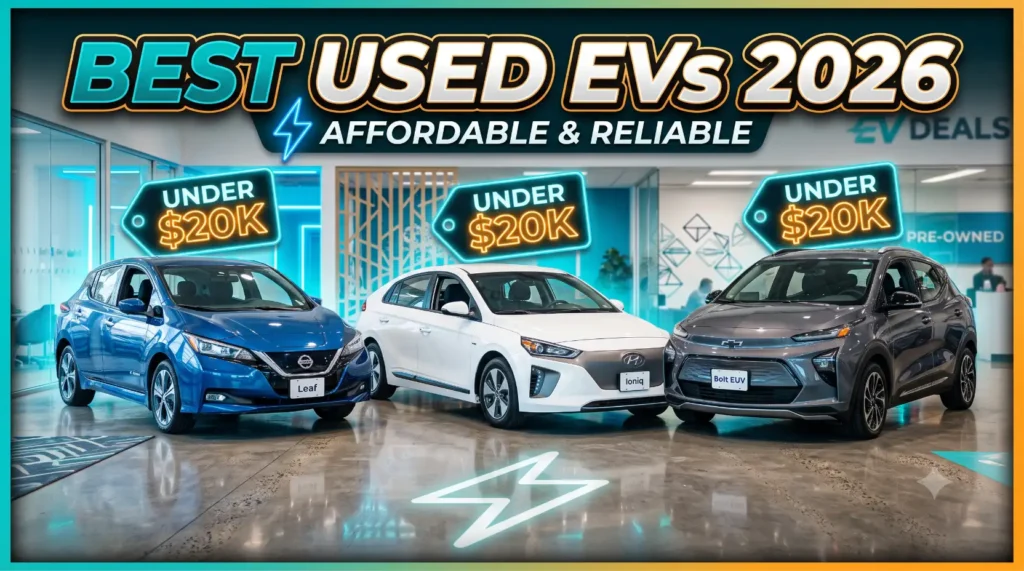
If you want the headline before the full story, here it is. The best used EVs under 20000 in 2026 cluster into a few clear winners. 🏆
- 🥇 The Chevy Bolt is the value champ — strong real range, frugal, roomy for its size, and usually well within budget at this point.
- 🔋 An older Tesla Model 3 is the range-and-resale king under $20k — but only the right year/condition, and only with a verified battery.
- 💸 The Nissan Leaf is the cheap-and-cheerful city commuter — fantastic value, if you understand its battery quirk (more on that below).
- ✨ A used BMW i3 is the premium-feel bargain — quirky, quick, and surprisingly affordable as it ages.
- 👨👩👧 Hyundai/Kia EVs (think Kona Electric, Niro EV, Soul EV) make brilliant family hatches with long warranties.
- 🤓 The Volkswagen e-Golf is the quirky-but-great sleeper pick — normal car, electric heart, easy to live with.
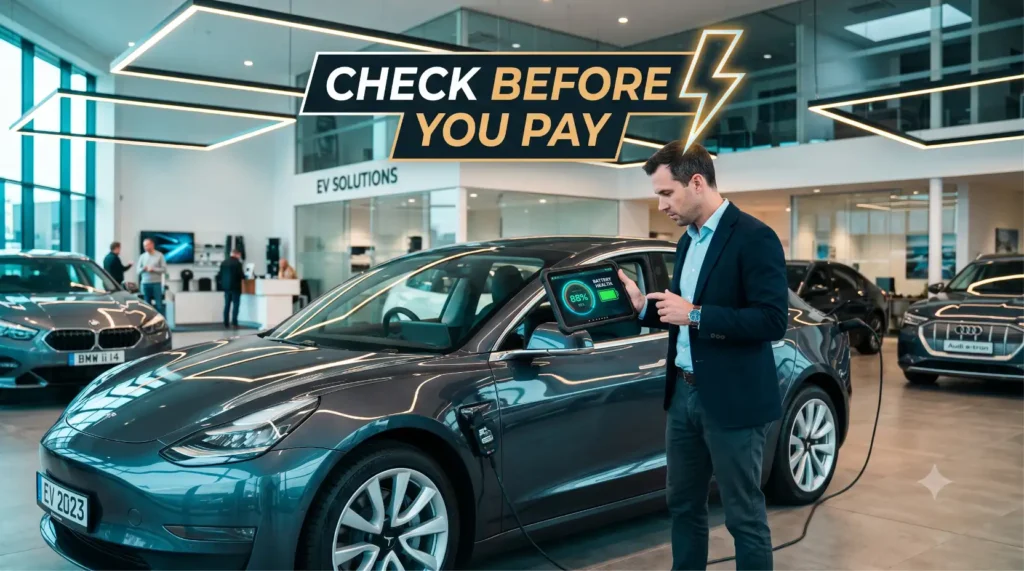
One rule outranks all of them: verify battery health before you pay. A cheap EV with a tired pack isn’t a bargain — it’s a future bill. 🎯
📊 Used EVs Under $20k at a Glance
Here’s the shortlist side by side. Prices are illustrative bands — what you’ll actually pay swings with year, mileage, trim, condition, and your region. Treat these as a map, not a quote. 🗺️
| Model Archetype | Typical Real Range | Used Price Band (illustrative) | Best For | Watch-Out |
|---|---|---|---|---|
| 🥇 Chevy Bolt | ~240–250 mi | Often found ~$13k–$19k | Value seekers who still want real range | Earlier recall history — confirm battery work done |
| 🔋 Older Tesla Model 3 | ~220–270 mi | Often found ~$17k–$20k+ | Range, tech, and resale strength | Right year/condition matters; verify pack |
| 💸 Nissan Leaf | ~100–215 mi | Often found ~$8k–$15k | City commuting on a tight budget | Air-cooled pack — degradation varies a lot |
| ✨ BMW i3 | ~100–150 mi | Often found ~$12k–$18k | Premium feel, small footprint, fun | Short range; specialist parts/service |
| 👨👩👧 Kia/Hyundai EV | ~230–260 mi | Often found ~$15k–$20k | Families wanting space + warranty | Higher demand can push the band up |
| 🤓 VW e-Golf | ~110–125 mi | Often found ~$11k–$16k | A “normal car” that happens to be electric | Modest range; fewer units around |
Every single row in that table comes with the same asterisk: the number that decides the deal isn’t in the table at all. It’s the state of health of the battery. We’ll fix that. 🔋
🥇 The Value Champ: Chevy Bolt
If one car owns the “smart money” slot in this bracket, it’s the Chevrolet Bolt. 🥇 It’s the rare used EV that’s genuinely affordable and delivers range you can actually plan a life around.
The Bolt’s whole personality is sensible. It’s tall, surprisingly roomy inside for a compact, efficient with electricity, and easy to live with day to day. For a single buyer or a small family, it just works — no drama, no compromise theater.
Pros: Excellent real-world range for the price, frugal efficiency, practical interior, and a strong used supply that keeps the price band friendly. 👍
Cons: Earlier Bolts were part of a high-profile battery recall, so charging behavior and cabin tech can feel a generation behind newer cars. Fast-charging speeds are modest, too. 👎
Battery note: 🔋 Because of the recall history, the Bolt is the poster child for “verify before you buy.” Many cars received battery remediation or full pack replacements — which can actually be a good thing, sometimes meaning a newer pack in an older car. Confirm exactly what was done, get the paperwork, and pull a state-of-health reading. A documented Bolt is a fantastic buy. An undocumented one is a coin flip.
🔋 The Range King Under $20k: Older Tesla Model 3
Yes — a Tesla Model 3 can land inside this budget. 🔋 Not the freshest one, and not in every market, but earlier examples in fair condition increasingly drift toward the top of the under-$20k band.
What you get is the thing the whole used-EV world quietly benchmarks against: long real range, a slick charging experience on the most built-out fast network, genuinely usable tech, and resale strength that holds up better than almost anything else here.
Pros: Class-leading range for this price, excellent road-trip ability, strong software, and resale value that protects you when you eventually sell. 👍
Cons: Repair and panel costs can be higher than a mainstream compact, interior plastics show wear, and “Tesla at $20k” usually means higher mileage or an earlier build. 👎
Battery note: 🔋 Tesla packs are generally robust, but generally isn’t the same as yours. Check the displayed range at a full charge against the original, look at the charging history, and confirm it still fast-charges normally. The right Model 3 is the range king of this list. The wrong one is an expensive lesson — so verify the pack before you fall for the badge.
💸 The Cheap-and-Cheerful Commuter: Nissan Leaf
The Nissan Leaf is the people’s EV — and often the single cheapest way into electric driving. 💸 For a short commute, school runs, and errands, a budget Leaf is almost unbeatable on dollars-in versus driving-out.
It’s easy, quiet, comfortable for a city car, and refreshingly simple to own. If your daily driving is modest and you can charge at home, the Leaf makes a lot of financial sense.
Pros: Lowest entry price on this whole list, dead-simple to live with, comfy ride, and a huge used supply so you can be picky. 👍
Cons: Here’s the honest one — the Leaf uses an air-cooled battery with no active liquid thermal management. In hot climates or with hard use, packs can degrade faster and less predictably than rivals. Older cars also use the aging CHAdeMO fast-charge standard. 👎
Battery note: 🔋 With the Leaf, battery health is the buying decision — more than any other car here. Two Leafs of the same year and price can have very different remaining range depending on climate and history. Never buy one on looks. Read the battery’s capacity bars, get a proper state-of-health figure, and weight a hot-climate car carefully. A healthy Leaf is a steal. A cooked one is heartbreak.
✨ The Premium-Feel Bargain: BMW i3
The BMW i3 is the most interesting car on this list, and as it ages it’s become a genuine premium-feel bargain. ✨ Carbon-fiber construction, suicide-style rear doors, a lounge-like cabin, and zippy around-town acceleration — it feels nothing like a budget car.
It’s small, it’s clever, and it has a cult following for good reason. For a city dweller who wants something special without a special price, the i3 is a delight.
Pros: Premium materials, genuinely fun to drive, tiny footprint that’s perfect for tight streets and parking, and real BMW build feel for compact-car money. 👍
Cons: Range is modest by 2026 standards, the back seat and cargo area are snug, and parts/service can lean specialist (read: pricier than a Leaf). The optional little gas range-extender on some examples adds complexity. 👎
Battery note: 🔋 i3 packs have generally held up well, but the smaller battery means every lost mile stings more. Verify the state of health and confirm the displayed range still matches your daily needs with comfortable headroom. If you want premium character on this budget, the i3 is hard to beat — just buy with your eyes open on range.
👨👩👧 The Family Hatch: Hyundai & Kia EVs
When you need space, warranty, and peace of mind, the Hyundai/Kia electric family is the grown-up answer in this bracket. 👨👩👧 Think Kona Electric, Niro EV, and Soul EV — practical, efficient hatchbacks and small crossovers that just get on with the job.
These cars pair strong real range with usable interior space and one underrated superpower: long battery warranties that often transfer to you as the second owner. That’s huge peace of mind on a used purchase.
Pros: Excellent range-for-the-money, roomy and practical, efficient, and that transferable long warranty that de-risks the battery question. 👍
Cons: They’re popular, so demand can push the price band toward the top of $20k. Earlier models had limited fast-charge speeds, and supply varies a lot by region. 👎
Battery note: 🔋 The transferable warranty is the headline, but don’t let it make you lazy. Confirm in writing how much warranty actually remains and that it transfers to you. Then still pull a state-of-health reading — a warranty covers catastrophic failure, not the slow, normal capacity fade that affects your daily range. A warrantied, healthy Kona or Niro is one of the safest used-EV buys on this list.
🤓 The Quirky-But-Great Pick: VW e-Golf
The Volkswagen e-Golf is the sleeper of the group — and that’s exactly its charm. 🤓 It looks like a normal Golf, drives like a normal Golf, and parks like a normal Golf. It just happens to be electric. No spaceship styling, no learning curve.
For a buyer who wants the EV running costs without announcing it to the neighborhood, the e-Golf is quietly brilliant. The build quality is solid, the ride is composed, and everything is exactly where you expect it.
Pros: Conventional, no-drama cabin and controls, solid build, comfortable and refined to drive, and an easy on-ramp for first-time EV owners. 👍
Cons: Range is modest and best suited to commuting rather than road trips, and there were never huge numbers sold, so finding one in your area can take patience. 👎
Battery note: 🔋 The e-Golf’s smaller pack means battery health really shapes its usefulness — a healthy one comfortably covers a normal commute, a tired one starts to pinch. Get the state-of-health number and match it honestly against your daily miles. If it clears that bar, the e-Golf is one of the most stress-free EVs you can own on a budget.
💵 What $20k Actually Buys in 2026
Let’s zoom out, because the bracket itself has changed. 💵 A few years ago, twenty grand bought you compromise — short range, old tech, or a worn-out commuter. Today it buys real capability.
That’s the depreciation gift at work. EVs lost value steeply in their early years, and the bottom of that curve is where smart used buyers now camp. The cars that took the biggest hit are often the best values left, because the hard loss already happened to someone else. 📉
So what does $20k realistically get you in 2026? Often a compact EV with 200+ miles of real range and modern-enough tech. Sometimes a premium-badge car with character. Frequently a practical family hatch with warranty left. Almost always, far more car than the same money bought new.
The trade-off is simple and fair: you’re buying age and miles, not the latest software. 🤝 What you’re not obligated to buy is a bad battery — and that’s the line that separates a great deal from a regret. Which brings us to the part that actually protects your money.
💡 Before you pay anything, run through the full checklist in our Used EV Buying Guide: What to Check Before You Pay — it covers the paperwork, charging, and inspection steps that catch most lemons.
⚠️ What to Watch For at This Price
Cheap EVs are wonderful right up until they aren’t. ⚠️ Here’s where deals go wrong in this exact price band — so you can spot the traps before they cost you.
Battery health above all. 🔋 At this price you’re often buying older packs with real-world miles on them. A worn battery quietly erases the range you’re paying for, and it’s the single most expensive thing to fix. Never, ever skip the state-of-health check.
Recall and service history. Some models (the Bolt especially) had battery recalls. Confirm the work was actually done, with paperwork. A remediated car can be better than an unfixed newer one. 📋
Fast-charging compatibility. 🔌 Older EVs may use aging standards (like CHAdeMO) or charge slowly on DC. If road trips matter, confirm what plug it uses and how fast it actually charges — not just the spec-sheet maximum.
Software and updates. Some used EVs still receive updates; some are frozen in time. Confirm the car still gets support and that all features actually work, including connected services.
The “too cheap” listing. 💸 If one car is dramatically below the band for its year and miles, assume the battery is the reason until proven otherwise. Cheap is a feature. Suspiciously cheap is a warning. Verify before you celebrate.
🔋 This is the non-negotiable step: learn exactly How to Check Battery Health on a Used EV before you hand over a dollar. It’s the difference between a bargain and a boat anchor.
📈 Why Used EV Prices Under $20k Keep Improving
The good news for buyers: this bracket keeps getting better, not worse. 📈 A few forces are quietly working in your favor in 2026, and understanding them helps you shop with confidence.
More EVs aged into the used pool. The wave of new EVs sold over the past several years is now hitting the used market in volume. More supply means more choice, more competitive pricing, and far more reliability data than buyers had even two years ago. 🌊
Front-loaded depreciation does the heavy lifting. EVs lose value fastest early, so the cars landing under $20k already absorbed their steepest drop. You’re buying at the flatter part of the curve, where the value loss slows and the deals concentrate. 📉
Battery confidence is rising. Real-world data now shows that modern EV packs generally last longer than early fears suggested. As that reputation solidifies, well-kept used EVs become easier — and safer — to buy. 🔋
Tech “good enough” keeps expanding. What counted as cutting-edge range and software a few years ago is now perfectly livable. That pulls more genuinely capable cars down into budget territory.
The throughline: the best used EVs under 20000 are a moving target, and the target keeps moving toward more car for the money. The buyers who win are the ones who pair this tailwind with rigorous battery checks. 🎯
✅ 5 Tips for Buying in This Bracket
You’ve got the shortlist. Now here’s how to actually close a smart deal without getting burned. 💪
- Verify battery health first, everything else second. 🔋 Get a state-of-health reading and compare full-charge range to the original. This one number decides whether a cheap EV is a steal or a trap. No reading, no deal.
- Demand the service and recall paperwork. 📋 Especially on the Bolt — confirm any battery work was done. A documented history is worth real money and real peace of mind.
- Match range to your actual life, with headroom. 📏 Don’t buy borderline range and hope. Buy comfortable margin over your daily miles, because real-world range shrinks in cold weather and as the pack ages.
- Get a pre-purchase inspection from someone who knows EVs. 🔧 A regular mechanic checks brakes and tires. An EV-savvy inspection checks the pack, charging system, and software — exactly the expensive stuff.
- Quote insurance before you commit. 🛡️ Premiums vary a lot between models. A “cheap” EV with pricey parts can cost more to insure than you expect — two minutes of quoting can flip your pick.
None of this requires expertise you don’t have. It just requires doing the boring steps most buyers skip in their excitement. 😎
🛒 Shop This Post
Buying a used EV well is mostly about checking the battery and charging it cheaply once it’s yours. These three tools cover exactly that. 🛍️
1. An EV-Compatible OBD2 Scanner 🔋
This is how you read true battery state of health yourself — before you pay, and for years after. The single most important tool in any used-EV purchase. Don’t shop without one.
👉 Shop EV OBD2 scanners
2. A Pre-Purchase Inspection (EV-savvy) 🔧
A proper inspection catches the expensive stuff a quick test drive hides — pack condition, charging system, and software health. Cheap insurance against a costly mistake.
👉 Book a pre-purchase inspection
3. A Level 2 Home Charger ⚡
Once the car’s yours, home charging on off-peak rates is what makes EV ownership genuinely cheap. A solid Level 2 unit fills you up overnight while you sleep.
👉 Shop Level 2 home chargers
🛍️ Disclosure: These are affiliate picks. If you buy through them it costs you nothing extra, and it helps support EVs Mirror. 🙏 We only suggest gear that actually protects your purchase.
🎯 Quick Quiz: Are You Ready to Buy in This Bracket?
Answer honestly. 👀
- Have you pulled (or arranged) a battery state-of-health reading? 🅐 Yes 🅑 No
- Does your shortlisted car’s real range comfortably exceed your daily miles? 🅐 Yes 🅑 No
- Do you have the service and recall paperwork in hand? 🅐 Yes 🅑 No
- Did you quote insurance on the specific model? 🅐 Yes 🅑 No
Mostly 🅐: 🟢 You’re buying like a pro. Close the deal with confidence.
Mostly 🅑: 🟡 Pause. Check the battery, confirm range headroom, get the paperwork, and quote insurance before you sign — at this price, the battery is the whole game.
📋 Used EV Under $20k Checklist
Print this. Tick every box before you pay. ✅
- [ ] Pulled a battery state-of-health reading (OBD2 or shop)
- [ ] Compared full-charge range to the car’s original range
- [ ] Confirmed all recalls and battery work were completed (paperwork in hand)
- [ ] Verified fast-charge standard and real charging speed
- [ ] Checked that software/updates still work and are supported
- [ ] Matched real range to daily needs with headroom
- [ ] Got an EV-savvy pre-purchase inspection
- [ ] Quoted insurance on the specific model
- [ ] Confirmed any remaining/transferable warranty in writing ⚡
🤔 People Also Ask
Q: What are the best used EVs under 20000 in 2026?
A: The best used EVs under 20000 typically include the Chevy Bolt (value champ), an older Tesla Model 3 (range and resale), the Nissan Leaf (cheapest entry), the BMW i3 (premium feel), Hyundai/Kia hatches (family-friendly with warranty), and the VW e-Golf (no-drama daily). The right pick depends on your range needs — and, above all, on a verified healthy battery.
Q: Is it safe to buy a used EV under $20,000?
A: Yes, if you do the homework. The main risk at this price is battery condition, not mechanical wear — EVs have very few wearing parts. Pull a state-of-health reading, confirm any recall work, and get an EV-savvy inspection. Do that and a used EV under $20k can be one of the smartest car buys around.
Q: How many miles can a used EV under $20k actually go?
A: It varies a lot by model and battery health. Many cars in this band deliver 200+ real miles (Bolt, Model 3, Kona/Niro), while budget commuters like the Leaf, i3, and e-Golf often land closer to 100–150. Always compare the car’s current full-charge range to its original — that gap tells you how much the battery has aged.
Q: Which used EV holds its value best in this price range?
A: The Tesla Model 3 generally shows the strongest resale of the group, which both helps when you sell and explains why it sits near the top of the under-$20k band. Hyundai/Kia EVs also hold up well thanks to their warranties. Value-holding nameplates protect the biggest cost of ownership: depreciation.
Q: What’s the biggest risk when buying a cheap used EV?
A: A worn battery you didn’t check. It quietly erases the range you paid for and is the most expensive component to replace. A suspiciously cheap listing is usually cheap because of the pack. Verifying battery state of health before you pay is the single step that separates a great deal from a costly mistake.
Q: Do used EV batteries come with any warranty?
A: Often, yes. Many EV battery warranties run long and transfer to second owners — Hyundai/Kia are known for this. But a warranty usually covers catastrophic failure, not the normal capacity fade that shrinks your daily range. Confirm what remains in writing, and still check state of health yourself.
🚀 The Bottom Line
The best used EVs under 20000 in 2026 are no longer a compromise — they’re a genuine bargain. 🚀 Twenty grand now buys real range, real tech, and real character, all paid for by the steep depreciation someone else already swallowed.
The Bolt wins on value, the Model 3 on range and resale, the Leaf on raw affordability, the i3 on premium feel, the Hyundai/Kia hatches on family practicality, and the e-Golf on pure, easy normalcy. Any of them can be a brilliant buy. 🏆
But the price tag never decides that — the battery does. 🔋 So whichever archetype calls to you, do the one thing most shoppers skip: verify battery health before you pay. Get the state-of-health reading, demand the paperwork, book the EV-savvy inspection, and quote your insurance. Do that, and you’ll drive home a car that’s cheap to buy and cheap to live with for years. 😎
💬 Which used EV are you eyeing under $20k? Drop it in the comments — real buyer experiences help everyone shop smarter.
📤 Know someone about to buy a used EV without checking the battery? Send them this first. 🙏
🔖 Bookmark EVs Mirror for honest, battery-first used EV guides.