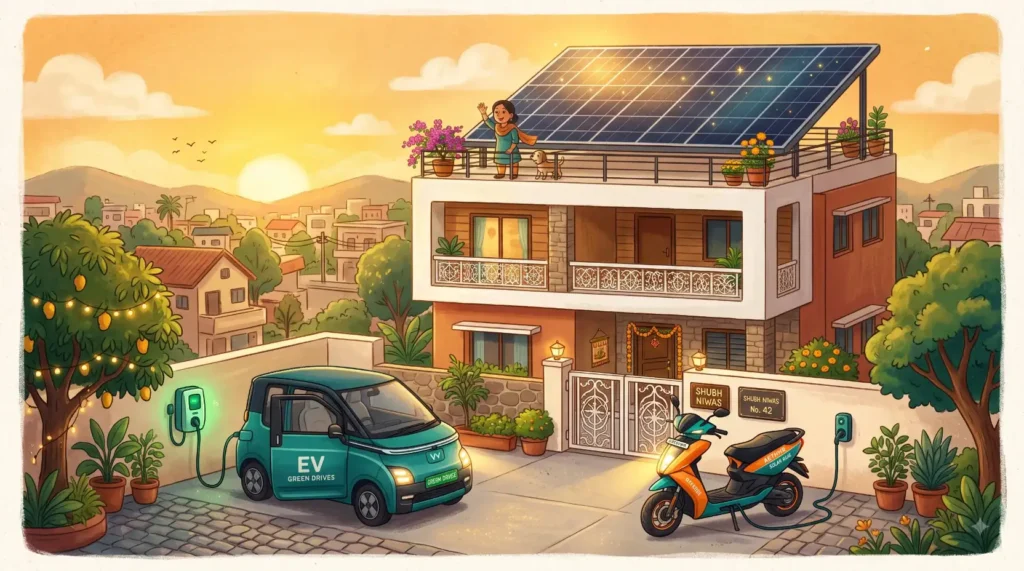
Petrol’s hovering near ₹100 a litre, your electricity tariff creeps up every billing cycle, and you’ve just parked a shiny new EV in the driveway. ☀️ Meanwhile, the sun is blazing down on your rooftop for 300-odd days a year, completely free, doing absolutely nothing.
That’s the itch this guide scratches. India gets more usable sunshine than almost anywhere on earth, fuel is brutally expensive, and electric two-wheelers and cars are flooding the market. Put those three facts together and you get one of the smartest money moves a homeowner can make right now.
If you’ve been wondering whether it actually makes sense to charge your car from your own roof, this is your full, no-fluff walkthrough of rooftop solar EV charging India edition — costs, subsidies, sizing, and the messy real-world bits nobody mentions. Let’s dig in. 👇
⚡ The Short Answer
- ☀️ India is almost tailor-made for solar + EV: high petrol prices, abundant sunshine, and rising grid tariffs all point the same direction.
- 🔋 A typical home needs roughly 1–3 kW of extra solar to cover an electric scooter or compact EV’s charging, on top of household use.
- 💰 Rooftop solar costs around ₹50,000–₹70,000 per kW before subsidy; the PM Surya Ghar Muft Bijli Yojana can knock a big chunk off the first few kilowatts.
- 🔌 Net metering rules vary by state DISCOM — some are generous, some stingy — so daytime charging is often your best strategy.
- ⚠️ Subsidy amounts, tariffs, and net-metering rules change frequently. Always verify current figures on official portals before you commit. Numbers below are illustrative.
📊 Rooftop Solar + EV Sizing at a Glance
Here’s a rough map of system sizes, panel counts, costs, and what each setup can realistically charge. These are illustrative figures — your roof, shading, and DISCOM will shift them.
| System Size | Approx. Panels (~550W each) | Indicative Cost (pre-subsidy) | EV Charging Capability |
|---|---|---|---|
| 1 kW | ~2 panels | ₹55,000–₹70,000 | One electric scooter, daily commute |
| 2 kW | ~4 panels | ₹1.0–1.4 lakh | Scooter + light car top-ups |
| 3 kW | ~6 panels | ₹1.5–2.0 lakh | Compact EV daily charge + home use |
| 5 kW | ~9–10 panels | ₹2.5–3.4 lakh | Full home + one EV comfortably |
| 7 kW | ~13 panels | ₹3.5–4.7 lakh | Larger home + two EVs / bigger car |
Notice the pattern: even a modest system covers a two-wheeler with ease, while 3–5 kW handles a car plus your fridge, fans, and AC. Let’s unpack why this combo works so well here.
🇮🇳 Why Rooftop Solar + EV Is Huge in India
If solar-plus-EV makes sense anywhere, it makes the most sense in India — and it’s not close.
Petrol is punishingly expensive. Relative to incomes, fuel here is among the costliest in the world. Every kilometre on petrol stings, which means every kilometre you shift to home solar saves real money.
The sun shows up. Most of the country sees 250–330 sunny days a year and strong solar irradiance. A panel that struggles in cloudy Europe quietly overperforms on an Indian rooftop. ☀️
Grid tariffs keep climbing. Residential electricity rates have been rising steadily across most DISCOMs. Generating your own power insulates you from those hikes — for the next 20-plus years.
EVs are everywhere now. Electric scooters, autos, and affordable cars are selling in huge numbers. A two-wheeler sips so little energy that even a tiny rooftop array can fully fuel it. The economics of rooftop solar EV charging India simply add up faster than they do almost anywhere else.
🔧 How Rooftop Solar EV Charging Works in Indian Homes
The setup behind rooftop solar EV charging India is simpler than people fear. At its heart, it’s just sunlight becoming electricity becoming kilometres.
The panels sit on your roof and generate DC electricity whenever the sun’s out. An inverter converts that DC into the 230V AC your home and EV charger use. From there, the power flows wherever it’s needed — fans, fridge, or your car’s charging point.
Most Indian homes run an on-grid (grid-tied) system. That means there’s no big battery bank; you stay connected to the DISCOM. When the sun shines, you use solar first and export any surplus. At night or on cloudy days, you simply draw from the grid as usual.
The smart move is daytime charging. Plug your scooter or car in during peak sun hours and you’re charging almost entirely on free solar. For the full how-to, see How to Charge Your EV With Solar Panels at Home — it walks through chargers, scheduling, and timing in detail.
No solar battery is required to start saving. The grid acts as your “virtual battery,” which keeps upfront costs sane. 🔋
📐 Sizing Your Rooftop System for an EV
This is the question everyone gets wrong by overthinking it. Let’s make it simple.
First, figure out your EV’s appetite. An electric scooter typically uses around 2–4 kWh for a full charge, good for 80–120 km. A compact electric car might need 20–30 kWh for a fuller charge, covering 250–350 km. Be honest about how far you actually drive each day.
Now the rule of thumb: in good Indian sun, 1 kW of solar generates roughly 4–5 kWh per day. So:
- A scooter rider needs barely 0.5–1 kW of dedicated solar to stay topped up daily.
- A compact-car commuter doing ~40 km/day needs around 1.5–2.5 kW dedicated to the car.
Then add your household load on top. Most homes already want 2–4 kW just for fans, fridge, lights, and AC. So a realistic combined system for “home + one EV” lands around 3–5 kW for most families.
Don’t massively oversize — extra panels you never use just lengthen payback. Aim to cover your real daily kWh, with a little headroom for cloudy stretches and a future second EV. Right-sizing is the quiet secret to making rooftop solar EV charging India pay back fast. ⚡
🏛️ The PM Surya Ghar Muft Bijli Yojana Subsidy
Here’s where India gets genuinely generous. The national rooftop solar scheme — PM Surya Ghar Muft Bijli Yojana — is designed to put solar on millions of homes, and it directly lowers your upfront cost.
Under the scheme, residential users can claim a central financial assistance (subsidy) on rooftop systems, weighted toward the first few kilowatts. The structure has typically offered meaningful per-kW support for systems up to around 3 kW, with a capped total for larger systems. Some states add their own top-up subsidy on top of the central amount, sweetening the deal further.
The process generally runs through the national PM Surya Ghar portal: you register, pick an empanelled vendor, get the system installed and inspected, and the subsidy is credited to your bank account after commissioning.
⚠️ Important caveat: subsidy amounts, eligibility caps, and per-kW rates change over time and by state. The figures and structure can be revised, and what’s true today may differ next quarter. Always confirm the current numbers on the official pmsuryaghar.gov.in portal (or your DISCOM’s site) before budgeting. Treat any rupee figure you read online — including illustrative ones here — as a starting estimate, not a promise. 📋
🔌 Net Metering in India (DISCOM Rules Vary)
Net metering is what lets your meter “run backwards” — you export surplus solar to the grid and get credited for it. In India, this is where it gets state-specific and a little messy.
Every DISCOM sets its own rules. Some states offer full net metering up to a certain system size (commonly around 1–10 kW for residential, but it varies). Others use net billing or gross metering, where you’re credited at a wholesale-ish rate rather than the full retail tariff. The size caps, banking periods, and rates differ widely between, say, Maharashtra, Tamil Nadu, Karnataka, and Delhi.
What this means practically: don’t assume you’ll be paid full retail for exports. In some states you will; in others, exported units are worth noticeably less than the units you’d otherwise buy.
The strategy that wins almost everywhere? Self-consume as much as possible. Charge your EV and run heavy appliances during sunny hours so you’re using your own cheap solar directly, rather than exporting low and buying back high. For a deeper dive on the export side, read Net Metering and EVs: How to Sell Power Back.
Always check your specific DISCOM’s current net-metering policy before sizing your system — it genuinely changes the math. ⚡
💸 Cost & Payback in India (Illustrative ₹)
Let’s run the numbers like adults — with rupees, caveats, and zero hype. Meet the Iyers: a family in a Tier-1 city with one electric scooter, one compact EV for weekends, and a 4 kW rooftop system.
The upfront cost:
- Gross 4 kW solar system: ₹2,40,000
- PM Surya Ghar subsidy (illustrative): −₹78,000
- Net system cost: ₹1,62,000
- Home EV charging setup: ~₹30,000
- Total net investment: ~₹1,92,000
The annual savings stack:
- Fuel saved (petrol they’d have burned across scooter + car): ~₹40,000/year
- Household grid offset (solar powering fans, fridge, AC): ~₹18,000/year
- Net-metering / surplus credits (where available): ~₹6,000/year
- Total annual savings: ~₹64,000
Payback: ₹1,92,000 ÷ ₹64,000 ≈ roughly 3 years. 😮
After that, the Iyers are essentially driving and powering their home on sunlight they already paid for, for another 20-plus years. The fast break-even comes from expensive petrol, generous subsidies, and a scooter that costs almost nothing to charge. Your numbers will differ — these are illustrative — but the shape of the math holds across most of the country.
🏢 Society & Apartment Rooftop Solar Challenges
Now for the honest part: not everyone has a private rooftop. Millions of Indians live in apartments, and that changes the game.
The roof is shared. In a housing society, the terrace belongs to everyone, so installing a system means getting the RWA or society committee on board. That’s a paperwork-and-politics exercise, not just a technical one.
Billing gets complicated. A society can install a common-area solar system (powering lifts, lighting, water pumps) fairly easily. But routing solar specifically to your individual flat’s meter for EV charging is trickier — it usually requires either a group net-metering arrangement or a dedicated allocation that your DISCOM permits.
Possible paths forward:
- Push for a society-wide rooftop project that offsets common loads and lowers everyone’s maintenance bills.
- Explore group net metering / virtual net metering if your state’s DISCOM allows crediting solar generation across multiple flats.
- For EV charging specifically, advocate for a shared solar-fed charging point in the parking area.
It’s more work, and it depends heavily on local rules. But solar societies are growing fast, and a motivated resident with the numbers in hand can often get the ball rolling. 🏢
🛠️ Installation & Approval Process
So you’ve decided to go for it. Here’s roughly how the journey unfolds for a home rooftop system.
1. Pick an empanelled vendor. For subsidy eligibility, you generally must use a vendor registered with your DISCOM or the national portal. Get at least three quotes — per-kW pricing varies a lot.
2. Apply through the portal. Register on the PM Surya Ghar portal and submit your application with your latest electricity bill and roof details.
3. DISCOM feasibility approval. Your DISCOM reviews the application and confirms your connection can support the proposed system size and net metering.
4. Installation. The vendor mounts panels, installs the inverter, and wires it to your distribution board and EV charging point. A typical home install takes a few days.
5. Net-meter & inspection. The DISCOM installs a bi-directional meter and inspects the setup. Once commissioned, your system is officially live. ⚡
6. Subsidy disbursal. After commissioning and verification, the subsidy is credited to your bank account (timing varies).
Keep copies of everything, and don’t pay the full amount expecting the subsidy as a discount — in most cases you pay, then get reimbursed. 📁
📈 2026: India Rooftop Solar Boom
If you’ve felt like solar is suddenly everywhere, you’re not imagining it. 2026 is shaping up to be a landmark year for rooftop solar EV charging India.
Panel prices keep falling. More watts per rupee means the upfront barrier — the thing that scares people off — keeps shrinking season after season.
The PM Surya Ghar scheme has scale. A national push to put solar on a huge number of rooftops has pulled in vendors, financing, and awareness, making the whole process smoother than it was a few years ago.
EV adoption is exploding. Electric two-wheelers and affordable cars are selling in record volumes, and each new EV owner is a natural candidate for rooftop solar.
Financing is maturing. More banks and NBFCs offer rooftop solar loans, and some bundle EV-plus-solar packages. Add it all up and the timing has rarely been better. 📉
✅ 5 Steps to Go Solar + EV in India
- Check your real consumption. Pull your last few electricity bills and estimate your EV’s daily kWh need. This sets your system size.
- Verify the current subsidy. Visit the official PM Surya Ghar portal and your DISCOM site for today’s subsidy rates and net-metering rules — don’t trust stale figures.
- Get three empanelled quotes. Compare per-kW pricing, panel quality, inverter brand, and warranty. Cheapest isn’t always best.
- Plan for daytime charging. A smart charger and a simple schedule let your EV drink free midday solar instead of pricey night-time grid power.
- Apply, install, commission. Submit through the portal, get DISCOM approval, install, and claim your subsidy after commissioning. Then enjoy near-free kilometres. ☀️🚗
🛒 Shop This Post
Gear that makes a solar-plus-EV home actually work:
- ☀️ High-efficiency rooftop solar panels — More watts per square foot means more generation from limited Indian rooftop space, and faster payback even on a compact terrace.
- 🔌 Smart home EV charger — Schedule charging for peak sun hours so your scooter or car runs on free solar, not expensive grid power.
- 📊 Solar generation monitor — Track exactly how much your panels generate, how much you self-consume, and how much you export, so you can squeeze maximum value from net metering.
Disclosure: This post contains affiliate links. If you buy through them, we may earn a small commission at no extra cost to you. It helps keep our solar-powered lights on. 🙏
🎯 Quick Quiz
You own an electric scooter that uses ~3 kWh per full charge. Roughly how much dedicated solar do you need to keep it topped up daily in good Indian sun?
- A) 5 kW
- B) Less than 1 kW
- C) 3 kW
👉 Tap for the answer
**B.** In strong Indian sunshine, 1 kW of solar generates roughly 4–5 kWh per day — more than enough to cover a scooter’s ~3 kWh daily charge. Under 1 kW of dedicated panels does the job, which is exactly why **rooftop solar EV charging India** is so cheap for two-wheeler owners. You’d add more capacity only to cover the rest of your household load.
📋 Your Solar + EV Checklist
Tick these off before you commit:
- [ ] Pulled your last 3–6 electricity bills to gauge consumption
- [ ] Estimated your EV’s daily kWh need honestly
- [ ] Checked the current PM Surya Ghar subsidy on the official portal
- [ ] Confirmed your DISCOM’s net-metering or net-billing policy
- [ ] Got at least 3 quotes from empanelled vendors
- [ ] Verified your roof’s shading, space, and direction
- [ ] Decided cash vs. solar loan (and compared the math)
- [ ] Planned a daytime-charging routine
- [ ] (Apartment?) Started the RWA / society conversation early
🤔 People Also Ask
Is rooftop solar EV charging in India actually worth it?
For most homeowners with a private rooftop, yes. Expensive petrol, strong sunshine, government subsidies, and cheap-to-charge two-wheelers mean rooftop solar EV charging India often pays back in roughly 3–6 years (illustrative), followed by two decades of near-free driving and home power.
How much solar do I need to charge an electric car at home?
A compact EV doing ~40 km a day typically needs around 1.5–2.5 kW of dedicated solar, on top of your household load. Most “home + one car” setups land at about 3–5 kW total. A scooter needs far less — often under 1 kW.
What is the PM Surya Ghar subsidy for rooftop solar?
It’s central financial assistance toward residential rooftop systems, weighted toward the first few kilowatts, sometimes topped up by state schemes. Exact amounts change, so verify the current rates on the official pmsuryaghar.gov.in portal before budgeting.
Do I need a battery to charge my EV with rooftop solar?
No. Most Indian homes use on-grid systems with no battery — the grid acts as your virtual storage. You charge on solar during the day and draw from the grid at night, which keeps upfront costs much lower.
Does net metering work the same across all Indian states?
No. Each DISCOM sets its own rules — some offer full net metering, others use net billing or gross metering at lower rates, with different size caps. Always check your specific state’s current policy before sizing your system.
Can I install rooftop solar if I live in an apartment?
It’s harder but possible. The terrace is shared, so you’ll need RWA approval, and routing solar to your individual flat for EV charging may require group or virtual net metering where your DISCOM allows it. Society-wide systems for common loads are the easiest starting point.
🚀 The Bottom Line
India might be the single best place on the planet to marry a rooftop full of solar panels with an EV in the driveway. The sun is relentless, petrol is painful, tariffs keep rising, and the subsidies are real — for now. That combination is why rooftop solar EV charging India has quietly become one of the smartest household money moves of 2026.
The payback isn’t the prize, though. It’s everything after: 20-odd years of driving and powering your home on sunshine you’ve already paid for, immune to the next petrol price spike or tariff hike.
Just remember the homework — verify the current subsidy and your DISCOM’s net-metering rules on official portals, because both change. Then size sensibly, charge in daylight, and let the sun foot the bill. ☀️🚗
👉 Ready to start? Read How to Charge Your EV With Solar Panels at Home for the charging side, and Net Metering and EVs: How to Sell Power Back to make the most of every surplus unit.