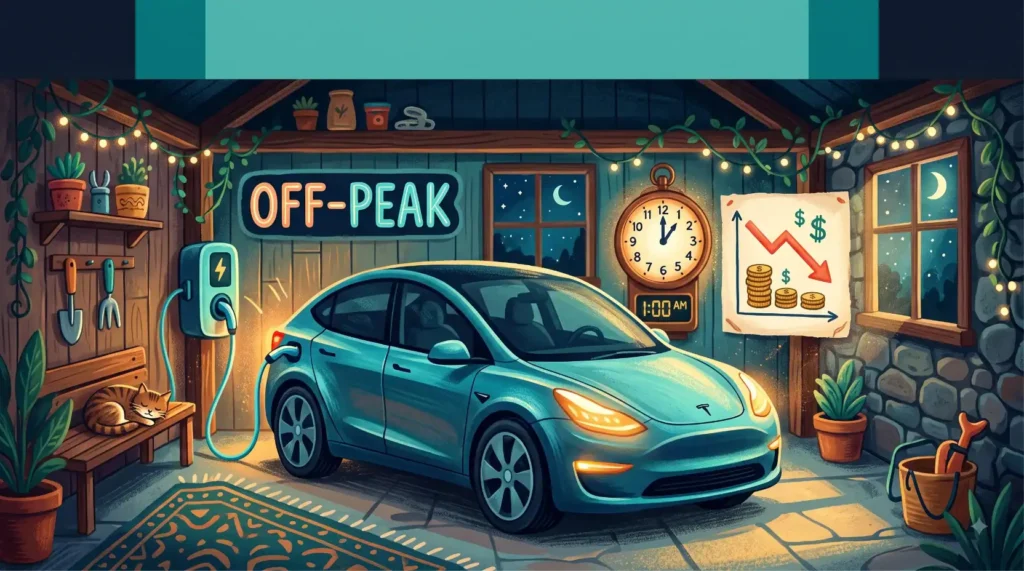
Here’s a small, slightly painful truth: most EV owners are paying more for electricity than they have to — and they have no idea. 😬
Not because they’re careless. Because nobody told them that the exact same kilowatt-hour can cost three times more at 6pm than it does at 1am. Your meter knows. Your utility definitely knows. You probably don’t.
And the wild part? Fixing it doesn’t require driving differently, charging less, or babysitting an app at midnight. You just plug in once and let software shuffle your charging into the cheap hours while you sleep, eat dinner, or binge something. The savings happen on autopilot.
That’s the whole magic of time of use EV charging — and once you set it up, it quietly pays you back every single month. 👇
⚡ The Short Answer
If you want the headline before the deep dive, here it is:
- 🕐 Time-of-use (ToU) pricing means your electricity costs different amounts at different hours — cheap overnight, expensive during the evening rush.
- 🌙 Off-peak windows (often late night to early morning) are where EV charging gets dirt cheap, sometimes less than half the peak rate.
- 🤖 Automation does the work — your smart charger or your car’s built-in scheduler waits for the cheap window and charges then, hands-free.
- 💰 The savings are real — many drivers cut their charging bill by 30–60% just by shifting when they charge, not how much.
The big idea: you don’t pay less per mile by driving less. You pay less by charging smarter. That’s the heart of time of use EV charging — and the money lives in the details below. 😎
📊 Typical Rate Periods, Costs & Best Time to Charge
Here’s how a typical time-of-use day breaks down. The numbers are illustrative — your utility’s exact rates and windows will differ — but the shape is almost universal. ⚡
| Rate Period | Typical Hours | 🇺🇸 Cost (illustrative) | 🇮🇳 Cost (illustrative) | Charge Here? |
|---|---|---|---|---|
| 🔴 Peak | 4pm–9pm | ~$0.40/kWh | ~₹10/kWh | ❌ Avoid — most expensive |
| 🟡 Mid-peak / Shoulder | 9pm–12am & 7am–4pm | ~$0.22/kWh | ~₹7/kWh | ⚠️ Only if you must |
| 🟢 Off-peak | 12am–6am | ~$0.13/kWh | ~₹5/kWh | ✅ Yes — the sweet spot |
| 🔵 Super-off-peak | 12am–6am (EV plans) | ~$0.08/kWh | ~₹4/kWh | ✅✅ Best — if available |
Look at the spread. Peak can be 3–5x the cost of super-off-peak for the identical electricity. Charging a 60 kWh battery at peak might run ~$24, while super-off-peak drops it to ~$5. That gap, repeated nightly, is the entire game. 🎯
🕐 What Time-of-Use (ToU) Pricing Actually Is
Let’s start at the foundation, because once this clicks, everything else falls into place.
For decades, most homes paid a single flat rate for electricity — one price, all day, every day. Simple, but it hides a truth about how the grid works: power is genuinely cheaper to produce at some hours than others.
In the evening, everyone’s home. Lights, ovens, ACs, TVs, and EVs all switch on at once. Demand spikes, and utilities fire up expensive “peaker” plants to keep up. That’s peak time — and it costs the grid more.
Overnight, demand collapses. Power plants have spare capacity sitting idle, and wind often blows hardest. Electricity is abundant and cheap. That’s off-peak.
Time-of-use pricing simply passes those real costs through to you. Instead of one blended rate, your bill varies by the clock — pricey when the grid strains, cheap when it’s sleepy. 🌙 It’s not a gimmick; it’s the grid finally telling you the truth about timing. And time of use EV charging is simply listening to that signal.
🔌 Why Every EV Owner Should Be on a ToU Plan
Here’s why ToU and EVs are a match made in heaven: an EV is the single most flexible big load in your entire home. ⚡
Think about it. Your fridge can’t wait until midnight to run. Your evening shower can’t reschedule itself. But your car? It sits in your driveway for 10–14 hours overnight, and it genuinely does not care when those electrons flow in — as long as it’s full by morning.
That flexibility is exactly what ToU rewards. A gas-only household barely benefits from time-of-use pricing because their flexible load is tiny. But an EV adds a huge, shiftable chunk of demand that you can drop neatly into the cheapest hours.
In other words, time of use EV charging turns your car’s biggest “cost” — all that electricity — into your biggest savings lever. 💰
The math gets even better with EV-specific utility plans (more on those below), which are practically designed to make overnight charging absurdly cheap. If you’ve bought an EV and you’re still on a flat rate, you’re likely leaving real money on the table every month.
💡 New to scheduling? Start here: How to Set Up Scheduled EV Charging to Save Money
🌙 The Off-Peak Charging Sweet Spot
If there’s one habit that defines a money-smart EV owner, it’s this: charge in the off-peak window, almost always. 🌙
The off-peak window — typically somewhere between midnight and 6am — is where electricity hits its lowest everyday price. It’s the deep-discount aisle of the power grid. And because your car has all night to fill up, even a slower Level 2 charger comfortably tops off a battery in that window.
Here’s a real-world rhythm that works beautifully:
- 🅿️ You get home at 6pm and plug in immediately — no thinking required.
- ⏰ Your charger or car holds and does nothing during pricey peak and shoulder hours.
- 🌙 At midnight, the cheap window opens and charging quietly begins.
- ☀️ You wake up to a full battery, charged at the lowest rate of the day.
The beauty is that “plug in early, charge late” feels identical to normal charging — you never wait, you never miss a window. The only thing that changes is your bill shrinking. 📉
And no, regularly charging overnight doesn’t harm your battery. Slow, scheduled charging is actually gentler than constant fast-charging. It’s the win-win you don’t have to think about.
🤖 How to Automate Time-of-Use Charging
This is the part that turns a good idea into effortless savings. Because let’s be honest — nobody is going to wander out to the garage at 12:01am every night to flip a switch. 🥱
You’ve got two reliable ways to automate it, and you can use either (or both).
🚗 Your car’s built-in scheduler. Almost every modern EV — Tesla, Hyundai, Kia, Tata, Mahindra, MG, and more — lets you set a “departure time” or a charging window right in the dash or app. Tell it “be ready by 7am, charge during off-peak,” and it handles the timing internally. Zero extra hardware needed.
🧠 A smart charger. A Wi-Fi-enabled smart charger lets you set the off-peak window once and forget it forever. It waits, fires up at the cheap hour, and many even log your kWh and cost so you can see the savings stacking up. Some sync directly with your utility’s ToU schedule.
Either way, the workflow is the same: set it once, plug in daily, save automatically. 🎯 The smartest move is to schedule based on when power gets cheap, not when you happen to arrive home.
💡 Want the step-by-step setup? We walk through both methods in How to Set Up Scheduled EV Charging to Save Money — bookmark it.
💰 Calculating Your Savings: Peak vs Off-Peak
Alright, let’s put real numbers on this, because “you’ll save money” means nothing without the math. 💸
Take a typical driver charging about 250 kWh a month (roughly 1,000 miles for an efficient EV). The savings come entirely from the gap between peak and off-peak rates.
🇺🇸 The US example
Say peak is ~$0.40/kWh and off-peak is ~$0.13/kWh — a $0.27 spread.
- Charging at peak: 250 × $0.40 = ~$100/month
- Charging at off-peak: 250 × $0.13 = ~$32.50/month
- 💥 Monthly savings: ~$67.50 — that’s ~$810/year just from timing.
🇮🇳 The India example
Say peak is ~₹10/kWh and off-peak ₹5/kWh under a ToD tariff — a ₹5 spread.
- Charging at peak: 250 × ₹10 = ~₹2,500/month
- Charging at off-peak: 250 × ₹5 = ~₹1,250/month
- 💥 Monthly savings: ~₹1,250 — that’s ~₹15,000/year kept in your pocket.
Those numbers aren’t theoretical — they’re what happens when you simply move your charging into the cheap window. And the best part? You can plug your real rates and kWh into our EV Charging Cost Calculator to see your exact savings in about a minute. 🧮
🔵 Super-Off-Peak & EV-Specific Utility Plans
Here’s where it goes from “nice savings” to “wait, how cheap?” 🤯
Many utilities now offer EV-specific time-of-use plans designed to pull car charging into the dead of night. These plans often add a fourth tier: super-off-peak — an ultra-cheap window (commonly midnight to 6am) priced even below normal off-peak.
In the US, EV rate plans from utilities like PG&E, SCE, and many others can push super-off-peak charging down toward $0.08–$0.10/kWh. Charge a 60 kWh battery in that window and you’re looking at roughly $5–$6 for a near-full tank. ⛽➡️🔋
In India, several state DISCOMs have introduced concessional EV tariffs and night-charging slabs that drop the per-unit cost meaningfully below daytime rates — sometimes into the ₹4–₹5/kWh range for overnight EV charging.
The catch worth knowing: EV-specific plans sometimes carry higher peak rates as a trade-off. That’s totally fine — if you genuinely shift your charging off-peak (which automation makes easy). But if you can’t avoid peak usage elsewhere in your home, run the numbers first.
The takeaway: call your utility and ask, “Do you have an EV time-of-use plan?” That one question can unlock the cheapest charging tier you didn’t know existed. 📞
⚠️ Avoiding Peak-Rate Charging Mistakes
Even great intentions get sabotaged by a few sneaky pitfalls. Dodge these and your ToU plan actually delivers. 🛡️
🔴 Mistake 1: Plugging in and charging immediately at peak. The classic. You get home at 6pm, plug in, and charging starts right now — during the priciest window of the day. Always schedule, never default to instant charging.
🔴 Mistake 2: Switching to ToU but never automating. A ToU plan with manual charging is a trap. Forget once, charge at peak, and you’ve erased a week of savings. Automation isn’t optional — it’s the whole point.
🔴 Mistake 3: Ignoring your shoulder/mid-peak hours. Some folks charge at, say, 8pm thinking “it’s not peak.” But mid-peak still costs noticeably more than off-peak. Aim for the deepest discount window.
🔴 Mistake 4: Forgetting daylight-saving or seasonal shifts. Utilities sometimes move peak windows seasonally. Re-check your schedule a couple times a year so you’re not accidentally charging into a shifted peak. 📅
🔴 Mistake 5: Going ToU without checking the spread. If your utility’s peak-vs-off-peak gap is tiny, the savings may not justify a higher peak rate elsewhere. Always confirm the spread is worth it first.
Nail these, and time of use EV charging does exactly what it promises — quietly, reliably, month after month. ✅
🇮🇳 India: ToD / ToU Tariffs Explained
India deserves its own section, because the system here works a little differently — and it’s evolving fast. 🇮🇳
Indian electricity is largely billed in slabs (the more units you consume, the higher the per-unit rate climbs). On top of that, the country is rolling out Time-of-Day (ToD) metering, which is India’s version of time-of-use pricing.
Under the national framework, ToD tariffs are being mandated more widely — with peak hours priced higher and off-peak/solar hours priced lower (often a discount of 10–20% or more off the normal slab rate during cheap windows). For EV owners installing smart or net meters, this is a genuine opportunity.
Several states have gone further with dedicated EV charging tariffs — concessional per-unit rates specifically for charging an electric vehicle, sometimes with extra night-time discounts layered on. The exact structure varies by DISCOM, so your Maharashtra, Delhi, or Karnataka rate card will look different.
The practical move for Indian EV owners: 🔌
– Ask your DISCOM whether ToD metering and an EV tariff are available in your area.
– Find your designated off-peak / night window (commonly late night onward).
– Automate charging into that window with your car or charger scheduler.
Stack a ToD off-peak discount with overnight EV charging, and the savings compound nicely — exactly the kind of low-effort, high-reward win that makes EV ownership cheaper than petrol by a mile. ⚡
📈 2026: Dynamic Pricing & Smart Charging
The whole landscape is shifting under our feet — and 2026 tilts hard toward rewarding smart timing. 🚀
Dynamic (real-time) pricing is spreading. Beyond fixed peak/off-peak blocks, more US utilities are piloting dynamic pricing, where rates move hour-to-hour based on live grid conditions and even wholesale market prices. When solar floods the grid at midday or wind surges overnight, prices can drop to near-zero — and smart chargers can pounce on those troughs automatically. 🌞🌬️
Smart chargers are getting genuinely intelligent. Newer chargers don’t just follow a fixed schedule — they read live price signals, sync with utility ToU calendars, and optimize charging minute by minute. Set your departure time, and the software figures out the cheapest possible path to a full battery.
Demand-response is paying drivers. A growing number of utilities now pay you (via bill credits) to let them gently shift your charging during grid stress. It’s hands-off money for joining a managed-charging program. 💸
India is digitizing fast. Smart meters and ToD rollouts are accelerating, which means dynamic-style EV pricing is on the horizon for Indian drivers too.
The throughline: as pricing gets more time-sensitive, the gap between “I just plug in whenever” and “my charger optimizes automatically” only widens. Automation is becoming the difference between an average bill and a great one. 🎯
✅ 5 Tips to Maximize ToU Savings
- Find your exact off-peak window first. ⏰ Five minutes on your utility’s rate page (or a call to your DISCOM) reveals the cheapest hours. Everything else builds on this.
- Automate, then forget. Use your car’s scheduler or a smart charger so charging always lands in the cheap window — never rely on memory.
- Ask about EV-specific and super-off-peak plans. These hidden tiers can be dramatically cheaper than standard ToU. One phone call can unlock them.
- Plug in early, charge late. Make plugging in a 6pm habit, but let the schedule delay the actual charging to off-peak. No waiting, all savings.
- Re-check seasonally. Peak windows can shift with the season or daylight saving. A quick twice-a-year tune-up keeps you out of accidental peak charging. 📅
🛒 Shop This Post
Here’s the gear that turns time-of-use pricing into automatic, set-and-forget savings. 😍
1. A Smart Wi-Fi EV Charger 🧠
Schedules charging into your off-peak window automatically, tracks kWh and cost, and often syncs with utility ToU rates. The cornerstone of effortless savings.
👉 Shop smart Wi-Fi EV chargers
2. A Home Energy Monitor 📊
See exactly how much power you use — and when — so you can verify your off-peak charging is actually landing in the cheap window.
👉 Shop home energy monitors
3. A Wi-Fi Smart Plug (for accessories) 🔌
Great for scheduling smaller EV-related loads (a trickle charger, a garage heater) to run only during off-peak hours.
👉 Shop smart plugs
🛍️ Disclosure: These are affiliate picks — they cost you nothing extra, and they help support EVs Mirror so we can keep testing gear and writing honest, no-hype guides. 🙏
🎯 Quick Quiz: Are You Wasting Money on Peak Power?
Answer these three and you’ll know in about ten seconds. ⏱️
- Do you know your utility’s off-peak hours? 🅐 Yes 🅑 No idea
- Does your EV charge the moment you plug in? 🅐 No, it’s scheduled 🅑 Yes, instantly
- Are you on a ToU or EV-specific plan? 🅐 Yep 🅑 Flat rate / not sure
Mostly 🅐: 🎉 You’re already winning — your charging is optimized and your bill thanks you.
Mostly 🅑: 🚨 You’re very likely overpaying. Switching to ToU and automating off-peak charging could cut your charging bill 30–60%. Start today.
📋 Time-of-Use Checklist
Run through this to lock in your savings:
- [ ] Confirm your utility offers a ToU or ToD plan
- [ ] Find and note your off-peak / super-off-peak window
- [ ] Ask about an EV-specific rate plan
- [ ] Set a charging schedule in your car or smart charger
- [ ] Make “plug in at 6pm” a daily habit
- [ ] Verify charging actually starts in the off-peak window
- [ ] Run your real numbers through a cost calculator 🧮
- [ ] Re-check your schedule each season for shifted peaks 📅
🤔 People Also Ask
Q: What is time of use EV charging?
A: Time of use EV charging means scheduling your car to charge during the hours when electricity is cheapest — typically off-peak, overnight windows — instead of during expensive peak periods. Because your EV is a flexible, overnight load, shifting when you charge can cut your charging bill by 30–60% without changing how much you drive.
Q: When is the cheapest time to charge an EV?
A: Almost always overnight, in the off-peak window — commonly between midnight and 6am. On EV-specific plans, this is often a “super-off-peak” tier with the lowest rate of the entire day. Plug in when you get home, but schedule the actual charging to start in that cheap window.
Q: Do I save money with a time-of-use plan?
A: Yes — but only if you genuinely shift your charging off-peak. On a 250 kWh/month habit, the savings can reach roughly $810/year in the US or ₹15,000/year in India, purely from timing. Automation is key, because a ToU plan with manual charging risks expensive peak-rate slip-ups.
Q: How do I automate off-peak charging?
A: Use your EV’s built-in charging scheduler (set a departure time or charging window in the car or app) or a smart Wi-Fi charger that fires up only during off-peak hours. Set it once, plug in daily, and it charges in the cheap window automatically — no midnight trips to the garage required.
Q: What is the difference between peak and off-peak rates?
A: Peak rates apply during high-demand hours (often 4pm–9pm) when the grid is strained and power is most expensive. Off-peak rates apply during low-demand hours (often overnight) when power is abundant and cheap. The same kilowatt-hour can cost 3–5x more at peak than at super-off-peak.
Q: What is ToD tariff in India?
A: Time-of-Day (ToD) tariff is India’s version of time-of-use pricing, where electricity costs more during peak hours and less during off-peak/solar windows. It’s being rolled out widely alongside smart meters, and several states layer on concessional EV charging tariffs — making overnight EV charging notably cheaper.
🚀 The Bottom Line
After all the rate tiers, math, and fine print, time of use EV charging boils down to one beautifully simple idea: charge when power is cheap, and let software do the timing. 🎯
You don’t have to drive less. You don’t have to babysit a midnight schedule. You just plug in after work, let your car or smart charger wait for the off-peak window, and wake up to a full battery charged at the lowest rate of the day. The savings — $810 or ₹15,000 a year in our examples — happen entirely on autopilot.
So do the two things that actually unlock it: find your off-peak window (one quick check with your utility or DISCOM), and automate your charging to land in it. That’s the whole playbook.
Then plug in tonight and start saving — your future power bill will look noticeably lighter. ⚡
💬 What’s your off-peak rate — and how much did switching to ToU save you? Tell us in the comments!
📤 Know an EV owner still charging at peak? Share this and save them hundreds. 🙏
🔖 Bookmark EVs Mirror for honest, money-smart EV guides.
👉 Up next: How to Set Up Scheduled EV Charging to Save Money — and run your numbers in our EV Charging Cost Calculator.