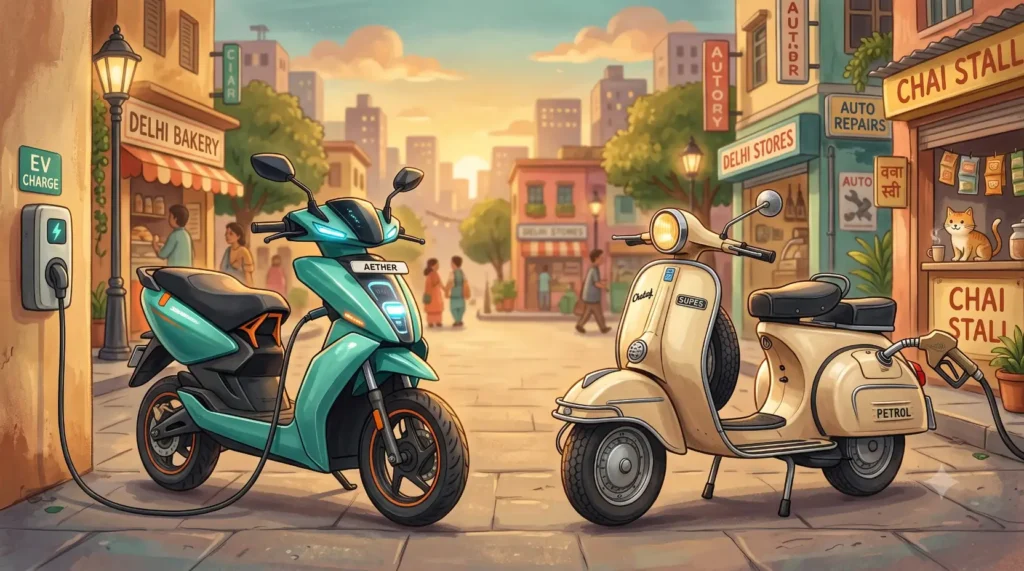
You walk into a showroom, eyes on a glossy electric scooter, and the salesperson quotes a price that’s clearly higher than the petrol model parked right next to it. Your gut says petrol. Your wallet, in the long run, says something very different. That gap between the sticker shock today and the savings tomorrow is exactly what most buyers get wrong.
Here’s the thing: a scooter isn’t a one-time purchase. It’s a five-year relationship with fuel pumps, service centers, and your monthly budget. And once you zoom out past the showroom and look at how much you actually spend keeping the thing running, the picture flips hard. That’s the real story behind the electric vs petrol scooter cost debate — and we’re going to break every rupee of it down.
⚡ The Short Answer
If you’re skimming, here’s the gist before we dig in:
- Running cost per km: Electric scooters cost roughly ₹0.20–₹0.40/km to run on home charging. Petrol scooters cost around ₹2.00–₹2.50/km. That’s a 5x to 10x gap.
- Monthly fuel/charge: A typical 1,000 km/month rider spends about ₹300 charging vs ₹2,200+ on petrol.
- Maintenance: Electric scooters have far fewer moving parts — no oil changes, no spark plugs, no clutch. Annual service can be 40–60% cheaper.
- Upfront price: Electric usually costs ₹20,000–₹50,000 more to buy, even after subsidies.
- Break-even: Most riders recover that gap in 18–30 months of normal use.
- Bottom line: Electric wins decisively on long-term cost. Petrol still makes sense for some specific use cases (we’ll cover those).
💰 Cost Comparison Table (Illustrative, India ₹)
These are ballpark figures for a mid-range scooter, ~1,000 km/month, home charging at ₹8/unit and petrol around ₹105/litre. Your real numbers will vary by city, tariff, and model — treat this as a directional guide, not a quote.
| Cost Factor | Electric Scooter | Petrol Scooter |
|---|---|---|
| Running cost per km | ₹0.30 | ₹2.25 |
| Monthly fuel/charge (1,000 km) | ~₹300 | ~₹2,250 |
| Annual service cost | ~₹1,500 | ~₹3,500 |
| Upfront price (on-road) | ~₹1,30,000 | ~₹95,000 |
| 5-Year fuel/charge total | ~₹18,000 | ~₹1,35,000 |
| 5-Year maintenance total | ~₹7,500 | ~₹17,500 |
| 5-Year TCO (approx.) | ~₹1,55,500 | ~₹1,47,500 |
Notice something interesting in that last row? Over five years the totals land surprisingly close — and that’s before you account for rising petrol prices, resale value shifts, and battery warranties stretching to 8 years. Push the timeline to 6 or 7 years, or ride more than 1,000 km a month, and electric pulls clearly ahead. Let’s unpack why.
🏆 The Headline: E-Scooters Are Far Cheaper to Run
Strip away the marketing and the subsidies for a second. The single biggest reason electric two-wheelers win on money is brutally simple: electricity is cheaper than petrol per unit of distance.
A petrol scooter burns fuel that’s taxed, transported, and priced on a volatile global market. An electric scooter sips electricity that, charged at home overnight, costs a fraction of that per kilometer. You’re not just saving a little — you’re often paying one-fifth to one-tenth as much to cover the same road.
And this isn’t a one-time bonus. Every single ride, every day, for years, that gap compounds quietly in your favor. The fuel pump is a recurring tax on petrol owners; the wall socket is barely a rounding error for EV owners.
That’s why, when people honestly run the electric vs petrol scooter cost numbers for their own commute, the daily-rider math almost always tilts electric. The more you ride, the louder the savings shout.
️ Cost Per Km: Electricity vs Petrol (Illustrative)
Let’s get concrete, because “cheaper” means nothing without numbers.
Petrol scooter: A decent 110cc scooter delivers around 45–50 km per litre in real-world riding (not the optimistic brochure figure). At ₹105/litre, that’s roughly ₹2.10–₹2.30 per km.
Electric scooter: A typical e-scooter uses about 2.5–3.5 units (kWh) to cover 80–90 km of range. At a home tariff of ₹8/unit, you’re looking at ₹0.25–₹0.35 per km.
Run a quick monthly comparison for a 1,000 km commuter:
- Petrol: ~₹2,250/month → ₹27,000/year
- Electric (home charge): ~₹300/month → ₹3,600/year
That’s roughly ₹23,000 saved every single year on fuel alone. Over five years, you’re talking well north of a lakh just on running cost. Even if you charge partly at paid public stations (₹15–₹20/unit), electric still wins comfortably — it just narrows the lead.
🏷️ The Upfront Price Gap: E-Scooters Cost More to Buy
Now for the honest counterpoint. Electric scooters genuinely cost more up front, and pretending otherwise does buyers a disservice.
A comparable petrol scooter might be ₹85,000–₹1,00,000 on-road. The electric equivalent — same usable range, similar build quality — often lands ₹1,20,000–₹1,40,000. That ₹20,000–₹50,000 premium is real, and it’s the number that stalls a lot of buyers at the showroom.
Why the gap? The battery. Lithium-ion packs are still the most expensive component in any EV, and a scooter’s battery can represent 30–40% of its cost. Add the electric motor, controller, and charging electronics, and you’re paying for technology that’s newer and not yet at petrol-engine economies of scale.
The good news: battery costs have been falling year over year, and subsidies (more on those soon) blunt the blow. But going in, expect to pay more on day one. The question is never “is it cheaper to buy” — it’s “does it pay you back fast enough?”
⚖️ The Break-Even Point: How Many Km Until You Save?
This is the question that actually decides the electric vs petrol scooter cost argument for your specific situation. Break-even is where your accumulated fuel savings finally cancel out that higher purchase price.
Let’s say the electric scooter costs ₹35,000 more up front. You save roughly ₹1,950/month on fuel (₹2,250 petrol − ₹300 electric). Add maintenance savings of, say, ₹150/month. That’s about ₹2,100 saved monthly.
₹35,000 ÷ ₹2,100 ≈ 17 months to break even.
Translate that to distance: at 1,000 km/month, you cross the line at roughly 17,000 km. For a daily commuter, that’s well under two years. After that point, every kilometer is pure savings — the scooter is literally paying you back.
The math shifts with your habits:
- Heavy rider (1,500+ km/month): Break-even in ~12 months. Electric is a no-brainer.
- Light rider (300 km/month): Break-even can stretch past 4–5 years. The case weakens.
In short — the more you ride, the faster electric wins. The less you ride, the longer petrol’s lower entry price holds its appeal.
🔧 Maintenance Savings: No Oil, Fewer Parts
Here’s where electric quietly racks up savings that don’t show on the fuel bill.
A petrol engine is a beautifully complicated thing — and complication costs money. Engine oil, oil filters, air filters, spark plugs, valve adjustments, clutch wear, fuel injectors. Each one is a periodic expense and a potential breakdown. Skip an oil change and you risk real engine damage.
An electric scooter? The drivetrain is almost embarrassingly simple. No engine oil. No spark plugs. No clutch, no gearbox to service. The motor is a sealed unit with very few wear points. Regenerative braking even reduces brake-pad wear because the motor helps slow you down.
What’s left to service on an EV is mostly the basics: brake pads, tyres, suspension, and occasional software updates. Real-world owners often report annual maintenance 40–60% lower than comparable petrol scooters. Over five years, that’s another ₹8,000–₹12,000 staying in your pocket.
The one big caveat: battery health. The battery is your most expensive component, and while most carry 3–8 year warranties, eventual replacement (rare, but possible) is a cost petrol owners never face. Modern packs are holding up well, but it’s worth factoring in.
🔌 Charging Cost Reality: Home vs the Petrol Pump
The cleanest savings come when you can charge at home — and most scooter owners can, because many models offer a removable battery you carry up to your flat and plug into a normal socket.
Home charging: At ₹8/unit and ~3 units for a full charge, a complete top-up costs about ₹24 and gives you 80–90 km. Compare that to filling 2 litres of petrol (₹210) for similar range. The difference is night and day.
Public/paid charging: If you rely on public stations at ₹15–₹20/unit, your per-km cost roughly doubles to ₹0.50–₹0.70/km — still far below petrol’s ₹2.25, but the gap narrows. This matters most for renters or apartment dwellers without a dedicated socket.
The honest friction: Charging takes hours, not minutes. A petrol fill-up is three minutes; a full charge is 4–6 hours (or a quick swap if your model supports it). For 95% of daily commutes this is irrelevant — you charge overnight. But it’s a real lifestyle change, not just a spreadsheet line.
A small portable charger or a second battery can transform the experience here, especially if you split charging between home and office. (More on smart gear in the Shop section below.)
🎁 Subsidies Narrow the Upfront Gap
Remember that scary ₹35,000 price premium? Government incentives chip away at it meaningfully.
India’s EV push — through schemes like FAME-II, the newer EMPS/PM E-DRIVE incentives, and various state subsidies — has historically knocked thousands off electric two-wheeler prices. Depending on the state and the year, buyers have seen subsidies of ₹5,000–₹15,000+ plus benefits like waived road tax and registration fees.
Stack those up and the real upfront gap can shrink from ₹35,000 to closer to ₹20,000–₹25,000 — which slashes your break-even time accordingly. Some states also offer scrappage bonuses if you trade in an old petrol vehicle.
The catch: subsidy schemes change, get capped, or expire. They’re a moving target, so always check the current incentive in your state before you buy. What was true last year may not hold in 2026. But broadly, the policy wind is firmly at electric’s back, and that helps the electric vs petrol scooter cost equation tilt further toward EVs each year.
💡 Quick tip: Subsidies often apply at the dealership as an instant discount, not a rebate you claim later. Confirm whether the quoted on-road price already includes it — some dealers show pre-subsidy prices to look competitive.
🚦 When Petrol Still Makes Sense
Let’s be fair — electric isn’t automatically right for everyone. There are genuine scenarios where a petrol scooter remains the smarter buy.
- You ride very little. If you’re a weekend-only or sub-300 km/month rider, the fuel savings are too small to recover the price premium in any reasonable timeframe.
- No reliable charging. If you live in a building with no socket access, no dedicated parking, and no nearby public chargers, the daily friction may outweigh the savings.
- Long, unpredictable trips. If you regularly ride beyond your scooter’s range with no charging stops, range anxiety is real. A petrol top-up takes three minutes anywhere.
- Tight upfront budget. If the extra ₹20,000–₹30,000 today simply isn’t available — even if it pays back later — petrol’s lower entry price wins by default.
- Remote areas. Where the grid is patchy and service networks for EVs are thin, petrol’s mature ecosystem still has the edge.
For everyone else — the daily city commuter with a place to plug in — the numbers overwhelmingly favor electric.
📈 2026: The Cost Gap Widening in EV’s Favor
Zoom out to the bigger trend and the direction is unmistakable. Every year, the electric vs petrol scooter cost comparison gets more favorable to EVs, not less.
Battery prices keep falling. Lithium cell costs have dropped dramatically over the past decade, and that flows straight into lower scooter prices. The upfront premium that’s ₹35,000 today could be ₹15,000–₹20,000 within a couple of years.
Petrol isn’t getting cheaper. Fuel prices trend upward over time with taxes and global volatility. Every rupee petrol rises makes electric’s per-km advantage even bigger.
Charging infrastructure is exploding. More public chargers and battery-swap stations mean the “no charging” objection keeps shrinking, opening EVs up to renters and apartment dwellers who previously had to pass.
Resale value is maturing. Early EV resale was uncertain, but as the used-EV market deepens and battery health reporting improves, electric scooters are holding value better than skeptics predicted.
Put simply: if the math already favors electric for most riders in 2026, that lead is only set to widen. Buying petrol today increasingly means buying into the more expensive long-term option.
✅ 5 Tips to Maximize Your Savings
Want to squeeze every rupee out of going electric? Do these:
- Charge at home, overnight. This is the single biggest lever. Off-peak home tariffs deliver the lowest possible per-km cost — far below any public station.
- Claim every subsidy. Check your state’s current EV incentive, road-tax waiver, and scrappage bonus before signing. Make the dealer confirm what’s already baked into the price.
- Match the scooter to your range. Don’t overpay for a giant battery you’ll never fully use. Buy for your real daily distance plus a comfortable buffer.
- Baby the battery. Avoid constant 0–100% cycles, don’t leave it fully drained for long, and charge in moderate temperatures. A healthy battery delays the one big cost EVs have.
- Track your real numbers. Note your monthly km and charging cost for the first three months. You’ll likely find you’re saving even more than you expected — and it keeps you motivated.
🛒 Shop This Post
Going electric is smoother with the right gear. A few accessories that genuinely improve the ownership experience:
- 🔌 Portable Scooter Charger — A compact spare charger to keep at the office or in your storage box means you’re never stranded with a low battery. Splitting charging between home and work flattens your routine and maximizes those cheap-electricity savings.
- 🪖 Certified Riding Helmet — Non-negotiable for any scooter, petrol or electric. A good ISI/DOT-certified helmet with proper ventilation pays for itself in safety and comfort on every commute.
- 🧰 Scooter Accessories Kit — Think a sturdy phone mount with charging, a weatherproof seat cover, and a security lock. Small upgrades that protect your investment and make daily riding far more pleasant.
Disclosure: This post contains affiliate links. If you buy through them, we may earn a small commission at no extra cost to you. We only recommend gear we’d actually use ourselves. Thanks for supporting evsmirror.com! 🙏
🎯 Quick Quiz
Test whether electric is right for you — give yourself a point for each “yes”:
- Do you ride more than 800 km a month? ⬜
- Do you have access to a charging socket at home or work? ⬜
- Are most of your trips within 50 km of home? ⬜
- Do you plan to keep the scooter for 3+ years? ⬜
- Is rising petrol cost a real concern in your monthly budget? ⬜
4–5 yes: Electric is almost certainly your cheapest, smartest choice. Go for it.
2–3 yes: It’s close — run the break-even math for your exact km and price.
0–1 yes: A petrol scooter probably still fits your life and budget better for now.
📋 Pre-Purchase Checklist
Before you buy either type, tick these off:
- ⬜ Calculated your real monthly km (not a guess)
- ⬜ Compared per-km running cost for both options
- ⬜ Confirmed your state’s current EV subsidy and road-tax benefit
- ⬜ Verified home/office charging access (socket, parking, permission)
- ⬜ Checked battery warranty length and replacement cost
- ⬜ Worked out your personal break-even timeline
- ⬜ Test-rode both to compare real-world range and comfort
- ⬜ Factored in resale value over your ownership period
🤔 People Also Ask
Is the electric vs petrol scooter cost difference really worth it for an average rider?
For most daily commuters, yes. The higher upfront price typically pays back within 18–30 months through fuel and maintenance savings. After break-even, every km is money saved. Light riders (under 300 km/month) benefit less, so it depends on how much you actually ride.
How much does it cost to charge an electric scooter at home in India?
A full home charge usually costs around ₹20–₹30 (about 2.5–3.5 units at ₹8/unit) and delivers 80–90 km of range. That works out to roughly ₹0.25–₹0.35 per km — a fraction of petrol’s ₹2.00–₹2.50 per km.
What is the running cost per km of a petrol scooter versus an electric one?
A petrol scooter runs about ₹2.00–₹2.50/km at current fuel prices. An electric scooter on home charging runs about ₹0.20–₹0.40/km. That’s a 5x to 10x difference, which is the core of the electric vs petrol scooter cost advantage.
Do electric scooters have lower maintenance costs?
Yes, significantly. With no engine oil, spark plugs, clutch, or gearbox, electric scooters have far fewer wear parts. Owners typically report annual maintenance 40–60% lower than petrol scooters. The main long-term variable is battery health.
How long does it take to break even on an electric scooter?
For a typical rider doing 1,000 km/month with a ₹35,000 price premium, break-even lands around 17–18 months. Heavy riders break even faster (under a year); light riders may take 4–5 years.
Will electric scooters get cheaper than petrol in the future?
Almost certainly. Battery costs keep falling, petrol prices keep rising, and subsidies and charging infrastructure keep improving. The cost gap is widening in electric’s favor every year, and many analysts expect upfront price parity within a few years.
🚀 The Bottom Line
Strip away the showroom sticker shock and the math is clear: for the everyday city commuter with a place to plug in, an electric scooter is the cheaper machine to live with. You pay more on day one, recover it in roughly a year and a half, and then enjoy years of fuel bills that look like rounding errors. Petrol still has its place — light riders, no-charging situations, long unpredictable trips — but those cases are shrinking, not growing.
The electric vs petrol scooter cost verdict for 2026? Electric wins on running cost, wins bigger every year, and only loses when your riding is too light to recover the premium. Do your own break-even math, claim your subsidies, charge at home, and the savings take care of themselves.
👉 Ready to pick a model? Start with our guide to the Best Electric Scooters in India for 2026, and if you want the full four-wheeler picture too, dive into our deep-dive on EV vs Petrol Running Cost in India. Crunch your numbers, then ride into the savings. ⚡
🇺🇸 Quick US note: The same logic holds stateside. Electricity at ~$0.16/kWh versus gas at ~$3.50/gallon gives e-scooters and e-mopeds a similar per-mile running-cost edge, though US upfront prices and incentives (federal and state) differ. The principle — cheaper to run, pricier to buy, pays back over time — travels well across both markets.