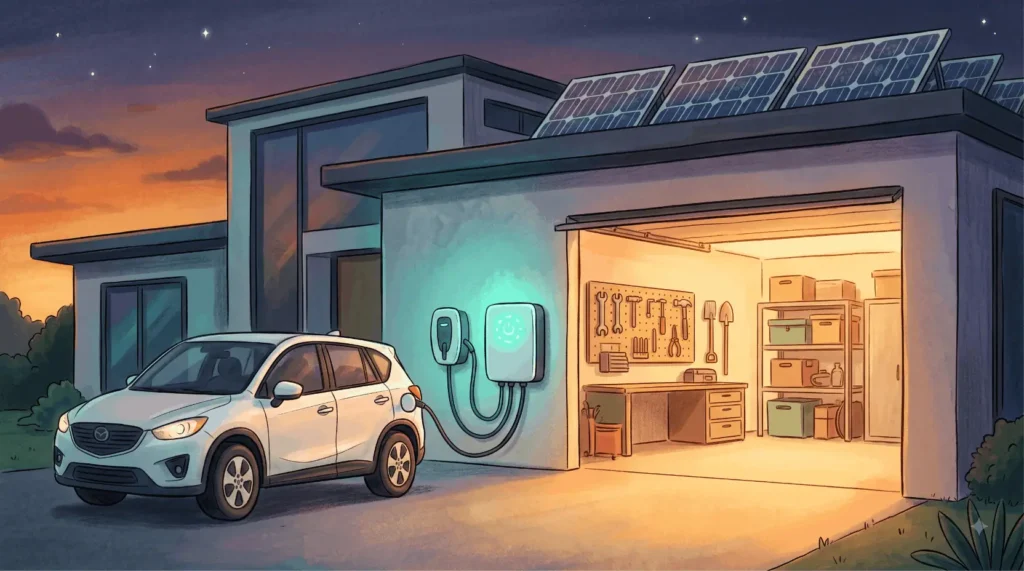
Picture this. It’s 11 PM, your EV is plugged in, and your home battery is quietly pushing stored solar energy into the car instead of pulling pricey grid power. ⚡ No noisy generator, no panic during an outage, no nasty peak-rate surprise on next month’s bill.
That’s the dream a lot of EV owners are chasing right now — and honestly, it’s more achievable in 2026 than it has ever been. Prices have dropped, chemistry has gotten safer, and the systems have gotten smarter.
But the market is also crowded and confusing. One brand promises “whole-home backup,” another sells a wall of modular blocks, and your installer keeps pushing whatever they happen to stock. So let’s cut through the noise and figure out the best home battery for EV charging that actually fits your roof, your car, and your budget.
⚡ The Short Answer
If you just want the quick version before we dig in, here’s the gist:
- For most homeowners who want plug-and-play simplicity: a premium all-in-one system (Tesla Powerwall-class) is the easiest path — backup, app, and solar integration baked in.
- For people who want to grow over time: a modular, stackable LFP home battery lets you start small and add capacity later.
- For solar newbies building a fresh system: a hybrid inverter + battery combo gives you the best price-per-kWh and one tidy install.
- For the budget-conscious and the tinkerers: a DIY LFP battery delivers the lowest cost per kWh — if you’re comfortable wiring it safely.
- Chemistry that matters: prioritize LFP (lithium iron phosphate). It runs cooler, lasts longer (often 6,000+ cycles), and is far less prone to thermal runaway than older NMC packs.
- Size for both jobs: EV charging and home backup. Most EV households land in the 10–20 kWh range.
🔋 Home Battery Types at a Glance
Here’s how the main categories stack up. Prices are illustrative ranges to show relative positioning, not quotes — installed costs swing wildly by region, incentives, and labor.
| Battery Type | Usable Capacity | Backup Capable? | Illustrative Price Band | Best For |
|---|---|---|---|---|
| Premium all-in-one (Powerwall-class) | 13–16 kWh per unit | Yes (whole-home ready) | $9,000–$14,000 / ₹7L–₹11L installed | Hands-off owners wanting one clean system |
| Modular stackable LFP | 5–30+ kWh (add blocks) | Yes (most models) | $6,000–$15,000 / ₹5L–₹12L installed | Growing needs, future EV upgrades |
| Hybrid inverter + battery combo | 8–20 kWh | Yes (depends on inverter) | $5,000–$11,000 / ₹4L–₹9L installed | New solar builds, best $/kWh |
| Mid-tier wall-mount LFP | 8–14 kWh | Partial / essential loads | $4,500–$9,000 / ₹3.5L–₹7.5L installed | Value buyers, moderate backup |
| Budget DIY LFP (server-rack) | 5–15 kWh per rack | Manual / limited | $1,800–$4,500 / ₹1.5L–₹3.5L installed | Tinkerers, lowest cost per kWh |
| Portable power station (XL) | 2–5 kWh | Plug-in only | $1,200–$3,500 / ₹1L–₹2.8L | Renters, trickle EV top-ups, emergencies |
What to Look for in a Home Battery 🔍
Before you fall in love with a brand, learn the six dials that actually matter. Get these right and almost any reputable system becomes a strong candidate for the best home battery for EV duty in your specific home.
1. Usable capacity (kWh). This is the headline number. “Usable” matters more than “rated” — some packs hold back 10–15% to protect cell life. For EV charging plus a night of essentials, think in the 10–20 kWh band.
2. Continuous power output (kW). Capacity is the fuel tank; power output is the engine. A battery can hold 15 kWh but only push 5 kW at once — fine for lights and a fridge, tight if you also want to run an EV charger and an AC together.
3. Battery chemistry — go LFP. This is the big one. LFP (lithium iron phosphate) has become the default for home storage because it tolerates heat better, deep-cycles thousands of times, and rarely catches fire. Older NMC chemistry packs more energy per kilo but ages faster and runs hotter. For a battery that lives on your wall for a decade, LFP wins.
4. Backup capability. Not every battery keeps your lights on during an outage. Some are “self-consumption only” — they store solar but go dark when the grid does. If outages (or India’s load-shedding) matter to you, confirm the system has a transfer switch and islanding capability.
5. Warranty. Look for 10 years and a throughput guarantee — something like “70% capacity retained after 10 years or X MWh.” A strong warranty is a quiet signal the maker trusts the cells.
6. Scalability. Will you add a second EV or a heat pump in three years? Modular systems let you bolt on capacity later instead of ripping everything out.
The Premium All-in-One Systems 🏆
This is the Tesla Powerwall-class tier — sleek wall units that bundle the battery, inverter, and smart management into one box. You get a polished app, automatic outage switching, and tight solar integration. It just works.
The appeal is simplicity. One contractor, one warranty, one dashboard that shows solar in, battery level, and EV charging at a glance. These systems handle whole-home backup gracefully and prioritize charging your EV from stored solar when rates are high.
The trade-off is price and lock-in. You’ll pay a premium — roughly $9,000–$14,000 / ₹7L–₹11L installed per unit — and you’re tied to that ecosystem. But for owners who never want to think about it again, that’s money well spent.
If you’re still deciding whether you even need storage versus just charging straight off your panels, our deep-dive on whether you really need a home battery to charge an EV with solar walks through the math before you commit a single rupee or dollar.
Modular & Stackable LFP Systems 🧱
If your needs are likely to grow, modular LFP home battery stacks are the smart-money pick. You start with, say, 10 kWh today and click on extra blocks as your life changes — a second EV, a bigger family, a home office that can’t lose power.
These systems use server-rack-style or tower-stacked LFP modules that share one inverter and controller. The per-kWh cost is reasonable, the footprint is tidy, and you avoid over-buying capacity you won’t use for years.
For EV households this flexibility is gold, and it’s a big reason modular stacks often top our shortlist for the best home battery for EV charging. Buy a bigger EV in 2028? Add a module instead of replacing the whole system. Most modular setups also support full backup, so you get outage protection alongside the expandability.
Expect roughly $6,000–$15,000 / ₹5L–₹12L installed depending on how many blocks you start with. The starter tier is one of the more accessible entry points into serious home storage.
Hybrid Inverter + Battery Combos 🔌
If you’re building a fresh solar system from scratch, this is often the best home battery for EV value play. A hybrid inverter handles solar, battery, and grid in a single unit — so instead of buying a separate inverter and a separate battery brain, you buy one device that does both.
The result is the best price-per-kWh in this guide and a cleaner install with fewer points of failure. You pair the hybrid inverter with LFP battery modules sized to your needs, and the whole thing acts as one coordinated system.
The catch: backup behavior depends on the specific inverter. Some hybrids offer seamless whole-home islanding; cheaper ones only back up a few “essential” circuits. Read the spec sheet before assuming your AC will run during a blackout.
Ballpark $5,000–$11,000 / ₹4L–₹9L installed, which makes it a favorite for cost-conscious new builds — especially in India, where hybrid inverters are widely available and well-supported by local installers.
Budget DIY LFP Options 🛠️
For the tinkerers and the genuinely budget-driven, DIY LFP is where the cost per kWh hits rock bottom. Server-rack LFP batteries — the kind that slide into a 19-inch frame — have flooded the market, and paired with a compatible inverter they deliver shocking value.
We’re talking roughly $1,800–$4,500 / ₹1.5L–₹3.5L per rack for capacity that would cost two to three times more in a premium all-in-one. If you can handle basic wiring, follow a torque spec, and respect electricity, the savings are real.
But be honest with yourself. ⚠️ DIY means you are the warranty department and you own the safety responsibility. Cheap cells without a quality BMS (battery management system) are a fire risk. Buy from reputable LFP suppliers, insist on grade-A cells, and in most regions you’ll still want a licensed electrician for the grid connection.
Done right, a DIY LFP bank is a fantastic way to charge an EV from stored solar without remortgaging the house. Done carelessly, it’s a hazard. Choose your comfort level honestly.
Sizing for EV Charging + Home Backup 📏
Here’s where a lot of people overthink it. You don’t need a battery that can charge your EV from 0–100% off storage alone — that’s a 60–80 kWh ask and wildly expensive. The smart approach is supplementing.
Think in terms of jobs. Job one: cover your evening home loads so you’re not buying peak-rate power — usually 5–10 kWh. Job two: push a meaningful EV top-up overnight from stored solar — another 5–10 kWh adds roughly 30–50 km / 20–30 miles of range.
Add those up and most EV households land comfortably in the 10–20 kWh sweet spot. That covers a night of essentials and a useful daily EV nudge without paying for capacity you’ll rarely touch.
A quick gut check:
- Light user, one EV, mild climate: 10–13 kWh.
- Two EVs or heavy AC/heating use: 15–20 kWh.
- Frequent outages + want the whole house running: size up, or go modular so you can add later.
And remember — your solar array has to actually fill the battery each day. If your panels are undersized, even a huge battery sits half-empty. Our guide to the best solar panel kits for EV charging pairs perfectly with this one for getting the generation side right.
Backup During Outages (and India Load-Shedding) 🔦
Here’s where a home battery quietly becomes a quality-of-life upgrade rather than just a money-saver. When the grid drops, a properly configured system keeps your essentials humming — and your EV ready to roll.
In the US, that means surviving storm outages without a smoky generator. Your fridge stays cold, your Wi-Fi stays up, and your EV can still trickle-charge enough to get you out if you need to evacuate.
In India, the calculus is different but even more compelling. Scheduled and unscheduled load-shedding is a daily reality in many areas, and an inverter-battery setup is already common in homes. Layering in LFP storage and solar turns that familiar setup into a clean, silent, EV-capable power hub — no diesel, no fumes, no fuel runs. 🇮🇳
The key feature to confirm is islanding — the ability to safely disconnect from the grid and run on battery. Not all systems do this, and the ones that do may only back up selected circuits. Decide upfront whether you want whole-home backup or just essentials, because that choice changes which tier you buy.
Installation & Safety ⚠️
A home battery is a serious appliance carrying serious energy. Treat the install accordingly.
Use certified gear and certified people. Look for batteries with recognized safety listings (UL, IEC, or BIS in India) and have the grid connection done by a licensed electrician. This isn’t the place to cut corners.
Mind the location. LFP tolerates heat far better than older chemistries, but no battery loves a baking garage. Ventilation, a stable mounting surface, and protection from direct sun and flooding all extend life and safety.
Get the permits and inspections. In many regions, grid-tied storage requires utility approval and an inspection. Skipping it can void warranties, insurance, and net-metering eligibility — a costly shortcut.
Insist on a quality BMS. The battery management system is the brain that prevents overcharge, over-discharge, and thermal issues. On premium and modular systems it’s built in; on DIY builds, it’s the single component you must not cheap out on.
📈 2026: Home Battery Tech & Prices
The storage market in 2026 looks genuinely different from a couple of years ago, and mostly in the buyer’s favor:
- LFP is now the default. What was the “premium safe” chemistry is now standard. That shift alone has improved lifespan and cut fire risk across the board.
- Prices keep sliding. Cell oversupply and fierce competition have pushed per-kWh costs down, especially for modular and hybrid-inverter setups. Storage that felt like a luxury now pencils out for mainstream EV owners.
- Smarter software. Modern systems auto-juggle solar, time-of-use rates, EV charging, and backup reserves with minimal fiddling. Set your priorities once and let it optimize.
- Tighter EV integration. More platforms now coordinate the car and the wall battery together — charging the EV from stored solar when rates spike, and even using the EV as backup (V2H) on supported vehicles.
- Stronger incentives. Many US states and several Indian programs now sweeten storage with rebates or subsidies — always check local incentives before you buy, as they can shift the math by thousands.
The takeaway: if you’ve been waiting for the tech to mature and prices to make sense, 2026 is a very reasonable year to pull the trigger.
✅ 5 Tips for Choosing a Home Battery
- Size for your routine, not your fantasy. Match capacity to real evening loads plus a modest EV top-up — 10–20 kWh suits most. Don’t pay for a tank you’ll never fill.
- Demand LFP chemistry. It’s safer, cooler, and longer-lasting. In 2026 there’s rarely a good reason to choose anything else for home storage.
- Check power output, not just capacity. Make sure the continuous kW rating can actually run your EV charger and your home loads at the same time.
- Confirm true backup before you assume it. Ask specifically about islanding and whether it’s whole-home or essentials-only.
- Stack incentives and get multiple quotes. Rebates and installer pricing vary enormously. Three quotes plus a check of local subsidies can save you a fortune.
🛒 Shop This Post
Three categories of gear worth bookmarking as you build your setup:
- Modular LFP home battery system — A stackable, app-managed LFP unit is the sweet spot for most EV owners who want backup today and room to grow tomorrow.
- Hybrid solar inverter — The brain that ties solar, battery, and grid together. A quality hybrid inverter is the single most important component for a clean, efficient build.
- Home energy monitor — A circuit-level energy monitor shows you exactly where your power goes, so you can size your battery accurately and verify your EV is charging from solar, not the grid.
Affiliate disclosure: Some links in this post are affiliate links. If you buy through them, evsmirror.com may earn a small commission at no extra cost to you. We only recommend gear and categories we’d genuinely consider ourselves. 🙏
🎯 Quick Quiz
Which home battery tier fits you?
- Mostly answered “I just want it to work”: Go premium all-in-one. Pay more, think less.
- Mostly “I’ll probably expand later”: Go modular stackable LFP. Start small, grow smart.
- Mostly “I’m building solar from scratch and want value”: Go hybrid inverter + battery.
- Mostly “I love a project and a bargain”: Go DIY LFP — carefully, with a great BMS.
📋 Checklist
Before you sign anything, tick these off:
- [ ] Confirmed usable capacity (kWh) matches my evening loads + EV top-up
- [ ] Verified continuous power output (kW) handles my charger + home together
- [ ] Battery is LFP chemistry
- [ ] Backup type confirmed (whole-home vs essentials-only) and islanding capable
- [ ] Warranty is 10 years with a throughput guarantee
- [ ] System is scalable if I add an EV or heat pump later
- [ ] Certified safety listing (UL / IEC / BIS) and licensed installer
- [ ] Local rebates and subsidies checked and applied
- [ ] Got at least three quotes
🤔 People Also Ask
What is the best home battery for EV charging in 2026?
There’s no single winner — the best home battery for EV charging depends on your goals. For hands-off simplicity, a premium all-in-one (Powerwall-class) wins. For value and flexibility, a modular LFP stack or hybrid inverter combo is hard to beat. Prioritize LFP chemistry, 10–20 kWh, and confirmed backup.
How many kWh do I need to charge an EV at home?
You don’t need to power a full charge from storage. Most owners pair 10–20 kWh of battery to cover evening home loads plus a daily EV top-up of 30–50 km / 20–30 miles. The battery supplements grid and solar rather than replacing them.
Is an LFP home battery better than NMC for EV owners?
Yes, for most home setups. LFP runs cooler, lasts thousands more cycles, and is far less likely to catch fire than NMC. NMC packs more energy per kilo, which matters in cars but not on a wall where space is rarely the constraint.
Can a home battery power my EV during a blackout?
If the system supports islanding, yes — it can keep essentials running and trickle-charge your EV. Confirm the unit has a transfer switch and backup capability, since self-consumption-only systems go dark when the grid does. This matters a lot in load-shedding-prone regions.
Are home batteries worth it in India?
Increasingly, yes. With frequent load-shedding and rising tariffs, an LFP solar-battery system replaces noisy diesel backup with clean, silent power — and can charge your EV too. Hybrid inverters are widely available, and several subsidies improve the payback.
Should I choose a DIY LFP battery to save money?
Only if you’re genuinely comfortable with wiring and safety. DIY server-rack LFP offers the lowest cost per kWh, but you take on the BMS quality and safety responsibility. Buy grade-A cells from reputable suppliers and use a licensed electrician for the grid tie-in.
🚀 The Bottom Line
A home battery used to be a luxury gadget. In 2026 it’s a practical, money-saving, blackout-proofing upgrade that pairs beautifully with an EV — and LFP chemistry has made it safer and longer-lasting than ever.
The best home battery for EV owners is simply the one matched to your temperament: premium for simplicity, modular for growth, hybrid for value, DIY for the brave. Size it at 10–20 kWh, demand LFP, confirm real backup, and stack every incentive you can find. Do that, and you’ve got a quiet little power plant feeding both your home and your car.
👉 Ready to build the full picture? Start with whether you need a home battery for solar EV charging at all, then dial in your generation with the best solar panel kits for EV charging. Your future self — and your power bill — will thank you. ⚡🔋