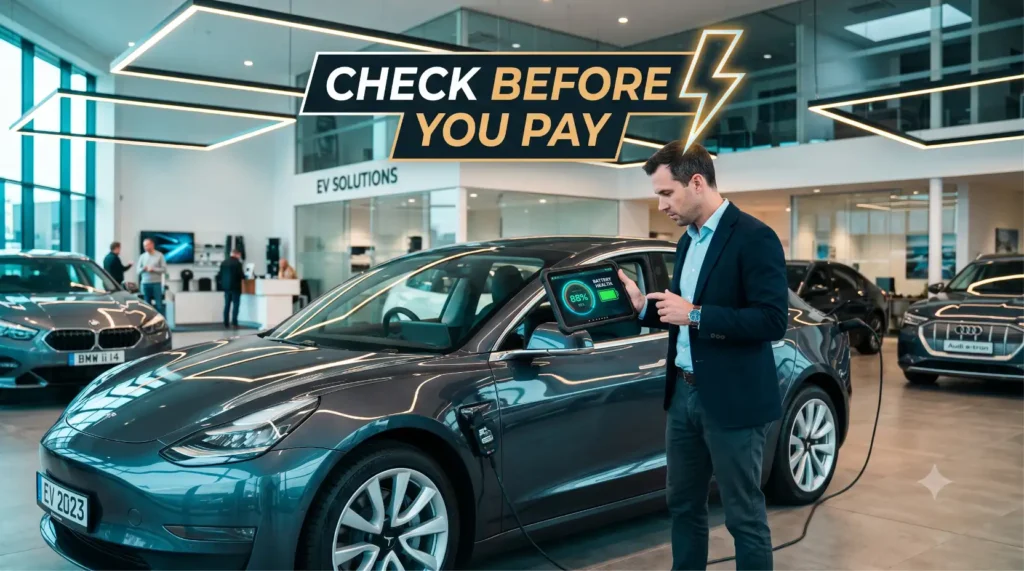
Buying a used electric car can feel like dating someone who refuses to talk about their past. The body looks clean, the screen lights up, the test drive is silent and smooth — but what about the 60,000 miles (or 95,000 km) that battery has already lived through? 🤔
Here’s the thing: a used EV is mostly a used battery wrapped in a car. The motor will probably outlive us all. The battery is where the money — and the risk — lives. And the only way to find out what you’re really buying is to ask the right things before the money leaves your account. That’s where the right questions to ask buying used EV come in.
That’s exactly why I put together this list. These are the real, practical questions to ask buying used EV that separate a great deal from an expensive mistake.
⚡ The Short Answer
If you only remember ten things to ask, make it these:
- 🔋 What’s the battery state of health (SoH)? And has the pack ever been replaced?
- ⚡ How often was it DC fast-charged? Daily rapid charging ages a pack faster.
- 📜 Is the battery warranty still active — and does it transfer to me?
- 🔧 Can I see the full service and accident history?
- 🤷 Why are you actually selling it?
- 🔌 What charging equipment is included? (Cable, portable charger, adapters.)
- 💻 Do the software features and subscriptions transfer to my name?
- 📋 How many owners has it had, and is the registration clean?
- 🛣️ What’s the real-world range right now, not the original brochure number?
- 💵 Is there any flexibility on the price?
Ask these, listen carefully, and you’ll know within minutes whether to write the check or walk away.
🗂️ The 10 Questions at a Glance
| # | Question | Why it matters | ✅ Good answer | 🚩 Bad answer |
|---|---|---|---|---|
| 1 | Battery state of health & replacement? | The pack is the most expensive part | “88% SoH, here’s the report” | “Battery’s fine, trust me” |
| 2 | DC fast-charge frequency? | Frequent rapid charging ages cells | “Mostly home Level 2 charging” | “Always Supercharged, it’s faster” |
| 3 | Warranty status & transfer? | Free repairs vs. a $15k bill | “Transferable, 3 years left” | “I think it’s expired?” |
| 4 | Service & accident history? | Hidden damage and skipped care | “Full records, one fender bender” | “No paperwork, sorry” |
| 5 | Why are you selling? | Reveals hidden problems | “Upgrading to a bigger EV” | Vague, defensive, or rushed |
| 6 | Charging equipment included? | Replacements cost real money | “Portable charger + all adapters” | “Just the car” |
| 7 | Software/subscription transfer? | Lost features after sale | “I’ll remove it from my account” | “Not sure how that works” |
| 8 | Owners & registration count? | Title issues, fleet abuse | “One owner, clean title” | “A few owners, long story” |
| 9 | Real-world range now? | Brochure range is fiction at 5 years | “About 210 mi on a full charge” | “Same as new, basically” |
| 10 | Price flexibility? | Room to negotiate fairly | “Make me a reasonable offer” | “Price is firm, take it or leave it” |
🔋 Start With the Battery — It’s 90% of the Decision
Everything else on this list matters. But the battery matters most, because replacing one can cost more than the rest of the car is worth. So when people ask me which questions to ask buying used EV they should prioritize, I always say: lead with these.
Question 1: What’s the battery state of health, and has the pack ever been replaced?
State of health (SoH) is the single most important number on a used EV. It tells you how much capacity the battery has lost compared to when it was new. A pack at 90% SoH is healthy; one at 70% has lost nearly a third of its range.
A good answer sounds like: “It’s at 88% according to the dealer health report from last month, and no, the original pack is still in there.” Bonus points if they let you plug in an OBD2 scanner to confirm.
A bad answer sounds like: “The battery’s totally fine, don’t worry about it.” Vagueness here is a red flag. If a seller can’t or won’t give you a number, assume the worst and verify it yourself before paying.
Also ask directly whether the pack was ever swapped under warranty. A replaced battery can actually be a good thing — it may be newer than the car — but you need the paperwork to know its real age.
Question 2: How often was it DC fast-charged?
Fast charging is wonderful for road trips and brutal for battery chemistry when it’s the only way a car gets charged. Heat is the enemy of lithium-ion cells, and DC fast charging generates a lot of it.
A car that lived on a home Level 2 charger and only used DC fast charging occasionally will usually have a healthier pack than one that was rapid-charged every single day.
A good answer sounds like: “I charged at home overnight 90% of the time and only used fast chargers on long trips.”
A bad answer sounds like: “I always used Superchargers — way more convenient.” That’s not a dealbreaker on its own, but it should push you to scrutinize the SoH number even harder.
⚡ Practical Tip: Bring Your Own Tools
You don’t have to take the seller’s word on battery health. A cheap OBD2 scanner paired with an EV-specific app (Car Scanner, LeafSpy for Nissan, or the brand’s diagnostics) can read SoH, cell balance, and charging stats in minutes.
If you’re spending $15,000–$40,000 (₹12–35 lakh) on a used EV, a $30 (₹2,500) scanner is the best insurance you’ll ever buy. We’ll link a reliable one in the Shop This Post section below.
📜 Cover Yourself: Warranty, History, and Honesty
The battery tells you the car’s physical condition. These next questions protect you legally and financially.
Question 3: Is the battery warranty still active, and does it transfer to me?
Most EVs ship with a separate battery warranty — typically 8 years or 100,000 miles (160,000 km) in the US, and increasingly 8 years in India too. The huge advantage of buying used is that this warranty often still has years left.
But it only helps you if it transfers. Most do automatically; some require a small transfer fee or paperwork.
A good answer sounds like: “There are about three years and 30,000 miles left, and it transfers to you for free — here’s the manufacturer’s confirmation.”
A bad answer sounds like: “I think the warranty expired? You’d have to check.” Don’t buy on a guess. Call the manufacturer with the VIN before you pay and confirm coverage yourself.
Question 4: Can I see the full service and accident history?
EVs need less maintenance than gas cars, but they’re not maintenance-free. Coolant for the battery thermal system, brake fluid, cabin filters, and software updates all matter. And accidents — especially underbody impacts — can damage a battery pack in ways you can’t see.
A good answer sounds like: “Here’s the complete service log from the dealer, plus a vehicle history report. It had one minor rear-bumper repair, fully documented.”
A bad answer sounds like: “I don’t really have records, but it never had any problems.” No paperwork on a five-figure purchase is a problem in itself. Run an independent history check and strongly consider a pre-purchase inspection.
Question 5: Why are you really selling it?
This sounds soft, but it’s one of the most revealing questions to ask buying used EV. People’s reasons — and how they answer — tell you a lot.
A good answer sounds like: “We had a second kid and needed a three-row SUV,” or “I’m upgrading to a longer-range model.” Normal life reasons.
A bad answer sounds like: anything vague, defensive, or oddly urgent. “I just want it gone” or “long story” deserves follow-up questions. Sometimes the real answer is “it keeps throwing a charging fault” — and you want that out in the open before you sign.
🔌 The Stuff That Comes With the Car (and the Stuff That Doesn’t)
These questions cover what physically and digitally comes with the car. They’re easy to forget — and expensive to overlook.
Question 6: What charging equipment is included?
EVs usually come with a portable charging cable, and many owners install a home wall charger. Find out exactly what’s coming with the car. A missing portable charger can cost $200–$500 (₹15,000–40,000) to replace, and an included home charger is a genuine bonus.
A good answer sounds like: “You get the portable charger, the original cable, and all the adapters I bought.”
A bad answer sounds like: “Just the car — I’m keeping the charger.” That’s fine, but factor the replacement cost into your offer.
If the car doesn’t include a home charger and your house doesn’t have one yet, budget for a Level 2 home charger separately — it’ll transform your ownership experience and we’ve linked a solid one below.
Question 7: Do the software features and subscriptions transfer to my name?
This one is new and genuinely catches people out. Modern EVs sell features as subscriptions or one-time unlocks — heated seats, enhanced autopilot, premium connectivity, faster acceleration. Some are tied to the original owner’s account, not the car.
A good answer sounds like: “I’ll remove the car from my account so you can register it fresh, and the connectivity package transfers with it.”
A bad answer sounds like: “I’m not sure how that works.” Before buying, confirm with the manufacturer which features stay with the car and which evaporate at sale. Losing a feature you assumed was included is a nasty surprise.
📋 Ownership, Range, and the Final Number
Last group — the questions that confirm the car is legally clean, still useful day-to-day, and fairly priced.
Question 8: How many owners has it had, and is the registration clean?
Fewer owners usually means a more consistent care history. More importantly, you need a clean title (US) or clear registration and no outstanding loan/hypothecation (India). A car with a lien still attached can’t legally be yours until it’s cleared.
A good answer sounds like: “One owner, clean title, no liens — here are the documents.”
A bad answer sounds like: “A couple of owners and there’s still a small loan on it, but we’ll sort that out.” Don’t pay until the loan is cleared and the paperwork is in your name. In India, confirm the RC, NOC (if interstate), and that hypothecation is removed.
Question 9: What’s the real-world range right now?
The range on the original window sticker is a fantasy by year five. Battery degradation, weather, and driving style all chip away at it. You want the honest current range, not the brochure number.
A good answer sounds like: “On a full charge in mild weather I get around 210 miles (340 km), and maybe 175 (280 km) in winter.”
A bad answer sounds like: “Same as new, basically.” No used EV gets the same range as new. A seller who claims otherwise is either uninformed or stretching the truth. Cross-check their answer against the SoH number — they should line up.
Question 10: Is there any flexibility on the price?
Always ask. Politely, but always. Used EV pricing has been volatile, and many sellers price with negotiating room built in. Your leverage comes from everything above: a lower SoH, a missing charger, an expired warranty, or skipped service all justify a lower offer.
A good answer sounds like: “Make me a reasonable offer,” or “I can come down a bit for a quick, clean sale.”
A bad answer sounds like: “Price is firm.” That’s their right — but if the car has issues you uncovered, firm pricing on a flawed car is your cue to walk. There’s always another EV.
📈 2026: What’s Changed About Used EV Due Diligence
The used EV market in 2026 looks very different from a few years ago, and that changes how you should shop. A few shifts worth knowing:
Battery health reports are becoming standard. More dealers and even private sellers now provide a certified SoH report, and some regions are moving toward mandatory battery passports. If a seller can’t produce one, that’s increasingly a red flag rather than the norm.
Prices have dropped — a lot. A wave of off-lease and trade-in EVs has flooded the market in both the US and India, pushing used prices down. That’s great for buyers, but it also means more high-mileage, hard-used cars are circulating. Due diligence matters more, not less.
Software-locked features are mainstream. What used to be a hardware question (“does it have heated seats?”) is now a software question (“are the heated seats still active for the new owner?”). Always verify.
Independent inspections are easier to book. Mobile EV-savvy inspectors now exist in most major US and Indian metros. For a few thousand rupees or a hundred-odd dollars, a specialist will check the pack, thermal system, and underbody — money very well spent.
✅ 5 Tips for the Conversation
Knowing the questions is half the battle. Asking them well is the other half. 💬
- Ask open-ended, then go quiet. “Tell me about how it was charged” reveals more than a yes/no question. Let silence do the work.
- Verify, don’t just trust. Bring an OBD2 scanner, run a history report, and confirm warranty status with the VIN. Friendly sellers can still be wrong.
- Watch the reaction, not just the words. Hesitation, deflection, or sudden urgency around battery or accident questions tells you more than the answer itself.
- Get the important answers in writing. Battery replacement, warranty transfer, included equipment — note it in the sale agreement so there’s no “I never said that” later.
- Be ready to walk. Your strongest negotiating tool is genuine willingness to leave. There’s always another used EV next week.
🛒 Shop This Post
A few tools that make answering these questions a whole lot easier:
- 🔌 OBD2 Bluetooth Scanner — Plug it in, open an EV app, and read true battery state of health in minutes. The smartest $30 (₹2,500) you’ll spend before any used EV purchase.
- 🔍 Pre-Purchase Inspection Service — A specialist checks the battery, thermal system, and underbody for hidden damage. A hundred dollars (or a few thousand rupees) of peace of mind.
- ⚡ Level 2 Home Charger — If your used EV doesn’t come with one, this turns overnight charging into a non-event and protects long-term battery health.
Disclosure: Some links above are affiliate links. If you buy through them, evsmirror.com may earn a small commission at no extra cost to you. We only recommend gear we’d genuinely use ourselves. 🙏
🎯 Quick Quiz
Test yourself before you go car shopping. 👇
A seller says, “The battery’s totally fine, I never bothered checking the health.” What should you do?
- A) Trust them and pay full price
- B) Plug in your own OBD2 scanner and read the SoH yourself
- C) Assume it’s at 100% since the car drives fine
Answer: B. Never accept “it’s fine” as a battery health report. Verify the actual number yourself — the test drive can’t tell you SoH.
📋 Checklist: The 10 Questions to Bring With You
Screenshot this and keep it on your phone for the viewing. 📱
- [ ] What’s the battery state of health, and has the pack ever been replaced?
- [ ] How often was the car DC fast-charged versus home-charged?
- [ ] Is the battery warranty still active, and does it transfer to me?
- [ ] Can I see the full service and accident history?
- [ ] Why are you actually selling it?
- [ ] What charging equipment is included with the car?
- [ ] Do the software features and subscriptions transfer to my name?
- [ ] How many owners has it had, and is the title/registration clean?
- [ ] What’s the real-world range right now, in summer and winter?
- [ ] Is there any flexibility on the price?
🤔 People Also Ask
What are the most important questions to ask buying used EV?
The battery questions come first — state of health, whether the pack was replaced, and how often it was DC fast-charged. After that, confirm warranty transfer, service and accident history, the real-world range today, and the title or registration status. Nail those and you’ve covered the biggest risks.
How do I check the battery health on a used EV?
The most reliable way is a battery state-of-health report, ideally from a dealer or an independent EV inspector. You can also plug in an OBD2 scanner with an EV-specific app to read SoH yourself. Don’t rely on the dashboard range estimate — it doesn’t show true degradation.
Does an EV warranty transfer to a second owner?
Usually yes. Most manufacturer battery warranties (typically 8 years / 100,000 miles, or 160,000 km) transfer to subsequent owners automatically, though a few require paperwork or a small fee. Always confirm directly with the manufacturer using the VIN before you buy.
Is it bad if a used EV was always fast-charged?
It’s not automatically a dealbreaker, but constant DC fast charging generates heat that can age a battery faster than home Level 2 charging. If a car was rapid-charged daily, scrutinize the state-of-health number more closely and adjust your offer accordingly.
How many miles is too many on a used EV?
Mileage matters less than battery health on an EV. A 90,000-mile car with a well-maintained pack at 88% SoH can be a better buy than a 40,000-mile car that was abused. Judge the battery, the warranty remaining, and the service history together, not the odometer alone.
Should I get a pre-purchase inspection on a used EV?
Yes, especially for any private-party purchase. An EV-savvy inspector checks the battery pack, thermal system, and underbody for damage you can’t see on a test drive. For a hundred dollars or a few thousand rupees, it’s cheap protection against a multi-thousand-dollar mistake.
🚀 The Bottom Line
A used EV can be one of the smartest car purchases out there — lower running costs, less maintenance, and prices that have come way down. But the difference between a brilliant deal and a costly regret comes down to what you ask before you pay. 🔑
Lead with the battery, verify everything instead of trusting it, get the key answers in writing, and never be afraid to walk away. Memorize the questions to ask buying used EV above and you’ll shop like a pro. These ten questions to ask buying used EV are your shortcut to buying with confidence instead of crossed fingers.
Want to go deeper before your viewing? Read our full Used EV Buying Guide: What to Check Before You Pay for the complete inspection walkthrough, and bookmark Used EV Red Flags That Should Make You Walk Away so you know the exact moment to say “no thanks.” 🚗⚡
Your move: print the checklist, charge your scanner, and go find your EV. 👉