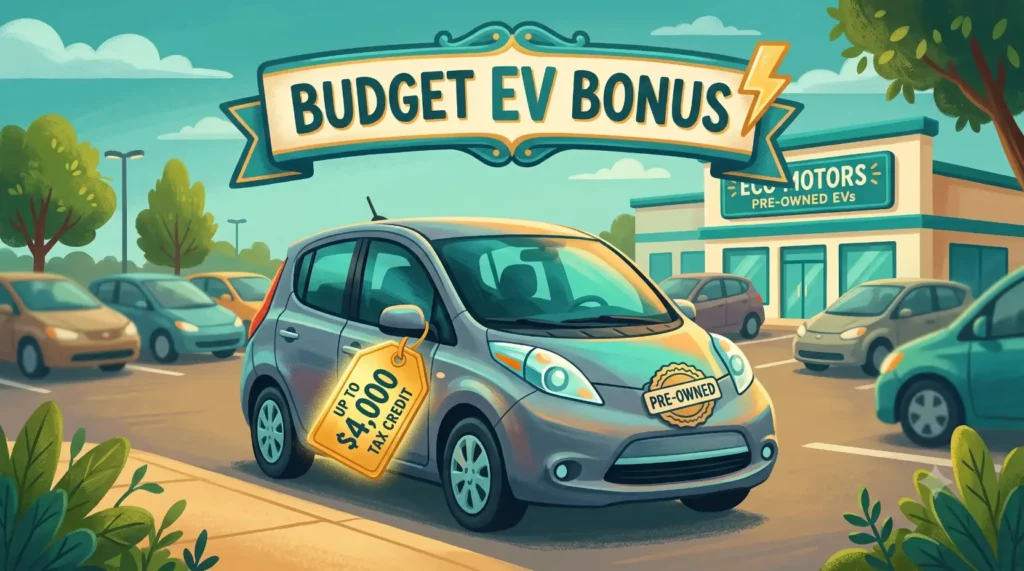
Everyone fixates on the $7,500 credit for new EVs — and then totally sleeps on its quieter, scrappier cousin. 😴
That cousin is the used EV tax credit, and honestly, for a lot of budget-minded shoppers, it’s the better deal. A pre-owned EV is already cheaper than a new one. Stack a federal credit on top, and you can end up with one of the best value-per-dollar cars on the road.
But here’s the catch: the rules are not the same as the new-car credit. Different income caps. A strict price ceiling. A dealer-only requirement. And a couple of “gotcha” conditions that quietly disqualify people who assumed they were fine.
So let’s slow down and walk through exactly how the used EV tax credit works, who actually qualifies, and how you’d go about claiming it. 👇
⚠️ Important — read this first: EV tax credit rules change constantly, and Congress can modify or even repeal them through legislation. This article is general information, not tax advice. The $4,000 figure, the price cap, and the income limits described here are general framing, not guarantees for your specific situation. Always confirm the current-year rules directly on the official IRS source and talk to a qualified tax professional before you buy.
⚡ The Short Answer
If you only read one section, read this. Here’s how the used-EV credit generally works:
- 💵 Worth up to $4,000 — specifically, the lesser of $4,000 or about 30% of the sale price
- 🏷️ Strict price cap — the used EV generally must cost around $25,000 or less
- 🚗 Vehicle must be older — typically at least 2 model years before the year you buy
- 🏪 Must buy from a licensed dealer — private-party sales don’t count
- 🧾 Income limits apply — and they’re lower than the new-EV credit’s caps
- 🔁 Once per buyer, once per vehicle — you can’t claim it repeatedly, and the car can usually only generate the credit once
Meet every one of those, and you could knock as much as $4,000 off an already-affordable used EV. 😎 But “every one of those” is the operative phrase — miss a single gate and the whole thing falls apart.
📊 Used EV Tax Credit — Eligibility At a Glance
Before we dig into the details, here’s the whole framework in one table. Think of it as the checklist the IRS effectively runs against your purchase. 👇
| Requirement | Typical Rule (verify current figures) |
|---|---|
| 🚗 Vehicle age | About 2+ model years older than the purchase year |
| 🏷️ Price cap | Sale price generally $25,000 or less |
| 🏪 Where you buy | Licensed dealer only — no private sales |
| 🧾 Income (MAGI) | Capped, and lower than the new-EV thresholds |
| 🔁 Buyer limit | Generally once per buyer within a set time window |
| 🔁 Vehicle limit | Credit usually claimable only once per vehicle |
| 💵 Credit amount | Lesser of $4,000 or ~30% of the sale price |
| 📄 Paperwork | Dealer must provide a time-of-sale report |
Treat these as the rule categories. The exact dollar amounts and income thresholds can shift year to year — and could change again in 2026 — so confirm the live figures on the IRS site before you assume any specific car or buyer qualifies. 🎯
💵 How Much Is the Used EV Tax Credit Actually Worth?
Let’s start with the number everybody wants. 💵
The used EV tax credit has historically been worth up to $4,000. But here’s the nuance most headlines skip: it’s not a flat $4,000. It’s the lesser of $4,000 or roughly 30% of the sale price.
That little word “lesser” matters a lot. Run the math and it changes the picture fast. 🧮
- A used EV priced at $25,000 → 30% is $7,500, but the credit caps at $4,000 (you hit the ceiling).
- A used EV priced at $13,333 → 30% is exactly $4,000 (the break-even point).
- A used EV priced at $10,000 → 30% is just $3,000 (the percentage wins, so you get less).
So the full $4,000 only shows up once the car costs around $13,333 or more. Below that, the percentage formula trims your credit down. It’s still free money — just not always the headline figure.
And remember, on a $14,000 car, a $4,000 credit is roughly a 29% discount. Proportionally, that’s a far bigger bite than $7,500 off a $50,000 new EV. That’s the whole appeal of the pre-owned clean vehicle credit for budget shoppers. 😎
Always verify the current maximum and the percentage formula, because both the cap and the rate are exactly the kind of thing legislation likes to tweak. 🎯
💡 Buying new instead? You’ll want the bigger-credit playbook here: EV Tax Credit 2026: Who Qualifies and How Much?
🚗 Vehicle Requirements: Age, Battery, and the “Used” Definition
Not every pre-owned EV on a lot qualifies. The car itself has to clear a few bars. 🚗
It has to be genuinely “used.” The vehicle generally must be at least 2 model years older than the calendar year you buy it. So if you’re shopping in 2026, the model year typically needs to be 2024 or earlier. A barely-driven 2025 demo unit? Probably too new to count as “previously owned” for this credit.
It needs a real battery. Like the new-car credit, the used version usually requires a minimum battery capacity (historically around 7 kWh) and the vehicle must be a plug-in electric or fuel-cell vehicle. Mild hybrids that can’t plug in generally don’t make the cut.
It has to weigh in under the limit. There’s typically a gross vehicle weight rating ceiling, though most passenger EVs and crossovers fall comfortably under it.
It must be for your own use, not resale. The credit is meant for people buying a car to drive, not flippers.
Because the eligible-vehicle list and the exact age math can change, check that the specific VIN qualifies before you fall in love with a car. We’ll cover how to do that verification in a dedicated section below. 🎯
🏪 You Must Buy From a Dealer — Not a Private Seller
This is the rule that surprises the most people, so let’s be blunt about it. 🏪
The previously owned EV credit generally requires that you buy from a licensed dealer. A Craigslist sale, a Facebook Marketplace find, your neighbor’s old Leaf in the driveway — none of those qualify, no matter how perfect the car is.
Why? Two reasons. First, the law was written that way to keep things trackable. Second — and this is the practical part — the dealer is the one who files the paperwork. They submit a time-of-sale report to the IRS and hand you a copy. Without that report, you generally cannot claim the credit at all, even if everything else lines up.
So before you put money down, confirm three things with the dealer:
- ✅ They are a registered dealer with the IRS for clean-vehicle credits
- ✅ They will submit the time-of-sale report for your purchase
- ✅ They’ll give you a copy of that report for your records
If a dealer shrugs at any of those questions, walk. 🚶 A great price means nothing if the paperwork that unlocks your $4,000 never gets filed. Verify the dealer’s registration status as part of your due diligence. 🎯
🧾 Income Limits: Lower Than You’d Expect
Here’s the gate that quietly disqualifies a lot of would-be buyers. 🧾
The used EV tax credit has income caps based on your modified adjusted gross income (MAGI) and filing status — and they are noticeably lower than the new-EV credit’s limits. That’s by design: this credit is aimed squarely at budget-conscious households.
Historically the used-EV thresholds have looked roughly like this (verify current figures):
- 👤 Single filers: around $75,000 MAGI
- 👫 Married filing jointly: around $150,000 MAGI
- 🏠 Head of household: around $112,500 MAGI
Compare that to the new-EV credit’s caps (often $150,000 single / $300,000 joint), and you can see the gap. Earn above the used-EV line and you’re out — even if you’re buying the cheapest qualifying car on the lot.
One helpful wrinkle: the rules have generally let you use your MAGI from either the year you take delivery or the prior year — whichever is lower. So if you had a one-off high-income year, the other year might still get you under the cap. That can be a lifesaver, but it’s exactly the sort of detail to confirm with a tax professional. 😎
For the full breakdown of how these caps work across both credits, see: Income Limits for the EV Tax Credit Explained
🔁 The “Once Per Buyer, Once Per Vehicle” Rules
This is a two-part rule, and both halves trip people up. 🔁
Once per buyer. A given person generally can only claim the used-EV credit once within a set time window (historically, once every three years). So you can’t buy a used EV, claim $4,000, sell it next month, buy another, and claim again. The IRS treats this as a once-in-a-while benefit, not a revolving discount.
Once per vehicle. Just as important, the credit can generally only be claimed one time over the life of a specific car. If a previous owner already triggered the used-EV credit on that exact VIN after the program’s start date, the car is “spent” — a new buyer can’t claim it again.
This second part is sneaky, because you might do everything right — under the income cap, buying from a dealer, car under the price limit — and still get denied because someone before you already used the credit on that vehicle. That’s another reason the time-of-sale report and VIN check matter so much. 🎯
Confirm both eligibility windows for your situation and the specific car before counting on the money.
💳 The Point-of-Sale Option: Get the Money at the Dealership
Here’s the genuinely great news, and it applies to used EVs too. 💳
You no longer have to wait until tax season to see your credit. Under the point-of-sale (transfer) option, you can choose to transfer the credit to a registered dealer at the moment of purchase. Instead of claiming it on next year’s return, the dealer applies it directly to your price — as an upfront discount or down payment.
In plain terms: a qualifying $20,000 used EV could cost you around $16,000 out the door, with the $4,000 handled at the register. 🤯 No waiting, no hoping you have enough tax liability, no year-long float.
A few things to keep in mind:
- 🏪 The dealer must be registered with the IRS and willing to process the transfer.
- 📄 You’ll still need that time-of-sale report — and a copy for your records.
- 🧾 You generally still have to file the relevant form with your tax return to reconcile it.
- ⚠️ If it later turns out you exceeded the income cap, you may have to pay the credit back at tax time. So don’t transfer it at the register if you’re unsure about your MAGI.
That last point is the big one. The upfront discount feels amazing, but it’s not “free and forgotten” — your income still has to clear the bar. Verify the current point-of-sale rules and how repayment works before you opt in. 🎯
🔍 How to Verify a Specific Used EV Qualifies
Theory is nice. Here’s the practical, on-the-lot process for confirming a real car qualifies for the previously owned EV credit. 🔍
- Check the price first. Is the sale price (before tax, title, and fees) at or under the price cap? If not, stop — no amount of paperwork fixes a too-expensive car.
- Check the model year. Is it at least 2 model years older than the current year? A quick VIN decode or the title confirms it.
- Confirm the dealer is registered. Ask directly: “Are you registered with the IRS to file clean-vehicle credit reports?” Get a yes.
- Ask whether the credit was already used. A registered dealer can often verify through the IRS portal whether this VIN’s used-credit was already claimed by a prior owner. This is the step most buyers skip.
- Confirm your own income eligibility. Pull last year’s MAGI and your expected current-year number. Are you under the cap on at least one of them?
- Get the time-of-sale report in writing. Before you sign, confirm the dealer will generate and give you a copy.
If all six line up, you’re in good shape. If even one is shaky, pause and verify with the IRS and a tax professional before committing. 😎 A few hours of checking can protect $4,000.
🔋 Buying used means battery health matters more than badge. A cheap EV with a tired battery isn’t a bargain. Run a State-of-Health check before you sign (more on the tool for that below).
📈 How 2026 Changes Could Affect the Used Credit
Here’s the honest, slightly uncomfortable part. 📈
The used-EV credit exists because of legislation — and legislation can change. The amount, the price cap, the income thresholds, the eligible-vehicle list, and even whether the credit exists at all can be modified or repealed by future laws. We’ve already seen the broader EV-credit landscape shift more than once.
What that means for you in 2026:
- 📅 Don’t rely on old articles — including older versions of this one. A figure that was accurate last year may be stale now.
- 🏛️ Watch for legislative changes that could phase out, shrink, or sunset the used credit on a specific date.
- 🧾 Treat the $4,000, the ~$25,000 price cap, and the income caps as general framing, not locked-in guarantees.
- ✅ Always cross-check the current-year rules on the official IRS clean-vehicle pages before you buy.
If there’s one habit to build, it’s this: before any EV purchase decision, spend ten minutes on the IRS site confirming the live numbers, then run your specific situation past a tax professional. Rules change; that verification step is what protects you. 🎯
✅ 5 Steps to Claim the Used EV Tax Credit
Ready to actually do it? Here’s the clean, repeatable sequence. 👇
- Confirm the current credit and amount. Check the IRS site for this year’s max, the percentage formula, and the price cap. 💵
- Verify your income against the cap. Compare both this year’s and last year’s MAGI to the current threshold; you generally qualify if either is under. 🧾
- Find a qualifying car at a registered dealer. Right model year, under the price cap, battery and weight requirements met — and the credit not already claimed on that VIN. 🚗
- Decide: point of sale or tax return. Take the discount upfront at the dealership, or claim it on your return — but only transfer it if you’re confident about your income. 💳
- Get your paperwork and file. Collect the time-of-sale report, keep a copy, and file the required IRS form (Form 8936 historically) to claim or reconcile the credit. 📄
Do all five and that pre-owned EV just got a whole lot cheaper. 😎
🛒 Smart Used-EV Buying (Shop This Post)
A used EV is only a bargain if the car is actually healthy and your paperwork is airtight. These three picks help on both fronts. 😍
1. An OBD2 Battery-Health Scanner 🔋
The single most important thing on a used EV is battery State of Health — and the dashboard won’t tell you the real story. A scanner plugs into the OBD2 port and reveals true capacity before you sign.
👉 Shop OBD2 battery-health scanners
2. Tax Software With EV Credit Support 🧾
Claiming the used-EV credit means filing the right form correctly. Good tax software walks you through the clean-vehicle credit step by step so you don’t fumble the $4,000.
👉 Shop tax software
3. A Home EV Charger (Separate Credit) ⚡
Once you’ve got your used EV, charging at home is where the savings really compound — and home chargers may qualify for their own separate federal credit. Two credits, one driveway.
👉 Shop Level 2 home EV chargers
🛍️ Affiliate disclosure: Some links above are affiliate links. If you buy through them, EVs Mirror may earn a small commission at no extra cost to you — and it helps keep these guides free. 🙏 We only recommend gear we’d actually use.
🎯 Quick Quiz: Could You Get the Used EV Credit?
Answer honestly. No peeking. 👀
- Are you buying from a licensed dealer (not a private seller)? 🅐 Yes 🅑 No
- Is the used EV priced at or under the price cap (~$25k)? 🅐 Yes 🅑 No/unsure
- Is the model year at least 2 years old? 🅐 Yes 🅑 No/unsure
- Is your income under the cap (this year or last)? 🅐 Yes 🅑 No
Mostly 🅐: 🟢 You may well qualify — verify the live IRS figures, grab your paperwork, and claim it.
Mostly 🅑: 🟡 Don’t give up — adjust the plan. A different dealer, a cheaper car, or using your lower-income year could flip a “no” into a “yes.”
📋 Used-EV Credit Checklist
Print this. Take it to the lot. 📋
- [ ] Confirm the current credit amount and percentage formula
- [ ] Check the used-EV price cap for this year
- [ ] Verify the model year is 2+ years old
- [ ] Confirm battery/weight requirements are met
- [ ] Check your MAGI against the cap (this year and last year)
- [ ] Buy from a registered, licensed dealer
- [ ] Ask whether the credit was already claimed on that VIN
- [ ] Decide on point-of-sale vs. claiming on your return
- [ ] Get the time-of-sale report and keep a copy
- [ ] File the required IRS form
- [ ] Consult a tax professional and confirm everything on the IRS site ⚡
🤔 People Also Ask
Q: How much is the used EV tax credit worth?
A: The used EV tax credit has historically been worth up to $4,000 — specifically the lesser of $4,000 or about 30% of the sale price. So the full $4,000 generally requires a car priced around $13,333 or more; cheaper cars get the smaller percentage figure. The exact cap and rate can change, so verify the current numbers on the IRS site.
Q: Who qualifies for the used-EV credit?
A: Generally, buyers under the income cap (which is lower than the new-EV credit’s), purchasing a qualifying pre-owned EV at or under the price cap from a licensed dealer, where the vehicle meets the model-year, battery, and weight rules and the credit hasn’t already been claimed on it. Always confirm current eligibility with the IRS and a tax professional.
Q: Can I get the used EV credit from a private sale?
A: Typically no. The credit generally requires purchase from a licensed, registered dealer, partly because the dealer files the time-of-sale report that makes the claim possible. Private-party sales — Marketplace, Craigslist, a friend’s car — usually don’t qualify.
Q: Is there a price limit for the pre-owned EV credit?
A: Yes — the used EV generally must cost around $25,000 or less (verify the current cap). This keeps the credit focused on genuinely affordable cars. A used EV above the cap doesn’t qualify, no matter how good the rest of the deal looks.
Q: Can I get the credit upfront instead of waiting for my tax refund?
A: Often, yes. The point-of-sale option lets you transfer the credit to a registered dealer, who applies it as an instant discount on the price. You’ll still file the relevant form, and if you exceed the income cap you may have to repay it — so only transfer at the register if you’re confident about your MAGI.
Q: How do I claim the used-EV credit on my taxes?
A: Get the dealer’s time-of-sale report, confirm eligibility, then either let the dealer apply it at point of sale or claim it on your return using the required IRS form (historically Form 8936). Keep your paperwork and verify the current process with the IRS.
🚀 The Bottom Line
The used EV tax credit is the budget buyer’s secret weapon — historically up to $4,000 off an already-affordable pre-owned EV, which can mean a near-30% discount on a cheaper car. 🔥
But it comes with its own rulebook: a strict ~$25,000 price cap, lower income limits than the new-car credit, a dealer-only purchase requirement, a 2-year vehicle-age threshold, and once-per-buyer/once-per-vehicle limits. Miss one gate and the credit slips away — so the verification steps aren’t optional, they’re the whole game.
Do it right, though, and you can walk off a dealer lot in a quality used EV that costs thousands less than the sticker. Confirm the live figures on the official IRS source, run your numbers past a tax professional, buy from a registered dealer, grab your time-of-sale report — and enjoy one of the best value cars on the road. ⚡
💬 Did you snag a used EV with the credit? Tell us your deal in the comments!
📤 Know a budget EV shopper? Forward them this guide. 🙏
🔖 Bookmark EVs Mirror for honest, no-nonsense EV money guides.
👉 Up next: Income Limits for the EV Tax Credit Explained — and if you’re weighing a new EV too, start with EV Tax Credit 2026: Who Qualifies and How Much?
This article is general information, not tax advice. EV tax credit rules change and can be repealed. Always verify current rules with the IRS and a qualified tax professional before buying.