You found it. The used EV listing that looks too good to be true — low miles, glossy photos, a price that undercuts every other one on the market. Your finger hovers over the “Contact Seller” button. 🤔
Here’s the thing about used electric cars: the engine you’d normally inspect on a gas car barely exists. The real heart of the vehicle — the battery — is sealed under the floor, invisible, and worth roughly a third to half the car’s value. A bad one can cost $8,000–$20,000 (₹6–18 lakh) to replace. So the difference between a great deal and a money pit usually comes down to whether you can read the used EV warning signs that the seller is hoping you’ll miss.
⚡ The Short Answer
- 🔋 Battery is everything. A sudden state-of-health (SoH) drop or heavy degradation is the #1 dealbreaker — it’s the most expensive part to fix.
- 🚫 If a seller blocks a battery check, walk. No SoH reading, no test drive, no service history? That’s not shyness, that’s a warning.
- 💧 Flood and water damage are silent killers on EVs — high-voltage corrosion shows up months later.
- ⚡ DC-fast-charge-only cars age faster. Ask how the previous owner charged.
- 🧾 Paperwork and pricing tell a story. Rushed sales, missing title, and “too cheap” prices usually hide something.
- 🛠️ A $30 OBD2 scanner or a $150–$250 (₹4,000–₹15,000) pre-purchase inspection can save you five figures.
Below is the cheat sheet. Keep it open while you scroll listings. Each of these used EV warning signs maps to a body section further down, where we’ll dig into what it actually means and how to test for it.
| 🚩 Red Flag | Severity | What It Could Mean |
|---|---|---|
| Significant battery degradation / sudden SoH drop | 🔴 Critical | Failing cells, expensive replacement, range you can’t trust |
| Seller won’t allow a battery / SoH check | 🔴 Critical | They already know the battery is weak |
| No service history / out-of-warranty surprises | 🟠 High | Hidden repairs, voided warranty, no recourse |
| Evidence of flood or water damage | 🔴 Critical | Long-term HV corrosion, fire risk, total loss in waiting |
| Heavy DC-fast-charging-only history | 🟡 Moderate | Accelerated degradation, shorter remaining life |
| Dashboard warning lights / BMS errors | 🟠 High | Battery management or sensor faults, pending failures |
| Mismatched or repaired battery pack | 🟠 High | Salvage rebuild, unknown cell quality, safety risk |
| Suspicious pricing / rushed sale / paperwork issues | 🟠 High | Stolen, lien, undisclosed damage, or curbstoner |
🔋 Red Flag #1: Significant battery degradation or a sudden SoH drop
Every EV battery loses a little capacity over time — that’s normal. A healthy used EV might show 88–93% state of health after 50,000 miles (80,000 km). What’s not normal is a car that’s dropped to 75% when it should be at 90%, or one where the range fell off a cliff in the last year.
Of all the used EV warning signs, this is the one that hits your wallet hardest. State of health is the single number you care about most. It tells you how much of the original battery capacity remains. A car advertised with “270-mile range” that now only does 200 on a full charge has roughly 26% degradation — and that gap is permanent.
Watch for a sudden drop especially. Gradual decline is chemistry; a cliff usually means a failing cell module or a thermal-management problem. If the seller’s range numbers don’t match the EPA or WLTP figure for that model year, ask why — and don’t accept “it’s just winter.”
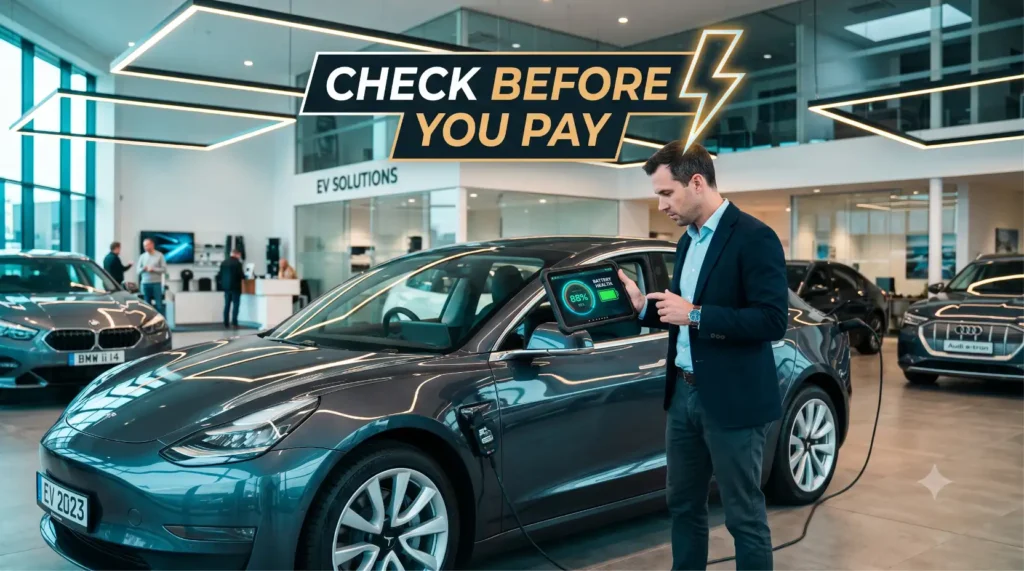
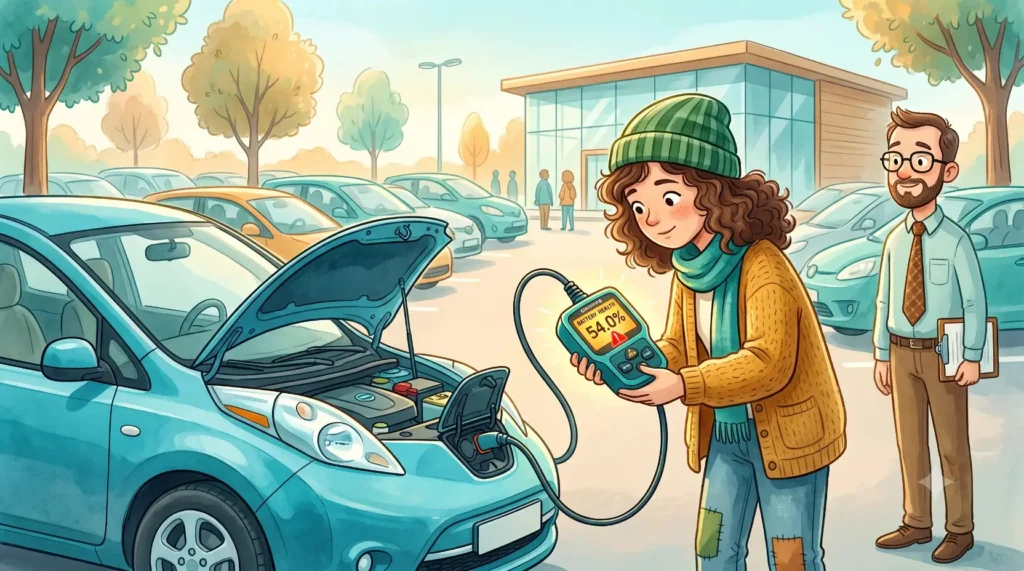
How to test: charge to 100%, read the projected range, and compare. Better yet, pull the actual SoH with a scan tool. Our full walkthrough on how to check battery health on a used EV shows you exactly which apps and adapters read SoH for Teslas, Nissans, Hyundais, and more.
🚫 Red Flag #2: The seller won’t let you check the battery
This is one of the clearest used EV warning signs of all, and it’s simple. If a seller refuses to let you read the state of health, plug in a scanner, or charge the car to 100% in front of you — that is the loudest red flag in the book. 🚩
Legitimate sellers want you to verify the battery, because a strong SoH reading is their best selling point. The excuses to be suspicious of:
- “The charger’s broken, but it charges fine, trust me.”
- “We don’t have time for a full charge today.”
- “You can’t connect anything to the OBD port, it’ll void something.” (It won’t.)
- “Range readings aren’t accurate anyway.” (SoH from the BMS is.)
A seller hiding the battery is a seller who already knows the answer. Walk away, or at minimum make the sale 100% contingent on an independent battery check. No reputable dealer or private seller should flinch at that.
🧾 Red Flag #3: No service history or out-of-warranty surprises
Gas cars hide their history in oil changes. EVs hide theirs in software logs, recall completions, and battery warranty status. A car with zero paper trail is a car you’re buying blind.
Two things to nail down before you pay:
1. Battery warranty status. Most EVs carry an 8-year / 100,000-mile (or 160,000 km) battery warranty. Find out if it’s still active, whether it transfers to you, and whether any battery work has already been claimed. A pack that’s been replaced under warranty can actually be a good sign — newer cells — but only if it’s documented.
2. Open recalls. Several EVs have had battery-related recalls. An incomplete recall can mean the car is one software update — or one fire risk — away from trouble. Run the VIN through the manufacturer or the NHTSA (US) / dealer service portal (India) to confirm.
No history at all, combined with a seller who shrugs? Treat it as a high-severity flag, not a minor inconvenience.
💧 Red Flag #4: Evidence of flood or water damage
This is the one that scares EV mechanics the most. A flooded gas car is bad. A flooded EV is potentially a slow-motion fire risk, because water that reaches the high-voltage battery pack or the wiring causes corrosion that may not show symptoms for months.
After major floods — hurricanes in the US, monsoon flooding in India — damaged EVs get cleaned up and quietly resold across state and city lines. The car looks perfect. Then the corrosion eats through an HV connector six months later.
What to look for:
- Water lines, silt, or mud in the spare-tire well, seat tracks, and under carpets
- 👃 A musty or chemical “air-freshener overload” smell hiding mildew
- 🔩 Rust on screws, brackets, or seatbelt mechanisms that should be clean
- 💦 Fogging or moisture inside headlights and tail lights
- 📋 A salvage, flood, or “rebuilt” title — or a VIN history report flag
If you see any combination of these on an EV, do not negotiate. Walk. A flood-damaged high-voltage system is one of the few used EV warning signs with genuine safety stakes.
⚡ Red Flag #5: A history of DC-fast-charging only
Fast charging is convenient, but it’s harder on a battery than slow Level 2 (240V) or home AC charging. The high current and heat stress cells over time. A car that lived its entire life on DC fast chargers — think a ride-share or fleet vehicle that topped up at a Supercharger or fast-charge hub every single day — will usually show more degradation than an identical car charged gently at home.
It’s not an automatic dealbreaker, but it changes the math. Two cars with the same mileage can have very different remaining life depending on how they were charged.
Questions to ask the seller:
- “Did you mostly charge at home or on the road?”
- “How often did you use DC fast charging?”
- “Was this ever a fleet, rental, or ride-share vehicle?”
A car charged at home overnight on a wallbox (which you’ll want anyway — see our shop section below) is the gold standard. Heavy fast-charge history alone is a moderate flag; combine it with high degradation and it becomes a reason to walk.
🛠️ Red Flag #6: Dashboard warning lights and BMS errors
Turn the car on and watch the dash carefully before the seller can talk over it. EVs throw specific warnings that gas drivers never see — and sellers sometimes clear codes right before a viewing, hoping they won’t return before you’ve paid.
Red flags on the cluster and in the scan:
- ⚠️ A persistent “reduced power” or turtle-mode icon
- 🔋 A battery or high-voltage system warning light
- 🌡️ Thermal-management or coolant warnings
- 🧮 BMS (battery management system) fault codes pulled by a scanner
This is where a cheap OBD2 scanner earns its keep. Even if the dash looks clean, a scan tool can surface stored or pending BMS codes that the seller “reset.” If codes reappear during your test drive, or you see a warning the seller can’t explain, that’s a clear signal something in the battery or its management system is unhappy.
For the full pre-purchase routine — paint, tires, brakes, software, and electronics — pair this with our used EV buying guide on what to check before you pay.
🔧 Red Flag #7: A mismatched or repaired battery pack
Salvage EVs sometimes get back on the road with rebuilt packs — modules swapped from other cars, mixed cell ages, or third-party repairs done outside the manufacturer’s process. A rebuilt pack isn’t always dangerous, but an undocumented one is a gamble with the most expensive and safety-critical part of the car.
Signs of a tampered or non-original pack:
- 🔩 Fresh tool marks, mismatched bolts, or new sealant on the underbody battery enclosure
- 🏷️ A SoH or capacity reading that doesn’t match the car’s age and mileage at all
- 🧾 No paperwork for a battery replacement that the BMS data clearly shows happened
- 🌐 A VIN check showing prior salvage/total-loss status
If the numbers and the physical pack don’t tell the same story, assume the worst until proven otherwise. A factory-documented warranty replacement is fine. A mystery rebuild from a salvage auction is one of the more dangerous used EV warning signs you can run into.
💸 Red Flag #8: Suspicious pricing, a rushed sale, or paperwork problems
Sometimes the warning sign isn’t the car — it’s the deal. A price thousands below market for a clean-looking EV almost always hides something: undisclosed damage, a weak battery, a lien, or a stolen vehicle being flipped fast.
Behavioral and paperwork flags:
- 🏃 “I need to sell today, cash only, meet me halfway.”
- 🚷 Refuses a test drive, an inspection, or to meet at a public/dealer location
- 📄 The name on the title doesn’t match the seller (classic curbstoner / flipper move)
- 🔒 An open loan or lien still on the vehicle
- 📵 Pressure to skip the VIN history report or pay a deposit before you see the car
In the US, run the VIN through a history service and confirm the title is clean and in the seller’s name. In India, verify the RC (Registration Certificate), check for an active hypothecation/loan with the RTO, and confirm there are no pending challans. If the paperwork doesn’t line up and the seller is rushing you, the deal itself is the red flag.
📈 2026: New scams and red flags to know
The used EV warning signs above are timeless, but the market matured fast, and so did the scams. A few things to watch this year:
- 🤖 AI-faked listings. Generated photos and cloned listings of cars that don’t exist, designed to collect deposits. Never pay before you’ve physically seen the car and its VIN/RC.
- 🔄 “Battery refresh” claims. Sellers advertising a “renewed” or “balanced” battery. A balance-and-recalibrate can nudge readings temporarily; it doesn’t restore lost capacity. Demand the actual SoH.
- 🧊 Winter-range cover stories. As EVs age into colder climates, some sellers blame all range loss on weather. Real degradation doesn’t disappear in spring.
- 🛰️ Software-locked features. Cars sold with subscription range or features the previous owner unlocked that don’t transfer. Confirm what you’re actually buying with the account.
- 🏷️ Title-washing across borders. Flood and salvage EVs moved between states (US) or states/RTOs (India) to scrub a damaged title. Always pull a full history.
✅ 5 Tips to Protect Yourself
- 🔌 Get an SoH reading every time. A $30 OBD2 scanner plus the right app turns the invisible battery into a hard number. No reading, no deal.
- 🧑🔧 Pay for a pre-purchase inspection. A $150–$250 (₹4,000–₹15,000) EV-aware inspection is the cheapest insurance against a five-figure mistake.
- 📋 Demand the full paper trail. Service records, battery warranty status, open recalls, and a clean title/RC in the seller’s name — all before money changes hands.
- 🚗 Test drive long enough to see warnings appear. Charge to 100%, drive 20+ minutes, and watch the dash and the projected range under real conditions.
- 🚶 Be willing to walk. The best negotiating position is a buyer who genuinely doesn’t need this car. There’s always another listing.
🛒 Shop This Post
Affiliate disclosure: the links below are affiliate links. If you buy through them, evsmirror.com may earn a small commission at no extra cost to you. We only recommend tools we’d use ourselves.
- 🔌 OBD2 Bluetooth Scanner (~$30 / ₹2,500) — Pairs with EV-specific apps to read state of health and BMS codes. The single best tool for catching used EV warning signs before you pay.
- 🧑🔧 Pre-Purchase EV Inspection Service (~$150–$250 / ₹4,000–₹15,000) — A mobile EV-trained mechanic checks the battery, HV system, and structure where you can’t. Book one for any car you’re serious about.
- 🏠 Level 2 Home EV Charger (~$400–$700 / ₹25,000–₹55,000) — Once you buy a healthy EV, charging gently at home is what keeps it healthy. Skip the DC-fast-only lifestyle that ages packs early.
🎯 Quick Quiz
You’re viewing a used EV. The seller says the charger is “broken today” but the battery is “totally fine,” and wants a cash deposit to hold it. What do you do?
- A) Pay the deposit — it’s a great price
- B) Walk away (or make the sale contingent on a verified SoH check on a working charger)
- C) Trust them and skip the inspection
👉 Answer: B. A blocked battery check plus a rushed cash deposit is two red flags stacked together. Verify the SoH on a working charger and a clean paper trail, or move on.
📋 Pre-Purchase Red-Flag Checklist
- [ ] 🔋 SoH read with a scanner and matches the car’s age/mileage
- [ ] ⚡ Range at 100% charge is close to the model’s rated figure
- [ ] 🚫 Seller allowed a full battery check and test drive
- [ ] 🧾 Service history, battery warranty status, and recalls confirmed
- [ ] 💧 No flood/water signs (smell, silt, rust, foggy lights)
- [ ] 🔌 Mostly home/Level 2 charged, not DC-fast-only
- [ ] ⚠️ No dashboard warnings or stored BMS codes
- [ ] 🔧 Battery pack is original/documented, underbody untampered
- [ ] 📄 Clean title/RC in the seller’s name, no lien, fair price
🤔 People Also Ask
What are the biggest used EV warning signs to walk away from?
The critical ones are heavy battery degradation or a sudden SoH drop, a seller who won’t let you check the battery, and any evidence of flood or water damage. Each of these can cost you five figures or pose a safety risk, so treat them as hard stops, not bargaining chips.
How do I know if a used EV battery is bad before buying?
Read the state of health with an OBD2 scanner and EV app, charge to 100% and compare the projected range to the model’s rated figure, and watch for battery or reduced-power warning lights. A big gap between rated and real range is the clearest sign of a weak pack.
Is buying a used EV with high mileage a red flag?
Not by itself. Battery health matters more than the odometer. A 70,000-mile EV charged gently at home can be healthier than a 40,000-mile car that lived on DC fast chargers. Always judge by SoH, charging history, and warranty status — not mileage alone.
Can flood damage on an EV be hidden?
Yes, and that’s what makes it dangerous. Cleaned-up flood EVs look perfect but develop high-voltage corrosion months later. Check the spare-tire well, carpets, and seatbelt mechanisms for silt and rust, sniff for mildew, and always pull a title/VIN history report.
Does DC fast charging ruin a used EV battery?
It doesn’t “ruin” it, but frequent fast charging adds heat and current stress that accelerate degradation versus home charging. Ask how the previous owner charged. Occasional fast charging is fine; a fast-charge-only fleet history paired with high degradation is a reason to walk.
Is it worth paying for a pre-purchase EV inspection?
Almost always. A $150–$250 (₹4,000–₹15,000) inspection by an EV-aware mechanic is trivial next to an $8,000–$20,000 (₹6–18 lakh) battery replacement. It catches the used EV warning signs you can’t see from the driver’s seat — HV system, structure, and pack condition.
🚀 The Bottom Line
Buying used is still one of the smartest ways into an EV — you skip the steepest depreciation and let someone else absorb the new-car premium. But the savings only count if the battery underneath is healthy and the history is clean.
Treat the battery like the engine it effectively is. Insist on a state-of-health reading, walk from any seller who blocks the check, and never wave off flood signs, BMS errors, or a rushed cash deal. The used EV warning signs in this guide each map to a real, expensive failure — and spotting even one early can save you a fortune. 💪
Ready to inspect with confidence? Arm yourself with our used EV buying guide on what to check before you pay, then learn exactly how to check battery health on a used EV so you walk in knowing more than the seller. Then go find the EV that’s actually worth it. 🚗⚡